A customer pays $100 a month for your software. Later, their team grows, and they move to a $150 plan. The extra $50 a month is expansion monthly recurring revenue, or expansion MRR.
The calculation is straightforward. Earning that extra $50 takes more thought. The customer needs a reason to buy more, a clear understanding of the cost, and confidence that the first purchase was worthwhile. Expansion revenue grows when a business can meet a customer’s next need.
What counts as expansion revenue?
Expansion revenue is additional revenue from a customer a business already serves. In a subscription business, it commonly comes from a plan upgrade, more paid seats, a recurring add-on, a complementary product, or increased paid usage.
The word additional matters. If a customer moves from $100 to $150 a month, the expansion is $50. The full $150 is the account’s new monthly value. If someone else signs up for a $150 plan, that is new customer revenue. An unchanged renewal retains revenue but adds no expansion.
The idea applies beyond software. An agency client might add a monthly reporting service or commission a separate project. Both increase sales to an existing client. Only the ongoing service increases monthly recurring revenue; the one-time project does not.
When I look at an account that is spending more, I want to know what the customer bought, what changed for them, and whether the higher spend is likely to last. A single increase does not answer all three questions.
How to calculate expansion MRR
For a subscription business, add the increases in recurring monthly spend from existing paying customers during the period. Keep revenue from new customers separate.
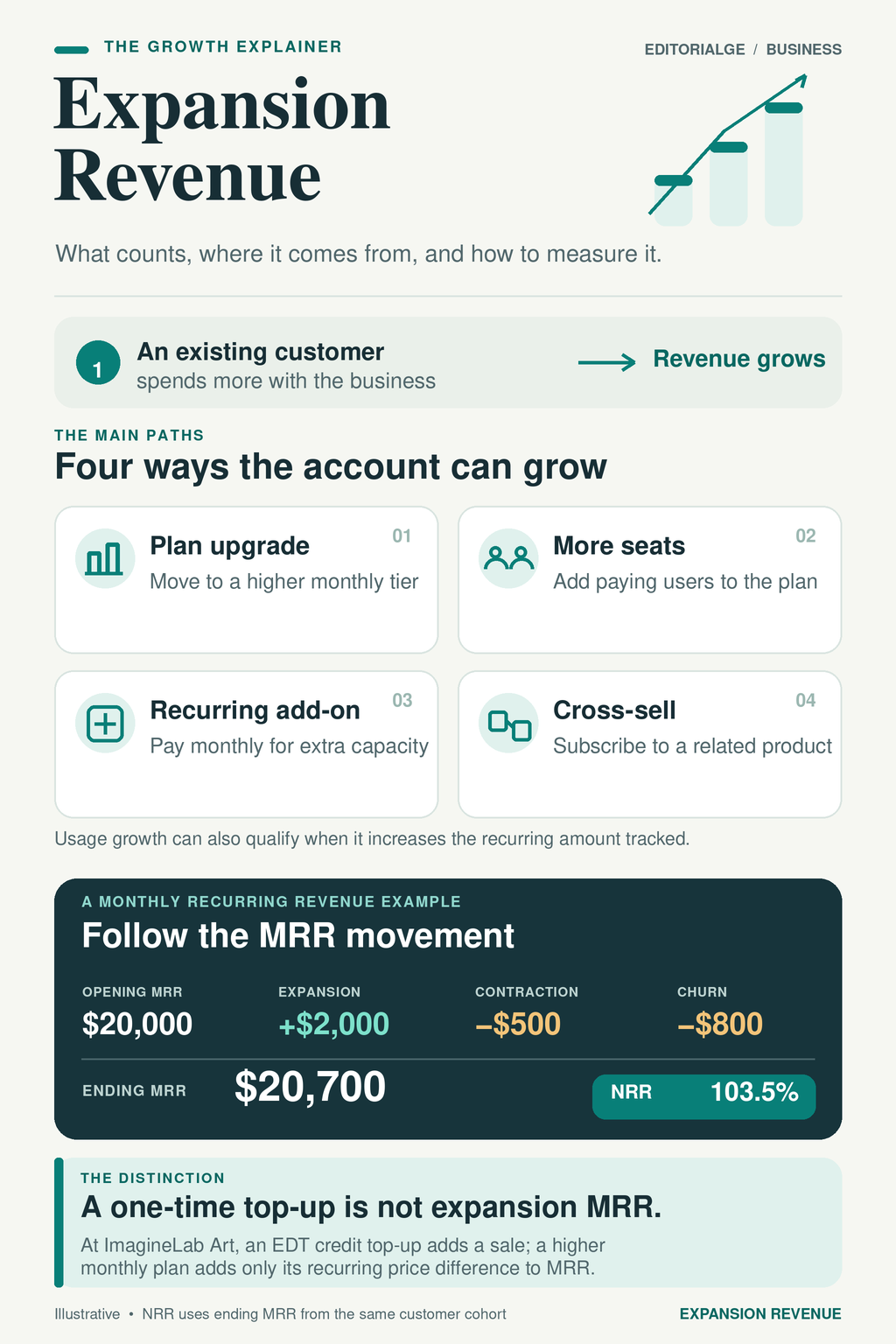
Here is an illustrative month for a company that starts with $20,000 in MRR:
| Change during the month | MRR movement |
| Plan upgrades by existing customers | +$1,200 |
| Recurring add-ons bought by existing customers | +$800 |
| Downgrades | −$500 |
| Cancellations | −$800 |
Expansion MRR is $2,000: $1,200 from upgrades plus $800 from add-ons. Dividing that by the $20,000 starting MRR gives an expansion rate of 10% for this example.
The company did not gain the full $2,000 from its existing customer base overall. Downgrades and cancellations removed $1,300. To see the net effect, calculate net revenue retention (NRR):
NRR = (Starting MRR + Expansion MRR − Contraction MRR − Churned MRR) ÷ Starting MRR × 100
For this company, that is ($20,000 + $2,000 − $500 − $800) ÷ $20,000 × 100 = 103.5%. The customers present at the start of the month now account for 3.5% more MRR, even after the losses.
Read that alongside gross revenue retention, which excludes expansion. Here it is: ($20,000 − $500 − $800) ÷ $20,000 × 100 = 93.5%. The upgrades covered the losses, but the company still needs to understand why some customers reduced their spending or left.
If it also won $3,000 MRR from new customers, that would increase total MRR. It would not enter either retention calculation for the customer group present at the start.
Annual contracts need the same care. If an existing customer’s annual recurring contract rises from $12,000 to $18,000, the increase is $6,000 in annualized recurring value, equivalent to $500 in expansion MRR. Collecting an annual payment upfront does not turn the full payment into one month of MRR.
Why expansion revenue matters
Expansion gives a business room to grow within relationships it has already established. A customer may bring another team onto the product, adopt a new workflow, or need more capacity as their own business grows. A suitable offer lets the business serve that change.
Expansion can also offset revenue lost to downgrades and cancellations. If it exceeds those losses, NRR rises above 100%. That is useful, but it should not distract from churn. A few growing accounts can lift the headline number while problems spread through the rest of the customer base.
Expansion becomes a larger part of growth for many mature subscription businesses. In ChartMogul’s 2024 analysis of more than 2,500 SaaS businesses, it contributed up to 40% of growth among larger company groups beginning at $15 million in annual recurring revenue. That finding describes a particular sample and stage; it is not a target every business should copy. A young company with few customers will often need to concentrate on winning good-fit customers first.
Expansion also takes work. Onboarding, product development, customer success, sales conversations, and support all cost time and money. Its value lies in the opportunity for an established customer relationship to grow.
How to earn expansion revenue
The strongest offers respond to a need the customer can recognize. That calls for more than placing an “Upgrade” button beside every limit.
Make the first purchase work
Before asking customers to spend more, check whether they have achieved what they came for. A team that has barely set up its account may need help using the current plan. An upgrade pitch at that point can sound like a charge for solving a problem it did not expect to have.
Customer success teams can begin with the result the customer wanted when they bought the product. Look at adoption and speak to the people using it. If they have reached that first goal and their work is growing, there may be a sound reason to discuss what comes next.
High usage alone is not proof that someone is ready to upgrade. A customer might be getting substantial value, or they might be working around a cumbersome process. The conversation should establish which is true.
Give customers a sensible next step
Plan tiers should reflect meaningful changes in need. More paid seats fit a product whose value grows as more colleagues use it. Usage pricing can fit a service where customers understand the billed unit and gain value as consumption rises. A recurring add-on can serve a specialist need without pushing everyone into a more expensive package.
Our in-house AI creative software, ImagineLab Art, offers another route. An existing subscriber can buy an EDT credit top-up for more capacity without changing plans. That purchase adds revenue from an existing customer, but the separate top-up does not add expansion MRR. A move to a higher monthly plan would add the difference between the old and new recurring prices.
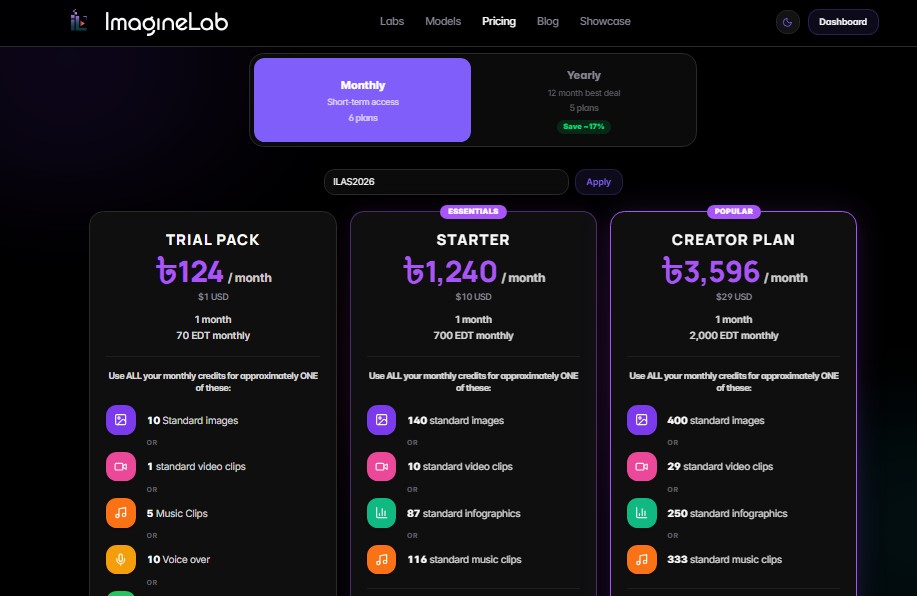
The lesson for pricing is practical: customers should be able to choose a next step that fits their need. Check where they outgrow the current offer. Are they asking for more capacity, a capability for a larger team, or a second product for a related task? Each may call for a different purchase.
With metered billing, show usage and likely costs before a larger bill arrives. An upgrade or overage that surprises the buyer may raise SaaS revenue for one period and lead to a downgrade later.
Use customer behavior to time the conversation
A team repeatedly approaching a plan limit is a better starting point than a generic campaign sent to every account. So is a request for seats in another department or a feature the team now needs for regular work.
Treat these as reasons to investigate, not automatic sales triggers. Ask what has changed, who needs the added capacity, and whether the proposed offer solves the problem. Check open support issues before making the pitch. If the customer is frustrated with the current service, resolving that friction may matter more than selling an upgrade.
For larger accounts, the person using the product may not control the budget. Give the account owner time to identify the buyer, explain the value, and prepare for the customer’s purchasing process.
Cross-sell a connected job
Cross-selling means offering another product or service to an existing customer. It works best when the new purchase helps with a task adjacent to the one you already support.
Imagine a customer using a support platform who is trying to understand why ticket volume has risen. A reporting product could be relevant if it helps the team answer that question. The case is weaker if the customer has not yet managed to use the original platform effectively.
Explain the proposed purchase in practical terms: what work will it handle, who will use it, and what will improve? Those details give the customer a basis for deciding. A list of extra features is rarely enough.
Remove friction from the purchase
A customer who wants to expand should be able to see the full price and understand when it takes effect. For a simple subscription change, that may mean an easy self-service flow. For a larger contract, it may mean a prompt quote, clear terms, and agreement between sales and customer success on who handles the account.
Be specific about prorated charges, existing discounts, renewal dates, and any change in service level. Uncertainty can delay a useful purchase. It can also create resentment after the invoice arrives.
Know when an upgrade is the wrong move
Expansion is a poor response to every customer problem. An account with inactive seats, unresolved support requests, or falling product use may need a review of its current setup. Selling it more capacity will not fix weak adoption.
The same judgment applies to price increases. A higher price can raise reported revenue from existing customers, and some analytics systems may classify the increase as expansion. But it tells a different story from a customer choosing to add seats or another product. I would separate those movements when assessing demand.
Discounts can affect the picture, too. When a promotional discount expires, a reporting tool may show an increase in MRR even though the customer has bought nothing new. Keep that change visible without treating it as a successful upsell.
Measure whether the added revenue lasts
Expansion MRR tells you what increased this month. It does not tell you whether the customer adopted the new purchase or will keep paying for it.
Review expanded accounts after the change. Are the added seats being used? Did the new product become part of the customer’s workflow? Are downgrades or cancellation requests appearing soon afterward? Compare results by plan, customer size, and reason for the upgrade. That can expose an offer that sells well but fits poorly.
Use consistent reporting rules. Some subscription analytics tools show a former customer’s return as reactivation MRR separate from expansion; others include it within expansion. Free-to-paid conversions can also be classified differently. Document what your business counts before comparing reports, setting targets, or citing a benchmark.
A manageable starting process is to review one customer group with a clear growing need. Check its adoption and support history, offer one relevant next step, then follow both the added revenue and subsequent retention. Counting an upgrade on the day it closes gives you only part of the result.
Frequently asked questions on expansion revenue
1. Is expansion revenue the same as upselling?
No. An upsell, such as moving a customer to a higher-priced plan, is one source of expansion revenue. Additional seats, add-ons, complementary products, and higher paid usage can also increase an existing account’s value.
2. Does a renewal count as expansion?
A renewal at the same recurring price does not. If the account’s recurring value rises at renewal, the incremental amount may count as expansion under your reporting rules. Separate a general price rise from a purchase of more seats, usage, or products when analyzing what drove it.
3. Can expansion revenue be negative?
Expansion describes an increase. The net change in revenue from existing customers can be negative when downgrades and cancellations exceed that increase. Track both sides of the movement.
4. What is a good expansion revenue rate?
There is no single rate that fits every company. Customer size, product maturity, pricing, and room to grow all affect the result. Compare similar customer groups over time, then check whether expansion persists and exceeds the revenue you lose.
Before the next upsell, identify the customer need it will serve and how you will know the purchase helped. Clear pricing gets the sale over the line; adoption and retention show whether the expansion was earned.