In today’s digital landscape, being visible to your local audience isn’t optional — it’s essential. Whether you run a neighborhood café, a dental clinic, or a home repair business, your customers are searching online before stepping through your door. That’s where affordable local SEO services come in.
These strategies are designed to boost your Google Maps ranking, improve your visibility in “near me” searches, and drive real foot traffic — all without draining your marketing budget. By optimizing your online presence for your specific community, local SEO helps you compete with larger brands and attract the right audience at the right time — people ready to buy, visit.
Key Points
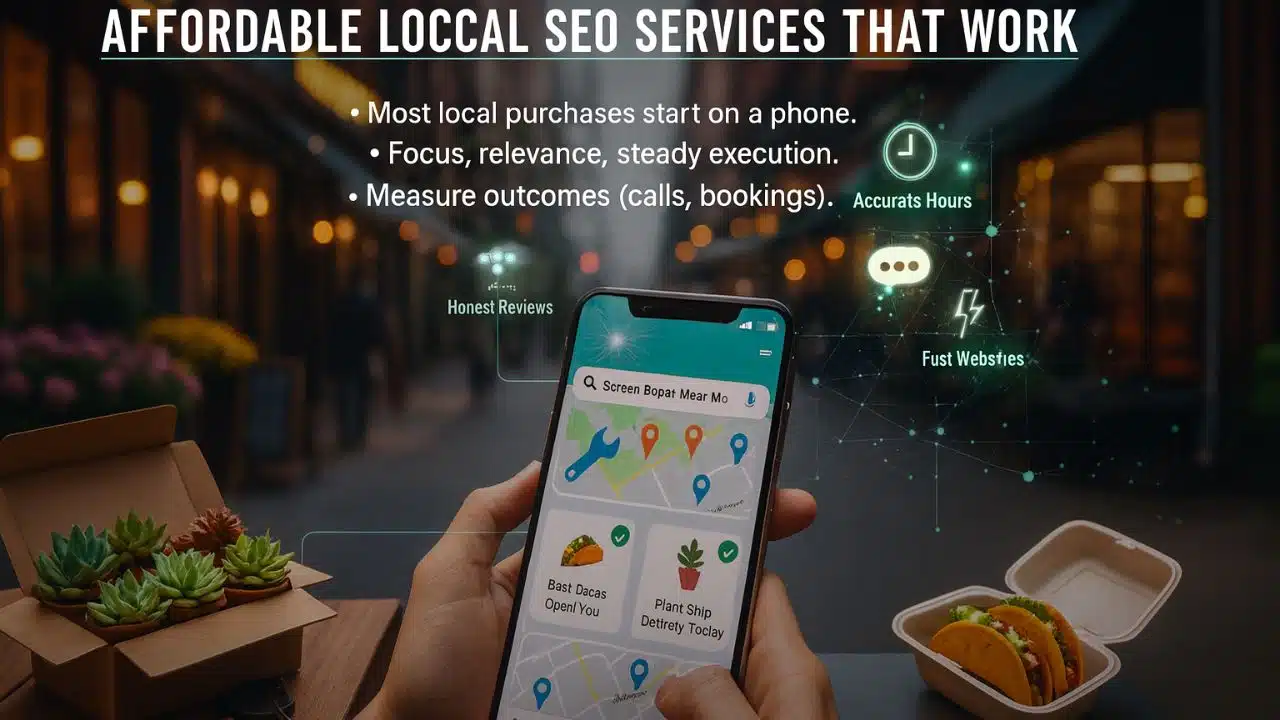
- Most local purchases start on a phone, within a few kilometers of the business—so showing up in the map pack beats chasing generic traffic.
- The lever isn’t one “hack,” it’s a tidy set of small signals: a complete business profile, consistent data, honest reviews, useful pages, and precise tracking.
- You don’t need a huge budget to see wins in 30–60 days; you need focus, relevance, and steady execution.
- Measure outcomes (calls, bookings, direction requests), not vanity metrics. Let the numbers steer the plan.
Let’s start with something tangible
Saturday morning. Cracked phone screen, dinner with friends at six, and a birthday plant I forgot to buy (oops). I asked my phone for three things: “screen repair near me,” “best tacos open now,” and “plant shop delivery today.” Within minutes, I had a route, three calls made, two bookings, and a bag of succulents riding shotgun. Here’s what I noticed about the businesses I chose: current photos, accurate hours (including holidays), reviews that sounded like actual neighbors, and websites that loaded fast enough not to make me sigh.
That, in one messy human story, is why this matters. When people ask me what local seo services are for, I say: you’re making it easy for nearby customers to find you right when they’re ready to decide. Not next month. Not after a seven-scroll blog post. Right now—standing on a sidewalk, phone in hand.
What “local SEO” actually means (the friendly version)
Local SEO is the practice of tuning the signals that search and map systems use to pick winners in a specific geography. Think proximity (how close you are), relevance (do you clearly offer what they need), and prominence (do people vouch for you?). In plain terms: a clean, complete Google Business Profile; consistent name-address-phone across the web; location or service-area pages people can actually use; steady, honest reviews; a few meaningful local links; and enough tracking to see what’s working.
If you’ve ever run a good brick-and-mortar shop, this will feel familiar. Clear sign, correct hours, friendly staff, neighbors who say nice things. Same idea, just digital.
Affordable doesn’t mean flimsy
Let’s be real: “affordable” has baggage. It can mean watered-down packages, mystery deliverables, or promises no one can keep. But local doesn’t need a firehose budget. In most towns, a business with crisp basics will outrun big brands that phone it in. Why? Close intent. People typing “near me” or tapping “call” aren’t browsing for sport. They’re in buying mode.
The goal is to direct scarce time and money into the work that actually moves rankings, click-through rates, and leads. No glitter. Just the signals that compound.
The 30-day quick wins (on a normal budget)
1) Tune your Google Business Profile
Pick the most accurate primary category. Add supporting categories for real services you perform (not wishful thinking). Fill out services/products with simple language and price ranges. Update hours—including holidays—so no one drives to a locked door. Switch on messaging only if you’ll respond quickly.
Photos and videos: Upload fresh images every week or two—team, storefront, work-in-progress, before/after. Short phone videos are perfect. Authentic beats glossy.
Posts and Q&A: Post weekly (offers, events, quick tips). Seed the Q&A with actual answers to common questions.
2) Clean up NAP + citations
Your name, address, and phone should match across key directories and maps. Fix old addresses, remove duplicates, prioritize quality (industry and local lists) over quantity. Consistency reduces confusion—for customers and algorithms.
3) Build a lightweight review habit
Right after a job or purchase, send a short message with a direct review link. Don’t script customers; suggest specifics (“Was scheduling easy?”). Reply to every review—short, human, grateful. Spread reviews where your audience actually reads, with a natural pace.
4) Ship one helpful location page
Write like a neighbor. Mention neighborhoods you serve, local quirks (“older wiring in 1960s houses,” “pipes that freeze on the north side”), add a map embed, and clear contact options. Include a short FAQ. Link to relevant services. No city-name swap templates.
5) Track what matters
Add UTM tags to your profile links and posts. Use call tracking with dynamic number insertion on your site (keep your main number in directories). Define conversions: calls over 30–60 seconds, forms, bookings, and even “Get Directions.”
Past the basics: compounding moves
Local links with common sense
Skip the random high-authority domains that don’t know your town. Go for:
- Community sponsorships (get listed on the organizer’s site).
- Expert quotes or how-to tips for neighborhood blogs or local media.
- Partner pages with complementary businesses (electrician ↔ remodeler, bakery ↔ florist).
- Unlinked mentions—someone wrote about you but forgot the link; ask politely.
These links carry more weight than you’d think because they make sense in real life.
Content that earns attention
No fluff. Try:
- Seasonal checklists (storm prep, winter clean-ups).
- Short case studies with outcome bullets and photos.
- “Best of” guides that include you and other credible options (be honest).
- Micro-videos that answer fundamental questions: price ranges, timelines, and warranty concerns.
Photos that sell quietly
People look at photos before they read. Keep them current. Show humans. Show scale. Show the messy middle—trust lives there.
How to choose a provider (without getting burned)
Ask for clarity, not magic.
- First 30–60 days: What exactly will you audit and fix? Listen for GBP work, citations, on-page, reviews, and tracking.
- Deliverables: What do I get each month—content, links, reports, review requests? No black boxes.
- Success metrics: Leads and revenue, not just impressions.
- Local links plan: If they mumble, that’s a flag.
- Ownership: You should own profiles, content, and data—not the agency.
Red flags: guaranteed rankings, thousands of directory submissions overnight, or “partner networks” that smell like private blog networks.
What it might cost (ballpark, not gospel)
Budgets vary by market and competition, but affordable packages often start with:
- Set up montcleanupts, profile cleanup, citations, tracking, and one location page.
- Ongoing (monthly): review requests + replies, posts, small content pieces, a couple of local link pitches, and iterative on-page improvements.
You can DIY portions (photos, reviews, minor updates) and reserve the budget for technical bits and link outreach—hybrid works.
What to measure (so you can sleep at night)
- Calls and call quality (duration matters).
- Direction requests (a powerful, underrated conversion).
- Bookings/messages from your business profile.
- Page conversions are tied to location pages.
- Query data in Search Console/GBP—what’s rising, where you’re just shy of page one.
- Map-pack visibility at a few grid points around town (not just one ZIP code).
When these move in the right direction, rankings and revenue tend to follow.
Real-world mini-wins you can borrow
- A neighborhood pizza place added “half-bake at home” to its profile products. Friday calls spiked, and pickup lines got faster.
- A plumber posted a 40-second winter checklist filmed on a phone; emergency calls dropped, but jobs got bigger because prevention built trust.
- A salon documented real color corrections with before/after photos. Those images earned shares in local groups and booked out slow weekdays.
- A bike shop replied to reviews with repair ETAs and route tips; those replies rank for micro-queries like “flat fix how long,” which quietly pulls in riders.
A no-drama 90-day plan
Weeks 0–2: Clean profile, categories, hours; upload 10–20 fresh photos; standardize NAP; claim core directories; add UTM tags; set up call tracking.
Weeks 3–6: Publish one location page with FAQ and map; start weekly posts; launch a review request flow; pitch two local collaborations.
Weeks 7–12: Secure 3–6 relevant local links; ship two micro-case studies; adjust internal linking; prune thin pages; keep photos and reviews rolling. Watch which queries climb and tune copy accordingly.
When to DIY and when to hire
If you have time for an hour a day, you can handle photos, posts, and review replies. If your schedule is slammed, outsource the profile polish, citations, content, and link outreach. The point isn’t heroics; it’s momentum.
The quiet truth
Local search doesn’t reward the loudest brand; it rewards the business that looks reliably helpful in the exact moment someone needs help. Show your work. Keep data tidy. Ask for honest reviews. Answer questions like a neighbor. Stack small wins weekly. It compounds.
And if you’re wondering whether this is worth doing at all, here’s my take: the businesses that invest a little, consistently, keep showing up—on phones, in maps, in conversations. That’s where decisions happen. That’s where trust lives. And that’s where the right local seo services make an outsized difference.
FAQ
How fast will I see results?
Quick wins from profile fixes, photos, and citations can appear in a few weeks. Bigger gains from reviews and local links usually compound over 2–3 months.
Do I need separate pages for each city?
Only if each page has a unique value—specific neighborhoods, services, photos, and FAQs. If it’s jopy-paste with a city token, consolidate.
Are directories still useful?
The right ones are. Prioritize accurate listings on major platforms plus industry and local directories people actually use.
What should I track first?
Calls, direction requests, and bookings/messages from your profile—plus page-level conversions. Add UTM tags so you can attribute wins without guesswork.