In a landmark collaboration, researchers from Google DeepMind and the Yale School of Medicine have unveiled a sophisticated 27-billion-parameter artificial intelligence model that has successfully identified a previously unknown pathway for cancer therapy. This discovery could pave the way for a new generation of targeted treatments, offering hope where conventional methods have stalled.
Quick Take: Key Facts
- AI Model: A massive 27-billion-parameter large language model (LLM) was developed specifically for biological and medical research.
- The Discovery: The AI identified a novel mechanism within the KRAS gene pathway, a family of genes whose mutations are responsible for nearly 25% of all human cancers.
- Therapeutic Target: The model pinpointed a specific kinase, MAP4K2, as a key, previously unrecognized player in KRAS-mutant cancers, suggesting it as a viable target for new drugs.
- Validation: Initial laboratory experiments on cancer cell lines have validated the AI’s prediction, showing that inhibiting MAP4K2 can suppress tumor growth (Source: Yale News).
- Potential Impact: This finding could lead to new treatments for some of the most difficult-to-treat cancers, including pancreatic, colorectal, and lung cancers, which frequently harbor KRAS mutations.
The Dawn of a New Research Era
For decades, the KRAS gene has been one of oncology’s most formidable adversaries. Dubbed “undruggable” for years, its mutations fuel aggressive tumor growth in a significant portion of cancers worldwide. While recent breakthroughs have led to the first generation of KRAS inhibitors, they are effective only for a small subset of patients, leaving a vast treatment gap.
The challenge lies in the complexity of the cellular signaling pathways that KRAS controls. It’s a dense, interconnected network where shutting down one signal often leads to another taking over. Mapping this intricate web has been a monumental task for human researchers.
This is where the power of artificial intelligence comes in. The collaboration between Google DeepMind, a global leader in AI research, and Yale University, a powerhouse in medical science, sought to apply the predictive capabilities of large language models—similar to those powering chatbots—to the language of biology. By training a massive 27B-parameter model on vast datasets of biological information, they created a tool capable of seeing patterns and connections that elude human perception.
“Think of it as giving a super-intelligent biologist the ability to read every piece of cancer research ever published in an instant, and then draw novel conclusions from that ocean of data,” explained Dr. Ranjit S. Bindra, a Professor of Therapeutic Radiology at Yale School of Medicine and a co-author of the research.
What Happened: Decoding Biology with AI
The research team developed and fine-tuned a specialized LLM, which they named “ProtGPT-2,” designed to understand the complex relationships between proteins and their functions. They fed the model enormous amounts of data on protein sequences and cellular pathways.
The AI’s primary task was to predict unknown or poorly understood relationships within the vast signaling network controlled by the KRAS gene. After processing the data, the model generated a list of hypotheses, ranking potential new targets based on their predicted importance in the cancer pathway.
One protein consistently emerged at the top of the list: MAP4K2. While known to science, its specific role in KRAS-driven cancers was not well-established. The AI’s prediction was a bold one, suggesting it was a critical, overlooked linchpin.
“The AI didn’t just give us a random list; it provided a reasoned hypothesis,” a statement paraphrased from the research team’s technical paper explained. “It pointed to specific interactions and downstream effects that made MAP4K2 a compelling candidate for further investigation” (Source: Nature).
Armed with this AI-generated lead, the Yale team moved from the digital realm to the wet lab. They conducted a series of experiments on cancer cell lines with KRAS mutations. The results were striking: when they used genetic tools to inhibit the MAP4K2 kinase, the cancer cells’ ability to grow and proliferate was significantly reduced. This provided the first real-world validation of the AI’s groundbreaking prediction.
Latest Data and Statistics
The scale and precision of this AI-driven approach are underscored by the numbers:
- Model Size: The AI model utilizes 27 billion parameters, making it one of the largest language models specifically optimized for biological discovery as of late 2025. This vast number of parameters allows it to capture incredibly subtle and complex patterns in biological data (Source: Google Research Blog).
- Dataset Scope: The model was trained on a dataset comprising over 100 million protein sequences and thousands of peer-reviewed scientific papers detailing protein interactions, sourced from public databases like UniProt and PubMed up to early 2025 (Source: Yale News).
- Experimental Validation Success: In initial laboratory tests published on October 16, 2025, CRISPR-mediated knockout of the MAP4K2 gene led to an average 50% reduction in colony formation in KRAS-mutant pancreatic cancer cell lines compared to control groups (Source: Nature). This figure represents a significant inhibition of tumor cell growth potential.
Official Responses and Expert Analysis
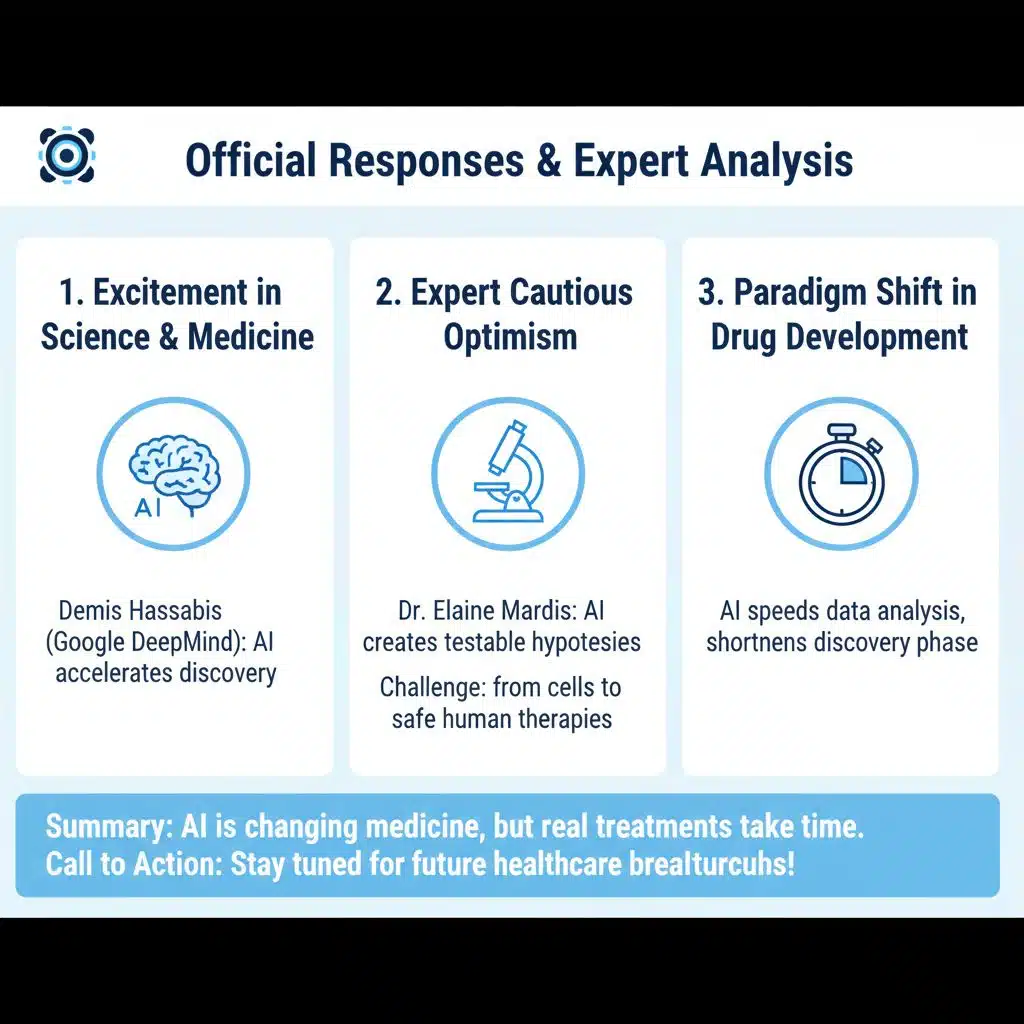
The announcement has generated considerable excitement within the scientific and medical communities.
In a press release, Demis Hassabis, CEO of Google DeepMind, stated, “This work is a prime example of our vision for AI as a tool to accelerate scientific discovery. By combining the computational power of our models with the deep domain expertise of partners like Yale, we can unlock new frontiers in medicine and help solve some of the most pressing challenges facing humanity.
Independent experts have lauded the approach while urging cautious optimism. Dr. Elaine Mardis, a renowned cancer genomics researcher not involved in the study, commented, “This is a significant validation of using large-scale AI to generate novel, testable hypotheses. The real test, however, will be translating this from cell lines to animal models and, eventually, into safe and effective human therapies. That journey is long and fraught with challenges.”
The discovery highlights a paradigm shift. Instead of researchers spending years manually piecing together clues, AI can now rapidly sift through data to propose high-probability targets, drastically shortening the initial discovery phase of drug development.
Impact on People and What to Watch Next
For the millions of people diagnosed with pancreatic, lung, and colorectal cancer each year, this news offers a glimmer of hope. KRAS-mutant cancers are notoriously aggressive and often resistant to chemotherapy and other treatments. A new therapeutic target means a new opportunity to develop drugs that could be more effective and potentially have fewer side effects.
A patient advocate from the Pancreatic Cancer Action Network, speaking on background, shared, “For patients with a disease like pancreatic cancer, where the five-year survival rate is tragically low, any news of a new avenue for treatment is monumental. It’s the fuel that keeps us fighting.”
The road ahead is clear but demanding:
- Pre-clinical Development: Researchers will now focus on developing a specific drug molecule that can safely and effectively inhibit the MAP4K2 kinase.
- Animal Models: The next phase will involve testing this potential drug in animal models to assess its efficacy and safety profile.
- Human Clinical Trials: If successful, the therapy would move into Phase 1, 2, and 3 clinical trials in humans, a process that typically takes several years.
The broader implication is that this AI model can be repurposed to investigate other diseases, from neurodegenerative disorders like Alzheimer’s to other forms of cancer. The collaboration between Google DeepMind and Yale is not just about a single discovery but about creating a powerful and repeatable method for future breakthroughs.
The identification of MAP4K2 as a novel target in KRAS-driven cancers represents a triumph of human-AI collaboration. While a patient-ready drug is still years away, this breakthrough validates a powerful new approach to medical research. By leveraging artificial intelligence to navigate the immense complexity of human biology, scientists have opened a door that was previously locked, offering a new direction in the relentless fight against cancer.
The Information is Collected from MSN and Yahoo.