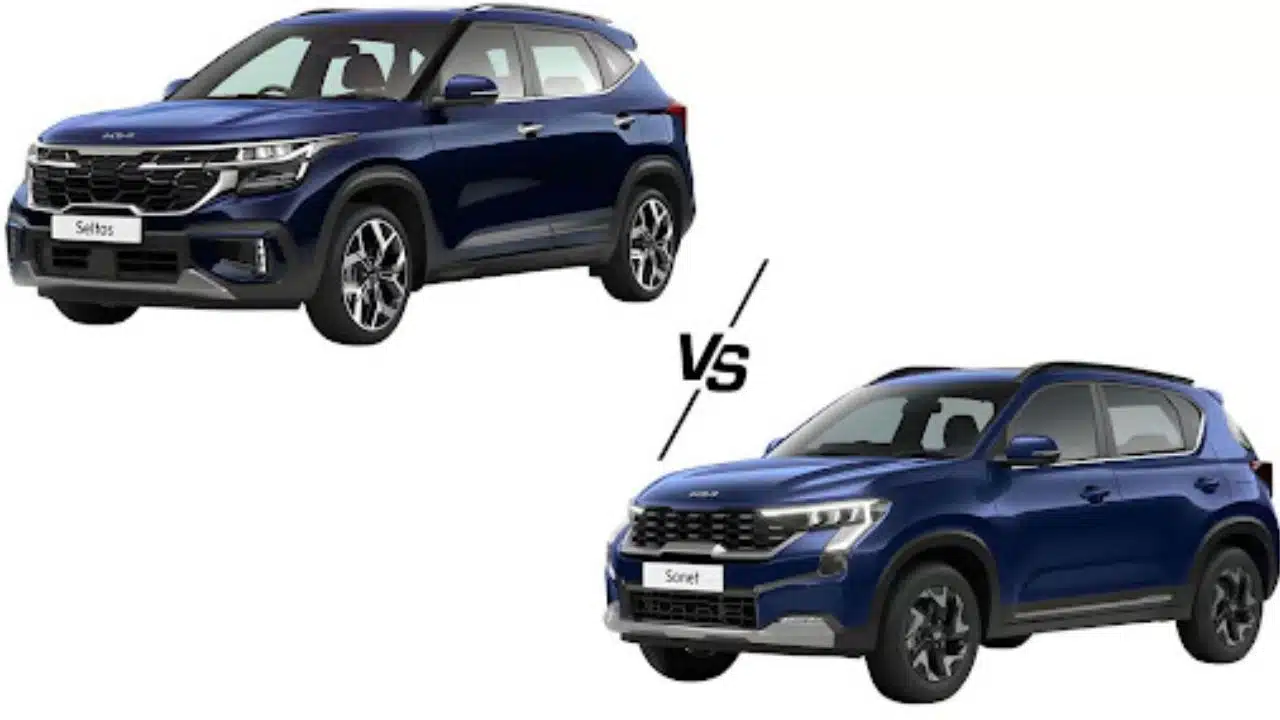
Kia India’s SUV lineup is among the most popular in the country, led by two stars — the Kia Seltos and the Kia Sonet. Both have recently received updates, and each offers its own distinct blend of design, power, and technology. While the Seltos is positioned as a premium mid-size SUV, the Sonet targets the compact SUV market. So, which one should you buy in 2025? Here’s a detailed comparison across design, interiors, safety, performance, and value.
Bold Design That Fits Every Personality
Both models reflect Kia’s “Opposites United” design philosophy, combining boldness with sophistication.
The Kia Seltos exudes confidence with its Star Map LED headlamps, connected LED tail lamps, and muscular front bumper design. The new facelift also brings larger R18 (46.20 cm) Crystal Cut alloy wheels, sleek lines, and an imposing front grille that makes it look wider and more premium.
In contrast, the Kia Sonet embodies youthful sportiness. Its heartbeat-inspired LED DRLs, Crown Jewel LED headlamps, and connected Star Map LED tail lamps give it an athletic appeal. The GT-Line and X-Line variants bring exclusive blacked-out grilles, dark skid plates, and red brake calipers for a sportier edge.
The Seltos stands tall with a more mature and premium look, while the Sonet captures a sportier, more urban vibe.
Interiors and Comfort
Inside, both SUVs showcase Kia’s knack for premium cabin design.
The Seltos offers an Intuitive 26.03 cm (10.25”) HD touchscreen infotainment system with navigation, paired with a 26.04 cm (10.25”) digital driver display, creating a panoramic cockpit feel. You also get dual-zone automatic climate control, ventilated front seats, a Bose 8-speaker system, and a dual-pane panoramic sunroof.
Meanwhile, the Kia Sonet surprises for its size, offering features usually found in larger SUVs: a 26.03 cm (10.25”) touchscreen, ventilated seats, a 4-way powered driver’s seat, and a Bose 7-speaker sound system with LED ambient lighting.
The Seltos delivers a more luxurious and spacious experience; the Sonet delivers big-car features in a compact package.
Advanced Connectivity
Both SUVs are equipped with Kia Connect, Kia’s advanced connected-car suite.
The Seltos includes OTA map and system updates, voice-controlled window operation, and integration with Amazon Alexa and Google Assistant, allowing remote access via smartphone or smartwatch.
The Sonet also offers 70+ connected features, such as remote climate control, find-my-car with surround view, and real-time vehicle tracking.
Connectivity is excellent on both, but Seltos edges ahead with more seamless smart-home integration and OTA updates.
Safety and Driver Assistance
Safety has been a major focus for both models.
The Kia Seltos offers six airbags as standard, all-wheel disc brakes, Electronic Stability Control (ESC), Vehicle Stability Management (VSM), and Hill Assist Control (HAC). It also features ADAS Level 2 with 19 autonomous functions, including Forward Collision-Avoidance Assist (car/pedestrian/cyclist), Lane Keep and Follow Assist, Smart Cruise Control with Stop & Go, and Blind Spot Collision-Avoidance Assist.
The Kia Sonet now matches this safety emphasis with six airbags across all variants, ESC, VSM, and a 360-degree camera with Blind-View Monitor. It adds ADAS Level 1, featuring Forward Collision-Avoidance Assist, Lane Keep Assist, Driver Attention Warning, and Leading Vehicle Departure Alert.
Both SUVs deliver segment-leading safety, but the Seltos offers more advanced ADAS functionality.
Engines and Performance
The Kia Seltos offers three powertrains:
- 1.5 L Smartstream Petrol – 115 PS, 144 Nm, 6MT/IVT.
- 1.5 L Smartstream Turbo GDi Petrol – 160 PS, 253 Nm, 6iMT/7DCT.
- 1.5 L CRDi VGT Diesel – 116 PS, 250 Nm, 6MT/6AT.
The Kia Sonet features smaller but capable engines:
- 1.2 L Smartstream Petrol – 83 PS, 115 Nm, 5MT.
- 1.0 L Turbo GDi Petrol – 120 PS, 172 Nm, 6iMT/7DCT.
- 1.5 L CRDi VGT Diesel – 116 PS, 250 Nm, 6MT/6AT.
Both models include Drive Modes (Eco, Normal, Sport) and Traction Modes (Sand, Mud, Snow) on automatic trims.
The Seltos wins on performance versatility with a stronger turbo-petrol and diesel setup, while the Sonet balances efficiency and punch for urban driving.
Space and Practicality
The Seltos offers greater roominess with its 4,365 mm length, 1,800 mm width, and 2,610 mm wheelbase, yielding 433 litres of boot space.
The Sonet, measuring 3,995 mm in length and 2,500 mm in wheelbase, manages a respectable 385 litres of boot capacity, ideal for a compact SUV.
For families or frequent travellers, the Seltos offers better comfort and storage. The Sonet’s compact dimensions make it perfect for city dwellers and new drivers.
Pricing and Value
- Kia Seltos: ₹10.79 lakh – ₹19.81 lakh (ex-showroom).
- Kia Sonet: ₹7.30 lakh – ₹14.09 lakh (ex-showroom).
Both SUVs come with Kia’s 3-year unlimited-kilometre warranty, extendable up to 5 years, and 3 years of 24×7 Roadside Assistance.
The Sonet offers remarkable value for its price, while the Seltos justifies its premium with size, performance, and luxury.
Final Thoughts
The Kia Seltos and Kia Sonet are two sides of the same coin — both embody Kia’s design flair, technology, and safety.
- Choose the Kia Seltos if: You want a feature-packed mid-size SUV with strong engines, ADAS Level 2, and premium comfort. Perfect for families and frequent highway travellers.
- Choose the Kia Sonet if: You’re a city driver seeking a compact, tech-loaded SUV with lower running costs and easier manoeuvrability.
Whichever you choose, both SUVs deliver the trademark Kia quality — stylish, smart, and safe.