
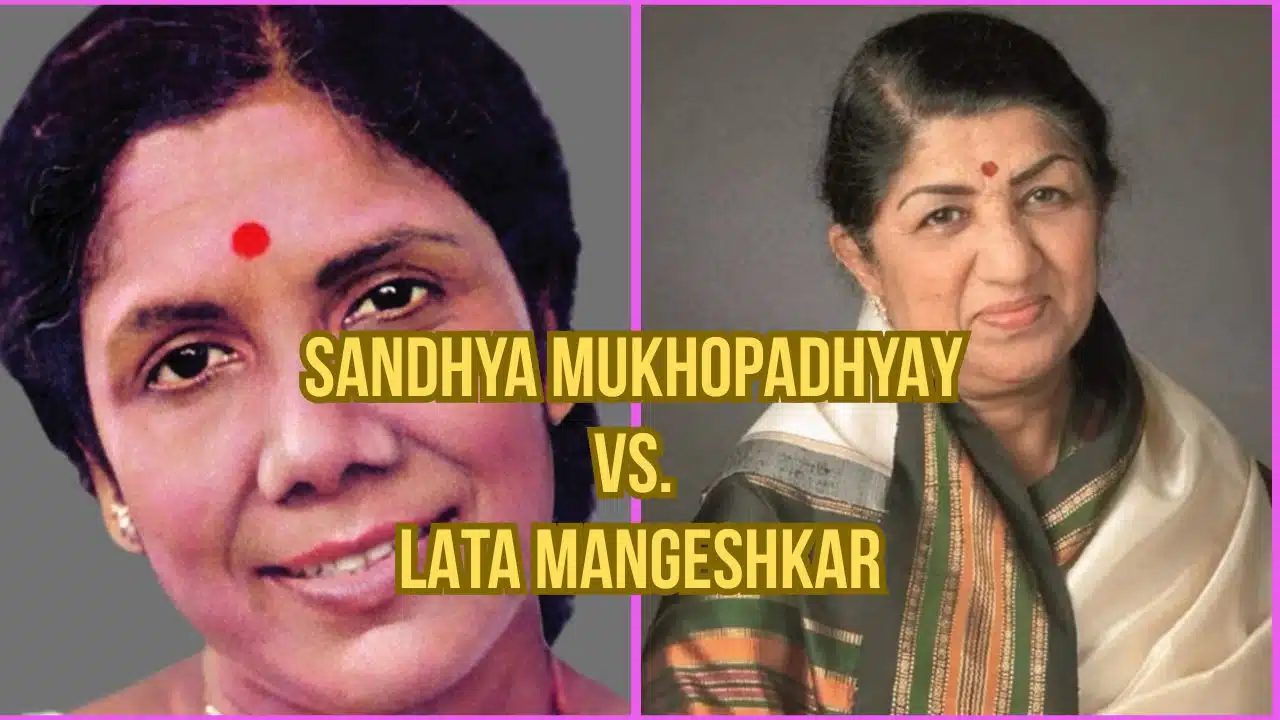
The golden era of Indian music produced many unforgettable voices, but two names continue to echo across generations: Sandhya Mukhopadhyay, the beloved Geetashree of Bengal, and Lata Mangeshkar, the immortal Nightingale of India. Both singers emerged during a period when cinema and music were deeply intertwined with cultural identity.
Their artistry gave voice to the emotions of millions, from romantic love to patriotic zeal.
When we think of Sandhya Mukhopadhyay vs Lata Mangeshkar, the discussion is not about rivalry but about celebrating two parallel streams of music history. Sandhya became the symbol of Bengal’s cultural pride, while Lata defined the soundscape of India’s Hindi film industry. Together, they demonstrate how two legendary voices shaped the heart of South Asian music in different yet complementary ways.
Early Life and Musical Training
Both Sandhya Mukhopadhyay and Lata Mangeshkar were products of India’s rich classical music traditions. Their early education not only refined their technical skills but also infused their singing with emotional depth and cultural authenticity. A closer look at their formative years reveals how each artist developed a unique identity within the vast landscape of Indian music.
Sandhya Mukhopadhyay’s Classical Roots
Sandhya Mukhopadhyay was born on October 4, 1931, in Kolkata, into a family that valued art and culture. She was exposed to music early, receiving lessons from her father before pursuing formal training. Her talent blossomed under the guidance of maestros like Pandit Santosh Kumar Basu, A. T. Kannan, and Chinmoy Lahiri.
The defining moment in her training came when she became a disciple of Ustad Bade Ghulam Ali Khan, the legendary figure of the Patiala gharana. His rigorous classical discipline sharpened Sandhya’s voice, giving her both technical strength and emotive richness. After his passing, she continued her training under his son, Ustad Munavvar Ali Khan, which further anchored her classical foundation.
Though she started in classical music, Sandhya transitioned seamlessly into playback singing, bringing a unique depth to Bengali cinema that few could replicate.
Lata Mangeshkar’s Early Journey
Lata Mangeshkar was born on September 28, 1929, in Indore, into a family steeped in music. Her father, Pandit Deenanath Mangeshkar, was a respected classical singer and theater actor. After his untimely death, the young Lata shouldered the responsibility of supporting her family through singing.
She began her career in Marathi films before stepping into Hindi playback in the 1940s. Lata received guidance from several stalwarts, but her innate discipline and determination made her voice stand out. Within a few years, she emerged as a force in Bollywood, setting new standards for playback singing.
Distinctive Voice and Singing Styles
Though trained in similar classical traditions, Sandhya Mukhopadhyay and Lata Mangeshkar developed remarkably different vocal identities. Sandhya’s tone carried the tenderness and introspection of Bengal’s musical soul, while Lata’s voice embodied technical perfection and unmatched range. Exploring their distinct styles reveals how both singers mastered the art of emotion through sound.
Sandhya’s Soulful Bengali Expression
Sandhya Mukhopadhyay’s voice carried a soothing warmth and emotional richness. Unlike singers who leaned only on technical brilliance, she infused every note with storytelling. Her renditions of romantic songs, devotional pieces, and even patriotic anthems had a soulful pull. She became particularly famous for her Rabindra Sangeet interpretations and her unforgettable playback numbers in Bengali films.
Her voice had an intimacy that resonated deeply with the Bengali audience. It felt personal, as if she was singing directly into the listener’s heart.
Lata’s Pan-Indian Nightingale Voice
Lata Mangeshkar’s voice, in contrast, was like a crystal stream—clear, pure, and versatile. She could glide effortlessly from soft romantic melodies to powerful patriotic songs. Her command over high notes and impeccable diction across multiple languages allowed her to dominate playback singing in Hindi cinema for over six decades.
Her style was defined by technical perfection, emotional delivery, and the ability to adapt to changing musical eras, from classical-influenced songs of the 1950s to modern, light compositions of the 1990s.
Contribution to Cinema and Playback Singing
In the world of cinema, stories are remembered not only by what we see but by what we hear. The voices of Sandhya Mukhopadhyay and Lata Mangeshkar carried love, sorrow, hope, and longing into the hearts of millions. Their songs became eternal companions to iconic films, proving that music is the soul of storytelling.
Sandhya Mukhopadhyay in Bengali Cinema
Sandhya became the voice of Bengali cinema in the 1950s and 1960s. She worked with eminent composers like Hemanta Mukherjee, Salil Chowdhury, S. D. Burman, and Nachiketa Ghosh.
Her songs in films such as Nishi Padma and Jay Jayanti remain evergreen. In fact, she won the National Film Award for Best Female Playback Singer in 1970 for her exceptional contributions.
Apart from cinema, Sandhya was also deeply involved in cultural movements. During the Bangladesh Liberation War in 1971, she recorded and performed patriotic songs to support the cause, making her voice part of a larger historical narrative.
Lata Mangeshkar in Bollywood
While Sandhya dominated the Bengali screen, Lata Mangeshkar became the voice of Bollywood. She collaborated with every major composer of her time: Naushad, Shankar-Jaikishan, Madan Mohan, R. D. Burman, Laxmikant-Pyarelal, and many more.
Her timeless songs in films like Mughal-e-Azam, Guide, Kabhi Kabhie, and Dilwale Dulhania Le Jayenge remain benchmarks of Indian film music.
Lata’s career spanned over seven decades, making her one of the most prolific playback singers in history. She also won multiple National Film Awards, Filmfare Awards, and the Bharat Ratna, India’s highest civilian honor.
Cultural Identity and Legacy
Music is never just entertainment—it is identity, memory, and heritage. For Sandhya Mukhopadhyay and Lata Mangeshkar, their voices carried more than melodies; they carried the spirit of their people. While Sandhya became the cultural heartbeat of Bengal, Lata’s songs echoed as the sound of a nation.
Sandhya Mukhopadhyay—The Voice of Bengal
For Bengalis, Sandhya was more than a singer—she was an icon of cultural pride. Her ability to combine classical traditions with modern melodies gave her a special place in Bengali households. She was lovingly titled “Geetashree,” meaning queen of songs.
Her patriotic songs during Bangladesh’s struggle for independence elevated her legacy beyond music, tying her voice to freedom and identity.
Lata Mangeshkar—The Nightingale of India
Lata, on the other hand, became India’s national treasure. Her voice transcended regional boundaries, reaching listeners from Kashmir to Kanyakumari. She recorded songs in more than 36 languages, making her one of the most versatile singers in the world.
Her patriotic song “Ae Mere Watan Ke Logon” moved Prime Minister Nehru to tears, demonstrating the emotional power of her voice.
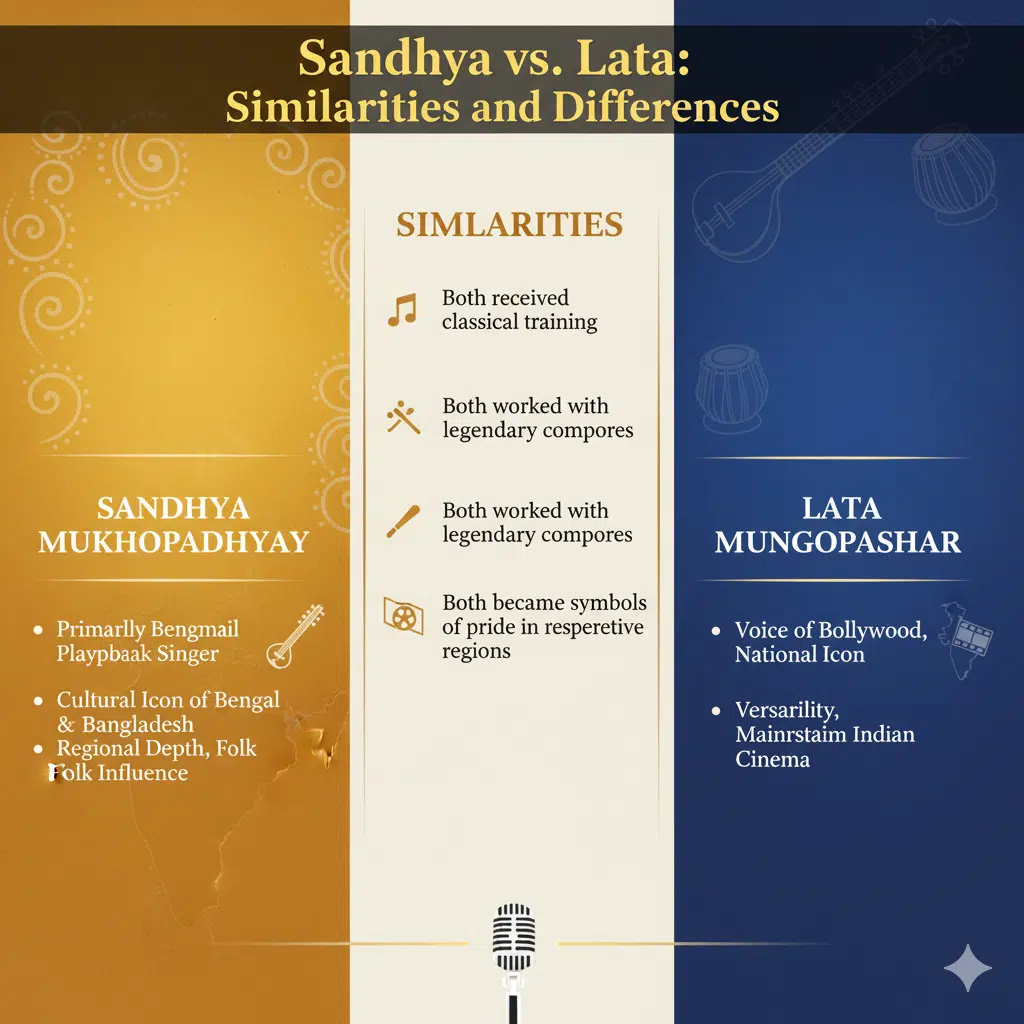
Sandhya vs. Lata: Similarities and Differences
-
Similarities:
-
Both received classical training.
-
Both worked with legendary composers.
-
Both became symbols of pride in their respective regions.
-
-
Differences:
-
Sandhya primarily sang in Bengali and became a cultural icon of Bengal and Bangladesh.
-
Lata became a pan-Indian voice, dominating Bollywood.
-
Sandhya’s songs carried regional depth, while Lata’s versatility made her the face of mainstream Indian cinema.
-
Memorable Duets and Crossovers
Though they carved different paths, Sandhya and Lata did share rare collaborations. One of the most notable was in the film “Tarana” (1951), where Sandhya sang “Bol Papiha Bol” alongside Lata under composer Anil Biswas.
These duets reflected harmony, not rivalry. They highlighted how both singers could complement each other’s styles, creating a rare musical delight.
Awards, Recognition, and Honors
-
Sandhya Mukhopadhyay:
-
National Film Award (1970)
-
Banga Bibhushan (2011)
-
Refused the Padma Shri in 2022, stating it was “too little, too late.”
-
-
Lata Mangeshkar:
-
Multiple National Film Awards and Filmfare Awards
-
Padma Vibhushan (1999)
-
Bharat Ratna (2001)
-
Lifetime Achievement Awards across India and globally
-
Public Perception and Cultural Pride
For Bengalis, Sandhya Mukhopadhyay is remembered as the eternal voice of Bengal, a singer who gave soul to Bengali cinema and stood as a cultural guardian. Her refusal to accept the Padma Shri reflected her pride and dignity.
For Indians as a whole, Lata Mangeshkar became a national identity in music. Her voice symbolized India’s cultural diversity and cinematic glory.
The debate over Sandhya Mukhopadhyay vs Lata Mangeshkar often comes up among fans, but most agree that both singers are irreplaceable, each reigning supreme in her own musical world.
Takeaways
Sandhya Mukhopadhyay and Lata Mangeshkar were not rivals—they were two shining stars in the same musical sky. Sandhya embodied the richness of Bengal’s music and inspired patriotic and cultural pride, while Lata gave India its soundtrack across seven decades of cinema.
Together, they represent the soul of South Asian music. Listening to their songs today reminds us that true legends never fade—their voices continue to live on in every note, every memory, and every heart they touched.