

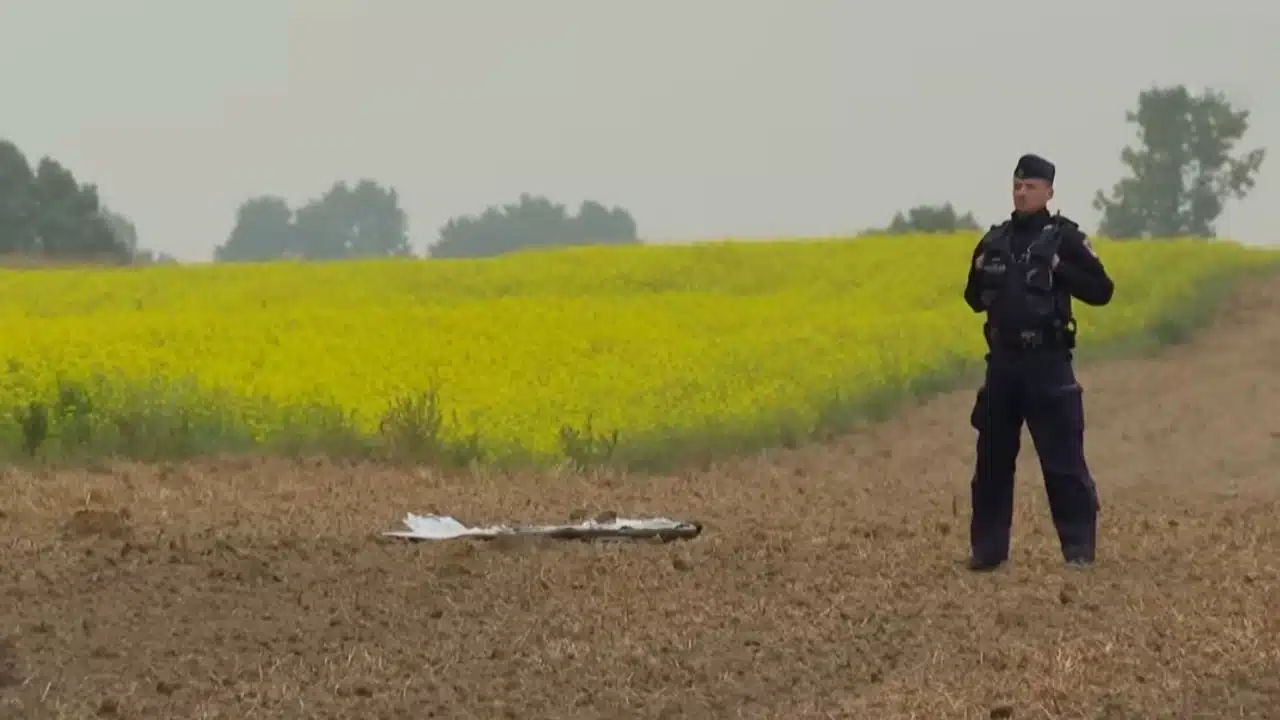
Tensions across Eastern Europe have spiked sharply after a dramatic overnight incident involving Russian drones in Polish airspace. In the early hours of Wednesday, Polish air defenses — supported by NATO allies — shot down multiple drones that Warsaw says crossed its borders in what it has called an “unprecedented incursion.” Other drones reportedly crashed in rural areas, scattering debris across eastern Poland.
The Polish government immediately described the event as the most serious airspace violation since Russia’s full-scale invasion of Ukraine in February 2022, stressing that this was not an isolated navigation mistake but a serious threat to national security and NATO’s credibility.
How the Incident Unfolded
According to Polish officials, at least three Russian drones were confirmed shot down after entering Polish airspace. Several others fell to the ground, including one that smashed into a house in the small village of Wyryki-Wola. Although the property was destroyed, residents miraculously escaped without injury.
Poland closed several airports, including in Warsaw, Lublin, and Rzeszów, while drones were overhead. Fighter jets from Poland, the Netherlands, and other NATO countries scrambled into the air to monitor and intercept the threat. NATO surveillance and refueling aircraft were also deployed to ensure real-time tracking.
Poland’s Strong Diplomatic Push
The Polish government wasted no time in bringing the incident to the international stage. Foreign Minister Radosław Sikorski formally requested an urgent meeting of the UN Security Council, now scheduled for Friday at 19:00 GMT, where Poland intends to present evidence and demand international condemnation of Russia’s actions.
Prime Minister Donald Tusk called the drone incursion “the closest Poland has been to open conflict since the Second World War,” underscoring its seriousness. Poland also invoked Article 4 of the NATO treaty, which allows member states to call for consultations whenever their security is threatened.
NATO’s Response: A Unified Military Front
NATO partners quickly rallied to Poland’s side. Several member states made concrete commitments:
- Netherlands: Sending air defense systems, artillery units, and 300 troops to bolster Poland’s defenses.
- Czech Republic: Deploying helicopters and 100 soldiers to assist in securing the border.
- Germany: Announcing an expanded air policing mission over Poland and placing its Patriot missile defense batteries on alert.
- France: President Emmanuel Macron confirmed the deployment of three Rafale fighter jets to help safeguard Polish skies, declaring, “We will not yield to Russia’s growing intimidation.”
- United Kingdom: Discussed the option of deploying additional aircraft to NATO’s eastern flank.
Polish Defense Minister Władysław Kosiniak-Kamysz told parliament that for once, Poland was not hearing just “words of solidarity” but “concrete declarations” of support from NATO allies.
Divided Views on Russia’s Intentions
Whether Russia deliberately sent drones into Polish territory remains a point of contention.
- Poland, France, and Germany argue that the incident was a provocation — an attempt by Moscow to test NATO’s response time and political unity.
- NATO’s top commander, General Alexus Grynkewich, urged caution, saying it was too early to confirm if the breach was intentional. The exact number of drones that crossed into Polish airspace also remains unclear.
- The Kremlin issued a brief statement claiming it had “no further comment” and downplayed suggestions that Russia deliberately sought to escalate.
Some analysts argue that faulty navigation, electronic jamming, or the chaos of Russia’s ongoing strikes on Ukraine could have caused drones to drift across the border. However, others note that Poland has long been a critical NATO frontline state, and any violation of its airspace sends a dangerous message.
Regional Security Measures
In the wake of the incident, Poland announced new restrictions on drones and light aircraft along its borders with Belarus and Ukraine. Latvia followed by declaring its eastern airspace closed for a week, citing similar security risks.
Ukraine’s President Volodymyr Zelensky weighed in, offering Western militaries training and guidance on countering drones — skills Ukrainian forces have refined during almost nightly Russian attacks. Zelensky also renewed his call for a joint NATO air defense system across Europe, which he described as an “air shield” against Moscow’s “insolent behavior.”
A Tense Backdrop: Zapad 2025 Exercises
The drone incursions coincided with preparations for Zapad 2025, major joint military drills between Russia and Belarus beginning Friday.
- Previous Zapad exercises in 2021 involved nearly 200,000 troops and were seen as a rehearsal for Russia’s invasion of Ukraine months later.
- This year’s drills are expected to be smaller, with around 30,000 troops, according to Lithuanian military intelligence.
- Still, Poland views the maneuvers as “very aggressive” and announced it would temporarily close its border with Belarus for national security reasons.
Russia condemned the border closure, warning it would “seriously damage” trade and free movement, and urged Poland to reconsider.
The United States’ Cautious Reaction
U.S. President Donald Trump has so far adopted a muted tone compared with European leaders.
- Speaking to reporters, he suggested the drone incursion “might have happened by mistake” and reiterated his hope to broker a broader end to the war in Ukraine.
- On social media, however, Trump took a sharper tone, writing: “What’s with Russia violating Poland’s airspace with drones? Here we go!”
Despite the restrained response, Poland confirmed that President Karol Nawrocki spoke directly with Trump in a “series of consultations” aimed at reaffirming NATO unity.
Why This Matters for NATO and Europe
This was the most serious airspace violation by Russia involving a NATO member since 2022. It raises urgent questions about:
- NATO’s readiness to defend its eastern flank in the face of drone warfare.
- Deterrence credibility, as even small-scale incursions test how far NATO is willing to go.
- Escalation risks, with Zapad 2025 potentially acting as a cover for further provocations.
- Civilian safety, as drone crashes into homes highlight the human risk beyond military targets.
As experts warn, drone warfare is now the central weapon of Russia’s war in Ukraine, and NATO’s ability to counter these incursions will determine whether Europe can maintain a credible air shield.
The Road Ahead
- Poland and its allies will present evidence of the incursions at the UN Security Council meeting.
- NATO defense ministers are likely to accelerate discussions on a joint European air defense system, possibly modeled on Ukraine’s integrated approach.
- Eastern European countries remain on heightened alert, bracing for further provocations during the Zapad exercises.
While the world waits for clarity on Russia’s intentions, the message from Warsaw and NATO capitals is firm: any future violations will be met with stronger, faster, and more coordinated responses.
The Information is Collected from Washington Post and BBC.





















