


On September 5, 2025, President Donald Trump issued an executive order rebranding the U.S. Department of Defense with its original historic title—the Department of War. The move, described by the White House as an effort to emphasize strength, marks a symbolic return to the department’s name used between 1789 and 1947.
Although the executive order does not legally replace the statutory title of the Defense Department, it creates a secondary designation that allows the Pentagon to use “Department of War” in official communication, signage, and correspondence. The order also directs all federal agencies to recognize the new title in both internal and external communications.
Why Trump Pushed for the Rebrand
Trump has long criticized the name “Department of Defense,” arguing that it does not fully capture the military’s purpose. During his second term, he repeatedly said the Pentagon’s mission was not only to defend but also to project power and win wars. The new rebrand reflects his insistence that America’s military identity should highlight strength and decisive victory.
The President finalized the decision after discussions with aides and Defense Secretary Pete Hegseth, who had championed the idea for months. Hegseth has argued that restoring the older name would reinforce a “warrior ethos” among U.S. forces, aligning military culture with readiness for global conflicts rather than passive defense.
Immediate Implementation at the Pentagon
Following the signing ceremony at the White House, the Pentagon quickly moved to adopt the new terminology.
-
The official website of the Defense Department was updated to war.gov, and its social media accounts were switched to reflect the “Department of War” branding.
-
Placards, office signs, and correspondence within the Pentagon began using the term “Secretary of War.”
-
The outer office of Defense Secretary Pete Hegseth replaced references to “Defense” with the new designation, displaying “The Office of the Secretary of War.”
This rollout gave the rebrand an immediate public visibility, even though the official statutory name remains unchanged.
Legal and Political Boundaries
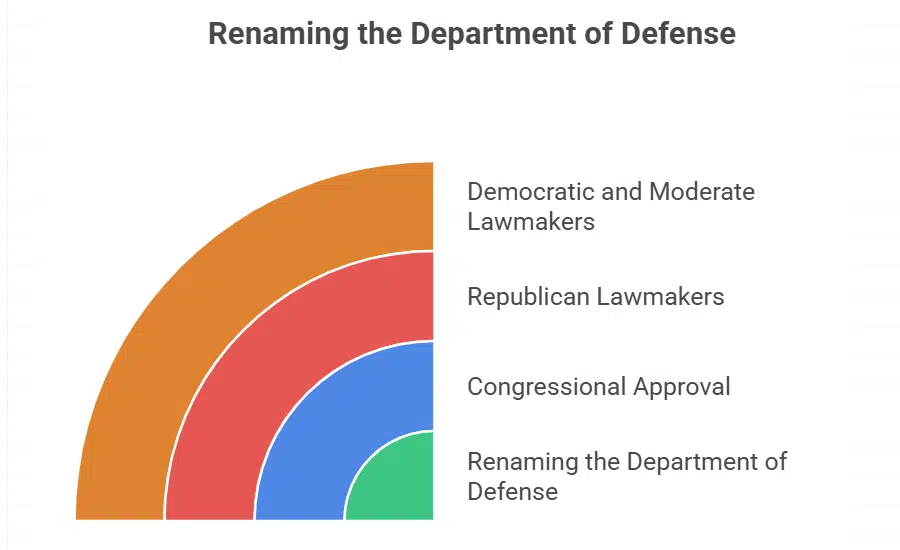
The executive order cannot legally rename the Department of Defense without congressional approval. By law, the Pentagon retains the statutory title it has held since 1949, when Congress settled on “Department of Defense” to replace the short-lived “National Military Establishment.”
Some Republican lawmakers are already working on legislation to formally enshrine the “Department of War” title. Supporters, including Senators Mike Lee and Rick Scott, argue that a congressional vote would cement America’s unapologetic commitment to projecting military power. However, the proposal is expected to face significant resistance from Democrats and some moderates, who see the move as politically motivated symbolism rather than substantive defense reform.
Historical Context
The Department of War was originally created in 1789 as part of George Washington’s administration. It oversaw the Army and early naval affairs for more than a century. After World War II, U.S. leaders sought to reorganize the military to better address modern global threats.
-
In 1947, President Harry Truman signed the National Security Act, creating the National Military Establishment, which brought the Army, Navy, and newly formed Air Force under a single leadership structure.
-
In 1949, Congress amended the Act to rename the entity the Department of Defense, citing practical reasons and concerns that the abbreviation “NME” (National Military Establishment) sounded too similar to the word “enemy.”
The Department of Defense has carried that title for more than 75 years—until Trump’s order resurrected the older “War Department” branding for symbolic purposes.
Support and Opposition
Supporters
Republican leaders and administration officials have welcomed the change. They describe it as a bold message to America’s adversaries that the U.S. is not merely defending itself but is ready to win wars decisively. To them, reviving the original name restores clarity and aligns with America’s historical legacy of military victories.
Critics
Opponents, including many Democratic lawmakers, have dismissed the rebrand as an unnecessary and costly distraction. Analysts have pointed out that the transition requires updated signage, websites, stationery, and official documents, which could cost millions of dollars. Critics also warn that symbolic gestures may overshadow urgent defense needs such as modernization, cybersecurity, and recruitment challenges.
Some policy experts argue that the name “Department of Defense” was intentionally chosen in the postwar era to emphasize deterrence, peacekeeping, and collective security, reflecting the U.S. role in alliances such as NATO. Reverting to “War Department,” they say, risks projecting aggression in international relations.
Global Reactions
The move has also drawn attention abroad. Allies in Europe and Asia, who have long relied on the U.S. for defensive partnerships, are carefully watching the symbolic shift. International media noted that the renaming may signal a more aggressive U.S. stance in dealing with adversaries such as China, Russia, and Iran.
Diplomatic observers stressed that while the executive order is symbolic, it could influence how allies and rivals interpret America’s global military posture.
Key Takeaways
| Aspect | Details |
|---|---|
| Date of executive order | September 5, 2025 |
| New designation | “Department of War” (secondary title) |
| Legal status | Symbolic only; “Department of Defense” remains official |
| Immediate changes | Website to war.gov, social media rebranding, Pentagon signage updates |
| Historical precedent | Department of War (1789–1947); renamed Department of Defense in 1949 |
| Supporters’ view | Restores warrior ethos, highlights U.S. military strength |
| Critics’ view | Symbolic, costly, potentially provocative internationally |
| Next step | Congressional approval required for permanent name change |
President Trump’s executive order reviving the Department of War name is a symbolic act that reflects his administration’s desire to project strength and redefine America’s military identity. While legally limited, the move has already reshaped the Pentagon’s public image and fueled political debate over whether the U.S. should embrace a more confrontational posture.
The rebrand now places pressure on Congress to decide whether to formally endorse the change or keep the long-standing “Department of Defense” title. For now, the Pentagon operates under dual identities: officially the Department of Defense, but publicly styled once again as the Department of War.






















