The U.S. State Department has confirmed that more than 6,000 international student visas have been revoked this year as part of the Trump administration’s ongoing immigration enforcement drive. Officials stated that the vast majority of these cancellations were linked to violations of U.S. law, while several hundred were tied to allegations of terrorism-related activity under federal immigration statutes.
Of the total figure, around 4,000 students lost their visas because of criminal offenses such as assault, burglary, and driving under the influence. A further 200 to 300 revocations were attributed to what the government described as terrorism-related activity under the Immigration and Nationality Act’s Section 3(B). This provision defines “terrorist activity” in broad terms, encompassing not only violent acts but also actions interpreted as providing material support to designated groups or threatening national security.
The announcement represents one of the largest coordinated cancellations of student visas in recent years, signaling a sharper focus on foreign students within the administration’s broader immigration strategy.
Allegations of Political Expression and “Support for Terrorism”
While officials did not provide full details of what constituted terrorism-related grounds, the Trump administration has previously directed scrutiny toward students and activists involved in pro-Palestinian demonstrations. The administration has claimed that some of these protests contained antisemitic undertones or crossed into support for terrorism.
Civil rights organizations and university groups have raised concerns that this approach risks punishing individuals for political expression and peaceful activism. Several students have reported losing their visas after participating in demonstrations or making social media posts critical of U.S. foreign policy. Advocacy groups argue that the government is using expansive legal definitions to target dissent, raising questions about academic freedom and free speech protections on campuses.
Expanded Screening and Surveillance of International Students
The visa cancellations are not an isolated measure but part of a broader series of policy changes introduced in 2025. Earlier this year, the State Department temporarily paused visa interview scheduling for international students. When the process resumed in June, applicants were informed they would be required to submit their public social media accounts for review.
Consular officers were directed to look for indicators of hostility toward U.S. citizens, government institutions, or founding principles, as well as any association with foreign terrorist groups. Officials were also instructed to flag applicants who engaged in antisemitic harassment or violence. This marked a major expansion of digital surveillance as a tool in U.S. visa adjudication, a policy shift that has drawn criticism from privacy advocates and legal scholars.
Lawmakers and Experts Debate Presidential Authority
The mass revocation of visas has also triggered debate in Washington over whether the president has the legal authority to enforce such measures without congressional approval. Secretary of State Marco Rubio told lawmakers in May that “thousands” of student visas had already been rescinded and indicated that the State Department would continue its efforts. He emphasized that international students were guests in the country and that the administration would not hesitate to act against those deemed disruptive or unlawful.
Legal experts, however, caution that the Constitution grants Congress—not the executive branch—primary authority over the regulation of federal elections and immigration. Scholars at institutions such as Florida State University and UCLA note that while the president can issue executive orders guiding agencies, sweeping changes to visa rules and enforcement may exceed the powers of the executive branch without congressional backing. This could expose the new policies to legal challenges.
Impact on Universities and Students
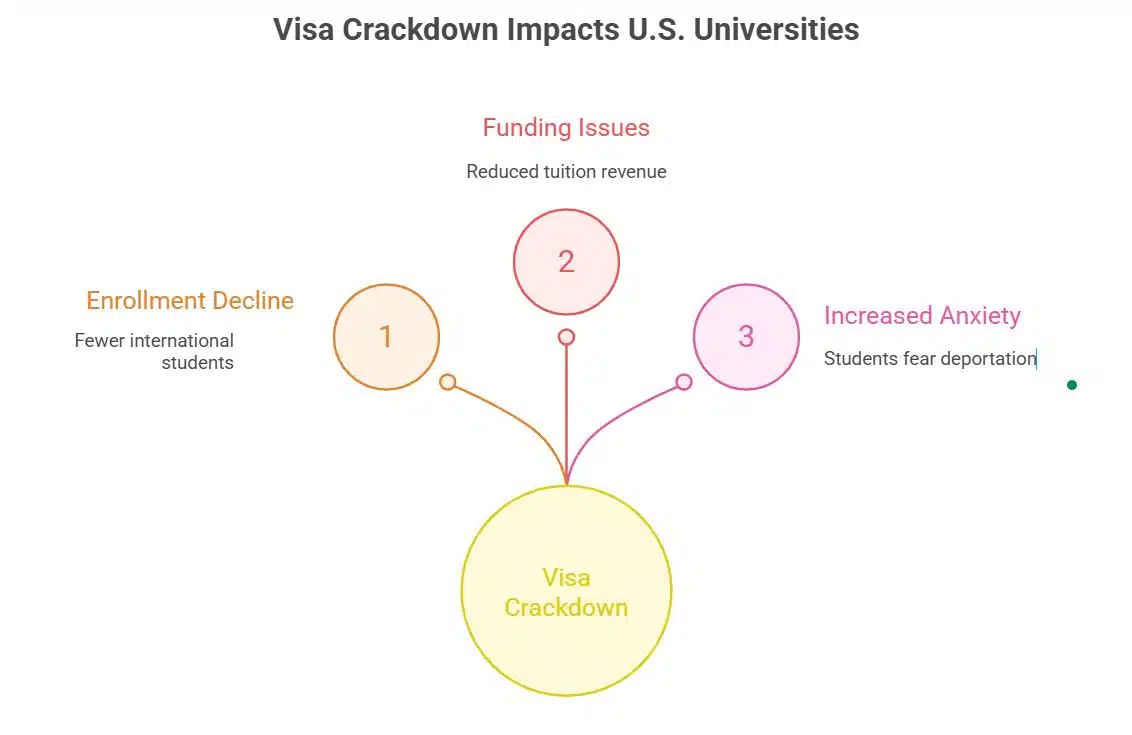
The effects of the visa crackdown are being felt across U.S. universities. According to Open Doors, an organization that tracks international student enrollment, more than 1.1 million international students from over 210 countries were enrolled in U.S. higher education during the 2023–2024 academic year. These students contribute significantly to campus diversity, cultural exchange, and the economy, bringing in billions in tuition and living expenses each year.
University administrators have warned that the revocations could discourage future applicants, especially if students perceive the U.S. as an unstable or hostile environment for higher education. Several campuses have reported heightened anxiety among international students, some of whom now fear that even minor infractions or political activity could jeopardize their status. For institutions already reliant on international tuition, a significant decline in enrollment could threaten funding and academic programs.
Democratic Pushback and Civil Liberties Concerns
Democratic lawmakers and civil rights groups have criticized the administration’s actions, arguing that mass revocations amount to an erosion of due process. They stress that many students invest years of effort, tuition fees, and research contributions in U.S. universities, and sudden visa cancellations can derail lives and careers without adequate legal recourse.
Organizations advocating for international education have also expressed concern that the crackdown undermines the United States’ reputation as a global leader in higher learning. Critics suggest that the policies risk sending talented students to countries like Canada, the United Kingdom, or Australia, which are competing to attract global talent and have less restrictive visa environments.
What This Means for the Future
The revocation of over 6,000 student visas underscores the administration’s determination to apply stricter immigration controls and redefine the role of international students in American society. While officials defend the measures as necessary for national security and law enforcement, universities, advocacy groups, and foreign governments will be watching closely to see how these policies affect academic exchange and diplomatic relations.
The long-term impact could be profound: a reduction in international enrollment, strained U.S. relationships with foreign educational partners, and intensified legal battles over the scope of presidential authority. For now, international students across the country face an uncertain landscape—one where both their academic futures and civil liberties may be at stake.