Smart contracts can pack big power. One small bug can blow up like a hidden bomb. Many web3 devs lose sleep over flaws that risk users and funds. They test code by hand, but that can miss tricky issues.
They need fast tools for static code analysis, fuzz testing, and formal verification to boost web3 security.
In 2022, hackers stormed DeFi and stole most of the loot, 80 percent of the losses in defi protocols. Our post will cover seven top security auditing tools. We list Slither, MythX, Echidna fuzzer, Manticore, Securify, the Remix IDE plugin, and Halmos.
You will learn how each tool finds smart contract vulnerabilities and boosts blockchain security. Read on.
Key Takeaways
- Hackers stole 80% of the $3.8 billion lost in DeFi hacks in 2022; developers use seven tools—Slither, MythX, Echidna, Manticore, Securify, the Remix IDE plugin, and Halmos—to catch smart-contract bugs.
- Slither runs static analysis on Uniswap, Yearn, and Compound code, and MythX links with Truffle, Remix, and CI pipelines to spot reentrancy and overflow issues through symbolic execution.
- Echidna fuzz tests EVM code, Manticore traces contract paths and native binaries with symbolic execution, and Securify plus the Remix plugin flag reentrancy, access control, and gas-use gaps in real time.
- Halmos applies formal verification to prove invariants in smart contracts; with DeFi now holding $50 billion and 6% at risk, early audits cut review time and guard assets before mainnet launches.
How Security Auditing Tools Enhance Web3 Development
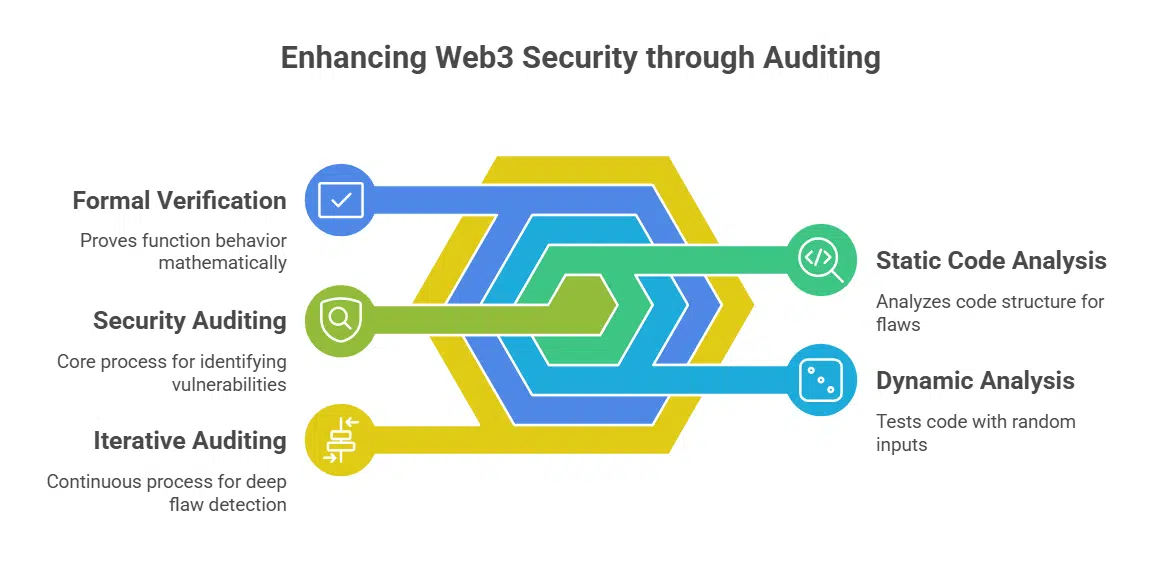
Auditing tools scan smart contracts for security vulnerabilities. They catch common flaws like reentrancy bugs and weak access controls. Tools run static code analysis, taint analysis, and symbolic execution to spot logic errors.
Some scanners run fuzzing tools and dynamic analysis to throw random inputs at your code. They show gaps that human reviewers might miss. This process raises web3 security and shields assets from theft.
Projects lost $3.8 billion in 2022; 80 percent came from DeFi hacks. Manual review and automated checks together improve blockchain security.
Formal verification adds proof that key functions behave as expected. Protocol owners and auditors run multiple audit rounds. Developers tweak code early to cut smart contract vulnerabilities.
This practice cuts deployment risks on a mainnet. Systems such as Slither, Echidna, and Manticore give fast feedback in dev environments. Each iteration finds deep logic flaws before hackers strike.
The DeFi sector holds $50 billion now, with six percent at risk of theft. Strong audit loops speed up growth in the blockchain ecosystem.
Key Features to Look for in Smart Contract Audit Tools
Choose a smart contract auditing tool that runs static code analysis and dynamic analysis with symbolic execution and taint analysis. That mix helps find bugs and security flaws fast.
Look for fuzz testing engines and formal verification to prove invariants in source code. Tools should flag reentrancy errors, overflow risks, and other common smart contract vulnerabilities.
Interactive reports and clear code comments boost code quality, and a user-friendly interface speeds review cycles.
Audit firms charge fees based on scope, so compare price points closely. Seek teams that share their methodology, whether they use fuzzing, static analysis, or formal verification.
Ask for named auditor contacts and a video walkthrough of your code. Open chat channels, clear issue tracking, and timestamped reports keep developers in sync. Clean, commented code and up-to-date best practices cut down review time and cut hidden risks.
7 Security Auditing Tools Every Web3 Developer Should Use
These seven auditing apps mix static code analysis, fuzz testing, symbolic execution, and formal proofs to catch smart contract flaws—read on to see how they boost your blockchain security.
Slither
Slither runs static code analysis on Solidity files. The Python program flags reentrancy, overflow, and gas issues. Trail of Bits released it in 2018.
Teams use it in smart contract auditing of Uniswap, Yearn, and Compound. It plugs into continuous integration pipelines to catch bugs fast. It boosts vulnerability detection and blockchain security.
MythX
MythX audits Solidity and Vyper with static code analysis and symbolic execution. It spots reentrancy attacks and overflow issues, two common smart contract vulnerabilities. It links with Truffle, Remix and CI pipelines for smooth integration.
Taint analysis traces data paths to find hidden bugs.
Developers call its API or scan code through a web UI. It runs dynamic analysis and fuzz testing for strong vulnerability detection. It acts like a watchdog for your code. Teams add it to pull request checks to speed up smart contract auditing and boost confidence.
Echidna
This popular Trail of Bits tool fuzz tests smart contracts, digging for flaws like a hound on a scent. It pushes random inputs into Ethereum Virtual Machine code to find smart contract vulnerabilities.
It uses dynamic analysis and property tests on invariants so no sneaky bug slips through.
Developers drop Echidna into a CI pipeline to catch security gaps early. It flags missing access controls and transaction security gaps in DeFi code, boosting blockchain security and web3 security.
Manticore
Manticore, a popular tool from Trail of Bits, acts as a powerful symbolic execution engine. The engine traces each path in smart contracts and native binaries for bugs. Developers spot hidden smart contract vulnerabilities, like reentrancy or integer overflow, fast.
Generated constraint checks make formal verification easier. Dynamic analysis tests build cases for protocol security and vulnerability detection. It runs on Ethereum virtual machine code and on compiled binaries.
Automated checks boost blockchain security before live launches. Its popularity stems from open source code and strong community support. You might laugh at how simple steps reveal flaws hidden in plain sight.
Securify
Securify scans smart contracts with static analysis. The tool uses taint analysis and symbolic execution to find vulnerabilities. It reports reentrancy attacks and callcode issues.
Developers read clear audit results and fix code fast.
Integrators trust its reports during smart contract auditing for decentralized finance protocols. This tool supports blockchain security and formal verification workflows. Users add Securify to CI pipelines for continuous checks.
Teams cut risk before mainnet launches.
Remix IDE Plugin

This add-on plugs into Remix and runs static code analysis on Solidity code in real time. Common issues like reentrancy, overflow, or broken access controls pop up as you type. Integration with MythX runs deeper scans via symbolic execution and taint analysis, so you catch hidden bugs.
You see in-IDE vulnerability detection inside your editor. Results land in seconds, so you avoid context switching. It acts like a code bodyguard for your decentralized finance project.
Halmos
Halmos applies formal verification to smart contracts. Engineers run proofs that check mathematical correctness of code. Auditors plug it into blockchain security checks. It excels at vulnerability detection by spotting logic flaws.
Developers use it to boost smart contract security.
Users write invariants in a simple domain specific language. Halmos then turns those rules into machine proofs. The engine flags any mismatch. Programmers fix flaws fast. It helps protect blockchain applications from costly exploits.
Comparing the Effectiveness of Security Auditing Tools
Here is a quick comparison for key audit tools.
|
Tool |
Main Technique |
Integration |
Notable Strength |
|---|---|---|---|
| Slither | Static analysis | CLI, IDE | Fast bug detection |
| MythX | Static & dynamic | Truffle, Remix | Deep vulnerability search |
| Echidna | Fuzz testing | CLI | Custom rule checks |
| Manticore | Symbolic execution | CLI | Binary and source scans |
| Securify | Taint & symbolic exec | Web UI | Reentrancy alerts |
| Remix IDE Plugin | Static analysis | Remix | Live feedback |
| Halmos | Formal verification | IDE, CLI | Proof of correctness |
Tips for Integrating Security Auditing Tools into Your Workflow
Create pipelines early. Run static analysis tools like Slither and MythX before deployment.
- Integrate Slither and MythX in CI checks to add static code analysis, flag vulnerable functions, and enforce coding standards.
- Schedule dynamic analysis runs with Foundry and Hardhat on testnets to catch transaction security flaws, track real-state changes, and test DeFi protocols under load.
- Add Echidna and Manticore for automated fuzz testing and constraint analysis, surfacing edge-case vulnerabilities without manual scripting.
- Apply K framework for proof-based verification to prove mathematical correctness, define key invariants, and block logic gaps in smart contract development.
- Combine Burp Suite, SQLMap, and Nessus for broad penetration testing to scan transport layer security, detect SQL injection, and audit cloud services.
- Leverage the Remix IDE Plugin and Securify in your daily workflow for instant feedback on access controls, taint detection, and code quality analysis before merging.
Takeaways
Your smart contracts gain strength with these seven audit tools. CodeSlither and MythX scan code fast. TestEchidna simulates attacks with fuzz testing, while Manticore finds edge flaws with symbolic execution.
Securify spots access control gaps. The Remix IDE Plugin ties checks right into your code editor. Halmos adds deep taint analysis. You now guard your DeFi protocols like a digital knight.
Keep these tools close as you build. Code with confidence and watch hacks stay away.
FAQs on Must-Have Security Auditing Tools for Web3 Developers
1. What is formal verification for smart contract security?
Formal verification uses math to prove smart contract code works as planned. It spots vulnerabilities early to protect DeFi protocols and blockchain security.
2. How do static code analysis and taint analysis aid in smart contract auditing?
Static code analysis scans code without running it to catch bugs. Taint analysis tracks data flow to spot leaks in cryptographic algorithms and access controls. They speed up vulnerability detection.
3. What do dynamic analysis and fuzz testing do for blockchain security?
Dynamic analysis runs code in a test setting to track behavior under load. Fuzz testing sends random and invalid inputs; it is like a stress test for DeFi protocols. Both catch smart contract vulnerabilities before they go live.
4. How can a web application vulnerability scanner help with cross-site scripting?
A web application vulnerability scanner crawls web services to spot cross-site scripting flaws. It hunts injection holes like a guard dog.
5. What role does symbolic execution play in transaction security?
Symbolic execution treats inputs as symbols instead of fixed values. It explores all code paths to expose hidden errors that could risk transaction security. It is like a thought experiment for your code.
6. Which tools by Trail of Bits help with smart contract auditing and protocol security?
Trail of Bits, the security firm, made a tool for symbolic execution and dynamic analysis. They built a second test tool to run invariant testing and fuzz testing. Both aid smart contract auditing and bolster protocol security.