Former President Donald Trump’s executive order (EO), titled “Protecting the Meaning and Value of American Citizenship,” has sent shockwaves through immigrant communities, particularly the Indian diaspora. The EO has introduced a dramatic shift in U.S. immigration policy by altering the long-standing interpretation of birthright citizenship under the 14th Amendment. While Trump had hinted during his campaign that he might end citizenship by birth, many assumed this would apply only to children of undocumented immigrants. The reality, however, is much broader and affects families of legal immigrants as well, including those on temporary visas such as H-1B, L-1, and F-1. The implications are profound and far-reaching.
What the Executive Order Changes
Under the new executive order, children born in the United States will no longer automatically receive citizenship if:
- The mother’s presence in the U.S. is lawful but temporary, such as on a tourist, student, or work visa.
- The father is not a U.S. citizen or lawful permanent resident (green card holder).
Previously, the 14th Amendment was interpreted to guarantee citizenship to anyone born on U.S. soil, regardless of their parents’ immigration status, with limited exceptions such as children of diplomats or enemy occupiers. Trump’s EO challenges this interpretation, asserting that temporary visa holders are not fully “subject to the jurisdiction” of the U.S., a key phrase in the amendment. This change fundamentally alters the rights of children born to parents who are legally present in the U.S. on temporary visas.
The Immediate Impact on Indian Families
Indian immigrants, who are among the largest groups of legal visa holders in the U.S., are particularly affected. According to a 2022 Pew Research Center analysis, there are approximately 4.8 million Indian Americans in the U.S., with 34% (or 1.6 million) having been born in the country and gaining citizenship by birth. For Indian families stuck in the decades-long backlog for employment-based green cards, having a child born in the U.S. was a significant relief. Such children could eventually sponsor their parents for green cards upon turning 21.
The EO eliminates this possibility. Children born to parents on temporary visas will no longer be considered U.S. citizens. Instead, these children will face the same challenges as their parents, including potential self-deportation when they turn 21 unless they obtain another visa type, such as an F-1 student visa. This leaves families with limited options and increases uncertainty for their future in the U.S.
Legal Experts Raise Concerns
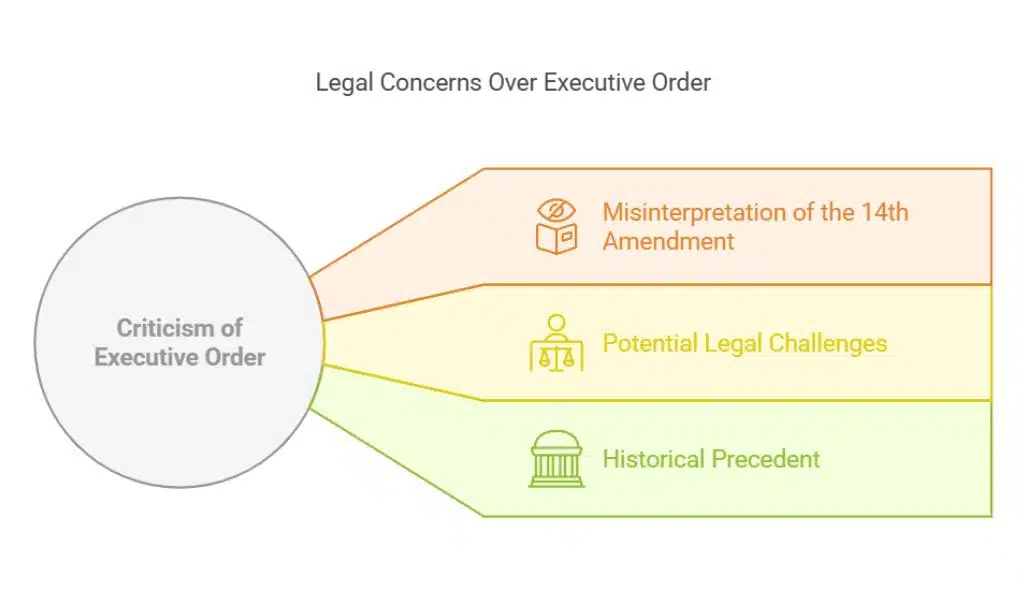
Immigration attorneys and rights advocates have sharply criticized the executive order, arguing that it misinterprets the 14th Amendment and sets a dangerous precedent. Several legal experts have highlighted the following issues:
- Historical Interpretation of the 14th Amendment: The phrase “subject to the jurisdiction thereof” has been consistently interpreted to include nearly all individuals born on U.S. soil. Notable Supreme Court cases, such as United States v. Wong Kim Ark (1898), reaffirmed that children born to non-citizen parents are entitled to citizenship if born in the U.S.
- Potential for Legal Challenges:
- Ashwin Sharma, an immigration attorney, noted that the precedent set by Wong Kim Ark leaves little room for reinterpretation.
- Greg Siskind, co-founder of Siskind Susser, described the EO as a “stunning” example of unconstitutionality and predicted that courts might block its implementation. However, he also cautioned that with a conservative majority in the Supreme Court, the final outcome remains uncertain.
Gender-Specific Language in the EO
Critics have also pointed out that the EO’s language is rooted in outdated assumptions about family structures. It uses gender-specific terms like “mother” and “father,” ignoring the diversity of modern families, including single-parent households and same-sex couples. Immigration attorney Fiona McEntee emphasized that this language further marginalizes certain groups and reflects a narrow, traditional view of family dynamics.
Ripple Effects on Immigration
The EO’s implications extend far beyond the Indian-American community. It introduces new challenges for all families on temporary visas and disrupts the lives of thousands already grappling with the complexities of U.S. immigration policies. Key areas of concern include:
- Long-Term Residency: Families relying on birthright citizenship for stability will now face greater difficulties securing legal residency or citizenship. For many, this policy change eliminates a crucial safety net.
- Workforce Impact: Many professionals on H-1B visas—a significant portion of whom are Indian—may reconsider their plans to stay in the U.S., potentially exacerbating talent shortages in industries like technology and healthcare.
- Educational Barriers: Children born in the U.S. who no longer qualify as citizens may encounter obstacles when applying for college or other educational opportunities.
Legal Challenges and Next Steps
Immigration rights groups, including the American Civil Liberties Union (ACLU), have already filed lawsuits to challenge the executive order. These lawsuits argue that the EO is unconstitutional and contradicts established legal interpretations of the 14th Amendment.
- Cyrus D. Mehta, a New York-based immigration attorney, predicts that the Trump administration will push the case all the way to the Supreme Court, where conservative justices may play a decisive role.
- Greg Siskind expressed hope that the courts would issue an injunction to delay the EO’s implementation, but acknowledged the uncertainty of the legal process.
Historical Context and Broader Implications
The 14th Amendment’s guarantee of birthright citizenship was a cornerstone of post-Civil War reconstruction, aimed at ensuring equal rights for all individuals born in the U.S., particularly formerly enslaved people. Trump’s EO challenges this foundational principle, raising questions about its broader implications for civil rights and equality.
For Indian families and other immigrant communities, the EO represents a significant setback. It disrupts carefully planned futures, heightens uncertainty, and adds new complexities to an already challenging immigration system. As the legal battle unfolds, the outcome will shape the lives of millions and redefine the meaning of American citizenship.
Trump’s executive order has triggered widespread concern and legal challenges, with immigration rights activists and legal experts questioning its constitutionality. For the Indian-American community, which has long relied on birthright citizenship as a pathway to stability and opportunity, the policy represents a profound shift. As the courts weigh the legality of the EO, immigrant families and advocacy groups are bracing for a fight that could redefine immigration policy in the United States.