Hey there, are you worried about keeping your digital assets safe in the wild world of Web3? Maybe you’ve heard whispers of hacks, data breaches, or sneaky phishing attacks, and it’s got you on edge.
You’re not alone, friend; tons of folks are scratching their heads, wondering how to guard their crypto wallets and decentralized apps from bad actors in 2025.
Now, here’s a jaw-dropping tidbit for you: security threats in the Web3 space are changing faster than a chameleon on a rainbow. It’s a real challenge for even the sharpest minds to protect blockchain networks and tokens.
But don’t sweat it yet. This blog is your trusty map through the maze of Web3 security. We’re breaking down the top 10 threats, from smart contract flaws to cross-chain bridge risks, so you can stay one step ahead.
Keep reading!
Key Takeaways
- Smart contract flaws are a top threat in 2025, with access control issues at number one on the OWASP Smart Contract Top 10.
- Cross-chain bridge hacks, like the Ronin hack, can lead to huge losses if multi-sig setups aren’t used.
- Centralized exchange hacks can wipe out millions, but a 2024 DEX exploit was stopped by quick automated watchers.
- Private key theft is risky, and a DeFi aggregator cut phishing by 50% with monthly training in 2025.
- Phishing and insider threats are growing, so regular training and bug bounty programs are key to Web3 safety.
Vulnerabilities in Smart Contracts
Smart contracts are like digital promises on the blockchain, but they can have flaws that crooks exploit. Think of them as a locked safe with a weak spot in the code. According to the OWASP Smart Contract Top 10 for 2025, access control vulnerabilities sit at the top spot, meaning bad guys can sneak in if permissions aren’t tight.
Logic errors also jumped up to number three this year due to more attacks. Plus, a new issue called lack of input validation landed at number four, showing how tiny oversights can open big doors for hackers.
Imagine a DeFi project almost losing $10 million in 2025, but a routine test caught a reentrancy bug just in time. These reentrancy attacks, now at number five, still haunt yield farming platforms.
Flash loan attacks hold steady at number seven, draining funds fast with sneaky tricks. Issues like integer overflow and unchecked external calls can also wreck a smart contract’s safety.
So, running smart contract audits is a must to spot these gaps before disaster strikes.
Exploitation of Cross-Chain Bridges

Hackers often target cross-chain bridges, and it’s a big problem for Web3 security. These bridges let assets move between different blockchain networks, like swapping tokens from one chain to another.
But, they’re like a weak link in a fence, easy to break if not guarded well. Criminals exploit flaws in the code or setup, stealing millions in crypto assets. Take the Ronin hack as a warning; it showed how a shaky setup can lead to huge losses.
If they had used a proper multi-sig setup, the damage might have been much smaller. Keep an eye on unusual token swaps, as Blockchain Analytics and Forensics suggest, to spot trouble early.
Tracing stolen funds gets tricky with mixers and bridging networks hiding the trail. Yet, tools like blockchain forensics help track down bad actors across these paths. For instance, analytics once pinned addresses tied to North Korean hackers, leading to blacklisting them.
It’s like following breadcrumbs in a messy forest, but it works. Cross-chain bridges need tight access control and constant checks to stop exploitation. Watch for odd patterns in decentralized finance (DeFi) deals, since hackers love to sneak through these gaps.
Stay sharp, folks, because losing assets to a bridge hack stings like a bad bee bite.
Centralized Exchange Hacks
Man, centralized exchange hacks are a big deal in the Web3 space, and they can hit hard. These platforms, where you trade crypto like Bitcoin or Ethereum, hold tons of user funds, making them prime targets for bad actors.
A single breach can wipe out millions in seconds, leaving users high and dry. Think of these exchanges as giant vaults; if the lock breaks, the thieves rush in. In 2024, we saw a DEX exploit where automated watchers spotted a shady contract and froze it fast, saving a huge chunk of cash.
That’s a rare win, but it shows how quick action matters.
Now, let’s talk protection, because losing your funds is no joke. Many exchanges are stepping up with tighter security, like multi-factor authentication, to keep hackers out. They’re also using blockchain forensics to track stolen coins and team up with other platforms to block the crooks.
Some even follow strict rules, like a stablecoin issuer did in 2024 by adding full AML steps while working with banks. It builds trust, and honestly, we need more of that to stop these hacks from turning your crypto dreams into a nightmare.
Private Key Compromise and Poor Custody Practices
Hey there, let’s chat about something super critical in the Web3 space, private key compromise and sloppy custody habits. Your private keys are like the secret code to your digital safe; if someone snags them, they can drain your funds faster than you can blink.
Poor practices, like storing keys on a sticky note or in an unsecured app, are just begging for trouble. Think about the Ronin hack, a massive loss that could’ve been dodged with a solid multi-signature setup.
So, tighten up your game, folks!
Stick with tools like multi-signature setups or Hardware Security Modules for top-notch protection. You can also try MPC wallets to keep those private keys safe. Rotate your keys regularly, maybe every few months, to cut down on risks.
Fun fact, a DeFi aggregator slashed phishing attacks by 50% just by running monthly micro-training for their team. Imagine that, a little learning goes a long way in dodging scams and keeping your blockchain security tight.
Decentralized Identity (DID) Exploitation
Let’s talk about a rising concern in the Web3 space, everyone. Decentralized Identity, or DID, is an innovative method to log in and verify your identity without large corporations storing your information.
Imagine it as possessing your own digital ID card. But here’s the challenge, malicious individuals are discovering deceptive methods to interfere with this system. They can deceive users into relinquishing control of their identity, resulting in severe identity theft.
As DID logins gain traction in decentralized finance (DeFi), a single mistake can lead to losing your funds in an instant.
Now, envision this issue escalating. Hackers frequently target user privacy by taking advantage of vulnerabilities in DID system operations. For example, stablecoin issuers rely on decentralized identity to balance KYC compliance with privacy, but if intruders gain access, they can steal sensitive data.
Employing sophisticated techniques like multi-party computation (MPC) for authentication offers protection, yet many users overlook these measures. Factor in phishing emails that appear incredibly convincing, and you have a perfect storm of risk.
Stay vigilant, because safeguarding your digital identity is the top priority.
Advanced Phishing and Social Engineering Attacks
Hey there, folks, let’s talk about a hidden threat in the Web3 space: advanced phishing and social engineering attacks. These schemes are like wolves in sheep’s clothing, deceiving even the most cautious users.
Scammers create fake messages or websites that appear genuine, aiming to snatch your private keys or login details. With decentralized finance (DeFi) growing rapidly, these attacks strike hard, often targeting your wallet through cunning deception.
It’s a digital scam, and staying vigilant is your strongest shield.
Imagine receiving a message that looks authentic, prompting you to click a link or share information. Next thing you know, your funds are gone. That’s why prioritizing security is so critical.
Consistent staff training on phishing can significantly reduce risks. Consider this case: a DeFi aggregator slashed phishing incidents by 50% simply through monthly micro-training.
So, advocate for internal security champions and bug bounty programs within your network. Stay sharp for suspicious emails or chatbots attempting to deceive you in this unpredictable Web3 landscape.
DDoS Attacks Targeting Web3 Infrastructure
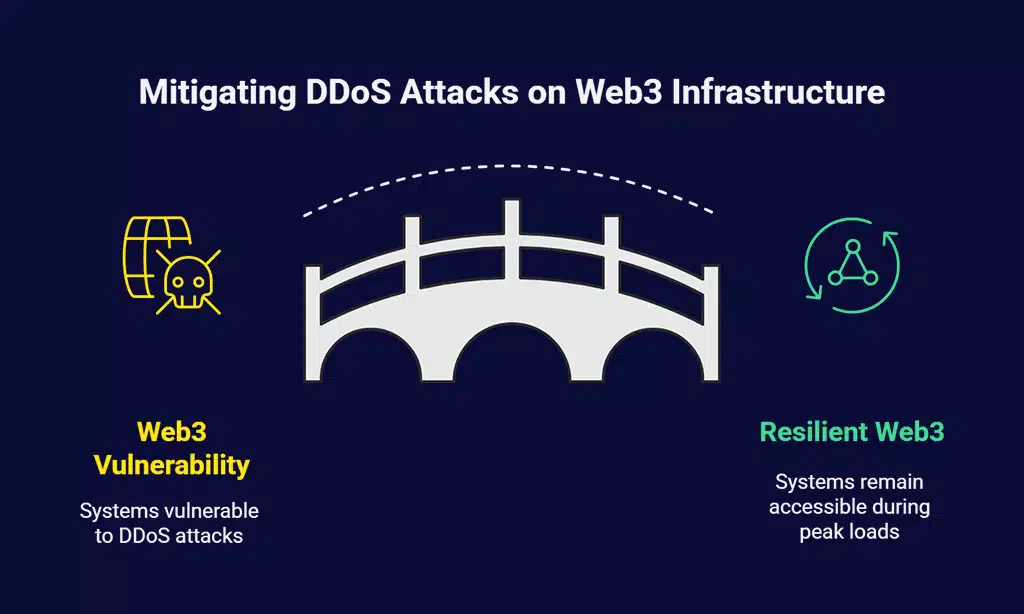
Folks, let’s discuss a hidden threat in the Web3 space: DDoS attacks, or denial of service attacks, striking our infrastructure with force. These assaults aim to overwhelm systems with false traffic, blocking access for genuine users.
Even though they sit at the bottom of the OWASP Smart Contract Top 10 for 2025, they can still disrupt your operations. Envision a highway clogged with cars that have no destination; that’s the impact these attacks have on blockchain networks.
Now, imagine this turmoil during a major transaction surge. A reliable solution is to adopt a modular structure and distribute backups across various cloud providers. Learn from a Layer 2 solution that managed 1 million new users in a single week, thanks to its effective design.
Routine stress tests also prepare you for those intense peak periods. So, stay vigilant with Web3 security, and counter those denial of service (DoS) threats with strategic preparation.
Malware and Ransomware in Blockchain Networks
Hey there, readers, let’s chat about a sneaky danger in the Web3 space, malware and ransomware hitting blockchain networks. These nasty programs can slip into your system like a thief in the night.
They lock up your data or steal your private keys faster than you can blink. Once they’re in, they might demand payment to free your info, often in crypto. It’s like a digital hostage situation, and it hits hard in decentralized finance (DeFi) where money moves quick.
This threat isn’t just a small bump; it can wipe out wallets if you’re not careful.
Now, think of malware as a wolf in sheep’s clothing, tricking users on blockchain systems. It can hide in fake apps or shady downloads, waiting to pounce. Ransomware, on the other hand, acts like a bully holding your data for ransom.
With poor key management, you’re an easy target for these attacks. Add in weak access control vulnerabilities, and it’s like leaving your front door wide open. Staying safe means using multi-factor authentication (MFA) and keeping backups.
Watch out for odd links or files, especially on platforms tied to blockchain interoperability. Stay sharp, and don’t let these digital pests catch you off guard.
Insider Threats in Decentralized Systems
Insider threats in decentralized systems can hit hard, folks. Think of it as a fox guarding the henhouse, sneaky and dangerous. These risks come from people inside your team who might misuse access or leak sensitive info.
In Web3, where trust is spread across networks, a single bad actor can mess up everything. It’s not just about hacking; it’s about betrayal from within. That’s why building a security-first culture matters so much.
Start with regular staff training on Web3-specific threats like data leaks. Appoint internal security ambassadors to keep everyone alert. Run bug bounty programs to catch issues early.
Take a cue from a DeFi aggregator that slashed phishing attacks by 50% with monthly micro-training. Also, strong anti-malware measures can shield against insider threats in Web3 spaces.
Stay sharp, and keep your team tighter than a drum.
Takeaways
Hey there, let’s wrap this up with a quick chat about Web3 security. Staying ahead of threats in 2025 is like playing whack-a-mole, but you’ve got the hammer now. From smart contracts to cross-chain bridges, keep your eyes peeled for sneaky attacks.
Don’t let those private keys slip through your fingers, okay? Stick with us, and let’s tackle this wild blockchain ride together!
FAQs on Web3 Security Threats
1. What are the big risks with smart contracts in Web3 security for 2025?
Hey, let’s chat about smart contracts, those nifty bits of code on the blockchain. They’re awesome, but logic errors, reentrancy attacks, and unchecked external calls can turn them into a hacker’s playground. Keep an eye out, and don’t skip those smart contract audits, alright?
2. How do flash loans mess with decentralized finance (DeFi)?
Flash loans, oh boy, they’re like borrowing a Ferrari for a quick spin with no collateral. But flash loan attacks and flash-loan exploits can drain funds from DeFi platforms faster than you can blink. Stay sharp to dodge these speedy scams.
3. Why should I worry about phishing attacks in Web3?
Listen up, phishing attacks are like wolves in sheep’s clothing, tricking you into giving up private keys or security keys. They’re a sneaky way to crack your self-sovereign identity (SSI). Guard your info like it’s gold.
4. What’s the deal with oracle manipulation in blockchain security?
Price oracle manipulation is a sly trick, messing with data feeds to twist market prices on a decentralized exchange. It’s a real headache for DeFi folks. A chief information security officer (CISO) might lose sleep over this one, so watch those data sources.
5. How do denial of service (DoS) attacks hit Web3 systems?
Denial of service (DoS) attacks are like clogging a highway, stopping traffic cold on blockchain networks. They exploit gas limit vulnerabilities or timestamp dependence to stall everything. It’s a pain for business continuity, so beef up that security architecture.
6. Can zero-knowledge proofs help with Web3 safety?
Absolutely, zero-knowledge proofs (ZKPs) are like a secret handshake, proving stuff without spilling the beans. They boost identity and access management while keeping end-to-end encryption tight. For regulatory compliance and governance, risk, and compliance (GRC), they’re a solid tool against points of failure.