Have you ever watched a strong candidate sit in limbo while someone chases a registrar, a licensing board, or a PDF attachment? That delay is exactly why verifiable credentials are getting so much attention in hiring.
A digital credential turns proof of education, licensing, or skill into something an employer can verify fast, without trusting a screenshot or a forwarded file. Done well, it cuts fraud, reduces paperwork, and gives candidates a smoother path from application to offer.
I am going to walk you through how employers verify digital credentials, what the technology actually checks, where blockchain helps, and where it is just extra complexity.
What Are Verifiable Credentials?
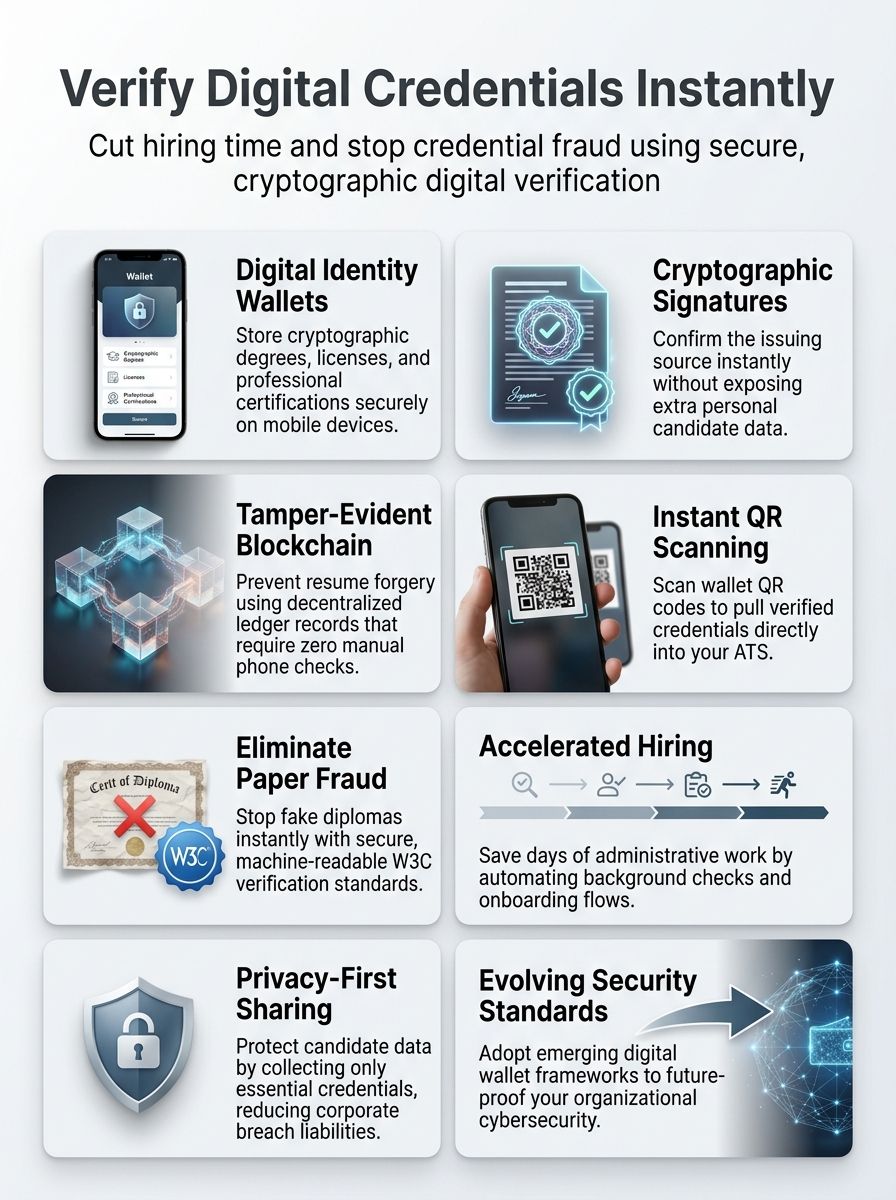
A verifiable credential is a digital record that carries claims about a person, such as a diploma, license, badge, or work authorization, plus the proof needed to check that the claim came from the real issuer and has not been altered.
NIST describes verifiable digital credentials as cryptographically verifiable digital representations of credentials or attributes that are secured in a digital wallet. The World Wide Web Consortium frames them the same way: machine-readable, privacy-respecting, and built for cryptographic verification.
What matters for employers is simple. A digital credential is not just a prettier certificate, it is a package of data, metadata, and proof that a verifier can test.
Types of Digital Credentials
When I explain the digital credential ecosystem to hiring teams, I start with the formats they are most likely to see first. In the U.S., these usually fall into a few practical buckets.
- Digital diplomas and degree records: Colleges and universities issue these to prove completion of a program. They work best when the record includes the issuer name, issue date, credential type, and a live verification method instead of a flat PDF.
- Open Badges and microcredentials: 1EdTech says each OpenBadgeCredential is digitally signed by the issuing organization and compatible with the Verifiable Credentials Data Model. That makes badges useful for skill-based hiring because employers can inspect the skill, criteria, and evidence behind the badge.
- Comprehensive Learner Records: A CLR bundles many achievements into one secure record. For employers, that means fewer separate files to review when a candidate wants to show coursework, certifications, and workplace training together.
- Mobile driver’s licenses and state IDs: These are digital representations of government-issued ID stored in a wallet app. They are especially useful for identity verification, age checks, and regulated onboarding steps.
- Professional licenses and workforce certifications: These prove a candidate can legally perform a role, which matters in health care, finance, education, and other regulated fields.
- Employee and contractor IDs: Organizations can issue these for workforce access, internal role verification, and passwordless or low-friction access control.
Examples of Digital Credentials
A good example is a mobile driver’s license in a wallet app. ABI Research projected the U.S. install base would grow from 21.73 million mobile driver’s licenses in 2025 to 143 million by 2030, which tells me employers should treat wallet-based identity checks as a real adoption trend, not a side experiment.
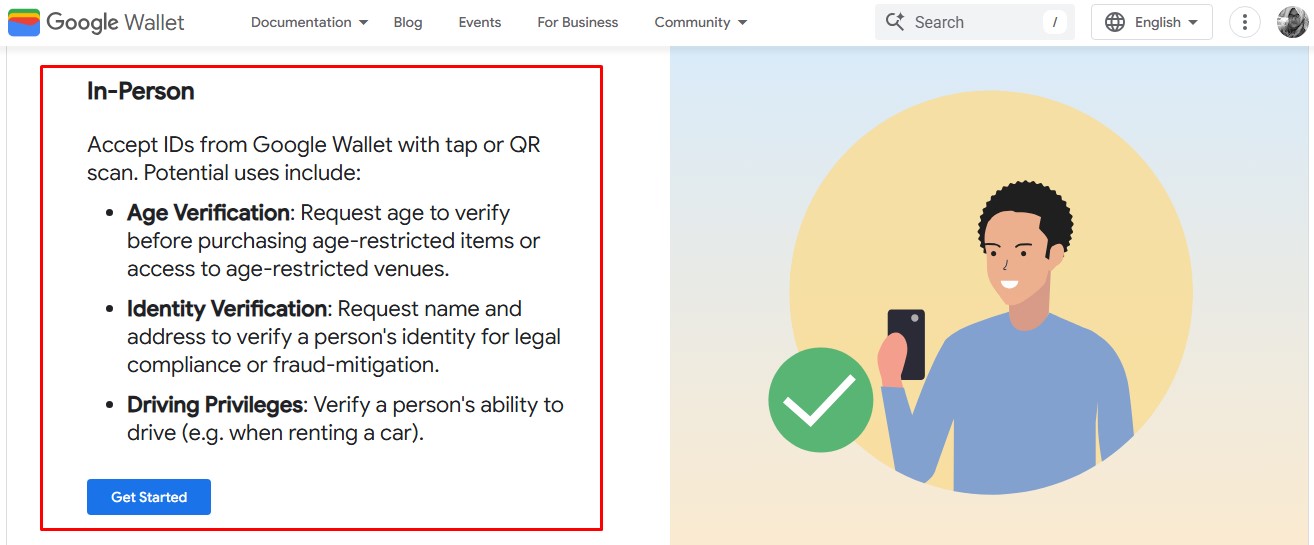
In 2026, Apple says IDs in Wallet can be presented at eligible U.S. airport TSA checkpoints in participating locations, while Google says IDs in Google Wallet are cryptographically signed and can be verified by a business after a tap or QR scan. That same pattern, issuer-backed data plus user consent, is what makes hiring use cases practical.
| Credential example | What an employer can verify | Why it helps |
| University diploma | Issuer, degree type, date, and status | Reduces fake diploma risk and speeds education checks |
| Skill badge | Specific competency, criteria, and evidence | Makes skills-based hiring easier than reading vague resume claims |
| Mobile driver’s license | Name, age status, or driving privilege data | Supports identity verification with less manual document handling |
| Professional license | License number, issuer, expiration, and current standing | Helps regulated employers avoid onboarding someone with lapsed authority |
I like these examples because they show the real shift. The employer is no longer judging whether a document looks official, the employer is checking whether the proof behind it passes.
How Employers Verify Digital Credentials
The verification flow usually has four parts: receive the credential, confirm the issuer, validate the cryptographic proof, and decide whether the claims satisfy the employer’s business rules.
That last part matters more than people think. A credential can be technically valid and still fail the hiring check if it is expired, issued by the wrong authority, or missing the exact field the employer needs.
Cryptographic Verification Methods
The best verification flow does not ask, “Does this file look real?” It asks, “Can I prove who issued it, whether it changed, and whether it is still valid?”
At the core is public-key cryptography. The issuer signs the credential with a private key, and the verifier checks that signature with the issuer’s public key.
NIST makes a useful distinction here: the verifier performs the technical check, while the relying party, such as the employer or bank, makes the decision based on that result. In hiring, that means HR, an applicant tracking system, or a background screening partner can rely on the output without storing every original document.
- Issuer check: Confirm the credential came from the right school, board, state agency, or training provider.
- Integrity check: Validate the digital signature so any tampering shows up immediately.
- Status check: Make sure the credential is not expired, suspended, or revoked.
- Holder check: Match the credential to the applicant through normal identity verification steps, which may include a selfie, biometric unlock, or a second government-issued ID.
W3C’s status list work matters here because a clean signature alone is not enough. A verifier also needs a reliable way to learn whether a once-valid credential has later been revoked or suspended.
Use of Blockchain Technology
Blockchain can help, but I would not treat it as a requirement for every digital credential program. Many employers hear “verifiable” and assume “blockchain,” yet plenty of strong implementations rely on signed credentials, hosted verification, or registry-based trust without putting every record on a chain.
That is also how 1EdTech approaches it in procurement guidance for learner records: platforms may use digital signatures, hosted verification, or blockchain verification. In other words, blockchain is one design choice, not the whole category.
| When blockchain helps | When it may be extra work |
| Multiple parties need a shared, tamper-evident audit trail | A single trusted issuer already runs a reliable verification service |
| You need independent proof of record history across organizations | The credential changes often and corrections are common |
| You want vendor-independent long-term verification | You need easy deletion or strict minimization of stored personal data |
The tradeoff is important. NIST has pointed out that immutable ledger designs can complicate deletion and update requirements, so I would keep sensitive HR data off-chain unless there is a strong reason to do otherwise.
Integration with Digital Wallets
Digital wallets are what make verifiable credentials usable in everyday hiring. They store the credential, let the holder review what is being requested, and send only the approved data to the verifier.
Apple says Wallet requires Face ID or Touch ID before a person presents an ID, and it states that the ID data are encrypted and that neither Apple nor the issuing authority can see when and where the ID is used. Google says IDs in Google Wallet use the ISO standard behind mobile driver’s licenses and can be presented with NFC, QR, and Bluetooth-based exchanges.
- Less oversharing: The holder can share only the fields needed for the check, such as age over 21 or license status.
- Better user control: The candidate sees the request before approving it.
- Cleaner mobile flow: A wallet is easier to use than digging through email for an old attachment.
- More interoperability: OpenID for Verifiable Credential Issuance 1.0 and OpenID for Verifiable Presentations 1.0 both went final in 2025, which is a strong sign that cross-platform credential exchange is maturing.
For employers, the practical move is to support wallets that follow open standards. That gives your verifier a better chance of working across issuers, phones, and platforms as the market grows.
Benefits of Verifying Digital Credentials for Employers
The biggest upside is trust with less friction. You verify faster, keep less unnecessary personal data, and make it easier for good candidates to move through the funnel.
Ensuring Authenticity and Accuracy
Paper credentials and PDFs are easy to copy, crop, and edit. A strong digital credential makes the source, issuance date, and verification status visible in a way software can check.
That is why I always tell teams to inspect the metadata, not just the artwork. A polished badge image means very little if the underlying record does not show who issued it, what standards were met, and whether the proof still checks out.
- Look for issuer identity: The school, board, or provider should be explicit, not implied by a logo.
- Check issue and expiration dates: This matters for licenses, safety training, and time-limited certifications.
- Review criteria and evidence: Open Badges 3.0 can include criteria, linked skill frameworks, and evidence of work, which gives hiring managers more than a simple pass or fail.
- Use trusted verification services when available: The National Student Clearinghouse says it offers immediate online degree and attendance verifications with 24/7 availability, which is much better than chasing manual registrar responses.
That mix of authenticity plus context is what turns a digital credential into a useful hiring signal.
Streamlining Hiring Processes
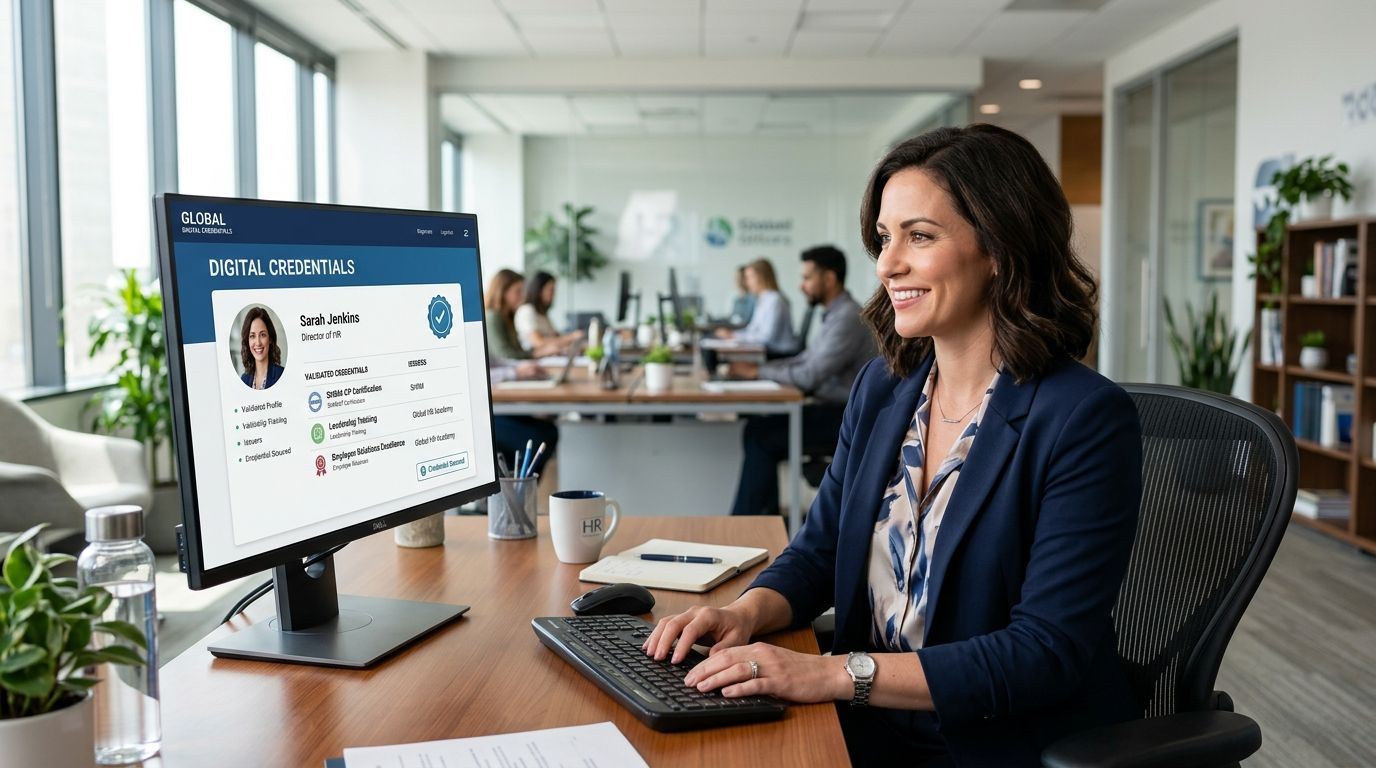
Speed is where employers feel the value first. If the credential arrives in a machine-readable format and your verifier can read it, the hiring team stops losing hours to one-off document checks.
In a 2025 employer survey by Accredible, 60% said integration with ATS or hiring platforms would make digital credentials easier to use or trust. I read that as a clear operations lesson: verification should happen inside the workflow recruiters already use.
| Manual process | Digital verification process |
| Resume claim plus uploaded PDF | Credential presented from wallet or verification page |
| Email or phone follow-up with issuer | Cryptographic or service-based verification in seconds |
| Broad document collection | Selective disclosure of only needed fields |
| Higher fraud review burden | Clear fail or pass signal for issuer, integrity, and status |
I have found that the smartest first use case is narrow. Start with one high-friction check, such as degree verification for campus hires or license verification for regulated roles, then expand once the ATS and compliance teams trust the flow.
Challenges in Verifying Digital Credentials
There are still real hurdles. The technology can be strong, yet the process can still fail if HR asks for too much data, uses the wrong legal sequence, or plugs the verifier into old systems badly.
NIST also noted in June 2026 that online mDL presentation still carries complexity because the ecosystem has had more than one presentation protocol. That means employers should expect some integration work, especially if they want broad wallet support.
- Privacy design: Verification should collect the minimum data needed. If you only need proof of age, license validity, or degree completion, do not ask for a full document dump.
- Revocation and freshness: A valid signature from last year is not enough if the credential is now expired or revoked. Verifiers need current keys, status data, and issuer metadata.
- Legal workflow: The FTC says employers generally need written permission before obtaining a background report from a reporting company. If a third party is doing part of your verification, the paperwork still matters.
- Fair hiring rules: The EEOC says background checks cannot be used in a way that denies equal employment opportunity on a protected basis. A cleaner technical system does not erase discrimination risk.
- Employment eligibility timing: E-Verify rules matter too. Employers cannot use E-Verify before a candidate accepts a job offer, and E-Verify does not replace Form I-9.
The common mistake is trying to solve everything at once. I would rather see an employer launch one trustworthy, privacy-aware verification flow than build a huge credential project that no recruiter actually uses.
Wrapping Up
I keep coming back to the same point: a digital credential is most valuable when it gives employers fast proof without forcing candidates to expose more personal information than necessary.
That is why I have been watching NIST’s NCCoE work closely. Its April 28, 2026 post on credential issuance and June 30, 2026 post on credential presentment show that the standards and operating models are getting much clearer for real employers, not just identity specialists.
If hiring teams want less fraud, better cybersecurity, and faster verification, verifiable credentials are no longer a future idea. They are becoming a practical part of how digital identities move through hiring.
Frequently Asked Questions on Verify Digital Credentials
1. How do employers verify digital credentials and skills?
Employers check digital credentials, like certificates and digital badges, they click verifiable links, and they spot-check training platforms or distributed ledger records. Then they test skills with short tasks, interviews, or reference calls, to cut through the fluff.
2. Can online certificates and badges be trusted?
Yes, when they come from known issuers, and when links or IDs let employers verify them, they carry weight. Some firms still run a quick live task, just to be safe.
3. How do employers test claimed skills?
They use skill assessments, timed tasks, and take-home projects, to see real work. They scan online portfolios, view code samples or demo videos, and call references, like a detective following a trail.
4. What should job seekers do to make verification easy?
Share direct links to verified digital credentials, list course IDs, and keep your professional profile current. Offer a short skills demo, and have portfolio files ready, so hiring teams can move fast.