In 2026, the “perfect” aesthetic that defined digital advertising for a decade is officially dead. It has been replaced by the “Lo-Fi” revolution, a seismic shift where brands are aggressively dumping traditional modeling contracts in favor of UGC Creators.
The data is clear: consumers no longer trust polished perfection. They trust “regular people.” As a result, marketing budgets are moving away from studio productions and toward authentic, user-generated content that drives actual sales rather than just vanity metrics. This analysis explores the economics, psychology, and future of the battle between UGC Creators vs Models.
The $200,000 iPhone Video: A Case Study in Authenticity
To understand this shift, look at a recent trend in the beauty industry. In early 2024, a major skincare brand scrapped a $50,000 studio campaign featuring a flawless, airbrushed supermodel. The ads were failing to convert; users were scrolling past them, their brains filtering the high-end visuals as “noise.”
In a last-ditch effort, the brand hired a college student to film a review in her messy dorm room using an iPhone 15. The lighting was imperfect, the background was cluttered, and she stumbled over her words. That single video generated $200,000 in sales in 48 hours.
This phenomenon is driven by “Ad Fatigue.” According to 2026 data, the human brain now instinctively skips high-production commercials. Conversely, content that mimics a friend’s social media update, shot with shaky hands and natural light, signals “safety” and “entertainment,” resulting in a 4x higher Click-Through Rate (CTR).
The “Ad Fatigue” Crisis: Why Perfection is Failing
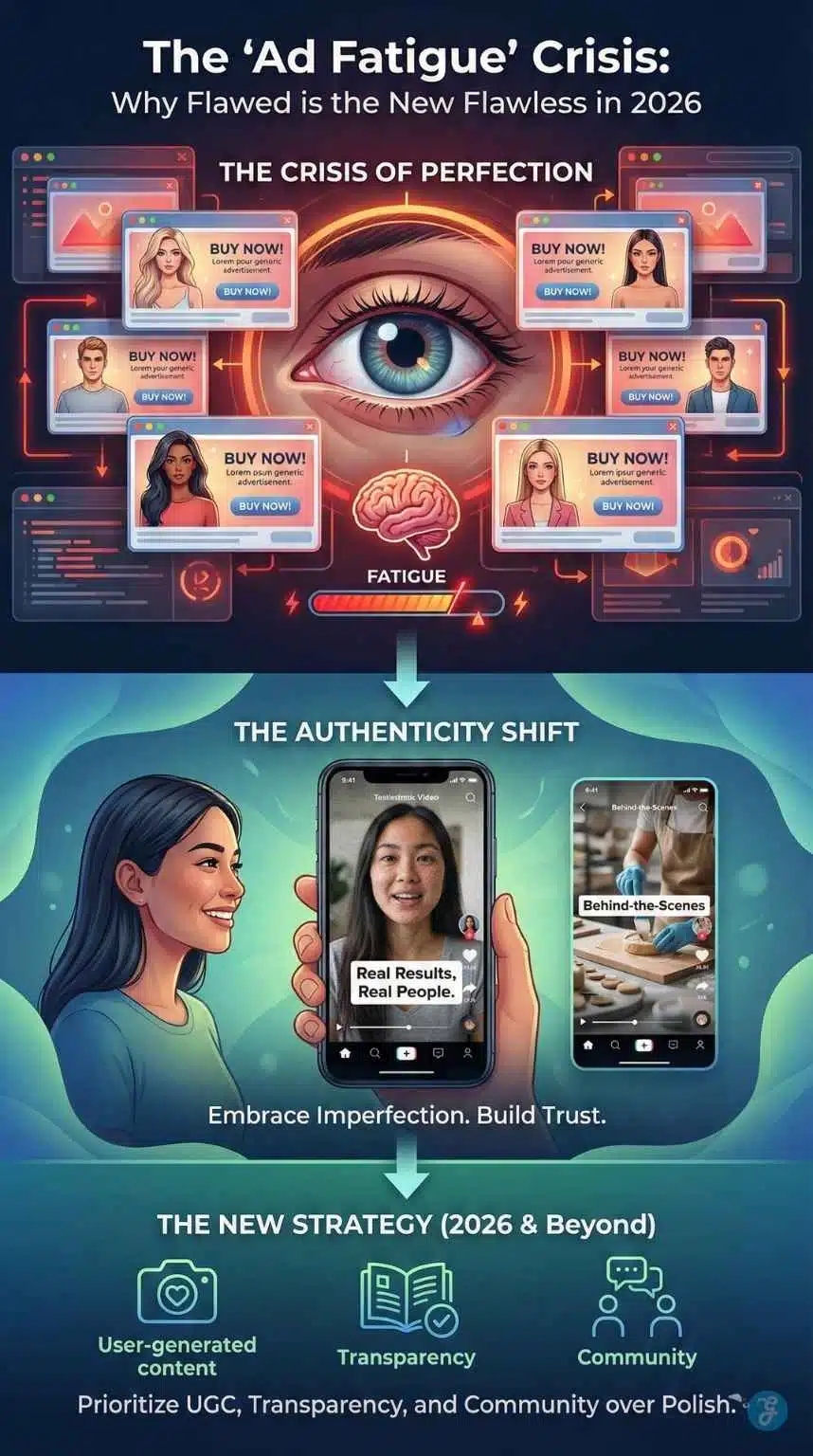
To understand why brands are paying “regular people,” we first have to understand the neurological crisis facing advertisers: Banner Blindness and Ad Fatigue.
For decades, the advertising formula was simple: Aspiration sells. Show the consumer a life they can’t have (perfect body, perfect house, perfect lighting), and they will buy the product to get a piece of that dream. But by 2025, a cultural shift occurred. Gen Z and Alpha consumers, raised in a digital environment saturated with filters and Facetune, began to view “perfection” not as aspirational, but as deceptive.
The Science of the “Skip” Button
According to 2026 data from House of Marketers, the human brain now processes high-production commercials as “noise.” When a user sees a video shot on a RED cinema camera with three-point lighting, their thumb instinctively swipes up before the first second is over. It signals “someone is trying to sell me something.”
Conversely, Lo-Fi content (Low Fidelity) acts as a “pattern interrupt.” When a video looks grainy, has natural lighting, or features a “regular” face, the brain categorizes it as entertainment or a social update. It signals “this is safe; this is a peer.”
- The Statistic: Ads that mimic organic, lo-fi user posts currently see a 4x higher Click-Through Rate (CTR) compared to high-fidelity brand assets.
- The Trust Gap: 84% of consumers state they trust a recommendation from a stranger on TikTok more than a branded advertisement.
UGC Creators vs. Influencers: The Business Model Shift
It is critical to distinguish UGC Creators from Influencers. While they both use social media, their economic models are opposites. Confusion between these two terms is the #1 reason brands waste money in 2026.
The Influencer: Selling “Eyeballs”
An influencer is paid for their audience. A brand pays Kim Kardashian not because she is a great videographer, but because she has millions of followers. The influencer posts the content to their feed.
The Problem: Influencers are expensive, protective of their “grid aesthetic,” and their engagement rates are plummeting (macro-influencer engagement is down to 1.2% in 2026).
The UGC Creator: Selling “Assets”
A UGC Creator is paid for their content. They are essentially freelance videographers and actors combined. They create the video, edit it, and send the raw file to the brand. The creator never posts it. The brand uses the video as a paid ad (Dark Post) on their own channels.
The Advantage: The creator’s follower count is irrelevant. They could have zero followers. All that matters is their ability to make a video that looks like a convincing personal recommendation.
| Feature | Traditional Influencer | UGC Creator |
| Primary Asset | The Audience (Reach) | The Content (Video File) |
| Posting Location | Influencer’s Personal Feed | Brand’s Ad Account (Dark Post) |
| Follower Count | Essential (10k – 1M+) | Irrelevant (0 – 5k) |
| Cost Basis | CPM (Cost Per Thousand Views) | Flat Fee (Per Video) |
| Goal | Brand Awareness / Clout | Conversion / Sales / ROAS |
| Ownership | An influencer usually retains rights | Brand owns 100% (Work for Hire) |
The Economics: Models vs. Creators [Financial Deep Dive]
Why are CFOs loving the shift to UGC? The math is undeniable. In 2026, 74% of brands have reallocated budget from traditional production to creator programs because of the sheer efficiency of the spend.
Let’s look at a hypothetical comparison for a fashion brand launching a new sneaker line.
Scenario A: The Traditional Model Shoot
To get “professional” assets, the brand needs a full production ecosystem.
- Model Agency Fee: $2,500/day (Day rate + agency cut)
- Photographer/Videographer: $3,000/day
- Studio Rental & Lighting: $1,500/day
- Hair & Makeup Artist: $800/day
- Retouching/Editing: $1,000
- Licensing Usage Rights: $5,000 (To use the model’s face for 1 year)
- TOTAL COST: ~$13,800 for perhaps 10 usable photos and one polished 15-second video.
Scenario B: The UGC Bundle
The brand hires 5 different “regular people” UGC creators found on a marketplace.
- Creator Fees: $250 per video x 5 creators = $1,250
- Product Cost: $100 per pair of shoes x 5 = $500
- Shipping: $100
- Usage Rights: Included in the fee (Perpetual digital rights).
- TOTAL COST: ~$1,850 for 5 distinct videos, 5 different body types, and 5 different environments.
The ROI Winner
Not only is the UGC option 86% cheaper upfront, but it also provides more data. With 5 different videos, the brand can A/B test which “hook” works best. Does the audience prefer the “unboxing” angle or the “trying it on” angle? Scenario A only gave them one angle.
2026 ROI Benchmark: For every $1 spent on UGC creation, brands are seeing an average return of $5.78 in revenue.
The Psychology of “Social Proof” in 2026
The shift to UGC is not just economic; it is psychological. It taps into the deepest driver of human behavior: Social Proof.
Relatability vs. Aspiration
For 50 years, marketing was based on “Aspiration.” Buy this perfume, and you will become the goddess in the commercial. But in a post-pandemic world riddled with economic anxiety, aspiration feels tone-deaf. Consumers don’t want to see a size 0 model in a mansion; they want to see how the jeans fit on a size 12 body in a messy bedroom.
This is the “Peer Review Effect.” When a UGC creator speaks to the camera, they mimic the body language of a friend FaceTiming you. They hold the product close to the lens. They use imperfect grammar (“Um, so I literally just bought this…”). These cues bypass the brain’s skepticism filters.
Diversity at Scale
Traditional modeling was notoriously exclusive. UGC solves this instantly. A beauty brand can hire a 20-year-old creator, a 50-year-old creator, a creator with acne, and a creator with vitiligo, all for less than the cost of one traditional shoot. This allows the brand to run targeted ads: the 50-year-old’s video is shown to women aged 45-60, while the 20-year-old’s video is targeted to Gen Z. The “Regular Person” allows for hyper-personalized marketing that a single supermodel cannot provide.
Where This is Happening: The Platform Breakdown
The rise of UGC is dictated by the algorithms of the “Big Four” platforms. In 2026, these platforms have tweaked their code to actively penalize content that looks too “commercial.”
1. TikTok & TikTok Shop
TikTok remains the epicenter of the UGC economy. The “For You” page (FYP) is merciless to polished ads. The platform’s integration with TikTok Shop has turned UGC creators into direct sales engines. A creator can now tag the product directly in the video, allowing for a frictionless “See Video -> Click -> Buy” journey.
2. Instagram Reels
While Instagram used to be the home of the aesthetic, Reels has largely copied TikTok’s preference for lo-fi content. However, Instagram UGC tends to be slightly more “styled” than TikTok. It’s “aspirational reality”, a clean apartment, but still a real apartment.
3. YouTube Shorts
YouTube Shorts has seen massive growth in 2025-2026 for product reviews. Because YouTube is a search engine (owned by Google), UGC here has a longer shelf life. A review titled “Honest review of X vacuum” can generate sales for years, unlike a TikTok, which dies in 48 hours.
4. Amazon Inspire
Amazon has fully entered the social commerce game with “Inspire,” a TikTok-like feed inside the Amazon app. Brands are hiring UGC creators specifically to flood this feed with vertical video reviews, knowing that customers watching these are already in a “buying mindset.”
How Brands Are “Faking” It: The Rise of Manufactured Authenticity
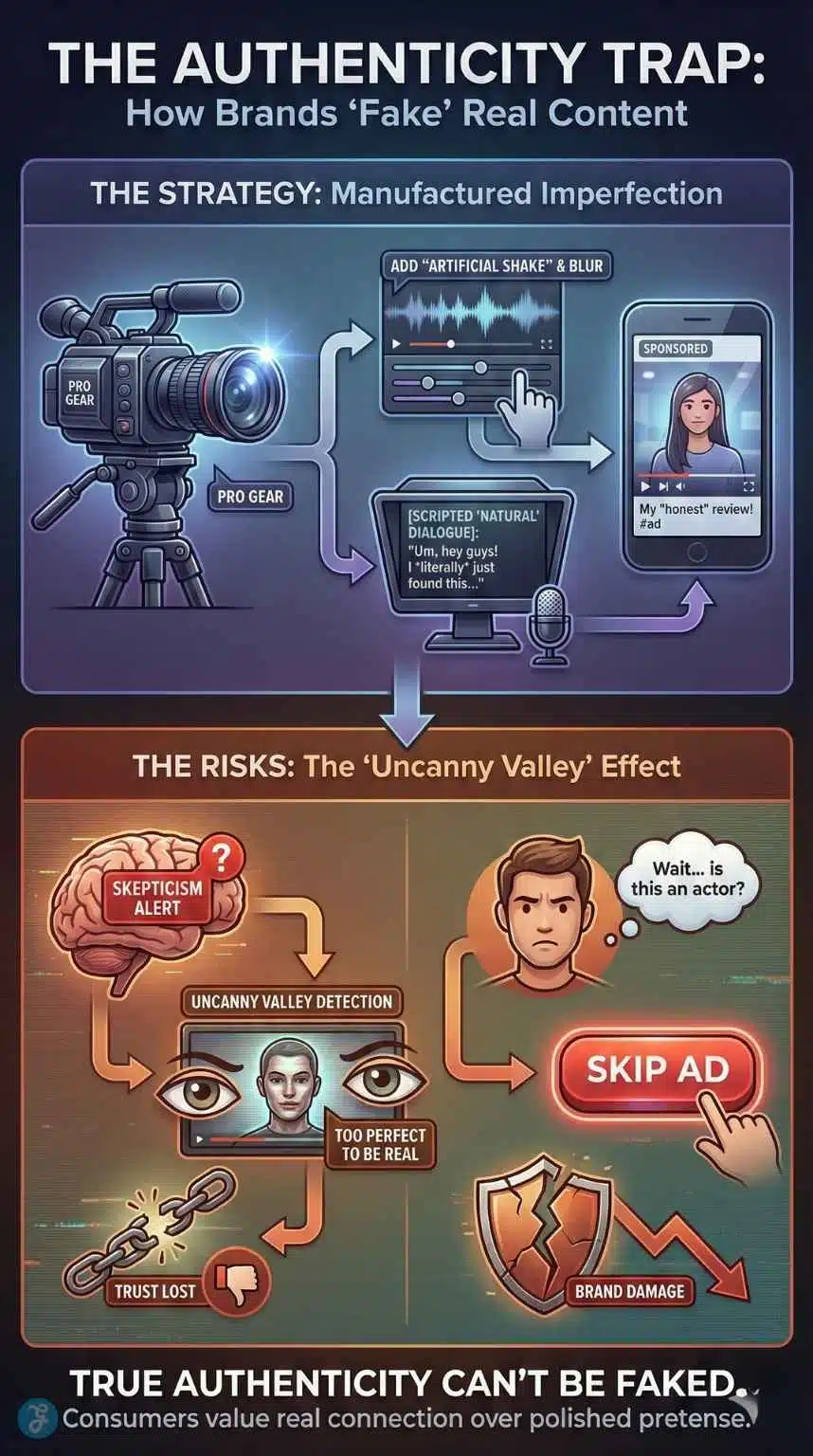
A fascinating (and controversial) trend in 2026 is the “Fake UGC” phenomenon.
Big legacy brands, think Nike, Sephora, and Ford, are realizing that their millions of dollars in production budget are actually hurting them. So, they are hiring professional production crews to pretend to be amateurs.
The Technique: They use high-end cameras but add “camera shake” in post-production. They intentionally mess up the audio slightly. They cast actors to look like “average neighbors.”
The “Uncanny Valley” Risk
Consumers are getting smarter. There is now an “Uncanny Valley” of advertising, videos that try so hard to look like real UGC that they feel creepy or manipulative. Audiences can spot a “fake” influencer voice (the “Hey guys!” intro) from a mile away.
The most successful brands in 2026 aren’t faking it; they are giving up control. They send the product to the creator and say, “Film this, however you want. We won’t edit it.”
How to Become a UGC Creator [A Guide for the “Regular Person”]
If you are reading this and thinking, “I have an iPhone, I can do this,” you are right. The barrier to entry is lower than ever, but the skill gap is widening. You do not need followers, but you do need Direct Response (DR) marketing skills.
1. No Followers Needed [The Portfolio Strategy]
Stop trying to grow your Instagram. Instead, build a Portfolio.
- Create 5-10 “Spec Ads” (practice commercials) for brands you already own.
- Film a skincare routine. Film a coffee-pouring video. Film a tech unboxing.
- Host these videos on a simple Canva website or Google Drive folder.
2. Platforms to Join
In 2026, you don’t need to cold email brands (though it helps). You can join “Creator Marketplaces” where brands post jobs:
- Billo: Great for beginners, high volume, lower pay.
- JoinBrands: a reliable platform for image and video assets.
- TikTok Creator Marketplace: The official hub for higher-tier deals.
- Upwork/Fiverr: Surprisingly active for “UGC Actor” gigs.
3. Setting Your Rates [2026 Market Standard]
Don’t undervalue yourself. Even if you have 0 followers, you are saving the brand thousands in production costs.
- Beginner: $150 per video.
- Intermediate: $250 – $350 per video.
- Pro (Proven ROI): $500+ per video + monthly retainers.
Pro Tip: Always charge extra for “Hooks.” Offer the brand one main video, but for an extra $50, give them 3 different beginnings (hooks) so they can test which one stops the scroll.
How Brands Should Hire UGC Talent [A Guide for Marketing Directors]
If you are a brand looking to pivot to UGC, do not treat creators like employees. They are creative partners.
The Briefing Balance
The biggest mistake brands make is over-scripting. If you send a creator a word-for-word script, the result will sound robotic, and you will lose the “authenticity” you paid for.
- Bad Brief: “Say exactly this: ‘I love this serum because it has hyaluronic acid.'”
- Good Brief: “Mention that the serum has hyaluronic acid, but say it in your own words. Show a close-up of the texture. Be high energy.”
The “Whitelisting” Clause
In your contract, ask for Whitelisting (or “Spark Ads” on TikTok). This grants you access to run the ad through the creator’s handle.
- Ad runs from “Sarah’s Life” -> High Trust, High CTR.
- Ad runs from “Brand Official” -> Low Trust, Lower CTR.
Vetting Talent
Don’t look at their follower count. Look at their Lighting and Audio.
- Can they speak clearly?
- Do they understand pacing (cutting out dead air)?
- Is their room messy in a “relatable” way or a “dirty” way? There is a difference.
Future Trends: AI and the Next Phase of UGC
As we look toward late 2026 and 2027, the UGC landscape faces a new challenger: Artificial Intelligence.
AI Avatars vs. Human Connection
Tools like HeyGen and Sora can now generate hyper-realistic AI avatars that look like “regular people” delivering scripts.
- The Threat: Why pay a human $200 when an AI can generate the video for $5?
- The Reality: While AI is good for generic explainer videos, it currently fails at tactile emotion. An AI cannot convincingly show the texture of a moisturizer on skin or the steam rising from a hot coffee. The “human element”, the slight imperfection, the real reaction, is becoming the premium asset.
Live Shopping
The next frontier is Live UGC. Instead of pre-recorded videos, brands are hiring creators to host 2-hour livestreams on TikTok Shop or Amazon Live, answering questions in real-time. This requires a higher skill level (improv, charisma) and pays significantly more.
Long-Form Revival
As “short-form fatigue” sets in, we are seeing a return to 10-minute vlog-style reviews on YouTube. Consumers want depth. They saw the 15-second TikTok, now they want the deep dive before they spend their money.
Final Thoughts: The Democratization of Influence
The rise of the UGC Creator is more than just a marketing trend; it is a democratization of the advertising industry. For a century, the ability to appear in commercials was gatekept by modeling agencies in New York and Paris. Today, a stay-at-home mom in Ohio or a college student in Dhaka can earn a full-time income simply by being themselves and understanding the psychology of the scroll.
For brands, the message is clear: Perfection is the enemy of profit. In 2026, your customers don’t want to be impressed by your budget; they want to be understood by your content. The brands that embrace the messy, unpolished, human reality of UGC are the ones that will win the decade.
“Stop trying to make ads. Start making content that feels like a recommendation from a friend.”