

The “billboard era” of social media is effectively dead. For nearly a decade, the playbook was simple: find a celebrity with millions of followers, pay them an exorbitant fee to hold your product, and watch the impressions roll in. But as we settle into 2026, a harsh reality has set in for brands relying on this Model 1.0 approach. The impressions are still there, but the trust is gone.
Consumers are no longer looking up to idols on pedestals; they are looking sideways to peers, experts, and community leaders. Influencer Marketing 2.0 is the industry’s response to this crisis of credibility. It is a fundamental pivot from “reach-at-all-costs” to “trust-at-scale.” It is no longer about how many eyeballs you can buy, but how many minds you can change. In this new landscape, a dermatologist with 15,000 followers is infinitely more valuable to a skincare brand than a pop star with 15 million.
This article dissects the mechanics of this shift, exploring why micro-niche authority has become the most potent asset in digital marketing and how brands can survive the “Agentic Era” of search and discovery.
The Anatomy of Influencer Marketing 2.0
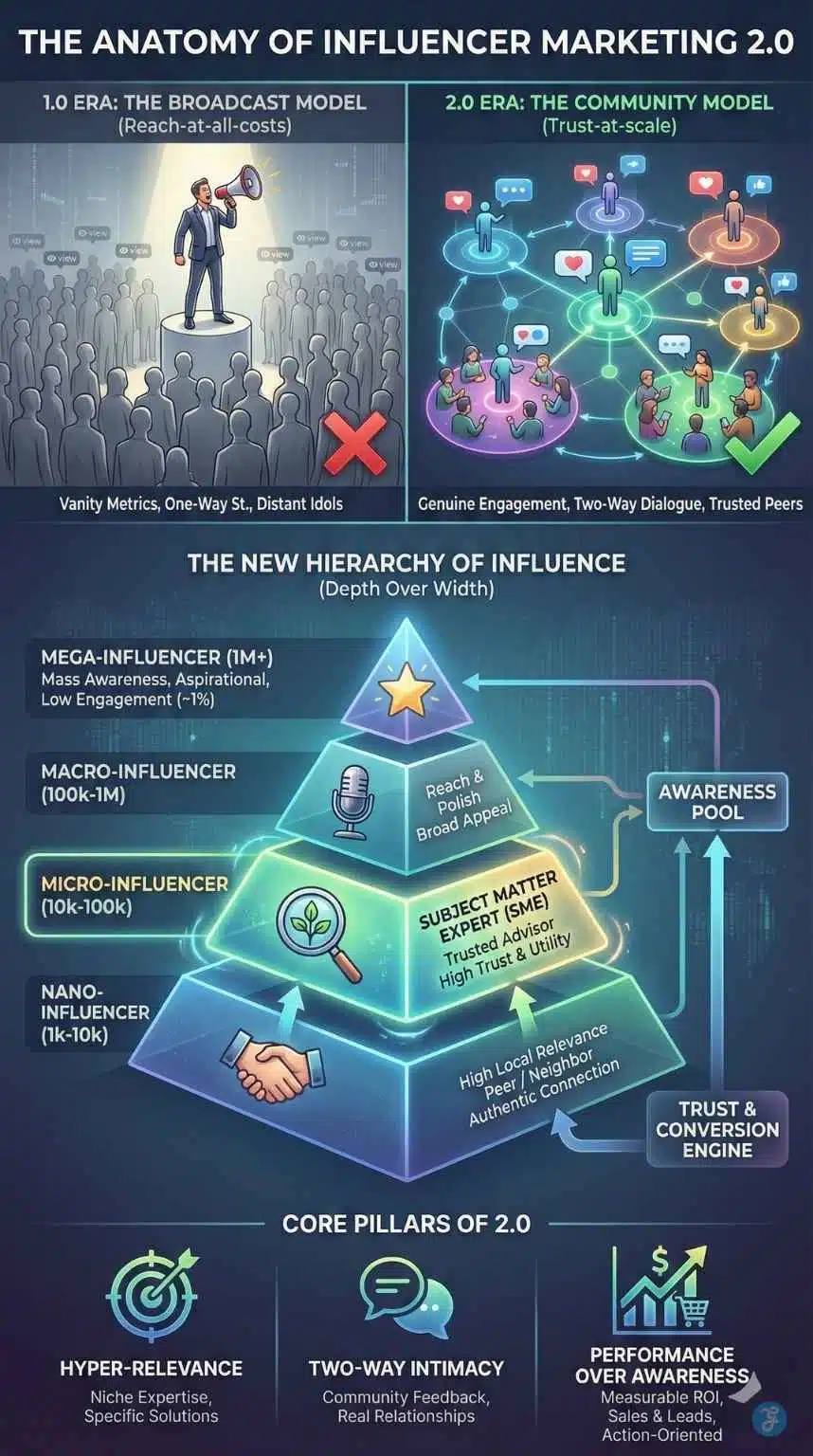
To understand where we are going, we must ruthlessly critique where we have been. Influencer Marketing 1.0 was built on the premise of broadcasting. It was a one-way street where content was pushed down from the top. Influencer Marketing 2.0 is built on community. It is a web of two-way conversations where the creator acts not as a broadcaster, but as a node of trust.
This shift has redefined the hierarchy of influence. In 2026, we categorize creators not just by size, but by the depth of their connection.
The New Hierarchy of Influence
| Influencer Tier | Follower Count | Primary Value | Audience Relationship |
| Nano-Influencer | 1,000 – 10,000 | High Trust & Local Relevance | Peer / Friend / Neighbor |
| Micro-Influencer | 10,000 – 100,000 | Subject Matter Expertise (SME) | Trusted Advisor / Coach |
| Macro-Influencer | 100,000 – 1M | Reach & Polish | Aspirational Figure |
| Mega-Influencer | 1 Million+ | Mass Awareness | Celebrity / Idol (Distant) |
The Nano-Influencer: The “Neighbor” Effect
Nano-influencers are often everyday people, a local barista who reviews coffee beans, or a junior developer sharing coding tips. Their power lies in their lack of polish. When a nano-influencer recommends a product, it doesn’t feel like an ad; it feels like a text message from a friend. In 2026, smart brands are aggregating hundreds of nano-influencers to create a “swarm” effect, generating authentic buzz that money simply cannot buy from a celebrity.
The Micro-Influencer: The Subject Matter Expert (SME)
This is the “sweet spot” of Influencer Marketing 2.0. These creators have grown their following not because of who they are, but because of what they know. They are the “Micro-Niche Authorities.” They might be experts in sustainable gardening, B2B SaaS sales strategies, or gluten-free baking for toddlers. Their audience follows them for education and utility, not just entertainment. When an SME says, “This software works,” their audience listens because their professional reputation is on the line.
The Data: Why Mega-Stars Are Losing Their Shine
The shift to 2.0 isn’t just a philosophical preference; it is a survival strategy dictated by hard data. In late 2024 and throughout 2025, we witnessed the “De-Influencing” movement, where creators went viral by telling their followers what not to buy. This shattered the illusion of the “perfect life” portrayed by mega-influencers and made consumers deeply skeptical of paid endorsements.
The Engagement Gap
Recent benchmarks from Q4 2025 reveal a staggering “Engagement Gap” between the tiers. As follower counts rise, engagement rates plummet.
| Platform | Nano-Influencer Engagement (Avg) | Mega-Influencer Engagement (Avg) |
| TikTok | 10.5% | 2.8% |
| 4.8% | 0.9% | |
| YouTube | 6.2% | 1.5% |
| 5.4% | 0.4% |
Data Source: Synthesized from 2025-2026 Industry Reports
The math is brutal for the old model. If you pay a Mega-Influencer with 1 million followers who has a 0.9% engagement rate, you are effectively reaching 9,000 people who care enough to click or comment. If you split that same budget across 20 Micro-Influencers with 50k followers each (totaling 1 million reach) but with a 5% engagement rate, you are generating 50,000 active engagements. That is a 5x increase in efficiency by simply moving down the funnel.
The Algorithm Factor: Interest Over Graph
Perhaps the biggest driver of Influencer Marketing 2.0 is the change in social algorithms. Platforms like TikTok, Instagram Reels, and even LinkedIn have moved away from the “Social Graph” (showing you content from people you follow) to the “Interest Graph” (showing you content you might like, regardless of who posted it).
This democratizes virality. A video from a creator with 400 followers can get 2 million views if the content provides high “Information Gain” and retention. This means brands no longer need to “rent” the audience of a celebrity; they need to partner with creators who understand how to trigger the algorithm with high-quality, niche-relevant content.
The Psychology of Micro-Niche Authority
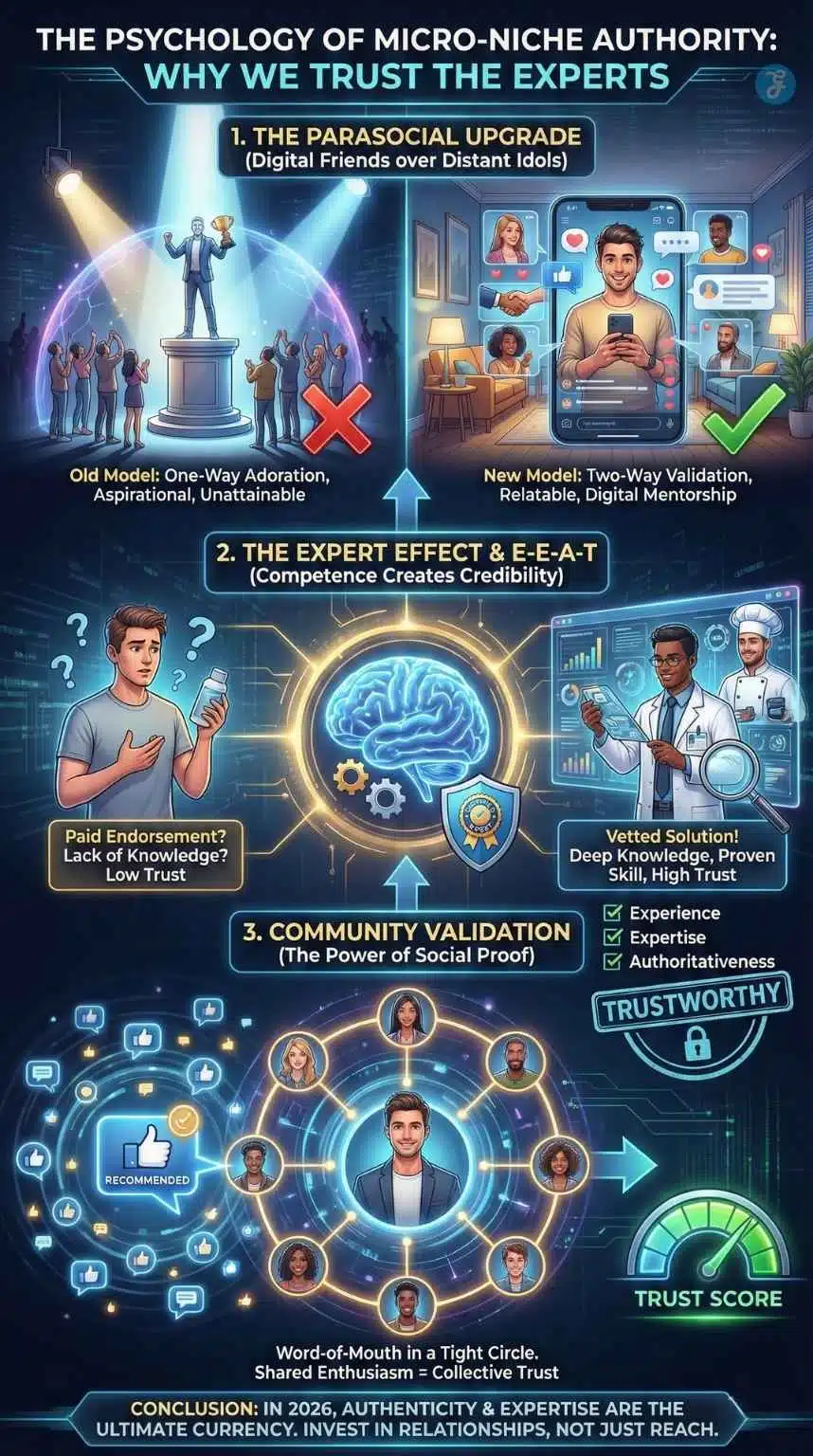
To execute a 2.0 strategy, marketers must understand the psychology of the modern consumer. Why do we trust a stranger on the internet?
In the 1.0 era, parasocial relationships (one-sided relationships with media figures) were based on adoration. We wanted to be them. In the 2.0 era, these relationships are based on validation. We want them to help us. A Micro-Niche Authority functions less like an idol and more like a digital mentor. When a fitness influencer with 30k followers replies to a comment about form correction, they bridge the gap between digital and reality, creating a loyalty loop that is incredibly hard to break.
2. The Expert Effect and “E-E-A-T”
This aligns perfectly with Google’s latest SEO strategy regarding E-E-A-T (Experience, Expertise, Authoritativeness, Trust). Just as Google ranks content higher when it comes from an expert, consumers rank recommendations higher when they come from a verified source.
If a fashion model promotes a protein powder, the consumer thinks, “They were paid to say this.” If a certified nutritionist with a PhD promotes the same powder, breaking down the amino acid profile in a 3-minute video, the consumer thinks, “This is a vetted solution.” In 2026, expertise is the only shortcut to trust.
3. Community Validation
Micro-influencers often cultivate “micro-communities”, Discords, Slack groups, or active comment sections where followers talk to each other. When a brand penetrates this circle, they gain “Social Proof” not just from the influencer but from the community itself. It’s the digital equivalent of a product spreading by word-of-mouth through a tight-knit neighborhood.
Strategic Framework: Building a 2.0 Campaign
You cannot run a 2.0 campaign with a 1.0 mindset. The days of sending a rigid script and a “mood board” are over. Here is the updated framework for success.
Phase 1: Identification [The Vetting Process]
Stop sorting by follower count. Start sorting by “Relevance Score.”
- The Comment Audit: Don’t look at the number of comments; look at the quality. Are people saying “Omg fire emoji” (low value) or are they asking specific questions like “Does this integrate with Notion?” or “How does the fabric feel after a wash?” (high value). High-intent questions are the hallmark of a Micro-Niche Authority.
- The “De-Influencing” Check: Has this creator ever given a negative review? Paradoxically, you want partners who are critical. A creator who loves everything has no credibility. A creator who rips apart bad products will be trusted implicitly when they praise yours.
Phase 2: The “Co-Creation” Contract
The biggest mistake brands make in 2026 is stifling the creator’s voice.
- The “No-Script” Rule: Provide a “Key Message” (e.g., “This battery lasts 24 hours”), but forbid the creator from reading it verbatim. Let them wrap it in their own narrative.
- Format Freedom: If the creator is known for chaotic, fast-paced vlogs, don’t ask for a polished studio shot. If they are known for calm, ASMR-style unboxings, don’t ask for a high-energy skit. You are hiring them for their format; let them use it.
Phase 3: The “Always-On” Approach
Trust takes time. A single sponsored post is often viewed as a “cash grab.” The 2.0 model relies on Ambassadorships.
- The 3-Month Minimum: Contract creators for a minimum of 3 to 6 months.
- The “Seven Touchpoints” Theory: Marketing psychology states a consumer needs ~7 interactions to make a purchase. An ambassador who uses your product in the background of their stories, mentions it in a Q&A, and does a dedicated deep-dive video over the course of a month creates those touchpoints organically.
Platforms & Ecosystems Driving 2.0
Different platforms serve different “Authority” functions in 2026.
TikTok & Social Commerce
TikTok has completed its evolution from a dancing app to a search engine and shopping mall. With the maturity of TikTok Shop, the funnel has collapsed. A micro-influencer can demonstrate a kitchen gadget, and the viewer can purchase it without leaving the app. This “frictionless” commerce rewards creators who can demonstrate utility quickly. The metric here is not “views,” but “saves” and “shares”, signals that the user found the content helpful enough to keep.
LinkedIn: The B2B Goldmine
LinkedIn has seen an explosion of “Thought Leader” influencers. These are CEOs, CTOs, and consultants who write long-form posts. For B2B brands, this is the ultimate 2.0 play. Sponsoring a newsletter from a DevOps expert to reach 5,000 senior engineers is infinitely more effective than running $50,000 of display ads. The trust barrier in B2B is high; peer endorsement vaults over it.
Substack & Newsletters
We cannot ignore the “Quiet Web.” Newsletters are the stronghold of deep niche authority. A creator with 5,000 paid subscribers on Substack has an audience with incredibly high intent. These readers have already voted with their wallets to hear what this person has to say. Sponsorships here feel like personal recommendations, not interruptions.
Measuring Success: The New Metrics of Truth
In the 1.0 era, we reported on “Reach” and “CPM” (Cost Per Mille). In the 2.0 era, those are vanity metrics. We now focus on Sanity Metrics.
The Shift to Performance
- CPA (Cost Per Acquisition): How much did it cost to generate a sale?
- UTM Parameters: Every influencer should have a unique tracking link.
- Whitelisted Ads: This is a hybrid strategy where the brand gains access to the influencer’s ad account to run paid ads as the influencer. This combines the trust of the creator’s handle with the targeting precision of the brand’s ad manager.
Information Gain as a Metric
Google’s 2026 “Helpful Content” system rewards “Information Gain”, content that adds new value rather than regurgitating existing info. We can apply this to influencers.
- Qualitative Analysis: Did the influencer’s content add a new perspective to your product? Did they teach their audience a new way to use it?
- The “Save” Ratio: High “saves” on Instagram or TikTok indicate that the content provided utility and information gain. This is a leading indicator of purchase intent.
Case Studies: Winners and Losers
Let’s look at two hypothetical scenarios that reflect the current market reality.
The Winner: “EcoWare” & The Cleaning Community
A sustainable cleaning brand, EcoWare, decided to skip the celebrity endorsement. Instead, they identified 50 “CleanTok” micro-influencers, mostly stay-at-home parents and professional organizers with 20k-50k followers.
- The Strategy: They sent product bundles with no posting requirements (seeding). Because the product was genuinely good, 60% posted organically. EcoWare then offered paid long-term contracts to the top performers.
- The Content: The influencers showed dirty grout, messy sinks, and real-time cleaning. No studio lights, just results.
- The Result: The campaign generated a 4.5% conversion rate and a ROAS (Return on Ad Spend) of 6:1. The “raw” nature of the content proved the product worked.
The Loser: “TechNova” & The A-List Actor
TechNova launched a new AI wearable and paid a famous A-list actor $2M to wear it in a polished 30-second commercial posted to Instagram.
- The Content: Cinematic, scripted, and beautiful.
- The Result: The video got 10 million views, but the comments were filled with skepticism (“How much were you paid to wear this?”, “Does he even know how to turn it on?”).
- The ROI: Sales were negligible. The audience saw an ad, not an endorsement. The brand paid for reach but failed to buy trust.
Future Outlook: Influencer Marketing 3.0?
As we look toward the latter half of 2026 and beyond, two major forces will shape the next evolution.
AI Agents as Consumers
We are entering the “Agentic Web,” where AI agents will search on behalf of users. An AI agent looking for “the best running shoes for flat feet” will not look at follower counts; it will look for consensus among trusted reviews and deep-dive content. Micro-Niche Authorities who produce detailed, text-rich, and video-rich reviews will be the primary data sources for these AI agents. Optimization for AI (AIO) will become part of the influencer brief.
The Rise of “Brand-Creators”
We are seeing the line blur completely. Influencers are becoming brands (e.g., launching their own competitors), and brands are becoming influencers (hiring in-house creators to be the “face” of the company). The future is a hybrid model where the distinction between “creator” and “company” dissolves.
Final Thoughts: The Trust Dividend
Influencer Marketing 2.0 is not a trend; it is a correction. The digital market became oversaturated with noise, and the human response was to retreat into smaller, trusted circles.
For brands, this is good news. It means you no longer need a Hollywood budget to make an impact. You need patience, you need empathy, and you need to respect the expertise of the creators you hire. When you stop buying “posts” and start investing in “partnerships,” you stop renting attention and start building equity in the most valuable currency on the internet: Trust.
The era of the Mega-Star is fading. Long live the Micro-Niche Authority.






















