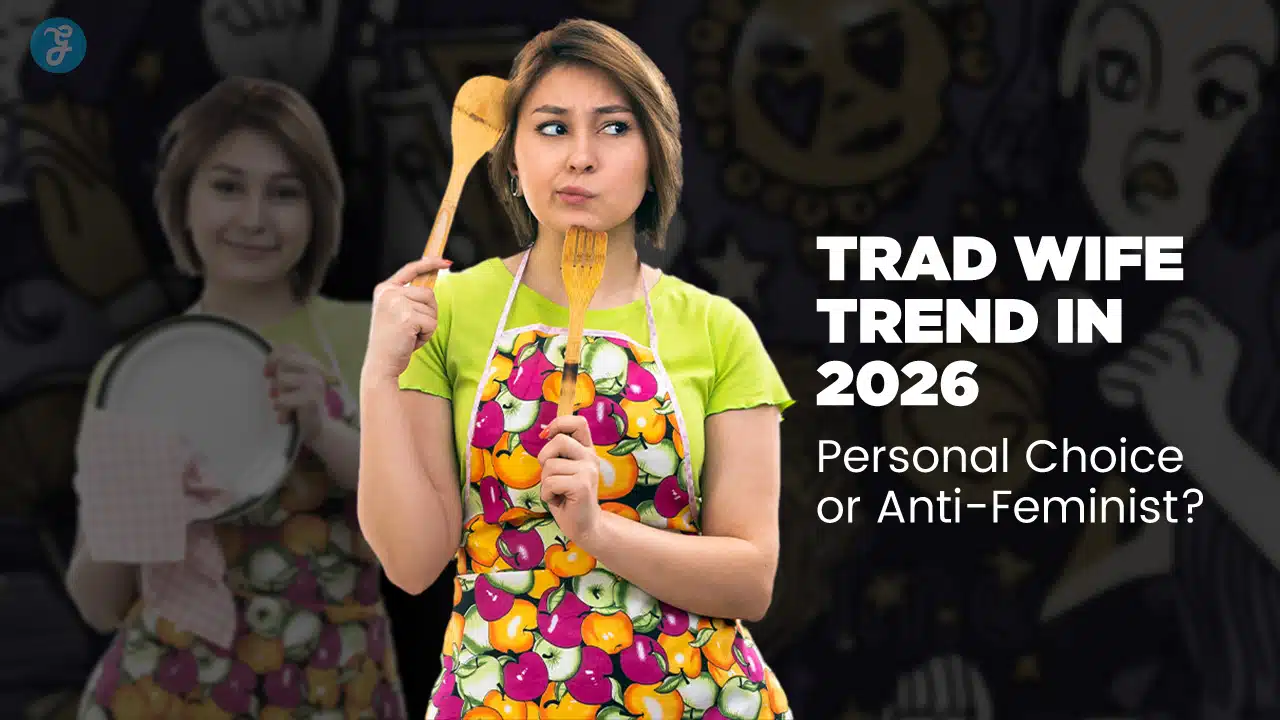
The “Trad wife” movement has been rising in popularity on social media. The movement did not appear overnight. It really took off during the COVID-19 lockdowns and has continued well into 2026. It was when influencers started sharing a lifestyle centred on traditional gender roles. These women often appear conventionally attractive and well-off. They embrace the role of a “traditional wife,” focusing on homemaking and supporting their husbands as the main earners.
Why the Trad Wife Ideal Is Resonating in 2026
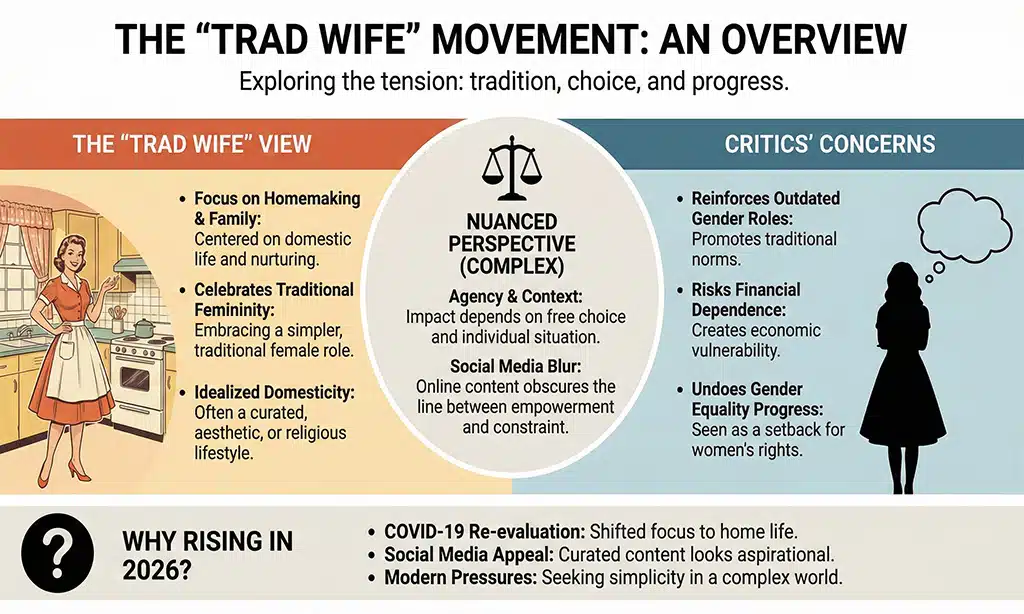
Much of the content idealises domestic life. Women are shown cooking, cleaning, raising children, and taking care of the home. Supporters say it celebrates femininity, domesticity, and a simpler, more traditional way of living.
Critics, however, argue it promotes outdated gender roles. They also warn it reinforces financial dependence on men and could undo decades of progress in gender equality. This tension raises a key question: is the Trad wife movement an old-fashioned, anti-feminist trend, or a personal choice that can be empowering for women? In my view, the answer isn’t simple. It depends on agency, support, and context. What looks empowering for one may feel constraining for another, and social media often blurs that line.
Some “Trad wives” openly link their lifestyle to conservative beliefs. Others focus on the aesthetic like vintage aprons, soft makeup, and a picture-perfect home posing with husbands more often.
But this romanticised image can be misleading. Young women may be drawn to it without seeing the possible limitations or pressures behind the curated posts. It also makes us ask: why is this trend rising in 2026, and what does it mean for women, men, and society as a whole?
In 2026, the appeal of the Trad Wife lifestyle reflects a wider fatigue with instability. Economic uncertainty, career burnout, and the emotional overload of modern life have made structure and predictability feel comforting. On social media, traditional roles are being repackaged as sources of comfort, clarity, and control.
Who Is a Trad Wife?
A “Trad wife” is a term combining the words traditional and wife used to describe a woman, especially on social media, who embraces traditional gender roles, often as a homemaker, caregiver, and supporter of a husband’s career, and promotes that lifestyle online.
Sukanya: Choosing Domesticity, Embracing Submission
Sukanya Joshi (name changed on request) was working at a school in Kolkata. She got married recently and moved to Bengaluru. Homemaking, she says, was always something she felt drawn to. After years of juggling work and responsibilities, she wanted a slower pace and more focus on home and family.
After the move, she decided to stay at home and support her husband in his career. He is a C-suite executive with a multinational company. Her days are now structured around managing the home, planning meals, a little bit of gardening and creating a routine that works for both of them. The shift, she says, has brought a sense of calm she did not feel earlier.
“I feel empowered,” Sukanya says. “I am happy with my husband, and there is a sense of complete fulfillment. I am comfortable being submissive to my husband. This is my decision. My husband is completely supportive and happy with it too.” So for Sukanya, empowerment does not come from a job title, but from choice.
But Sukanya’s experience is not universal. For many women, stepping fully into the homemaker role brings not calm, but constraint. Sukanya’s story shows how voluntary submission can coexist with empowerment. It is a reminder that personal fulfillment doesn’t always match society’s expectations of independence.
Puja: When Homemaking Turned into Loss of Identity
On the other hand Puja Sharma (name changed on request) says she tried hard to fit into what is often described as the ideal homemaker role. “I tried everything to stay as a housewife… or homemaker, as people like to call it now,” she says. “But slowly, I felt I was losing my identity. I was only somebody’s wife and somebody’s mother.”
For Puja, the problem was not domestic work itself, but what came with it. She says she had no financial independence. “My husband would often refuse to give me money when I wanted to buy something,” she recalls. At home, expectations were rigid. Her mother-in-law insisted she focus only on cooking and entertaining guests. “There was no space to be anything else,” Puja says.
The emotional toll was heavy. “There were days I felt like divorcing my husband,” she admits. But walking away was not easy. Social pressure weighed heavily on her decision. “My father kept saying he had invested so much in my marriage,” she says. “It felt like leaving would mean failing everyone.”
Eventually, Puja chose a different path. Against the wishes of her family, she decided to return to work. She joined as a primary school teacher. The change, she says, was not dramatic, but it was necessary. “Going back to work gave me back my sense of self,” she says. “I needed to be more than just a role inside the house.”
For Puja, the idea of fulfilment came not from tradition, but from reclaiming her independence. Puja’s experience shows the risks when choice is constrained by family, finances, or societal pressure. It reveals that empowerment cannot be assumed from appearances or lifestyle alone.
And then there is the male perspective, where ideals often clash with everyday realities.
Marine engineer Arunava Das believes women should be able to work, while also sharing household responsibilities with their partners. He feels men must actively help at home. “I feel guilty,” he says. “My job requires me to sail and travel abroad for long periods. My wife ends up taking care of all the household work, even though she is unwell.”
According to Arunava, his wife did not have much of a choice. “She couldn’t work outside the home because I am away so often,” he explains. “Someone had to look after the house, and that responsibility fell on her.” He says the arrangement was never about belief or ideology, but circumstance. “Because I travel, she had to manage everything on her own,” he adds.
For Arunava, the idea of choice is complicated. While he believes women should be financially independent, he also admits that work patterns like his often leave little room for equal partnerships at home. “It’s not always what you want in theory,” he says. “Sometimes life decides for you.”
Expert Perspective: Choice with a Safety Net
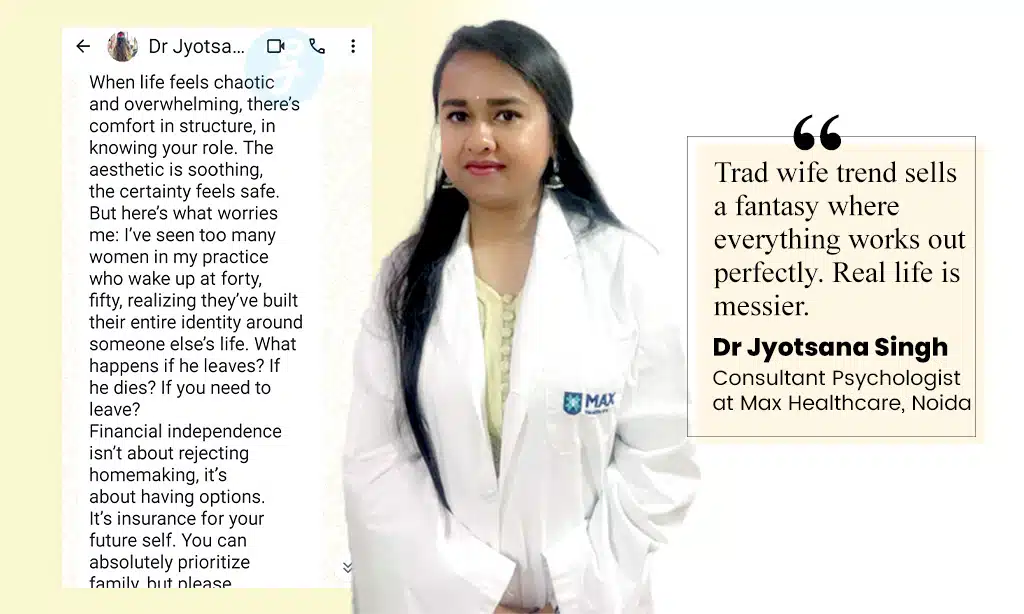
Says Dr Jyotsana Singh, Consultant Psychologist at Max Healthcare, Noida:
“When life feels chaotic and overwhelming, there’s comfort in structure, in knowing your role. The aesthetic is soothing, the certainty feels safe. But here’s what worries me: I have seen too many women in my practice who wake up at forty or fifty, realizing they have built their entire identity around someone else’s life. What happens if he leaves? If he dies? If you need to leave?
Financial independence isn’t about rejecting homemaking; it’s about having options. It’s insurance for your future self. You can absolutely prioritize family, but please don’t make yourself completely vulnerable in the process. Keep your skills current, maintain your own accounts, and stay employable.
The Trad wife trend sells a fantasy where everything works out perfectly. Real life is messier. Marriages end. People change. Economies shift.
Feminism fought so we could choose, and that includes choosing domesticity. But choose it with your eyes open, with a safety net, with your own financial foundation. Don’t trade temporary comfort for long-term security. Your future self will thank you for maintaining some independence, even if it’s less Instagram-worthy.”
Her words underline the key tension: domesticity can be empowering, but only if women retain control and options. Social media, with its curated imagery, can dangerously suggest that there is only one way to ‘do womanhood.’
How Trad Wife Content Can Be Ideologically Charged
Many Trad wife posts start as cute videos about baking or decorating, but at their core some push far stronger ideas. Some influencers don’t just show domestic life, they also promote the belief that women should “submit” to their husbands’ leadership and shouldn’t work outside the home.
Some of this content is rooted in beliefs that see women as inherently less capable than men, a view critics call misogynistic, because it frames independence and economic freedom as less desirable or even unnecessary.
Faith, Values, and the Trad wife Ideal
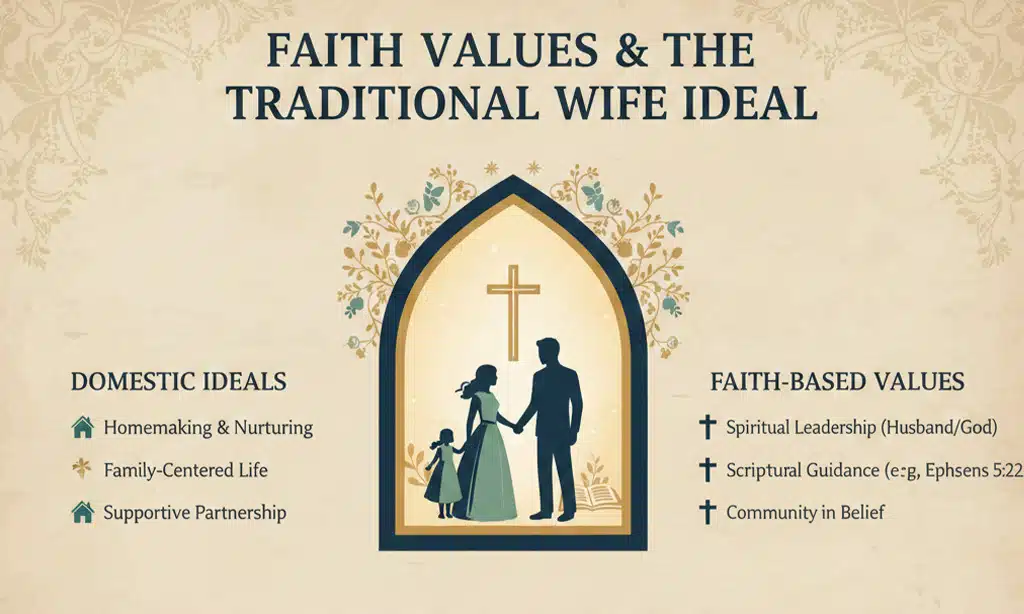
They often combine domestic ideals with faith-based values, pointing to specific verses to argue that a woman’s role is to let both God and her husband lead. This makes some Trad wife spaces feel almost like online parishes, communities built around shared interpretations of belief systems as much as lifestyle.
Soft Aesthetic, Strong Messages
One reason this kind of content travels so far is how calming it feels at first glance. The visuals are soft and nostalgic. Cottage-style kitchens, bread fresh out of the oven, farmhouse tables, balcony gardens. They seem untouched by deadlines or traffic noise. It offers a quiet fantasy of stepping away from a stressful, demanding outside world.
But linger a little longer and the comfort starts to feel more constructed. That cozy look often masks hours of filming, retakes, and careful staging. More importantly, it smooths over deeper messages about gender roles, unpaid labour, and identity. What appears effortless on screen is rarely so in real life, and the cost of maintaining that ideal is almost never part of the picture.
Political and Social Angles
Some influencers weave political views into their content, including opposition to abortion and resistance to debates around gender identity, framing these as consistent with their wider beliefs about women’s roles.
In extreme corners, this can even extend to ideas about family structure and national identity, although this isn’t the whole movement.
Final Thoughts: Choice, Power, and the Line in Between
At the onset of 2026, social media is no longer just shaping trends. It is shaping judgement. The Trad Wife debate has grown louder online, often far more polarised than the real lives behind the reels. What gets lost is context.
Sukanya’s story is one such example. Stepping away from formal work and choosing a more submissive role within her marriage was, in her words, deliberate. It came after burnout, shifting family priorities, and a desire for emotional steadiness. Her submission is not something she hides or resents. She frames it as a choice, and for now, it brings her a sense of stability.
Puja’s experience sits at the other end of the spectrum. Within a similar domestic setup, autonomy slowly narrowed. Financial dependence grew. Identity faded. Her decision to return to work was not driven by ambition or self-actualisation, but by the need to reclaim control over her own life.
Arunava’s reflection complicates the picture further. Even men who believe in equality recognise how traditional arrangements often leave women carrying invisible labour when life circumstances limit real choice.
Placed side by side, these stories resist easy conclusions. They suggest that empowerment is not a look, a role, or a trend. It lies in freedom, consent, and the ability to change course when a choice begins to feel like a trap.
The danger of the Trad Wife trend isn’t in choice itself, but in turning personal preference into a moral template for all women.