

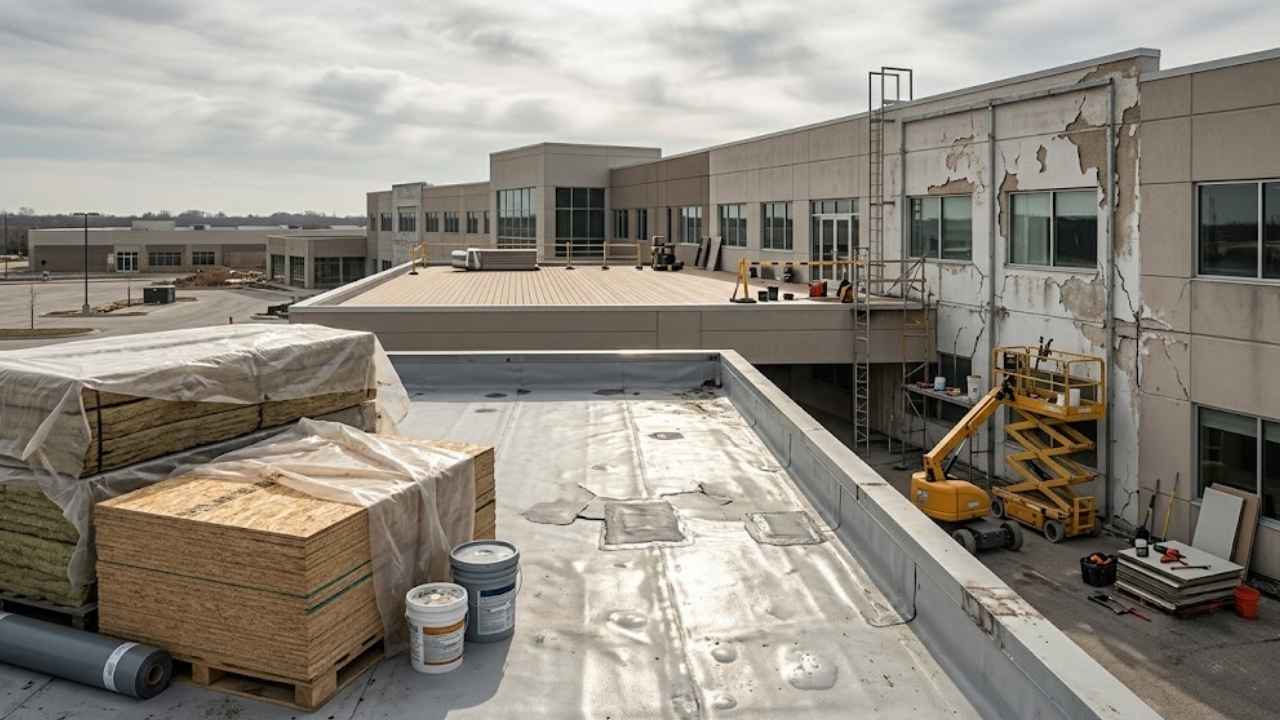
No architect specifies maintenance. At least, not deliberately.
Yet, every material selected during design is destined to eventually reappear somewhere else. A cladding panel becomes an inspection regime. A roof covering becomes a repair programme. A floor finish becomes a cleaning schedule. What begins life as a specification ultimately becomes an operational commitment, inherited by building owners, facilities managers and maintenance teams long after the project team has left the site.
That transfer of responsibility is a defining feature of construction. Material choices are often made under the pressures of procurement and capital cost, but they come to be judged, over decades, by entirely different criteria. A product that seems economical during the tender process may prove to be expensive in the long term, and vice versa.
This is the procurement trap. It exists because procurement and ownership measure success over fundamentally different timescales. A procurement exercise has a beginning and an end. Buildings rarely do.
Designing for Ownership
Construction operates within finite budgets, competitive tenders and demanding delivery programmes. Procurement teams are expected to demonstrate value, justify expenditure and control costs before work begins. Against those objectives, the lowest compliant price is often the simplest benchmark available.
But that purchase price marks the end of procurement and the beginning of ownership. From that point onward, value is measured in years.
The wisdom of every specification is eventually revealed by maintenance budgets, inspection schedules, replacement programmes and warranty claims. Associated costs accumulate gradually; sometimes so gradually that they are accepted simply as an inevitable function of the building’s lifecycle, rather than the direct consequence of a decision taken perhaps decades earlier.
Measuring the Wrong Thing
Buildings, after all, have long memories.
A material chosen today may shape facilities management budgets twenty years or more into the future. The contractor has moved on, the design team has dispersed, and the procurement exercise is long forgotten, but the building still demands attention. Annual treatment, regular repair or periodic replacement become part of its operating rhythm.
That perspective is increasingly centred, as commercial landlords retain assets longer, local authorities struggle to include maintenance in their strained budgets, and institutional investors prioritise long-term performance. At the same time, labour has become more expensive and sustainability conversations have expanded beyond embodied carbon to include durability, longevity and lifecycle performance.
Reframing Durability
Collectively, those pressures are changing industry values.
Purchase cost is increasingly being considered alongside the cost of ownership and durability, once a technical characteristic, a measure of a material’s ability to withstand wear and weather, is becoming something more significant.
A durable material demands fewer repairs, fewer replacements, less labour and fewer resources over its lifetime. Longevity is no longer simply an engineering outcome; it has become an economic and environmental one.
That shift has meant that specification is no longer simply about how materials perform on day one. As sustainability metrics expand, the industry is recognising that a material capable of decades of reliable performance is likely to deliver a very different environmental and financial outcome.
Composite in Context
External decking provides a good illustration of that shift in thinking.
Timber has remained a popular specification because it is familiar, readily available and comparatively inexpensive to procure. Contractors understand how to install it; clients recognise it; and there is relatively little uncertainty attached to it. As far as procurement is concerned, it is an obvious choice. From the perspective of ownership, it is much less so.
How frequently will the surface require treatment? How will prolonged exposure to weather affect its appearance and structural performance? What happens when boards begin to split, move or deteriorate? How much work will be involved in maintenance and how disruptive will it be?
It is in that context that more commercial projects are turning to composite decking.
Modern composite systems are manufactured using recycled wood fibres and high-density polymers, with many incorporating protective outer shells that resist moisture ingress, staining and ultraviolet degradation. They remain dimensionally stable, require little routine maintenance and are commonly supported by warranties of up to twenty-five years. Improvements in slip resistance, structural performance and fire classification have also broadened their suitability across commercial, public realm and residential developments.
These characteristics don’t make composite a panacea – across heritage and conservation environments, natural timber remains an essential part of the architectural vernacular – but they do illustrate something more significant: material decisions increasingly reflect the economics of ownership.
Life After Tender
Operational expenditure accounts for the majority of a building’s lifetime cost. Maintenance, repair and management continue long after construction budgets have been signed off, and they often outweigh the savings achieved by selecting the lowest purchase price in the first place. When viewed over the lifespan of an asset, the cheapest specification and the lowest-cost specification are, typically, two different things.
Buildings are completed in months and operated for decades. Every specification therefore carries two costs: one on the purchase order, and one that quietly accumulates.
The procurement trap is assuming those two numbers are the same.
Allan Jeffrey, founder and CEO of Ultra Decking






















