

Sri Lanka Declares Emergency as Cyclone Ditwah Leaves 153 Dead and Hundreds Missing. More than half a million people affected; India launches major relief operation as storm moves toward Tamil Nadu
Sri Lanka has declared a nationwide state of emergency after Cyclone Ditwah triggered devastating floods and landslides, killing at least 153 people and leaving around 190 missing across the island. Officials say more than half a million people have been affected in what is now one of the country’s worst natural disasters in over a decade.
The Disaster Management Centre (DMC) said nearly 78,000 people have been forced from their homes and are now packed into almost 800 relief centres, many of them schools and community halls. More than 15,000 houses have been destroyed, with thousands of others damaged or submerged.
Worst flooding in years
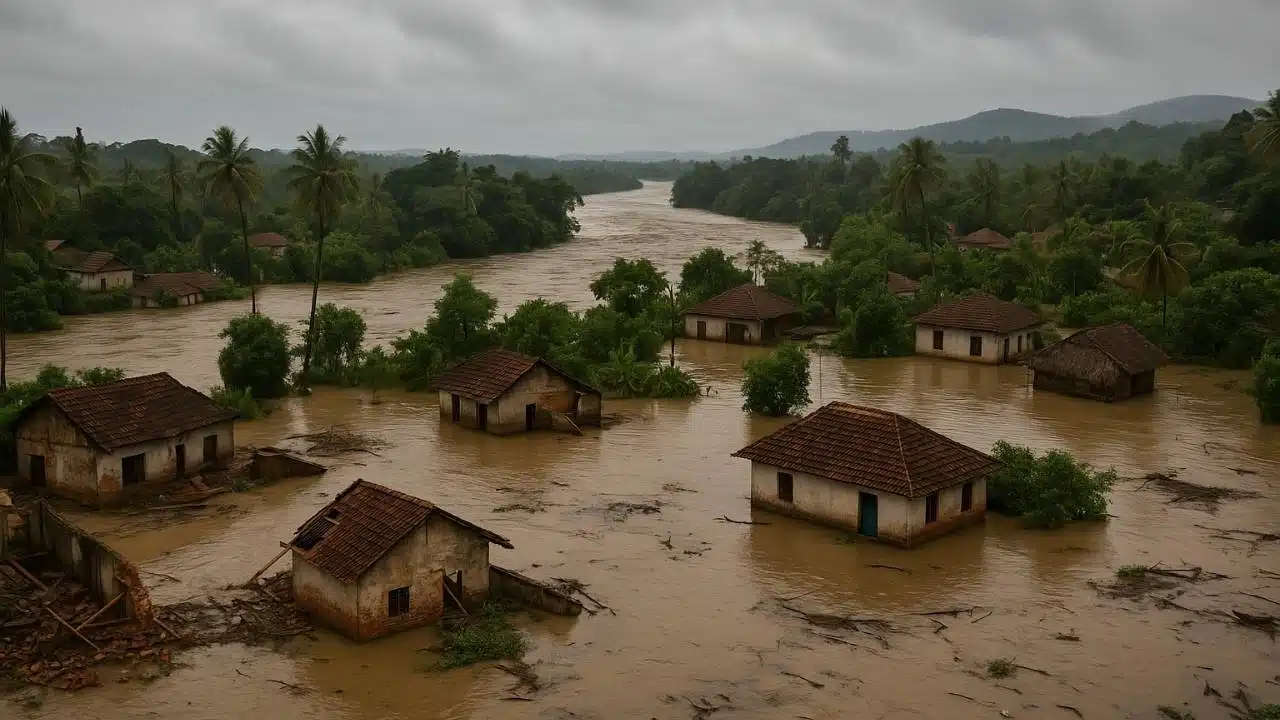
The heaviest damage has been reported in low-lying areas around the capital and along major river systems. Communities along the Kelani River, including Malwana on the outskirts of Colombo, are facing their worst flooding in about a decade, with some homes underwater up to the roof line.
Families have fled in the middle of the night as water levels rose faster than expected. Boats and improvised rafts are now the only way in or out of many neighbourhoods. Local businesses, including pharmacies, groceries, and textile shops, have been inundated, raising fears over both immediate shortages and longer-term economic losses.
In the central hill country, where slopes are saturated after days of rain, landslides have buried homes and cut off roads. Several villages remain reachable only by air or by military boats. Authorities warn that the death toll is likely to rise as rescue teams gain access to remote communities.
Emergency powers and a race against time
President Anura Kumara Dissanayake has invoked emergency regulations, granting the government sweeping powers over movement, logistics, and resource allocation. The move allows officials to bypass normal procedures to enforce curfews, commandeer vehicles, secure fuel, and prioritise supplies for the worst-hit districts.
Officials estimate that nearly one-third of the country is currently without electricity or running water, after power lines collapsed and water treatment plants were flooded. Internet and mobile networks have also been disrupted in multiple regions, complicating both rescue coordination and families’ attempts to trace missing relatives.
With floodwaters contaminating wells and surface water, health authorities are warning of heightened risks of disease outbreaks. Aid workers say many shelters are already reporting shortages of clean drinking water, food, infant formula, and basic medicines.
The Army, Navy, and Air Force lead the rescue effort
The DMC has mobilised thousands of personnel from the army, navy, and air force to reinforce exhausted local responders. Soldiers are clearing blocked roads, erecting temporary bridges, and helping to shore up river embankments. Naval teams are using boats to evacuate stranded families, while air force helicopters airlift the injured and drop food parcels into areas that remain cut off.
In towns along the Kelani and in the central districts, religious institutions and schools have turned into makeshift camps. Volunteers are cooking large batches of rice and lentils for people who have lost both their homes and their livelihoods overnight. Many of those displaced are daily-wage workers who now have no income and no savings to fall back on.
India launches ‘Operation Sagar Bandhu’
Responding to Colombo’s appeal for international assistance, India has become the first country to mount a large-scale relief operation, branded “Operation Sagar Bandhu.”
According to official briefings, Indian assistance so far includes:
- A C-130J transport aircraft carrying about 12 tonnes of relief supplies such as tents, tarpaulins, blankets, hygiene kits, and ready-to-eat food.
- An IL-76 aircraft with around 9 tonnes of material, plus an 80-member National Disaster Response Force (NDRF) team, four search-and-rescue dogs, and specialised equipment.
- Supplies from INS Vikrant and INS Udaygiri, including dry and fresh rations handed over to the Sri Lankan authorities for distribution in the worst-hit districts.
- Two Chetak helicopters from INS Vikrant, now flying joint missions with the Sri Lanka Air Force to locate stranded residents and ferry urgent medical cases.
- The patrol vessel INS Sukanya, which has sailed from Visakhapatnam with additional relief cargo and is expected to reinforce operations off Sri Lanka’s coast.
The Indian High Commission in Colombo is also assisting stranded Indian citizens at Bandaranaike International Airport, where flight schedules have been heavily disrupted by the storm and by persistent heavy rain.
Storm heads toward Tamil Nadu and Andhra Pradesh
After crossing Sri Lanka, Cyclone Ditwah has moved back over the southwest Bay of Bengal and is now heading toward the coasts of Tamil Nadu, Puducherry, and south Andhra Pradesh. The India Meteorological Department (IMD) expects the system to track north-northwest and possibly intensify slightly before approaching land early Sunday.
Authorities in Chennai and several coastal districts have cancelled dozens of flights, shut schools and colleges, and placed disaster-response teams on high alert. A red alert for very heavy to extremely heavy rainfall has been issued for parts of Tamil Nadu, while coastal Andhra Pradesh has been warned to brace for intense downpours and strong winds through the start of the week.
A Familiar Climate Warning
For Sri Lanka, Ditwah is a grim reminder of how vulnerable the island remains to extreme weather. The country last experienced a comparable catastrophe in 2017, when floods and landslides killed more than 200 people and displaced hundreds of thousands.
Meteorologists point to warmer sea-surface temperatures in the Indian Ocean and recurring La Niña–like patterns as key factors that can fuel heavier rainfall and more intense storms across the region. While detailed attribution studies will take time, the scale of destruction from Ditwah is already prompting fresh questions over urban planning, river management, and early-warning systems.
For now, the focus in Sri Lanka remains on survival and relief. With floodwaters still high in many districts and fresh rain in the forecast, authorities say the coming days will be critical in preventing further loss of life — and in stabilising a population that has seen whole communities washed away in a matter of hours.





















