
People everywhere want to know where they can use cryptocurrency without worry. Many are tired of slow banking and old tech that make digital money hard to manage. You may wonder which countries are making it easier for crypto fans and builders.
One quick fact: Spain leads Europe with a booming crypto scene, packed with startups in cities like Madrid and Barcelona. This blog will show how Spain became a hotspot for blockchain innovation, plus which Latin American countries are catching up fast.
Curious who is racing ahead? Keep reading!
Why Spain is Europe’s Crypto Hub
Spain is quickly becoming a key player in the crypto world. Its location makes it an easy link to Latin America, while its friendly rules help businesses grow and thrive.
Strategic location as a gateway to Latin America
Latin American investors often pick Spain as their first stop into Europe and Africa, thanks to its close ties and easy access. The country has strong trade relations with Latin America.
Its financial framework helps Latin American companies move money and expand business faster than in other European places.
Spanish banks speak the same language as many Latin Americans, making deals simpler, smoother. Want to enter European markets? Many choose Madrid or Barcelona before heading anywhere else.
As one Cuban entrepreneur said,.
Spain felt like home, just closer to new customers.
Proactive regulatory environment
Spain has set up clear rules for cryptocurrency and blockchain companies. The country welcomes digital assets, but does not give them a free pass. The EU’s MiCA framework now shapes how crypto firms must act across Europe.
Before MiCA, setting up shop cost some loose change, maybe $10,000. Today? Get ready to fork over as much as $60,000 just to meet compliance needs.
Licensing is no walk in the park either; six months can go by before anyone hears back from the regulators. Venture capital took a big dip too — funding dropped 70% since its peak of $5.7 billion in 2022 across Europe.
Despite these hurdles, Spain stands out for clarity and order in digital asset regulation while many other countries play catch-up with paperwork still piling high on government desks.
Thriving tech ecosystem and talent pool
Thanks to clear rules, tech entrepreneurs feel safe to build big ideas. Developers zip between Barcelona and Madrid with laptops in hand, ready for the next challenge. These cities are buzzing, but don’t count out Valencia or Malaga.
San Sebastián is catching more attention too.
In 2024, over 3.3 billion euros flooded into startups here—a huge leap of 37.5 percent from last year. More than 1,200 deep tech spin-offs now call Spain home, earning nearly 2 billion euros and giving jobs to over 12,000 people.
Fast internet pulses through Spanish streets; it’s some of the best digital infrastructure you’ll find on this side of Europe. That kind of fuel sparks new blockchain ideas and attracts bright minds eager for action and growth every day.
Key Factors Driving Crypto Adoption in Spain

Spain is buzzing with crypto energy. Many investors are pouring money into new blockchain startups. The government is backing these efforts with smart policies. Traditional banks, too, are starting to show interest in digital currencies and fintech innovations.
Increasing investment in blockchain startups
Investment in blockchain startups is on the rise in Spain. The crypto community is thriving, with many focused businesses found in cities like Madrid, Barcelona, Malaga, and Valencia.
Over 120 crypto companies operate across the country. These firms employ more than 1,100 people.
The tech culture and lifestyle attract investors and entrepreneurs alike. Events, meetups, and accelerators pop up regularly in places like Barcelona and Madrid. This growing interest boosts innovation and entrepreneurship within the digital asset space.
Strong investment trends promise to fuel further growth for these startups in Spain. Next up are supportive government policies that drive even more adoption of cryptocurrency.
Supportive government policies and initiatives
The Spanish government takes crypto seriously. They, along with the Bank of Spain, are working hard on rules for cryptocurrency use. In Spain, cryptocurrency is a legal digital asset.
This means people can buy and sell it without fear of breaking laws.
Profits from digital assets face taxes too. This tax support helps frame the government’s control over crypto activity. Also, anyone mining cryptocurrency needs to register with tax authorities in Spain.
These steps help create a clear path for growth in the crypto world while ensuring safety and compliance for everyone involved.
Growing interest from traditional financial institutions
Supportive government policies and initiatives are paving the way for more growth. Spain is seeing big banks get excited about cryptocurrency. BBVA, Spain’s second-largest bank, has started a bitcoin trading and custody service in Switzerland.
This shows that major players are ready to join the crypto game.
CaixaBank plans to add crypto custody features to its fintech platform as customer demand rises. Younger clients want cryptocurrencies linked with traditional systems. Prosegur, a security company, launched a new division for crypto storage called the Crypto Bunker.
This wave of interest from financial institutions proves that they see value in digital assets and blockchain technology.
Latin America’s Crypto Growth: Who’s Catching Up?
Latin America’s crypto scene is booming, with Argentina leading the charge and Brazil making strides in regulation. Mexico is also joining the race, expanding its blockchain companies.
Each country brings its own strengths to the table. The competition is heating up in this digital gold rush! Curious to learn more? Keep reading!
Argentina’s expanding crypto market
Argentina’s crypto market is growing fast. Cryptocurrency use has jumped 294%. Now, over 1.3 million people in Argentina engage with digital currencies. That’s about 2.94% of the country’s population.
More than 10% of Argentinians own cryptocurrency, and an extra 18% want to invest soon.
Low-cost electricity drives cryptocurrency mining in Argentina. Many see this as a chance for profit and economic growth. Ripio, a local crypto startup, plans to expand into Spain next.
With such interest in blockchain and digital currency, Argentina’s future looks bright in the crypto world.
Brazil’s regulatory advancements and adoption rates
Brazil has made big strides in cryptocurrency regulation. A new law took effect in July 2023. This law aims to stop scams and build trust in digital assets. It shows the government’s commitment to a safer crypto environment.
In 2021, about 8% of Brazil’s population was engaged with cryptocurrencies. That’s a lot of people! Nubank’s trading platform, Nucripto, gained one million users just one month after its launch.
The Central Bank plans to introduce a digital currency called the digital Real (Drex) by late 2024. These efforts boost adoption rates and growth in Brazil’s crypto market.
Argentina has also been working on expanding its crypto market; let’s see how it measures up next!
Mexico’s emerging blockchain ecosystem
Mexico’s cryptocurrency sector is buzzing with activity. Local startups are creating innovative blockchain products and services. The government, instead of shying away, is eager to talk about rules for this growing field.
They see the potential in working with the crypto industry.
World, known as Worldcoin before, has kicked off the Build LATAM campaign here. This program supports decentralized technology by backing 15 businesses with 1 million WLD tokens. It also offers mentorship to help these companies thrive and innovate even more in Mexico’s blockchain ecosystem.
Challenges and Opportunities for Spain and Latin America
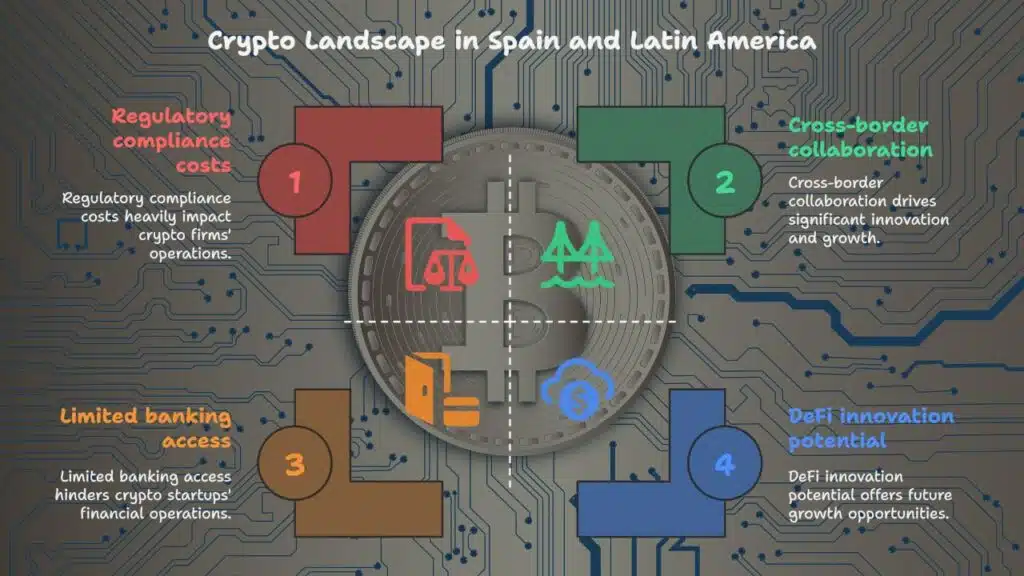
Spain and Latin America face both hurdles and chances in the crypto world. Rising regulations can slow growth, but strong partnerships can drive innovation in finance and tech.
Regulatory hurdles and compliance issues
Regulatory hurdles can slow the growth of crypto in Spain. Cryptocurrencies are not legal tender here. The euro is the official currency. Virtual Currency Service Providers must register with the Bank of Spain under Royal Decree 7/2021 for Anti-Money Laundering compliance.
This adds extra steps and costs for businesses.
MiCA regulations also create challenges, as they introduce transitional licensing periods. This can confuse many companies trying to enter the market. Moreover, Royal Decree 249/2023 requires detailed reporting obligations for virtual assets, increasing compliance complexity even more.
These rules put pressure on crypto firms as they try to operate smoothly while meeting strict standards.
Opportunities exist alongside these issues, especially in cross-border collaboration and decentralized finance innovation.
Opportunities for cross-border collaboration
Spain and Latin America share a strong economic bond. This relationship boosts investment flows between them. In 2023, Latin American investment in Spain rose by an impressive 138%.
It reached a total of 2,835 million euros. These investments have hit about 66,883 million euros.
Many Latin American companies aim for internationalization when investing in Spain. About 86% prioritize this goal. This focus creates many chances for countries to work together. They can build trade partnerships that foster growth and development for both regions.
Collaboration opens doors for innovation too. By joining forces, they can explore new ideas in finance and technology to benefit everyone involved.
Potential for innovation in decentralized finance (DeFi)
The opportunities for cross-border collaboration can lead to big changes in decentralized finance, or DeFi. Spain is shaping up as a major center for DeFi innovations. The demand for better financial services is strong.
Yet, some challenges hold back its full potential.
Regulatory hurdles and compliance issues weigh on startups. Many face high costs just to stay in line with rules. Plus, access to banking services is limited; only 14% of crypto firms have bank accounts.
This makes it harder for new ideas to thrive and grow in the digital economy. With these factors at play, the road ahead may not be easy but holds promise for those willing to adapt and create change.
Takeaways
Spain stands out as Europe’s new crypto hub. Its strategic location helps connect Europe with Latin America. The country has friendly rules for cryptocurrency and a strong tech scene.
Many blockchain startups are growing in cities like Madrid and Barcelona. Spain is also seeing more investment from banks into digital assets, making it easier for people to join the crypto world.
Latin America is not far behind, with countries like Argentina, Brazil, and Mexico pushing forward. Each of these places is building its own unique paths to success in the crypto field.
Are you ready to explore these changes? Understanding them can lead to great opportunities in finance and beyond.
For those who want to learn more about this exciting topic, stay curious! Keep up with news on cryptocurrencies and related fields; they can change how we think about money forever.
Let’s embrace this financial transformation—it’s just beginning!