American economic expansion has demonstrated remarkable resilience over recent years, but its long-term sustainability faces serious structural headwinds. While GDP growth, a near-full-employment labour market, and strong consumer spending paint an encouraging picture, mounting national debt, persistent inflation above the Federal Reserve’s 2% target, slowing job creation, and global trade disruptions raise legitimate questions about how much further this expansion can run — and at what cost.
Understanding the Current US Economic Expansion
Before asking whether American economic expansion is sustainable, it helps to understand what it has looked like in practice. The US economy has been on an extended growth path since recovering from the COVID-19 pandemic contraction of 2020 — a run that has outlasted many economists’ predictions of a sharp recession.
Key GDP and Growth Indicators
According to the US Bureau of Economic Analysis (BEA), real GDP grew 2.8% for the full year 2024 — a solid performance that surpassed many analyst forecasts. In 2025, full-year GDP growth came in at 2.2%, reflecting a volatile year that included a rare contraction of 0.6% in Q1, a strong rebound to 4.4% in Q3, and a significant pullback to just 1.4% in Q4 — the latter largely attributable to the longest government shutdown in US history, which the BEA estimates subtracted approximately 1.0 percentage point from Q4 growth alone.
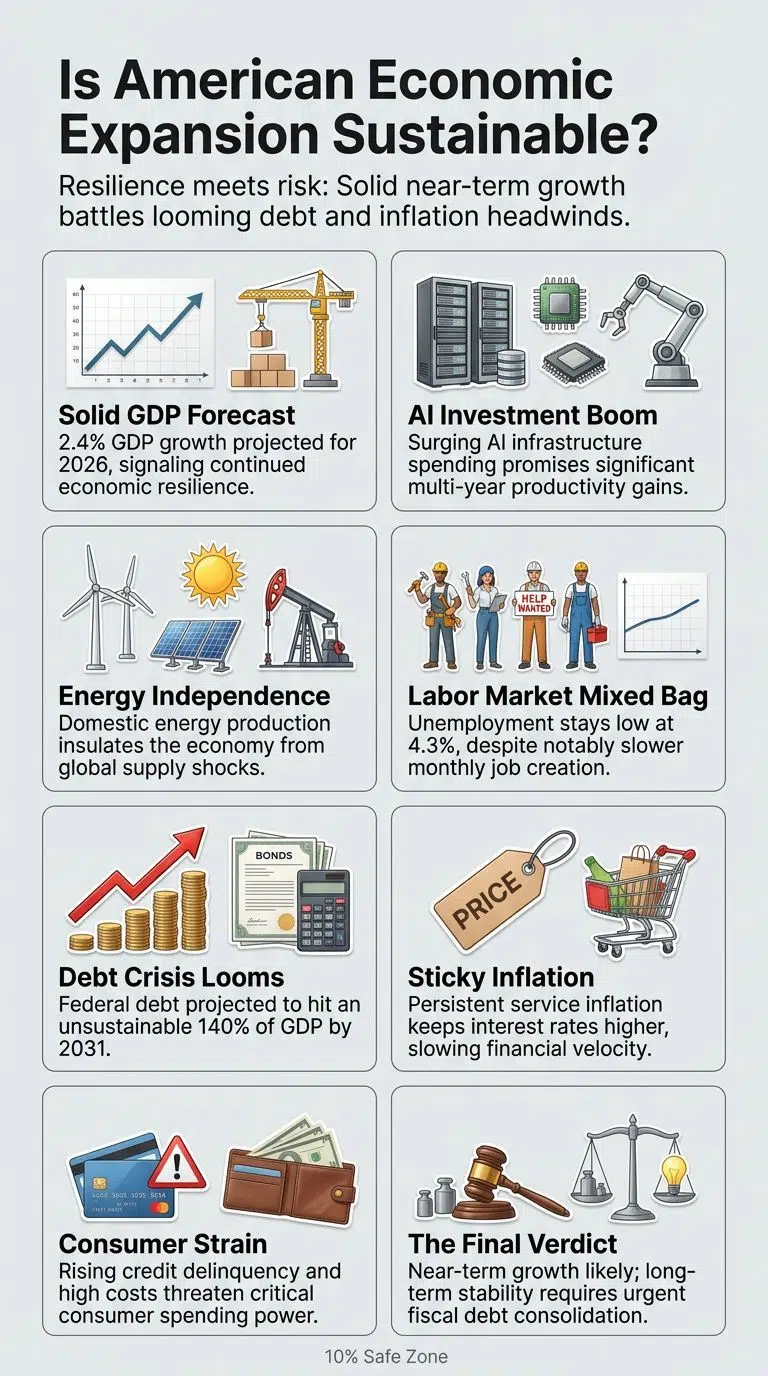
The IMF’s 2026 Article IV Mission forecasts the US economy will accelerate modestly to 2.4% growth in 2026, returning to a pace consistent with full employment. That would represent a healthier trajectory — though well below the post-pandemic boom years.
| Year / Period | Real GDP Growth Rate |
| 2023 | 2.9% |
| 2024 | 2.8% |
| 2025 (Full Year) | 2.2% |
| Q3 2025 | 4.4% (annualised) |
| Q4 2025 | 1.4% (annualised) |
| 2026 Forecast (IMF) | 2.4% |
Source: US Bureau of Economic Analysis (BEA), IMF 2026 Article IV Consultation, February 2026
Employment and Consumer Spending Trends
The US labour market has remained the backbone of expansion. As of January 2026, the unemployment rate stood at 4.3% — historically low, though slightly elevated compared to the sub-4% lows seen in 2022–2023. The IMF projects unemployment will remain close to 4% through 2026–2027, signalling continued full-employment conditions.
However, job creation has slowed markedly. In 2025, the economy added an average of just 75,000 jobs per month — less than half the 167,000 monthly average recorded in 2024. As EY’s macroeconomic analysts note, the 2025 expansion was notably ‘jobless,’ with businesses doing more with less in a high-cost, high-interest-rate environment.
Consumer spending, which accounts for approximately 68% of US GDP, has remained the primary engine of growth. Services spending in particular has stayed resilient, buoyed by affluent household expenditure on health care, recreation, and travel. Goods spending, however, has shown signs of softening — a pattern consistent with a maturing economic cycle.
The Case For Sustainability: Why the Expansion Could Continue
There are genuine structural reasons to believe American economic expansion has durable foundations — arguments made by mainstream economists, the IMF, and institutional forecasters.
Productivity Gains and the AI Investment Boom
Perhaps the most compelling bull case for sustained US expansion is the ongoing artificial intelligence investment surge. Business investment in intellectual property products grew 7.4% in Q3 2025 and 5.6% in Q4, driven overwhelmingly by AI infrastructure spending. This mirrors historical periods — such as the late 1990s technology boom — when productivity-enhancing investments extended economic cycles beyond what traditional models predicted.
The Indiana Business Research Center notes that AI investment represents a clear sign of strength in the current economy, capable of generating multi-year productivity dividends if the technology scales as expected. Unlike speculative asset bubbles, AI infrastructure investment is tied to tangible enterprise efficiency gains — and that distinction matters for long-run growth potential.
Energy Independence and Manufacturing Reshoring
The United States has achieved a degree of energy independence that insulates it from the supply-side shocks that historically ended expansion cycles. Domestic oil and gas production remains near record levels, reducing vulnerability to Middle Eastern geopolitical disruptions that hobbled previous expansions.
Simultaneously, a sustained trend of manufacturing reshoring — accelerated by supply chain vulnerabilities exposed during COVID-19 — is adding productive capacity to the domestic economy. Sectors including semiconductors, electric vehicles, and defence manufacturing are attracting large-scale capital investment, providing employment and output tailwinds that could support expansion for years.
Strong Labour Market Fundamentals
Despite slowing job growth, the quality of the US labour market remains sound. The prime-age labour force participation rate has been rising — a sign that workers are actively engaged in the economy rather than sitting on the sidelines. Real wages, though squeezed by inflationary periods, have recovered positive growth territory for most worker cohorts.
The IMF’s February 2026 consultation highlighted that unemployment has remained relatively low, prime-age labour force participation has been rising, and real incomes have been increasing — a combination that supports consumer-led expansion even as headline job creation moderates.
The Case Against Sustainability: The Structural Risks
The risks to American economic expansion are real, well-documented, and in some cases accelerating. A balanced analysis requires confronting them directly.
National Debt and Deficit Spending: The Unsustainable Trajectory
The most widely cited long-term risk to US economic sustainability is the trajectory of federal debt. The Congressional Budget Office (CBO) projects that if current fiscal policy continues, public debt could reach unsustainable levels within the coming decade. The federal deficit narrowed slightly to 5.9% of GDP in fiscal year 2025, but the IMF warns it is expected to exceed 6% of GDP in the near years ahead.
In its starkest projection, the IMF calculates that keeping the overall deficit at 7–8% of GDP could push public debt to around 140% of GDP by 2031 — a level that most economists consider incompatible with sustained low-cost borrowing. Rising debt servicing costs crowd out productive government investment, constrain fiscal flexibility, and — at sufficiently high levels — can trigger the very financial instability they seek to avoid.
The CBO’s long-range projections reinforce this concern: net interest on the national debt is the fastest-growing component of the federal budget. As interest rates have risen sharply from the near-zero environment of the 2010s, the cost of financing accumulated debt has increased dramatically.
Inflation and Federal Reserve Constraints
Inflation has proven stickier than policymakers hoped. The PCE price index — the Federal Reserve’s preferred inflation measure — stood at approximately 2.6–2.8% in late 2025, above the Fed’s 2% target. Goods inflation was partly inflated by tariff effects, but services inflation has remained persistently elevated, reflecting tight conditions in housing and healthcare markets.
The Federal Reserve, having cut rates by 0.75 percentage points during 2025, faces a delicate balancing act in 2026. Cut too aggressively and inflation re-accelerates; hold rates too high and a softening labour market tips into recession. Under the IMF’s baseline scenario, the federal funds rate is projected to decline modestly to 3.25–3.5% by end-2026 — a level that remains restrictive by historical standards.
The implication is clear: the era of near-zero interest rates that fuelled equity valuations, corporate borrowing, and the housing market is over. The expansion that follows will be fought against a higher-rate backdrop that inherently reduces the velocity of financial activity.
Income Inequality and Consumer Debt
The current expansion has been notably uneven in its benefits. EY’s macroeconomic analysis characterises the 2025 expansion as ‘more uneven, less inclusive, and ultimately less resilient’ — driven disproportionately by affluent household spending on services while lower and middle-income households face mounting affordability pressures from elevated housing costs, persistent food and energy inflation, and consumer credit burdens.
Consumer debt levels have risen significantly since the pandemic. Credit card delinquency rates have climbed toward multi-year highs, particularly among younger and lower-income borrowers. If the consumer spending engine — 68% of GDP — begins to sputter at the lower end of the income distribution, aggregate demand could soften faster than headline employment figures suggest.
Global Trade Risks and Geopolitical Factors
The United States has implemented sweeping tariff increases that represent, in the IMF’s characterisation, ‘a negative supply shock’ to the US economy — estimated to raise the PCE price index by approximately 0.5% and reduce the level of output by a similar margin. While tariff revenue provides a modest fiscal offset, the trade fragmentation costs are broader: disrupted supply chains, retaliatory measures from trading partners, and elevated input costs for US manufacturers.
Geopolitical risks — including continued uncertainty over Taiwan, ongoing conflicts affecting global energy markets, and the trajectory of US-China economic relations — add a further layer of unpredictability. For a $28 trillion economy deeply integrated into global trade networks, external shocks can translate into domestic disruption with significant speed.
What Economic Experts Say
The debate over American economic expansion sustainability is not settled — and serious economists occupy positions across the spectrum.
IMF and World Bank Projections
The IMF’s February 2026 Article IV consultation offered a cautiously optimistic near-term view, projecting 2.4% GDP growth for 2026 and describing near-term risks to activity, unemployment, and inflation as ‘broadly balanced.’ IMF Managing Director Kristalina Georgieva acknowledged the ‘buoyant’ state of the US economy while stressing that the continuing rise in public debt remains a major concern — something the Fund has flagged in successive consultations.
The World Bank and other multilateral institutions share a similar dual assessment: strong near-term performance, troubling medium-term fiscal arithmetic. The consensus view is that the US can sustain growth through 2026–2027 without a recession under baseline assumptions — but that failure to address the structural deficit creates compounding risks from 2028 onwards.
Federal Reserve Signals
Federal Reserve communications in early 2026 signal a data-dependent approach that prioritises avoiding both a labour market deterioration and an inflation re-acceleration. The Fed’s latest minutes suggest policymakers are likely to resume easing only for ‘good reasons’ — convincing progress on inflation toward 2% — or ‘bad reasons’ — a meaningful weakening in the labour market. Neither condition has fully materialised as of March 2026.
Private Sector Forecasters
Deloitte’s Q4 2025 US Economic Forecast projects real GDP growth of approximately 1.9% in 2026, with consumer spending moderating to 1.6% as affordability pressures bite and the labour market loosens. Deloitte also flags a downside scenario where AI investment proves overdone, leading to a sharper pullback in business spending by 2027.
The Indiana Business Research Center is more cautious, projecting 1.8% GDP growth in 2026 — and warning that an elevated possibility of volatility surrounds forecasts given the ‘bifurcated nature of the economy’ combining AI investment strength with labour market softness.
Historical Context: How Long Do US Expansions Last?
Understanding the current expansion requires context from previous cycles. The US has experienced 12 recessions since World War II, with expansions lasting an average of approximately 5–6 years between contractions. However, the post-2009 expansion — the longest on record — ran for nearly 11 years before the pandemic ended it in 2020.
The current expansion, having recovered from the 2020 contraction, is now entering its fifth year. By historical standards, that is neither unusually old nor unusually young. What makes the present cycle distinctive is the unique policy mix it has operated under: unprecedented post-pandemic fiscal stimulus, a rapid tightening cycle, the emergence of AI as a productivity driver, and a globalisation reversal reflected in tariff escalation.
Historical expansions have typically ended due to one of three causes: a Federal Reserve tightening cycle that overshot, an external shock (oil price spike, financial crisis), or the accumulation of domestic imbalances that unwound abruptly. All three risk factors are present to some degree in the current environment — though none has yet reached the threshold that has historically triggered a recession.
Is American Economic Expansion Sustainable? The Verdict
The honest answer is: sustainable in the near term, uncertain in the medium term, and structurally challenged in the long term.
In the near term — 2026 and into 2027 — the preponderance of evidence supports continued expansion. The IMF’s 2.4% growth forecast, near-full employment, robust AI investment, and a Federal Reserve with room to ease if conditions deteriorate all point toward resilience. A recession in the next 12 months is possible but not the base case for most credible forecasters.
In the medium term — 2027 through 2029 — the picture clouds considerably. The ‘sugar high’ effect of the 2025 tax legislation is projected to fade. Structural deficit pressures intensify. The labour market is softening. Consumer debt burdens are rising. And the global trade environment has become fundamentally more fragmented and costly. The CBO’s long-range projections do not envision a return to the 3%+ growth rates of previous decades.
In the long term, the trajectory of national debt is the single most important variable. The IMF’s warning that federal debt could approach 140% of GDP by 2031 under current policy is not alarmist — it is arithmetic. An economy that devotes an ever-larger share of federal revenue to debt servicing is an economy with progressively less capacity to invest in the productivity gains that sustain expansion.
What would make it more sustainable? Credible fiscal consolidation — spending discipline combined with revenue measures — that puts the debt-to-GDP ratio on a stable or declining path. Greater investment in infrastructure, education, and R&D that raises long-run productive potential. And trade policy that reduces, rather than amplifies, global economic fragmentation.
The US economy has surprised skeptics repeatedly. Its entrepreneurial dynamism, institutional depth, technological leadership, and consumer resilience are genuine competitive advantages. But sustainability is not guaranteed — it is earned, through policy choices that look beyond the next election cycle.