
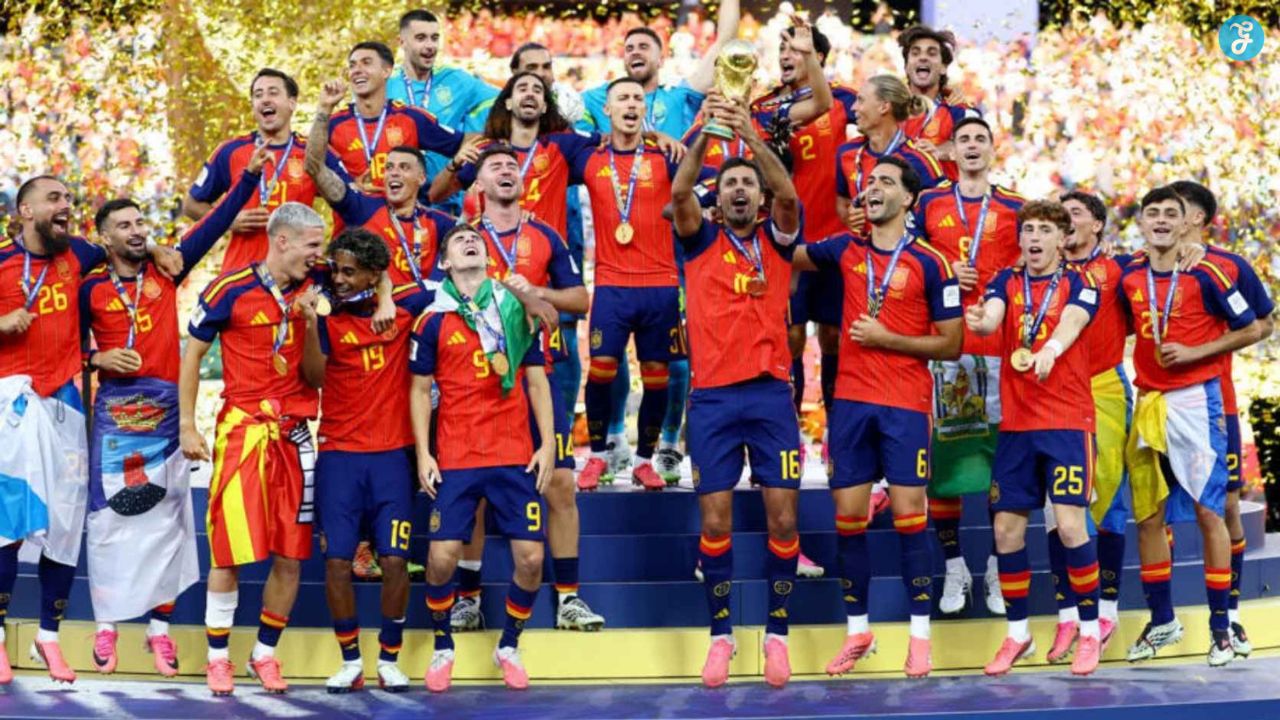
I do not believe Spain abandoned tiki-taka. I believe Spain finally stopped worshipping it. For years, every conversation about Spanish football seemed trapped inside the same tired argument. Spain either had to remain loyal to possession football or reject it completely and become faster, more direct, and more physical.
I never accepted that choice. The story of Spain beyond tiki-taka is not about destroying a football identity. It is about saving that identity from becoming a ritual.
Spain still values the ball. Their midfielders still understand space better than most. Their defenders still want to build rather than clear. Their first reaction after losing possession is still to recover control. The difference is that possession no longer has to be the answer to every question.
Luis de la Fuente’s Spain can wait, accelerate, press, counter, attack from wide areas, carry the ball through a defensive line, or protect a narrow advantage. The team can change its rhythm without looking as though it has betrayed its principles. That is the real transformation.
Spain did not become less Spanish. They became mature enough to understand that identity and method are not the same thing.
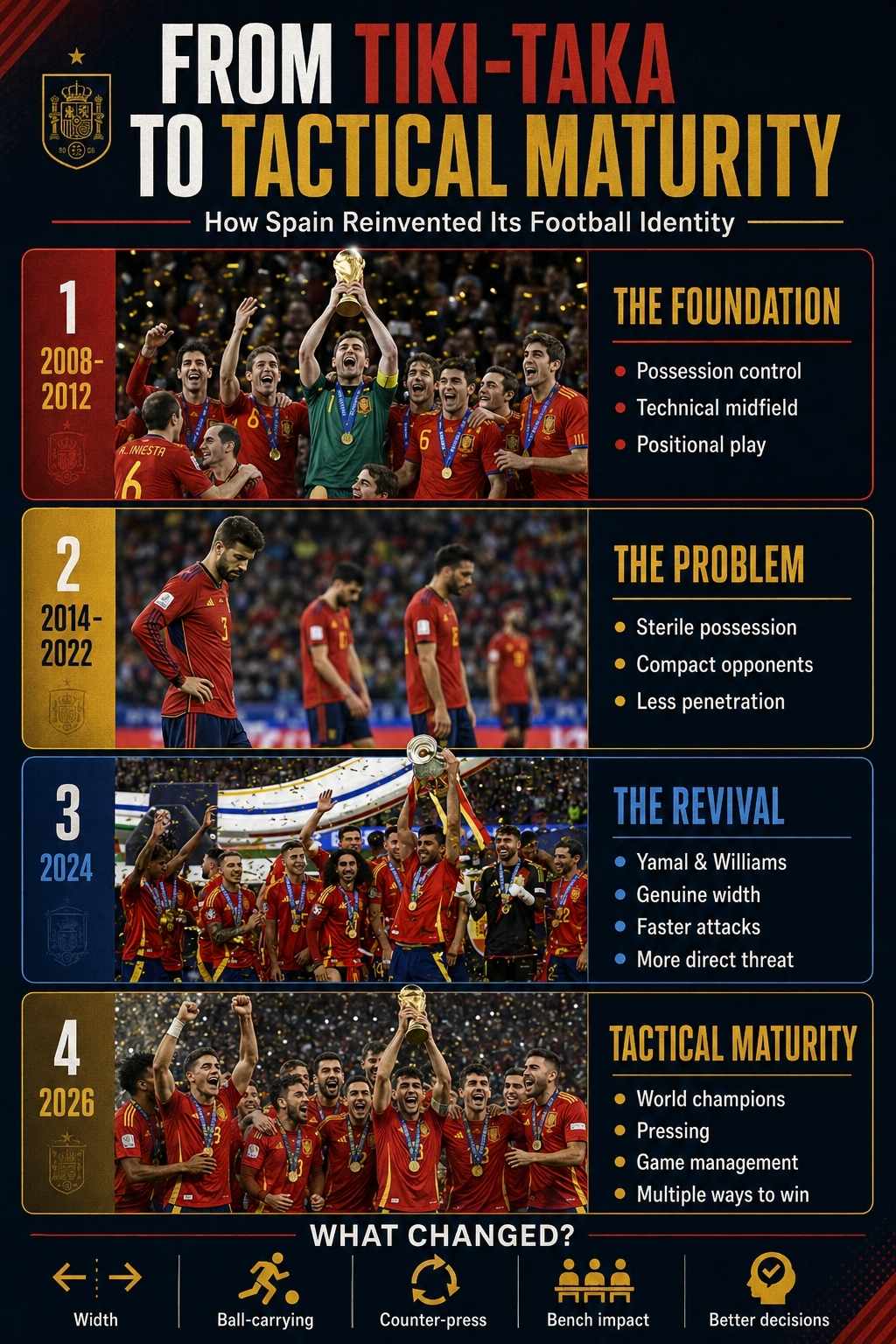
Spain Did Not Abandon Tiki-Taka; It Outgrew the Dogma
Tiki-taka has become one of football’s most overused and least understood terms. At its best, it was never about completing the largest possible number of passes. It was about moving opponents, opening spaces, creating superior numbers around the ball, and controlling what happened after possession changed. The passing had a purpose.
Spain’s great teams from 2008 to 2012 did not keep the ball because possession looked sophisticated. They kept it because the opponent became tired, disorganized, and increasingly unable to play its own game.
Later Spanish teams often kept the visible habits while losing some of that purpose. The triangles remained. The technical quality remained. The possession figures often remained impressive. The damage did not.
Spain could move the ball across the pitch without forcing defenders to move out of the positions they wanted to protect. Opponents learned that they did not have to chase every pass. They could stay compact, close the center, and wait for Spain to become impatient.
That is where the style became dogma. The problem was not too much passing. The problem was passing without enough threat.
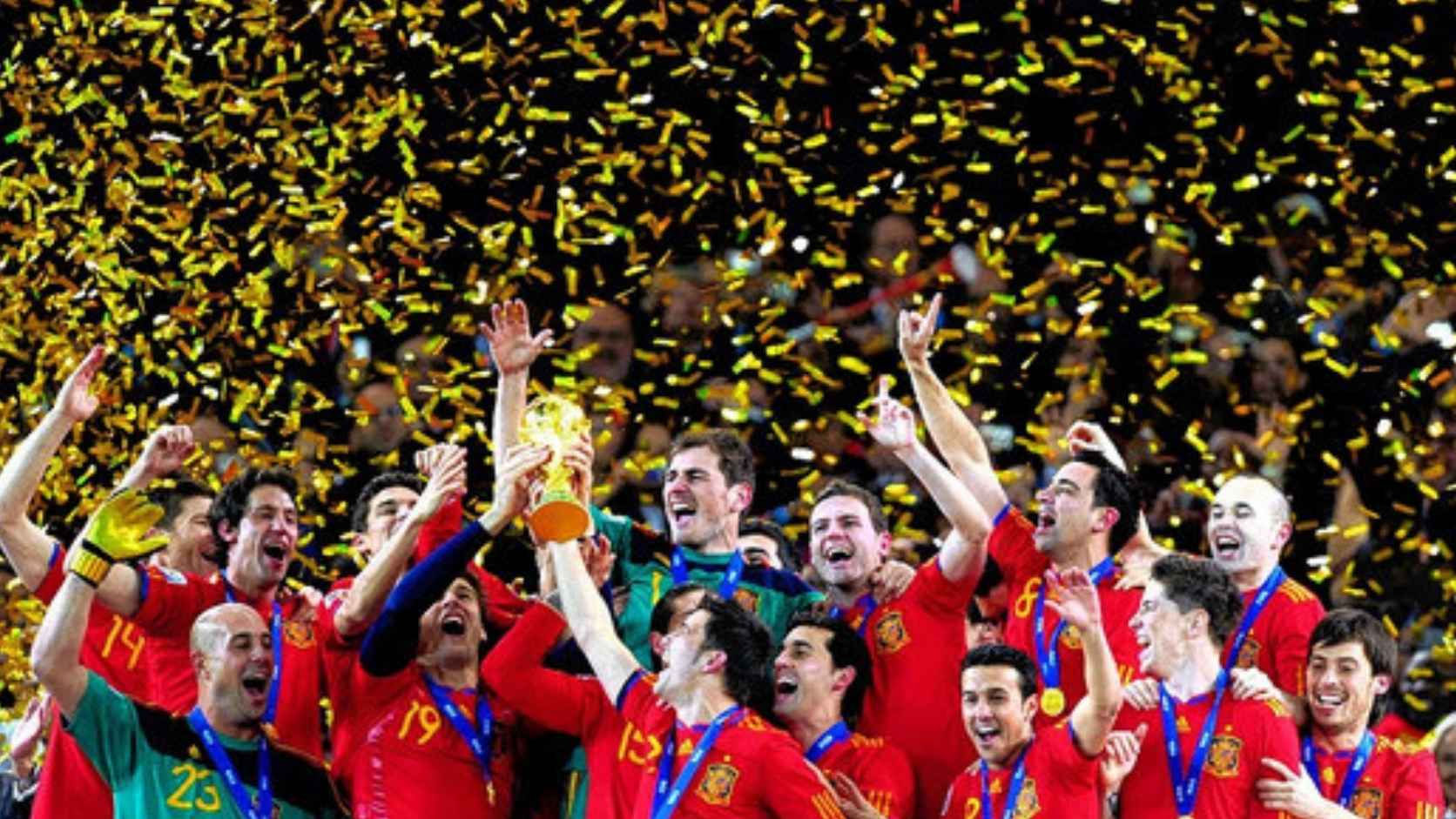
The Golden Generation Was More Practical Than Nostalgia Suggests
People often remember Spain’s golden era as a four-year exhibition of perfect football. The results tell a more grounded story.
Spain scored eight goals during their 2010 World Cup campaign. After losing their opening match to Switzerland, they won six consecutive games. Every knockout victory came by a 1–0 scoreline, including the final against the Netherlands. Spain also completed the entire knockout phase without conceding.
That team could be beautiful, but beauty was not the only reason it won. Possession protected Spain. It reduced the number of transitions their defenders had to face. It slowed opponents down. It allowed Xavi, Andrés Iniesta, Sergio Busquets, Xabi Alonso, and the players around them to control the emotional rhythm of a match.
Spain did not need to produce chance after chance. They needed to create the right chance while preventing the opposition from creating its own. That is often forgotten.
The 2010 team were not idealists who refused to compromise. They were ruthless enough to win four knockout matches by a single goal. To me, the modern Spanish are closer to that competitive spirit than some of the teams that tried hardest to copy its passing patterns.
Possession Eventually Became a Comfort Zone
The warning signs became harder to ignore after Spain’s golden cycle ended. Spain could still dominate the ball, but opponents became more comfortable defending against that dominance. Russia eliminated them on penalties in the 2018 World Cup round of 16. Morocco did the same after a goalless match in 2022.
Those defeats were not identical. They cannot be explained by one statistic. Still, both exposed the same weakness.
Spain could control where the ball was without controlling what the match was becoming. The clearest contrast came earlier in the 2022 tournament. Spain had 81% possession in their 7–0 victory over Costa Rica, the highest share recorded in a World Cup win. The passing was devastating because Costa Rica left spaces that Spain could attack.
Morocco did not give them the same match. They stayed organized. They protected the middle. They accepted that Spain would have more of the ball because the ball was often traveling through areas that did not hurt them.
That is the danger of treating possession as proof of dominance. A team can complete hundreds of passes and still allow the opponent to feel safe. I have never believed that Spain’s possession style failed. I believe its purpose became blurred.
Possession remains powerful when it forces the opposition to react. When defenders can watch the ball move from side to side without leaving their preferred positions, control has started to become comfort.
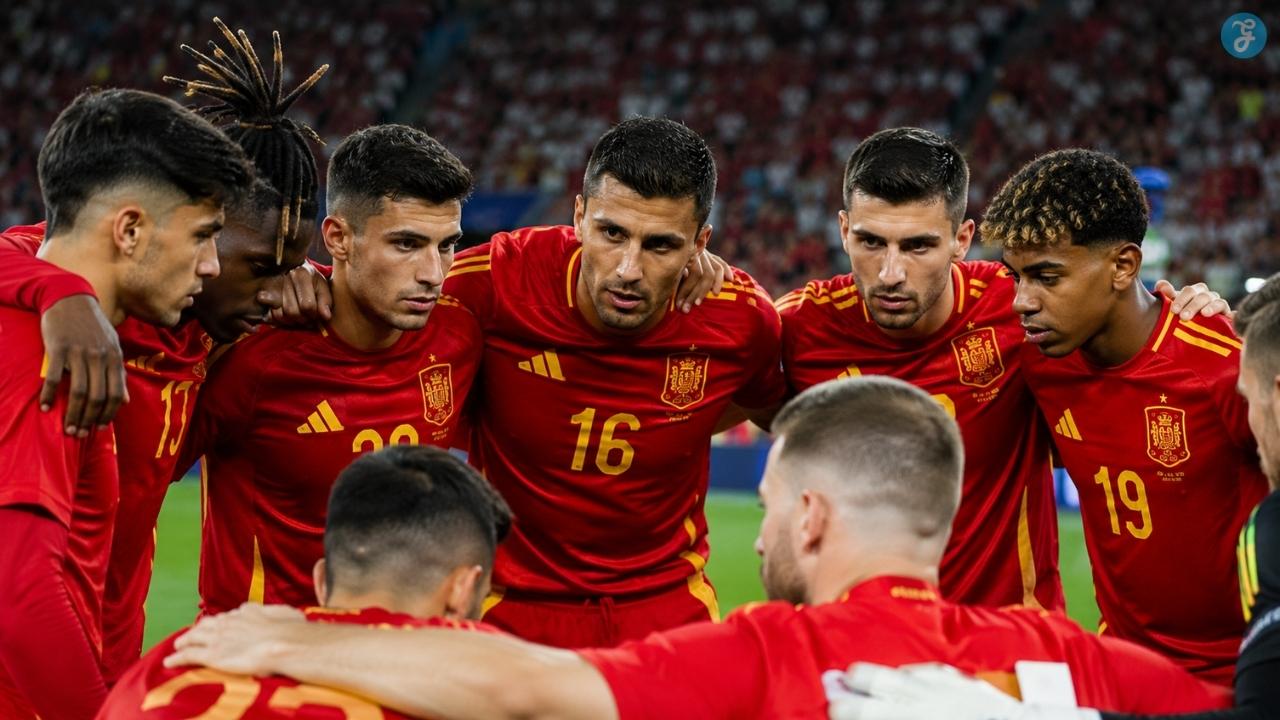
Luis de la Fuente Restored Purpose Without Starting a Revolution
Luis de la Fuente did not rebuild Spain around an exotic formation. The basic shape remained familiar. Spain still used a 4-3-3. They still built through technically strong center-backs and midfielders. They still tried to recover the ball quickly and spent most of the match in the opposition half.
The change was less dramatic and more important. De la Fuente gave Spain permission to choose the shortest route to danger.
If the center were crowded, Spain could go wide. If the winger had space, the ball could reach him early. If a defender stepped out, a midfielder could carry the ball through the gap. If the opposition pressed high, Spain could play through the pressure, around it, or beyond it.
The team no longer acted as if a direct pass was a rejection of its culture. De la Fuente’s background helped. Before coaching the senior team, he led Spain to the 2015 European Under-19 title and the 2019 European Under-21 Championship. He knew the national development system and had worked with members of the generation that would later reach the senior side. That continuity matters.
He did not arrive as an outsider telling Spanish players to forget everything they had learned. He understood what their football education gave them. He also understood where that education could become restrictive.
His achievement was not making Spain play a completely different sport. It was making their familiar qualities useful again.
Yamal and Williams Gave the Passing Somewhere to Go
The most obvious change appeared near the touchlines. Earlier Spanish teams often used wide players who naturally moved inside. David Silva and Iniesta could begin in wide positions, but their instinct was to join the midfield and create central superiority.
That worked brilliantly when Spain’s central combinations were almost impossible to stop. It became more predictable once opponents learned to defend narrow spaces with compact blocks.
Lamine Yamal and Nico Williams changed the geometry.
UEFA’s technical observers identified their genuine width as one of the defining differences between Spain’s 2012 and 2024 European champions. Yamal and Williams forced opposing full-backs to defend much closer to the touchline, while their partnerships with Spain’s own full-backs created constant uncertainty.
A defender facing Williams could not simply protect the inside channel. Williams could attack outside. He could move inside while Marc Cucurella overlapped. Cucurella could underlap and pull a defender away. The same kind of uncertainty existed on the right when Yamal drifted infield and Dani Carvajal advanced around him.
This opened the pitch in ways that passing alone could not. Opponents had to decide whether to remain compact or confront the winger.
Stay narrow, and Spain could release a dangerous player into space. Move wide, and gaps appeared between the fullback, center-back, and midfield. Send a second defender, and someone became free elsewhere.
Yamal and Williams did not replace tiki-taka. They gave it a destination.
Spain Learned to Let Individuals Break the Shape
There was another change that I found just as important. Spain began trusting players to carry the ball through pressure rather than always passing around it. A good pass can move a defense. A successful carry can force a defender to abandon his position.
When Yamal receives the ball near the touchline and moves inside, one defender often becomes two. When Williams accelerates at a fullback, the covering center-back has to make a decision. When Dani Olmo turns between midfield and defense, the whole block can be pulled out of shape.
Those moments introduce controlled disorder. For a long time, Spain seemed so committed to positional perfection that players sometimes waited for the ideal passing lane instead of creating one themselves. The newer team looks more comfortable with individual disruption. That does not make the football less collective.
A dribble that attracts two defenders can improve the structure for everyone else. A carry through the midfield can create the passing angle that did not exist seconds earlier.
Spain has not replaced combinations with individual talent. They have finally allowed both to work together.
The Euro 2024 Final Showed a Team Capable of Solving Problems
Spain’s victory over England in the Euro 2024 final was not their easiest or most fluent performance. That is why it revealed so much.
England defended Spain’s central midfield well in the first half. Spain struggled to progress through the middle and leaned heavily toward the left. Nico Williams received seven line-breaking passes before half-time, the most among Spain’s players. Williams and Cucurella together received 11 of Spain’s 18 successful line-breaking passes in that period.
The old version of Spain might have continued repeating the same central patterns and trusted that possession would eventually solve the problem. This team adjusted.
Rodri went off injured at half-time, and Martín Zubimendi replaced him. Fabián Ruiz moved deeper alongside Zubimendi, while Olmo found more space ahead of them. The change altered the midfield picture.
England’s players could no longer follow the same references. Spain started finding Olmo, Álvaro Morata, Carvajal, and Yamal in better positions. After creating three chances before the break, Spain produced 11 in the second half.
Williams scored shortly after the restart. Cole Palmer equalized. Then substitute Mikel Oyarzabal scored the winner in the 86th minute from Cucurella’s cross.
That match felt like a clear break from the most rigid version of Spain. They did not respond to difficulty by abandoning their structure. They changed the relationships inside it.
Rodri Made Spain’s New Freedom Safer
The wingers made the transformation easy to see. Rodri made it sustainable. To me, he is the clearest bridge between the great Spain of the past and the more adaptable team of the present.
He offers the positional security people once associated with Busquets. He protects the center, controls the pace, blocks counter-attacking routes, and gives the players ahead of him the confidence to take risks.
But Rodri is not simply a recycler of possession. He can play forward early. He can switch the attack. He can step into higher areas. He can arrive near the box. He can recognize when Spain needs to pause and when a quick pass can catch the opponent before it resets.
That judgment holds everything together. Width creates space, but it can also create defensive gaps.
When Yamal and Williams stay high, when the full-backs advance, and when an attacking midfielder moves beyond the ball, someone must manage what remains behind the attack.
Rodri allows Spain to be more adventurous without becoming careless. He was named Player of the Tournament at Euro 2024, while Yamal received the Young Player award. Spain also finished as the competition’s top-scoring team with 15 goals.
Those awards captured the balance of the team. Youth and risk at the front. Control and judgment behind it.
Pressing Became Spain’s Second Way of Creating
Spain’s football is still usually discussed through possession. Their work immediately after losing the ball deserves just as much attention. A strong counter-press can create a better attacking opportunity than a long build-up.
When Spain recover possession near the opposition box, they do not have to break down a complete defensive block. The opponent is still moving forward. Passing lanes are open. Defenders are facing their own goal. This is where Spain’s positional structure becomes aggressive.
Players stay close enough during attacks to surround the ball quickly after it is lost. The wingers press the first receiver. Midfielders block the easiest central pass. Defenders step forward instead of immediately retreating.
The result is not only defensive security. It creates repeat attacks. This is one reason the newer Spain feels faster even when they have not changed the speed of every possession. They are creating more moments against unsettled opponents.
The ball is still central to their identity. So is the fight to win it back before the match can breathe.
The center-forward became part of the structure
Spanish football has spent years discussing the absence of a perfect striker. I think the modern team became better when it stopped treating that absence as a national emergency. The center forward still matters, but the role is not limited to finishing.
Morata could press center-backs, run into channels, occupy defenders, and create room for Williams and Yamal. Oyarzabal offered different movements. Ferran Torres could attack space with fresh legs. Other options gave Spain more physical presence when a match required it.
The striker often creates the conditions for someone else to become decisive. He may drag a center-back away from the middle, may drop short and give Olmo space to run beyond him, or may lead the press so the team can recover the ball higher, or may spend much of the match creating space and still be judged only by whether he scored. That is too limited a view of the role.
Spain’s attacking threat now comes from several directions. The winger can score. A midfielder can arrive late. A full-back can create the final pass. A substitute can change the game. The attack no longer collapses when the number nine is not its biggest star.
The Bench Became a Tactical Weapon
One of Spain’s clearest signs of maturity is the way substitutions change the match rather than merely refresh it.
Oyarzabal came off the bench to score the winning goal in the Euro 2024 final. UEFA’s technical report also noted how scoring substitutes shaped that tournament more broadly.
Two years later, another substitute delivered the largest prize. Ferran Torres scored in the 106th minute as Spain defeated Argentina 1–0 after extra time in the 2026 World Cup final. It was Spain’s second men’s World Cup title.
Those moments should not be dismissed as convenient stories about inspired substitutions. De la Fuente uses his bench to change the type of problem Spain presents.
A fresh winger can force a tired full-back to defend deeper. A different forward can attack the channels rather than drop toward midfield. An additional midfielder can help Spain regain control.
The substitute is not always replacing the same role with a fresher body. He may be introducing a new route into the match. That is a major difference from teams whose identity depends entirely on the starting eleven reproducing one rehearsed plan.
Euro 2024 Restored the Joy
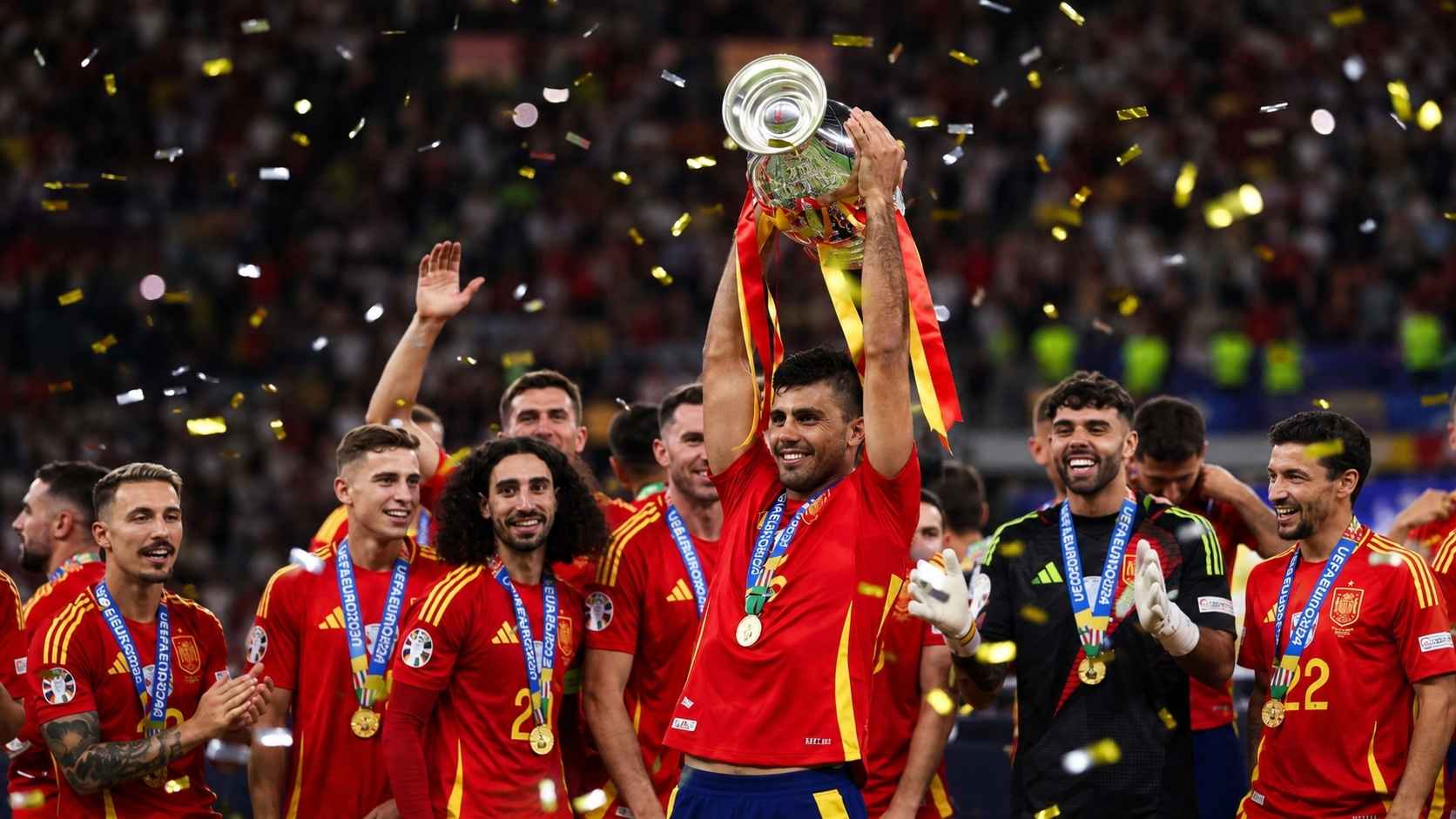
Euro 2024 was the tournament in which Spain looked exciting again. They became the first team to win all seven matches at a European Championship. Their 15 goals set a tournament record for a winning side, and the victory over England gave Spain a record fourth European title.
The numbers were impressive. The football felt more important. Spain was no longer using possession mainly to avoid mistakes. They were using it to create difficult choices.
Yamal could attempt the unexpected. Williams could attack his full-back. Olmo and Fabián could enter dangerous areas. Cucurella and Carvajal could support attacks without turning the team into a shapeless rush.
Spain still looked organized. They no longer looked restricted by that organization. That tournament proved Spain could move beyond the most rigid version of tiki-taka without becoming a transition-only team or copying another country’s football culture. They remained recognizable. They simply became harder to predict.
The 2026 World Cup Completed the Transformation
Euro 2024 proved Spain could attack with more variety. The 2026 FIFA World Cup proved they could combine that variety with ruthless defensive control.
Spain beat Argentina 1–0 after extra time in the final and finished the tournament having conceded only one goal, the fewest ever allowed by a men’s World Cup champion.
That record changes how the team’s evolution should be understood. This was not simply a story about adding quick wingers to an old possession system.
Spain also learned to manage space, protect transitions, remain patient in tight matches, and survive moments when their attacking rhythm was not flowing.
The final against Argentina was not a four-goal celebration of attacking freedom. Spain had to remain composed. They had to trust their defensive structure. They had to wait until extra time for Torres to find the breakthrough.
In 2010, Spain won through control, defensive security, and narrow margins. In 2026, they reached the same destination with a wider tactical vocabulary.
They could still dominate the ball. They could also press, carry, attack the wings, change the striker, use the bench, and win a final that refused to open easily.
That is why I see the 2026 title as the completion of the reinvention rather than a separate achievement. Spain did not merely recover their winning habit. They proved the new identity could survive the most demanding kind of match.
Spain Rescued Its Identity From Nostalgia
I will always respect the Spanish side that dominated international football between 2008 and 2012. That generation changed how people thought about control. It showed that technique, movement, timing, and intelligence could defeat stronger and faster opponents.
But no football identity can survive as a museum exhibit. Opponents learn. Players change. Space appears in different areas. A solution that once felt revolutionary can become predictable when it is repeated without adaptation.
Spain’s mistake was never believing in possession football. It was allowing possession football to become a test of ideological purity.
De la Fuente’s team corrected that. They kept the technical security, positional awareness, and patience. They added wide threats, ball-carrying, aggressive pressing, more flexible forwards, and a bench capable of changing matches.
They also recovered something the golden generation understood very well: winning a tournament sometimes means controlling an ugly match rather than producing a beautiful one.
To understand Spain beyond tiki-taka, we have to stop treating the modern team as a rejection of its past. It is a more complete continuation of it. Spain did not abandon its football culture. It stopped confusing that culture with one rigid method.
The pass now serves the match again. The structure supports creativity instead of restraining it. Possession remains important, but it no longer decides whether Spain is allowed to play quickly, directly, or pragmatically.
I do not believe Spain killed tiki-taka. I believe Spain rescued it from nostalgia and finally allowed it to grow up.