
The rapid convergence of Generative AI and sovereign national infrastructure has triggered a global shift toward “SaaS Nationalism,” making data control and local B2B hosting the new pillars of 21st-century statecraft. In 2026, a nation’s silicon footprint is as critical as its physical borders.
The concept of a “Silicon Sovereign” is no longer a theoretical exercise for digital futurists; it is the operative reality of 2026. As Generative AI (GenAI) evolves from a corporate productivity tool into a foundational layer of national infrastructure, governments are abandoning the borderless “Cloud 1.0” philosophy of the previous decade. In its place, a fierce trend of SaaS nationalism has emerged—a strategic movement where sovereign states prioritize locally hosted, government-vetted B2B technologies to protect national security, economic data, and cultural integrity. This transition marks the end of an era where data was viewed as a fluid, global commodity. Today, data is recognized as the “new soil”—a sovereign asset that must be tilled, guarded, and harvested within one’s own borders to ensure survival in an AI-driven global order.
This shift is driven by the realization that AI models trained on a nation’s specific data—from its legal codes to its citizens’ medical records—are too strategic to be hosted on foreign-controlled “black box” servers. Whether it is France’s multibillion-euro investment in local LLM infrastructure or the Middle East’s construction of massive sovereign AI factories, the message is clear: To control the AI is to control the future of the state. The centralization of AI power in a few corporate hands has forced a geopolitical reckoning, leading nations to realize that digital dependence is a form of modern-day vulnerability.
The Geopolitical Evolution of Digital Borders and SaaS Nationalism
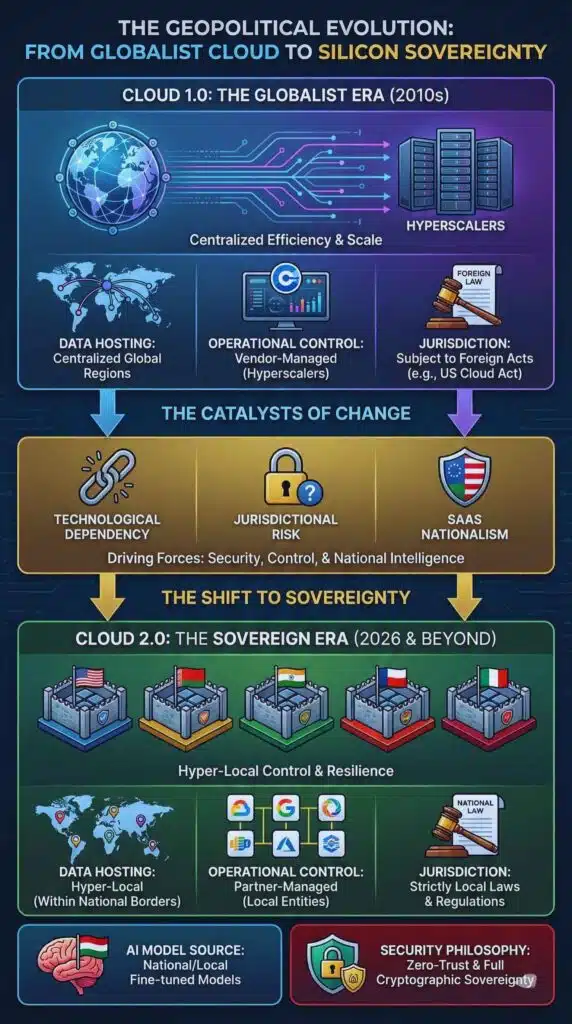
The path to the Silicon Sovereign began with the “Cloud Wars” of the 2010s, where a handful of hyperscalers captured the majority of the world’s data storage. This centralized model prioritized efficiency and scale, but it created a massive strategic vulnerability: technological dependency. By 2026, the arrival of Large Language Models (LLMs) has changed the stakes entirely. Governments have realized that if their critical B2B infrastructure—the software running their banks, hospitals, and power grids—is powered by foreign AI, they are essentially outsourcing their national intelligence to a third party. The risk is no longer just about data privacy; it is about jurisdictional risk. If a foreign power could switch off a cloud service or change the weights of a foundational model, they could effectively paralyze a rival nation’s economy.
SaaS nationalism is fundamentally altering how business-to-business (B2B) technology is sold and deployed. The standard multi-tenant cloud model is being rejected by government-linked sectors in favor of Sovereign Clouds. This isn’t just about where the data sits; it’s about who holds the keys to the kingdom. The new mandate for B2B providers is “Data Residency by Design.” Global giants have had to adapt by launching localized platforms that allow local partners to operate the infrastructure entirely within national borders. This ensures that even the provider cannot access the data without explicit local authorization, shielding the host nation from foreign subpoenas or “kill switches.” This evolution has led to a fragmented but more secure global digital landscape where the “Splinternet” is no longer a prediction but a functional reality.
| Feature | Cloud 1.0 (The Globalist Era) | Cloud 2.0 (The Sovereign Era) |
| Data Hosting | Centralized Global Regions | Hyper-Local (Within National Borders) |
| Operational Control | Vendor-Managed (Hyperscalers) | Partner-Managed (Local Entities) |
| Jurisdiction | Subject to Foreign Acts (e.g., US Cloud Act) | Strictly Local Laws & Regulations |
| AI Model Source | Foreign Proprietary Models | National/Local Fine-tuned Models |
| Security Philosophy | Perimeter & Shared Responsibility | Zero-Trust & Full Cryptographic Sovereignty |
The Mechanics of Sovereign AI Factories and Strategic Compute
In 2026, we are witnessing the rise of the “AI Factory”—a specialized, national-scale data center dedicated to training and running sovereign GenAI models. These facilities are the new oil refineries of the digital age. Countries like Japan and the UAE are investing billions to ensure they have the “compute liquidity” necessary to remain competitive. This compute power is not just for private enterprise; it is a national utility. By controlling the hardware—the specialized chips and high-bandwidth interconnects—nations can prioritize AI training for public health, defense, and economic forecasting over commercial interests. This tiering of compute access has become a major lever of domestic policy.
France, for example, has positioned itself as the European hub for AI sovereignty. By partnering with local champions and investing in massive hardware clusters, the French government is building a compute ecosystem that serves both the public sector and domestic B2B industries. This allows French companies to build AI tools that understand the nuances of French culture, linguistic idioms, and specific legal frameworks without ever sending data to a foreign server. Similarly, the Middle East has emerged as a powerhouse, developing blueprints for Sovereign AI that balance global technology partnerships with local governance. This ensures that a nation’s “Intelligence Grid” can power everything from smart cities to autonomous energy management while maintaining strict alignment with national security protocols.
| Nation/Region | Key Strategy | Primary Infrastructure Focus | Est. 2026 Investment |
| European Union | “Strategic Autonomy” | Local LLMs & GDPR-Compliant Compute | $115 Billion |
| Middle East | “The Intelligence Grid” | AI Sovereign Factories & Energy Integration | $18.5 Billion |
| Japan/Asia-Pacific | “Resilient Supply Chains” | Domestic Chip Fab & Sovereign Clouds | $45 Billion |
| India | “Hyperconnected Bharat” | Multi-language Models & Gov-SaaS | $12 Billion |
The Economic and Social Impact of Technological Fragmentation
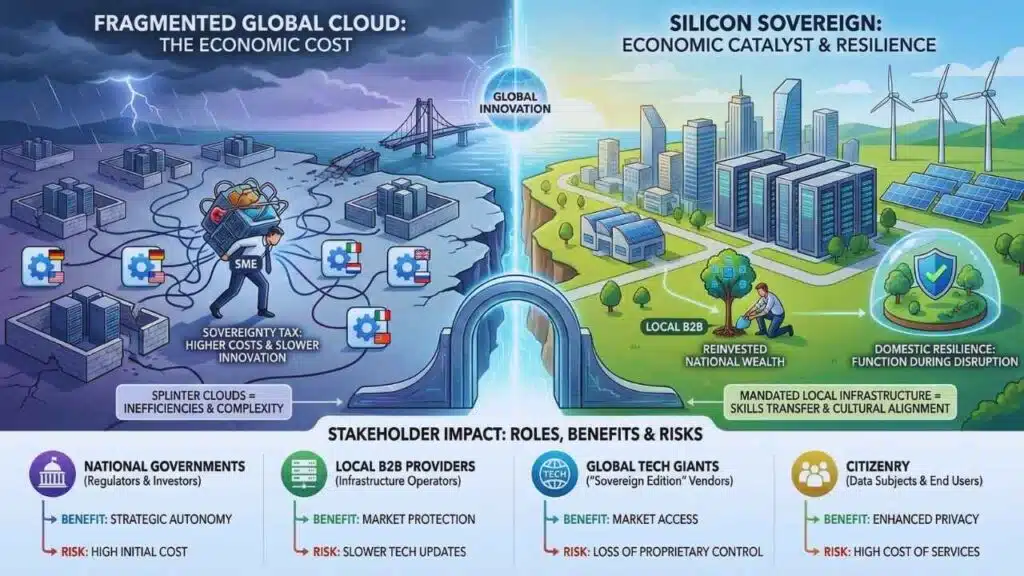
While SaaS nationalism enhances security, it comes with a significant economic price tag. Critics argue that fragmenting the global cloud into “splinter clouds” leads to inefficiencies, higher costs for B2B consumers, and slower innovation. When a company has to maintain twenty different versions of its software to comply with twenty different national sovereignty laws, the cost of doing business skyrockets. This “Sovereignty Tax” is currently being felt most acutely by small and medium enterprises (SMEs) that lack the capital to navigate a complex web of localized requirements. However, proponents argue that these technological walls are actually economic catalysts. By mandating local infrastructure, governments are forcing a transfer of skills and capital.
Instead of paying digital rent to foreign entities, national wealth is reinvested into local data centers, renewable energy projects to power them, and a specialized workforce. This creates a more resilient domestic economy. If a global supply chain for chips or software is disrupted, the nation with its own Silicon Sovereign infrastructure can continue to function, whereas those dependent on the global cloud may find themselves digitally stranded. Furthermore, sovereign AI allows for “Cultural Alignment”—ensuring that AI models do not reflect the biases or values of a foreign power, but rather the unique societal norms of the host country. This preservation of digital culture is becoming a core component of social stability in the AI age.
| Stakeholder | Role in the Sovereign Ecosystem | Primary Benefit/Risk |
| National Governments | Regulators & Investors | Benefit: Strategic Autonomy; Risk: High Initial Cost |
| Local B2B Providers | Infrastructure Operators | Benefit: Market Protection; Risk: Slower Tech Updates |
| Global Tech Giants | “Sovereign Edition” Vendors | Benefit: Market Access; Risk: Loss of Proprietary Control |
| Citizenry | Data Subjects & End Users | Benefit: Enhanced Privacy; Risk: High Cost of Services |
Future Outlook: The Rise of National AI Agents and Pax Silica
As we look toward the remainder of 2026 and into 2027, the trend of the Silicon Sovereign will likely accelerate, moving from passive infrastructure to active “National AI Agents.” These government-sanctioned digital assistants will handle citizen services, tax filings, and healthcare navigation. Because they are built on sovereign B2B infrastructure, these agents will ensure that sensitive citizen interactions never touch the public internet, creating a “walled garden” of public service. This move will redefine the relationship between the citizen and the state, as the AI becomes the primary interface for governance.
Furthermore, we expect the emergence of “Pax Silica” alliances—strategic digital blocs based on shared technical standards and mutual trust. Much like military alliances, these blocs will share compute resources and data pools to stay competitive against rival blocks. The next frontier will be the localized manufacturing of AI hardware. Expect more nations to offer massive subsidies to lure semiconductor fabrication plants to their soil, completing the Silicon Sovereign circle. The era of the borderless internet is fading; in its place, a new map is being drawn—not in ink, but in silicon. For the B2B world, the challenge is clear: Adapt to the national borders of the cloud, or be left out of the most important technological shift of our time.