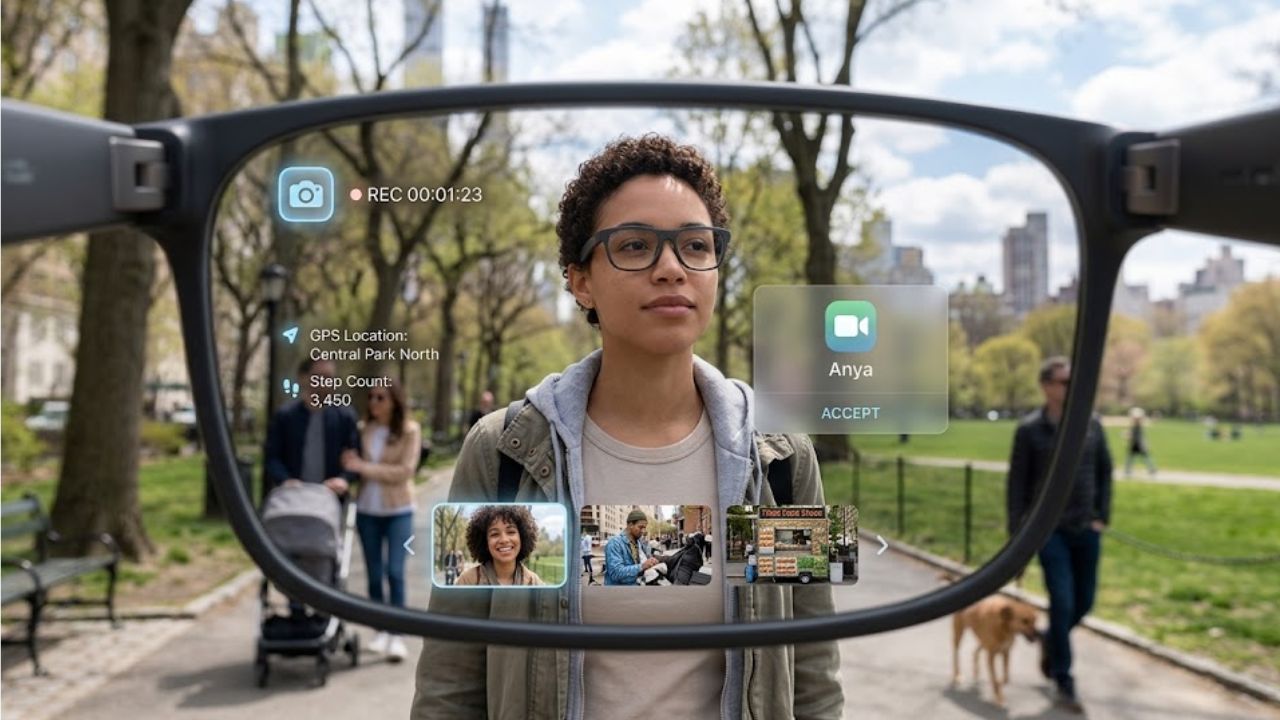
Think about how often you reach for your phone during a normal day. You might pull it out to take a photo, check a message, look something up, or record something that catches your attention. Phones have become so familiar that most of us barely notice how often we interrupt what we are doing to use them.
Smart glasses are taking a different approach. Instead of asking people to carry another device or constantly look at a screen, they bring some of those digital functions directly into something many people already wear.
The idea is simple, but the technology behind it is becoming increasingly sophisticated. Cameras can sit inside the frame, speakers can deliver audio without covering the ears, and AI can respond to questions or interpret information from the world around the wearer. What once sounded like science fiction is gradually becoming a practical category of consumer technology.
When Eyewear Becomes a Technology Platform
Glasses have traditionally been remarkably simple objects. They help people see clearly, protect their eyes from the sun, or complement an outfit. Adding electronics changes that relationship completely.
Today’s smart glasses can include miniature cameras, microphones, speakers, wireless connectivity, and AI capabilities without necessarily looking like a piece of high-tech equipment. That is one of the reasons the category is interesting. The technology is being built into an object people already understand and know how to use.
There is also a broader reason for this shift. Technology companies are looking for ways to make digital interactions feel less intrusive. Instead of another screen demanding attention, wearable devices can provide information through voice and audio or respond to what the user is seeing.
Recent research has explored the growing use of AI-powered smart glasses across different applications while also pointing to challenges involving privacy, battery life, data management, and validation.
The Camera Changes How Moments Are Captured
The camera may be the feature that makes smart glasses immediately understandable.
A phone camera requires a small routine: take the phone out, open the camera, hold it up, compose the shot, take the picture, and put the phone away. None of that is particularly difficult, but it can pull you out of the moment.
A camera built into eyewear works differently. Because it follows the wearer’s viewpoint, it can capture a scene from the same perspective as the person experiencing it.
Imagine walking through a market in another country and suddenly seeing something worth remembering. Or watching a concert and wanting a short clip without holding a phone above your head. The appeal of hands-free recording becomes obvious in situations like these.
For people interested in this combination of everyday eyewear and technology, sunglasses with camera are an example of how cameras are being incorporated into modern frames alongside other connected features.
The bigger attraction, however, is not simply having another camera. It is having one that is available at the exact moment something interesting happens.
AI Turns a Camera Into More Than a Camera
A camera can record what is in front of you. AI can potentially help make sense of it.
That distinction is becoming increasingly important. Smart glasses are moving beyond the idea of wearable cameras toward devices that can understand images, respond to spoken questions, and provide useful information based on context.
For example, someone could eventually look at an unfamiliar object and ask what it is, or point their attention toward a sign and ask for help understanding it. The goal is not necessarily to replace search engines or smartphone apps. It is to make certain interactions quicker and more natural.
Researchers are already investigating these possibilities. A study evaluated AI-enabled smart eyeglasses for identifying and describing stationary objects, demonstrating how the technology could have applications beyond entertainment and photography.
That kind of research is significant because it shows that smart glasses are not only being developed as consumer gadgets. Their ability to combine cameras with AI could eventually make them useful in accessibility, navigation, education, and other areas where understanding the surrounding environment matters.
Sound Without Blocking Your Ears
There is another part of the experience that is easy to overlook: audio.
Many smart glasses use speakers built into the frame rather than requiring conventional earbuds. The wearer can hear music, calls, notifications, or spoken responses while keeping their ears open to the surrounding environment. Researchers have also explored wearable glasses that deliver context-aware information through audio based on a user’s questions and surroundings.
That can be useful in everyday situations. Someone walking through a busy city may want to hear directions without completely isolating themselves from traffic or the people around them. A traveler could listen to information about a destination while continuing to explore, rather than stopping to take out a phone and read a screen.
Voice input is just as important. With microphones built into the frame, interacting with a digital assistant can become more conversational. Instead of typing a question or tapping through an app, the user can simply ask.
None of these individual features is revolutionary on its own. What makes smart glasses interesting is the way they bring audio, voice input, cameras, and connectivity together in a single device.
A Different Relationship With the Smartphone
It is tempting to ask whether smart glasses will replace smartphones. That is probably the wrong question.
Phones remain better suited to many tasks. A large display is useful for editing photographs, watching videos, writing long messages, shopping, gaming, and navigating complex applications. Smart glasses cannot realistically replace all of that.
Their potential lies elsewhere.
They can handle small interactions that currently require a phone. Take a quick photo. Answer a call. Hear a notification. Ask a short question. Record a moment. Listen to information while walking.
In those situations, the phone does not necessarily disappear. It simply stays in your pocket.
That could prove to be one of the strongest arguments for wearable technology. People may not want fewer devices because of a desire to own less technology; they may want technology that gets in the way less often.
Travel Could Be One of the Biggest Use Cases
Few activities involve a smartphone as constantly as travel.
A typical trip can involve taking photographs, checking directions, translating text, researching attractions, communicating with hotels, and searching for restaurants. The phone becomes a digital companion almost by necessity.
Smart glasses could take over some of those smaller interactions.
A traveler walking through an unfamiliar neighborhood might want directions delivered through audio rather than constantly checking a map. A visitor standing in front of a landmark might want to ask a question without pulling out a phone. And when an unexpected moment appears, a hands-free camera can make capturing it much easier.
There is also something appealing about the perspective. Travel photos taken from a phone often show what the traveler deliberately decided to photograph. Wearable cameras can capture a more immediate point of view — the moment as it unfolds from the wearer’s perspective.
Of course, recording in public places comes with responsibilities. Not every moment should be captured, and people nearby may have legitimate expectations of privacy. As camera-equipped eyewear becomes more common, social norms and responsible recording practices will need to develop alongside the technology.
Privacy Could Shape the Future
The convenience of smart glasses comes with a complicated question: what happens when a camera is always within easy reach?
Traditional cameras are usually obvious. A person holding up a phone or using a dedicated camera is visibly recording. Glasses are different because they can look almost indistinguishable from ordinary eyewear.
That makes privacy an important part of the conversation. Manufacturers need to consider how users can clearly indicate when recording is taking place, while users need to think carefully about where and when they use recording features.
Academic research into smart glasses has also emphasized privacy and ethical considerations alongside technical development. These issues will become increasingly important if wearable AI moves into everyday environments rather than remaining a niche product category.
Where Smart Glasses Go From Here
The future of smart glasses probably will not be defined by one spectacular feature. Instead, it will come down to how well several technologies work together.
Battery life needs to improve. Cameras need to become better without making frames bulky. Audio needs to remain clear. AI needs to become faster and more useful, especially as the benefits of 5G connectivity help smart glasses respond faster and work more seamlessly with other devices. And the entire experience needs to remain comfortable enough for people to wear the glasses for hours.
There is also a design challenge. People may be willing to carry a futuristic gadget in their pocket, but they are less likely to wear something on their face if it looks awkward or feels uncomfortable.
That is why the most successful smart glasses may ultimately be the ones that attract the least attention. If a pair looks like normal eyewear but quietly lets its wearer capture a photo, listen to a call, ask an AI assistant a question, or receive useful information, the technology becomes almost invisible.
And that may be the real promise of wearable computing.
Rather than asking people to stop what they are doing and interact with another screen, smart glasses can bring technology into the background of everyday life. The phone will still have its place, but some of the moments that once required reaching into a pocket could eventually happen with little more than a glance or a spoken request.
Smart glasses are still developing, and plenty of questions remain. But the direction is clear: cameras, AI, audio, and connectivity are steadily moving closer to the way people naturally see, hear, and interact with the world.