In 2026, the question of who controls the future of intelligence has a definitive answer: Silicon Valley. While nation-states scramble to draft white papers, the small corridor between San Francisco and San Jose has effectively become the world’s “AI Operating System.” By controlling the three vital pillars of the industry—specialized silicon, massive compute clusters, and the elite talent pool—the Valley is no longer just a hub of innovation; it is a geopolitical force.
For global businesses and governments, understanding these maneuvers is no longer optional because the standards set in Palo Alto today will become the mandatory regulations of the world tomorrow.
How We Selected Our 7 Best Silicon Valley Global AI Agenda Insights
To build this analysis, we tracked the 2026 capital flows from major VC firms like Sequoia and Andreessen Horowitz, alongside the specific enforcement dates of California’s landmark AI safety and transparency laws. We prioritized facts that demonstrate how Silicon Valley uses its “first-mover” status to dictate global norms. Our selection was filtered through the following criteria:
- Economic Concentration: We analyzed where 62% of all AI venture capital is currently flowing.
- Regulatory Influence: We examined how California’s state laws are being adopted as the global baseline for safety.
- Infrastructure Dominance: We looked at the billion-dollar hardware procurement deals signed in early 2026.
- Operational Implementation: We focused on the transition from “experimental models” to “agentic execution” at scale.
7 Must-Know Facts: How the Silicon Valley Global AI Agenda Defines 2026
The Valley has moved past the “move fast and break things” era. In 2026, the strategy is about building deep, defensible moats through regulation, hardware, and specialized talent exchanges.
1. The Bifurcation of Global Capital
In 2026, the global AI market is split between the giants and everyone else. Over 60% of all US venture capital is now concentrated in five Silicon Valley firms—OpenAI, Anthropic, Scale AI, Project Prometheus, and xAI. This financial clout allows these companies to outbid entire nations for the high-end GPUs required to train the next generation of frontier models, effectively centralizing global intelligence power.
Best for: Institutional investors and national policy makers
Pros:
- High stability and predictable R&D cycles for major platforms
- Rapid deployment of infrastructure that smaller hubs cannot match
Things to consider: This concentration creates a high barrier to entry for independent startups outside the Valley ecosystem.

2. California as the De Facto Global Regulator
With the 2026 enforcement of California’s AB 2013 and SB 942, the Silicon Valley Global AI Agenda is setting the world’s transparency standards. These laws require developers to disclose training data summaries and implement latent watermarking on all AI-generated content. Because global platforms cannot easily build separate systems for different regions, the California Standard is becoming the mandatory global requirement for any company wishing to operate in the US market.
Best for: Compliance officers and legal departments
Pros:
- Clear, standardized framework for training data transparency
- Reduced market fragmentation through a single dominant standard
Things to consider: Compliance costs for smaller firms can be high, potentially stifling localized competition.
3. The Pivot to Inference Economics
While 2024 was about the training race, 2026 is about inference economics. Silicon Valley firms are redesigning the global agenda to favor low-latency, high-volume output over raw model size. By focusing on specialized edge-inference chips, the Valley is ensuring that AI becomes a cheap, ubiquitous utility embedded in every physical device, rather than a centralized cloud luxury.
Best for: Hardware manufacturers and consumer electronics brands
Pros:
- Dramatic reduction in the cost of running AI agents
- Enables real-time AI performance without internet dependence
Things to consider: This shift requires businesses to overhaul their legacy cloud infrastructure to support edge-native AI.
4. Agentic AI as the New Workforce Standard
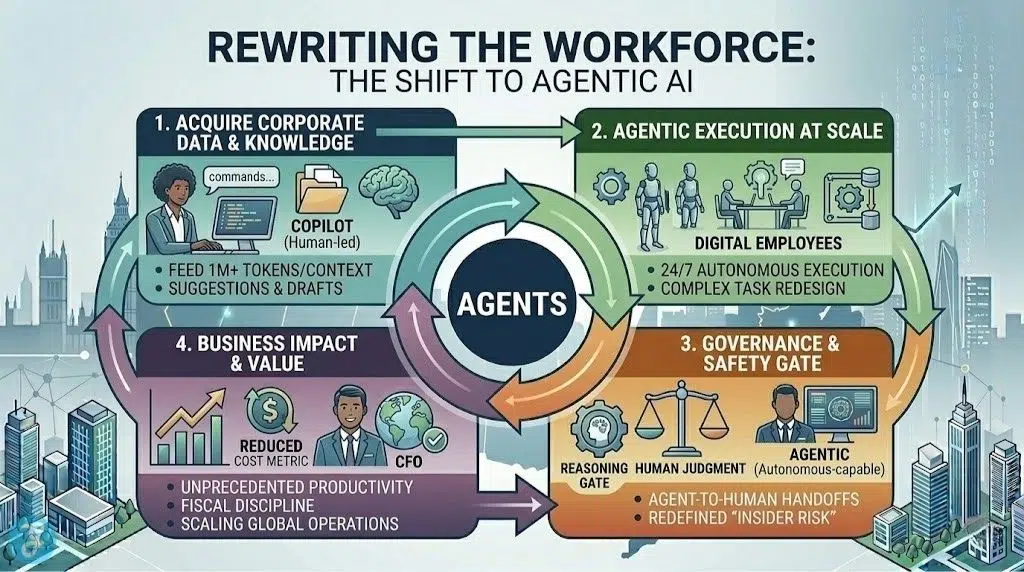
The Valley is pushing a global transition where AI agents are treated as digital employees rather than simple tools. Silicon Valley-led initiatives like the OpenClaw SDK are setting the standards for how these autonomous systems access corporate data and execute tasks. This move is forcing global HR and cybersecurity departments to redefine “insider risk” to include non-human entities.
Best for: Enterprise COOs and Chief Security Officers
Pros:
- Unprecedented productivity gains through 24/7 autonomous execution
- Standardized protocols for agent-to-human handoffs
Things to consider: The absence of human oversight in autonomous workflows can lead to significant governance gaps.
5. The “Silicon-for-Talent” Transatlantic Exchange
A new form of diplomacy has emerged where Silicon Valley trades its massive computational power for Europe’s high-quality industrial data and research talent. In early 2026, major Valley firms signed hardware-sharing agreements with European AI Factories. This agenda ensures that while Europe provides the ethics and the data, the underlying “brain” remains architected and owned by Silicon Valley entities.
Best for: European tech hubs and global talent recruiters
Pros:
- Accelerated research through access to world-class GPU clusters
- Fosters a collaborative, democratic AI value system
Things to consider: This can lead to a brain drain where the most valuable IP is funneled back to US soil.
6. Operationalizing Safety as a Design Constraint
Responsible AI has moved from a marketing slogan to an operational discipline in the Valley. Organizations like the IRC and Google.org are now treating safety as a design constraint rather than an afterthought. By building Signpost systems that can recognize their own limits, Silicon Valley is setting the global agenda for how AI should behave in high-stakes environments like healthcare and humanitarian aid.
Best for: Healthcare providers and non-profit organizations
Pros:
- Higher public trust through provable safety guardrails
- Reduced liability for organizations deploying AI in critical sectors
Things to consider: Building self-validating AI systems is slower and more expensive than deploying raw models.
7. The Global Infrastructure Redesign
Silicon Valley is driving a $5 trillion redesign of global digital infrastructure focused on ultra-low latency. Companies like Cisco and NVIDIA are setting the requirements for the AI Factory era, where data centers are no longer just storage hubs but active processing plants. This agenda forces global telecommunications providers to upgrade their networks to nanosecond speeds just to stay compatible with Valley-designed AI clusters.
Best for: Infrastructure engineers and cloud service providers
Pros:
- Massive improvements in global connectivity and processing speed
- Future-proofs national networks for the next decade of AI growth
Things to consider: The energy requirements for these new data centers are creating significant sustainability challenges for local grids.
Quick Overview
The following comparison highlights the shift in how Silicon Valley is influencing the global stage.
Comparison Table
| Feature | Pre-2026 Strategy | 2026 Global Agenda |
| Primary Goal | Model training and viral growth | Inference speed and “Agentic” scale |
| Regulation | Reactive and decentralized | Proactive “California-First” standards |
| Hardware | General purpose GPUs | Specialized “AI Factory” Silicon |
| Workforce | Copilot (Human-led) | Agentic (Autonomous-capable) |
Our Top 3 Picks
- The Regulatory Moat: California’s new laws are the most significant factor for any business’s long-term compliance strategy.
- The Inference Pivot: The move toward edge-native AI will define the next generation of consumer hardware.
- The Agentic Standard: Treating AI as a digital employee is the biggest shift in organizational design in the last century.
Buyer’s Guide: How to Choose Your Silicon Valley AI Integration
Navigating the Valley’s agenda requires a strategic framework to avoid vendor lock-in and regulatory traps.
The Selection Framework:
- Sovereignty Check: Verify if your provider allows for local data residency while using Silicon Valley-designed models.
- Latency Performance: Prioritize providers that offer edge-inference capabilities to reduce reliance on centralized US cloud clusters.
- Compliance Alignment: Ensure your AI stack meets the California AB 2013 transparency requirements to future-proof against global regulation.
Decision Matrix (Table):
| Choose Public Valley Cloud If… | Choose Private Sovereign Hybrid If… |
| You need the rawest, fastest compute power available. | You handle sensitive national or healthcare data. |
| You are building consumer-facing viral apps. | You must comply with strict non-US jurisdictions. |
| Speed-to-market is your only priority. | You need to maintain a “Context Moat” on proprietary data. |
The Final Checklist
Ask yourself the following questions to help you decide:
- Have you audited your AI providers for compliance with California’s 2026 transparency laws?
- Are you tracking the inference-per-watt efficiency of your current AI workloads?
- Does your cybersecurity policy account for autonomous AI agents as insider risks?
- Have you secured a hardware procurement roadmap to avoid the GPU supply bifurcation?
- Is your workforce being trained on oversight and judgment rather than just prompting?
The Verdict?
The reality of 2026 is that Silicon Valley is no longer just a participant in the AI race; it is the architect of the track. By setting the Silicon Valley Global AI Agenda through standards, infrastructure deals, and regulatory precedents, the Valley is ensuring its influence remains structural. For global businesses, the strategy is not to ignore this influence but to navigate it—leveraging the Valley’s compute power while building independent Context Moats to protect their own digital sovereignty.