The era of “free” AI is over; the era of “funded” AI has begun. As OpenAI introduces ads to survive its own success, Google makes a counterintuitive bet on ad-free purity—for now. In the unfolding Gemini vs ChatGPT divide, the two AI leaders are charting starkly different paths to sustainability.
Key Takeaways: Gemini vs ChatGPT – Google Resists Ads as OpenAI Experiments
- The Divergence: OpenAI is testing ads in its Free and “Go” ($8/mo) tiers to plug a projected $17 billion burn rate, while Google is keeping the Gemini app ad-free to build habit and trust, subsidizing it via its Search empire.
- The Mechanism: ChatGPT’s ads will appear at the bottom of responses based on “conversation context,” signaling a shift from a pure productivity tool to a media hybrid.
- The Gamble: Google is positioning Gemini as a “neutral assistant” to contrast with ChatGPT’s new commercial layer, aiming to steal user loyalty despite being the world’s biggest advertiser.
- The Stakes: This is a battle for the “Interface of the Future.” If ChatGPT’s ads succeed, the entire AI industry may pivot to an “attention economy” model, fundamentally changing how AI serves answers.
Contextual Background: The Billion-Dollar Burn
For the past three years, the Generative AI revolution was subsidized by venture capital. The implicit promise was that subscription revenue (the $20/month Plus model) would eventually cover the staggering costs of compute. By early 2026, that math stopped working.
With OpenAI projecting a $17 billion cash burn in 2026 due to massive infrastructure costs (including a $1.4 trillion long-term commitment), the “free tier” became a financial black hole. Only ~5% of its 800 million users convert to paid plans. Simultaneously, Google has stabilized its ship. By integrating AI into its high-margin Search business (AI Overviews), Google has secured its revenue stream, allowing it to treat the standalone Gemini app as a “loss leader” to capture ecosystem dominance.
This week’s confirmation that ChatGPT will test ads in the US, while Google explicitly confirmed Gemini will remain ad-free, marks the first major bifurcation in AI business models.
Core Analysis: The Battle for the Business Model
1. The Financial Imperative vs. The Ecosystem Play
OpenAI’s move is defensive; Google’s is offensive. OpenAI, despite its massive valuation, operates like a startup that must show a path to profitability to satisfy investors like Microsoft. It cannot afford to subsidize 760 million free users indefinitely. Ads are the only lever left to monetize this massive base without putting up a paywall that would kill growth.
Google, conversely, plays a different game. It doesn’t need Gemini to be profitable today because Google Search already generates billions. By keeping Gemini ad-free, Google creates a “premium” perception for its product. It is effectively weaponizing its bank account to squeeze OpenAI: if users get annoyed by ChatGPT’s ads, the ad-free Gemini is just a click away.
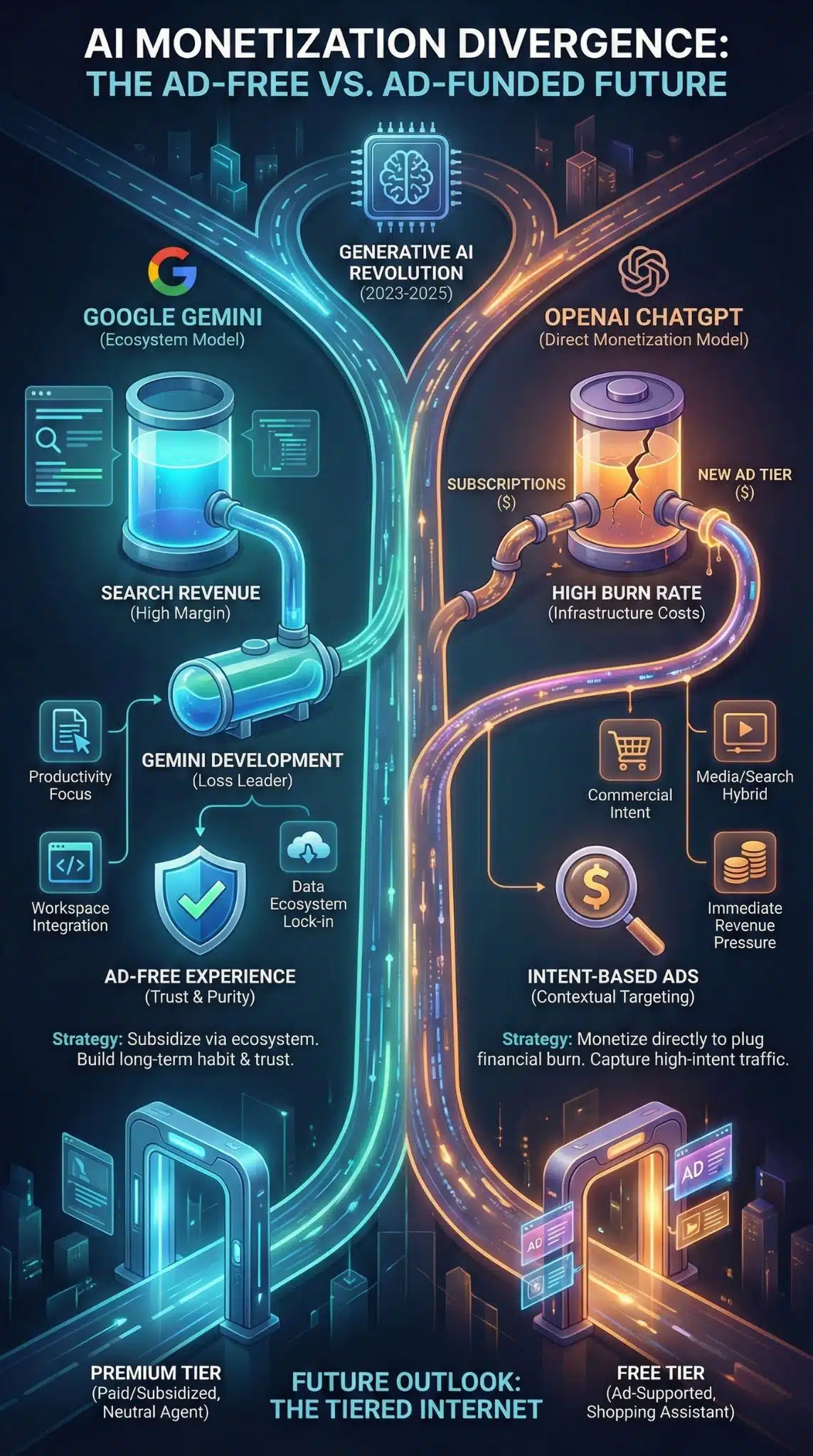
The Economics of Survival (2026 Projections)
| Metric | OpenAI (The Specialist) | Google (The Ecosystem) |
| 2026 Projected Burn Rate | ~$17 Billion (Critical High) | Absorbed by $300B+ parent revenue |
| Primary Funding Source | VC Capital + Subscriptions | Search Ads + Cloud Revenue |
| Free User Strategy | Monetize Directly (Ads) | Monetize Indirectly (Data/Lock-in) |
| Infrastructure Cost | High (Renting Azure) | Low (Owns TPUs/Data Centers) |
| Pressure to Monetize | Immediate / Existential | Low / Strategic |
2. The “Assistant” vs. “Search Engine” Identity Crisis
This split reveals how each company defines its tool.
- ChatGPT as a Media Platform: By introducing ads, OpenAI acknowledges that ChatGPT is often used as a search engine (e.g., “Best hotels in Tokyo”). Capturing this “high-intent” traffic is lucrative. However, it risks diluting the tool’s identity as a creative partner.
- Gemini as a Workspace Extension: Google wants Gemini to be seen as an extension of your brain—a place to draft emails, code, and analyze docs. Ads in this context are intrusive and break “flow.” Google reserves its ads for Search, keeping the Assistant (Gemini) clean to encourage deep integration into users’ lives.
User Experience Friction Comparison
| Feature | ChatGPT (Free/Go Tier) | Google Gemini (App) |
| Ad Placement | Bottom of response (Contextual) | None (Currently) |
| Ad Trigger | Real-time conversation keywords | N/A |
| Visual Clutter | Moderate (Sponsored tags/Links) | Zero (Clean Interface) |
| User Mindset | “I am being sold to” | “I am being helped” |
| Risk of Ad Blindness | High (Users may ignore bottom text) | N/A |
3. Trust and the Hallucination Hazard
The biggest risk for ad-supported AI is “hallucination for profit.” If an AI is paid to show an ad for a specific shoe brand, users may subconsciously doubt whether the AI’s organic recommendation of that brand is genuine or influenced.
OpenAI has stated ads will be “clearly labeled” and “separate” from organic answers. However, in a conversational interface, the line is blurrier than on a search results page. Google avoids this specific minefield in Gemini, preserving the “fiduciary” feel of the assistant, while happily serving ads in its traditional Search results where users expect them.
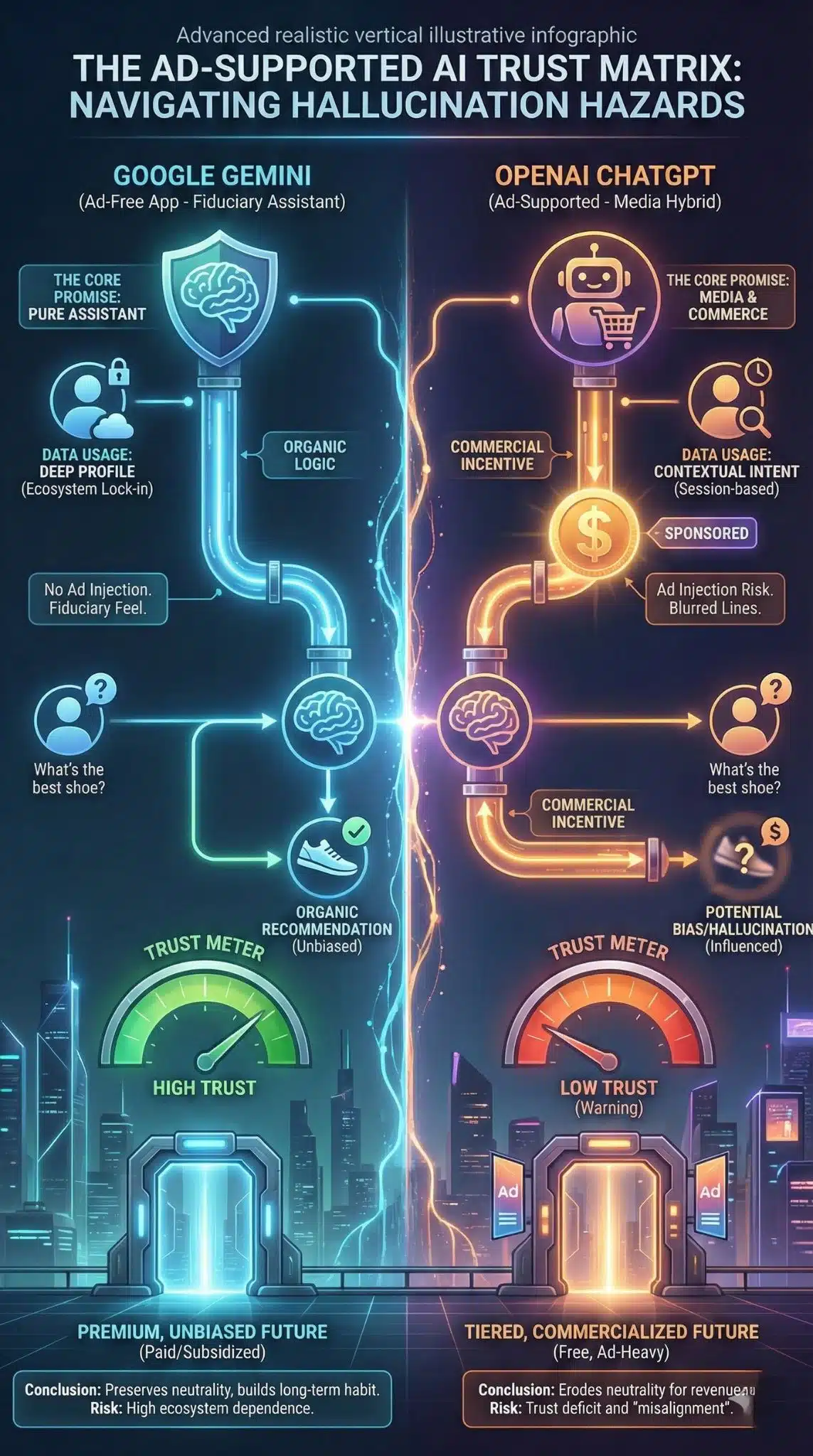
The Trust & Privacy Matrix
| Factor | ChatGPT Ad Model | Gemini Ecosystem Model |
| Data Used for Ads | Current Session Context (Intent) | History & Account Data (Deep Profile) |
| Privacy Promise | “We don’t sell training data” | “We use data to improve services” |
| Bias Concern | High: Will AI favor advertisers? | Low: (In App) / High (In Search) |
| Brand Safety | Hard to control in generated text | High (Strict control in Search) |
4. The Rise of “Agentic Commerce”
We are witnessing the birth of Agentic Commerce. This goes beyond simple banner ads.
- Actionable Ads: Instead of just showing a link to a hotel, ChatGPT will soon offer to book the hotel for you within the chat interface, taking a commission. This moves the model from “Cost Per Click” (CPC) to “Cost Per Action” (CPA).
- The Bundling War: Google will likely keep Gemini ad-free for as long as possible to bleed OpenAI. Eventually, OpenAI might be forced to bundle ChatGPT with other services (like they are doing with Apple/Microsoft partnerships) to maintain value.
Expert Perspectives
- The Bull Case for Ads: Caroline Giegerich, VP of AI at IAB, suggests that this is a “watershed moment.” If done correctly, conversational ads could be more valuable than search ads because the user has already provided deep context. “It’s not an interruption; it’s a solution,” proponents argue.
- The Bear Case for Trust: Sajal Gupta, Tech Analyst, warns that “The free layers available today will not be permanent.” He argues that once ads are introduced, the incentive to provide concise answers diminishes. The AI might become “chatty” to keep you on the page longer—a phenomenon known as “misalignment.”
- The Google Strategy: Dan Taylor, Google VP of Global Ads, emphasized that Gemini and Search are “complementary but distinct.” This signals Google knows that putting ads in a “creative partner” tool like Gemini would kill adoption faster than a subscription fee.
Future Outlook: The “Tiered” Internet
The divergence between Gemini and ChatGPT signals a future where the internet splits into two distinct experiences:
- The Clean Web (Paid/Subsidized): AI tools that summarize information, remove clutter, and act as neutral agents. (Gemini App, ChatGPT Plus).
- The Cluttered Web (Free): AI tools that act as “shopping assistants,” constantly nudging users toward transactions to pay for the compute bills. (ChatGPT Free, Bing Chat).
What Comes Next?
- Q3 2026: Expect Google to introduce “Sponsored Actions” in Gemini (e.g., “Book this flight with Google Flights”) rather than traditional ads, keeping the interface clean while monetizing the action.
- 2027: OpenAI may be forced to restrict “advanced reasoning” models (like o1/o3) strictly to paid tiers, leaving the free tier with faster, dumber, ad-heavy models.
Final Words
The divergence between OpenAI and Google signals the definitive end of the “free lunch” era in generative AI. As ChatGPT pivots to an attention-based model to plug its financial burn rate, Google plays the long game, subsidizing Gemini to capture ecosystem loyalty. This isn’t just a business shift; it is a user experience fork. We are moving toward a tiered digital reality where neutrality is a premium feature, and “free” access comes with a visible commercial tax on your attention.