

Launching a new business is an exciting milestone, but getting your brand noticed in a crowded market presents a distinct challenge. Startups rarely have the luxury of multi-million dollar advertising budgets. Instead, they must rely on agility, high-ROI tactics, and clear messaging to convert casual interest into sustainable revenue.
Executing effective digital marketing strategies for startups requires prioritizing scalable channels over quick fixes. By combining organic reach, targeted paid efforts, and strong customer retention practices, early-stage companies can punch above their weight class. Below are 15 actionable strategies designed to help startups build brand awareness and drive measurable growth.
15 Powerful Digital Marketing Strategies for Startups
1. Search Engine Optimization (SEO)
Organic search remains one of the most reliable long-term customer acquisition channels for new businesses.
-
How It Works: Research long-tail keywords that your ideal customers search for when looking for solutions. Optimize your website structure, page speed, and content to rank organically on search engine results pages.
-
Why It Matters for Startups: SEO builds compounding traffic over time, reducing your long-term reliance on paid advertisements.
-
Pro Tip: Focus heavily on user search intent rather than just keyword density.
2. Educational Content Marketing
Publishing insightful articles, guides, and resources builds immediate domain authority and earns trust with prospective clients.
-
How It Works: Identify the biggest pain points of your target audience and create comprehensive articles, downloadable checklists, or how-to guides that solve those problems without demanding a hard sale.
-
Why It Matters for Startups: Establishes your company as a trusted industry authority while supporting your SEO footprint.
3. Strategic Short-Form Video Marketing
Short videos on platforms like TikTok, YouTube Shorts, and Instagram Reels offer unmatched organic reach for new accounts.
-
How It Works: Produce 15 to 60-second clips showing behind-the-scenes founder stories, product tutorials, or industry commentary.
-
Why It Matters for Startups: Algorithms on short-form platforms distribute content based on viewer interest rather than follower count, giving new accounts instant visibility.
4. Target-Driven Email Marketing
Email marketing continues to generate one of the highest returns on investment across all digital marketing channels.
-
How It Works: Offer a high-value lead magnet (such as a free template or trial) in exchange for email addresses. Nurture those leads with automated welcome sequences that deliver value before introducing paid offerings.
-
Why It Matters for Startups: Gives you direct ownership over your audience without relying on third-party social media algorithms.
5. Hyper-Targeted Pay-Per-Click (PPC) Advertising
Paid search ads allow startups to capture high-intent buyers at the exact moment they are looking to make a purchase.
-
How It Works: Run targeted ad campaigns on Google Search for specific transactional keywords related to your product or service. Set strict daily budget caps to manage burn rate.
-
Why It Matters for Startups: Delivers immediate traffic and validates messaging while your organic channels are still developing.
6. App Store Optimization (ASO) for Mobile Products
For startups launching mobile applications, ranking inside digital app storefronts is critical to organic discovery.
-
How It Works: Optimize app titles, subtitle keywords, preview screenshots, and localized descriptions. Actively encourage positive user reviews and rating updates.
-
Why It Matters for Startups: Converts high-intent store browsers into active downloads without requiring ongoing ad spend.
7. Micro-Influencer Partnerships
Partnering with niche creators often yields higher engagement rates than collaborating with celebrity influencers.
-
How It Works: Identify creators with 5,000 to 50,000 dedicated followers in your specific niche. Send free product samples or offer commission-based affiliate deals in exchange for authentic reviews.
-
Why It Matters for Startups: Highly cost-effective access to pre-built, trusting audiences.
8. Referral and Word-of-Mouth Campaigns
Turning your earliest adopters into active brand advocates accelerates user acquisition through built-in social proof.
-
How It Works: Implement a two-sided incentive program where existing users earn discounts, account credits, or perks whenever they successfully refer a friend.
-
Why It Matters for Startups: Referred customers typically have higher retention rates and lower acquisition costs.
9. Social Media Community Building
Rather than treating social channels like broadcast towers, startups should treat them like interactive community hubs.
-
How It Works: Create dedicated discussion groups on Facebook, LinkedIn, or Discord centered around an industry interest rather than just your product.
-
Why It Matters for Startups: Direct community feedback offers valuable product development insights while fostering brand loyalty.
10. Strategic Guest Posting and Digital PR
Earning coverage on established news sites and industry blogs introduces your business to new audiences while generating valuable backlinks.
-
How It Works: Pitch original industry data, founder stories, or expert commentary to journalists and blog editors in your domain.
-
Why It Matters for Startups: Dramatically improves domain authority and brand credibility in the early stages.
11. Retargeting and Remarketing Campaigns
Most first-time website visitors leave without making a purchase or signing up. Retargeting brings them back into your funnel.
-
How It Works: Install tracking pixels on your site to display targeted display or social ads to users who previously viewed your pages without converting.
-
Why It Matters for Startups: Maximizes the efficiency of your initial traffic by keeping your brand top-of-mind.
12. Interactive Tools and Calculators
Building lightweight, free interactive tools attracts high volumes of organic traffic and backlinks.
-
How It Works: Create a free web tool, such as an ROI calculator, a diagnostic quiz, or a basic generator that solves a micro-problem for your audience.
-
Why It Matters for Startups: Generates high engagement and natural shares, serving as a powerful top-of-funnel lead generator.
13. Local SEO and Google Business Profile
For location-based startups or service providers, dominating local search is essential for acquiring nearby clients.
-
How It Works: Claim and fully optimize your Google Business Profile, collect verified customer reviews, and maintain consistent NAP details across directory listings.
-
Why It Matters for Startups: Places your business directly in front of local customers actively seeking immediate services.
14. Co-Marketing and Brand Alliances
Teaming up with non-competing businesses that share your target audience allows you to double your promotional reach.
-
How It Works: Co-host webinars, bundle complementary products, or co-author industry reports alongside partner brands.
-
Why It Matters for Startups: Halves marketing costs while granting instant credibility through association.
15. Conversion Rate Optimization (CRO)
Attracting traffic is only half the battle; converting those visitors into leads or paying customers determines marketing efficiency.
-
How It Works: Run A/B tests on landing page headlines, call-to-action buttons, form fields, and page layouts to eliminate conversion friction.
-
Why It Matters for Startups: Increases revenue generated from existing traffic without increasing marketing spend.
Case Study: Leveraging Guest Blogging for Early SaaS Growth
To see how organic channels function in practice, consider how early social media management startup Buffer established its initial user base.
In its first few months, Buffer faced a zero-dollar marketing budget. Instead of buying digital ads, the founder executed a guest blogging strategy, writing over 150 guest posts for industry-relevant sites over a nine-month period.
-
Targeted Value Delivery: Rather than pitching the software directly, each guest post delivered actionable social media strategies and productivity tips to readers.
-
Compounding SEO Backlinks: Every published post included a contextual link back to Buffer’s landing page, establishing domain authority and search visibility.
-
Result: This simple, zero-cost content campaign scaled the startup from zero to over 100,000 active users within its first year.
Balancing Short-Term Growth with Long-Term Brand Equity
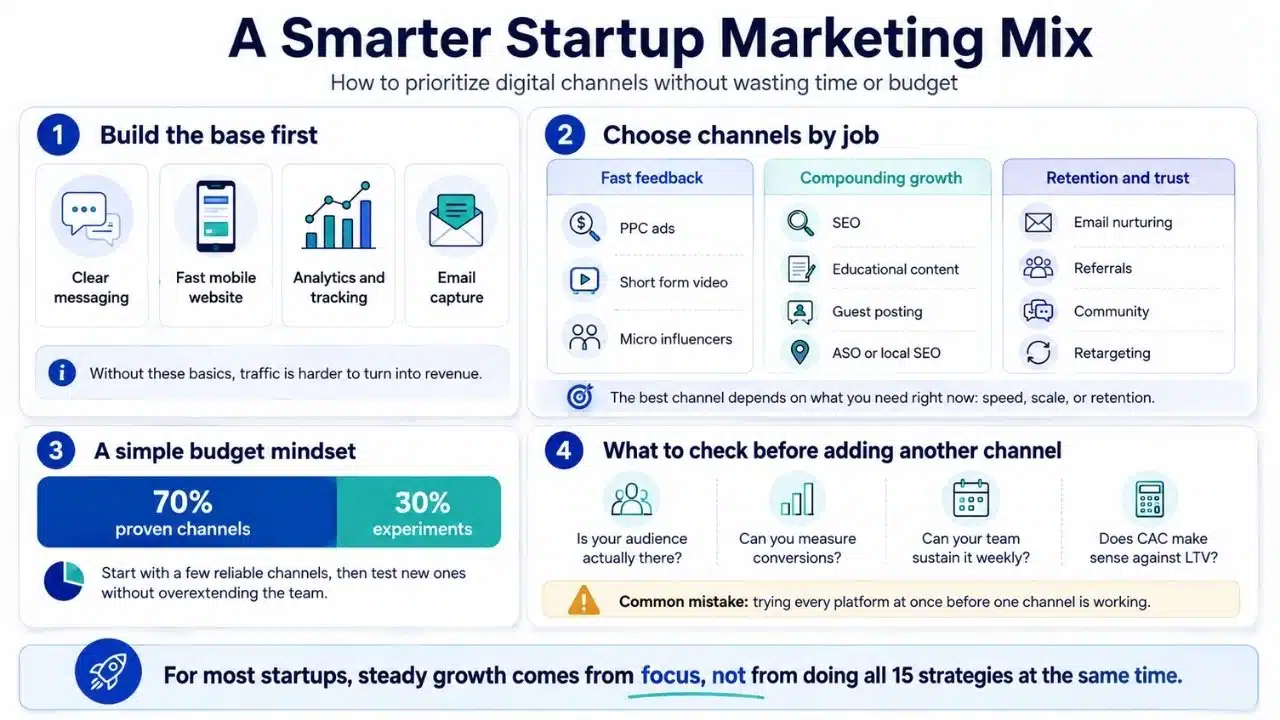
When building out your startup’s marketing engine, it is easy to over-index on either fast paid campaigns or slow organic strategies. A balanced approach works best:
-
The 70/30 Rule: Dedicate roughly 70% of your resources to predictable, sustainable channels (like SEO, email nurturing, and content marketing) and 30% to agile experiments (like new ad platforms or creator partnerships).
-
Track Unit Economics: Always measure Customer Acquisition Cost (CAC) against Customer Lifetime Value (LTV) to ensure your growth tactics remain profitable as you scale.
-
Iterate Based on Data: Avoid running all 15 strategies simultaneously. Start with 2 or 3 channels, master them, and expand once you reach predictable results.
Limitations & Trade-Offs
While digital marketing offers unprecedented scale, founders must navigate real-world constraints:
-
Time vs. Capital: Organic strategies like SEO and content marketing cost less upfront but require months to yield results. Paid ads yield fast traffic but require steady cash flow.
-
Resource Overextension: Attempting to maintain an active presence across every social platform leads to burnout and diluted messaging.
-
Platform Dependency: Building your entire business on a single third-party ad network or social algorithm leaves you vulnerable to unexpected policy updates.
Building a Sustainable Growth Engine
Selecting the right digital marketing strategies for startups comes down to understanding your target audience, working within your resource constraints, and remaining consistent. By combining organic content, focused digital channels, and conversion optimization, your startup can establish a reliable pipeline for customer acquisition.
Frequently Asked Questions(FAQs) on Digital Marketing Strategies for Startups
Which digital marketing strategy gives the fastest results for startups?
Pay-Per-Click (PPC) advertising and targeted social ads offer the fastest immediate traffic, making them ideal for quick messaging validation and early lead generation.
How much should a new startup spend on digital marketing?
Early-stage startups typically allocate 12% to 20% of their projected revenue toward marketing, focusing heavily on low-cost organic channels until product-market fit is achieved.
Is SEO still worth it for early-stage startups?
Yes. While SEO takes time to gain momentum, it builds a long-term competitive moat and creates a stable baseline of organic traffic that reduces your dependency on paid ad budgets.