Expanding into global markets in 2026 requires more than a high-quality product; it demands a technical SEO strategy that acknowledges the shift toward AI-driven search. Scandinavian brands, often synonymous with quality and ethical production, are uniquely positioned to win in international markets if they can bridge the gap between their Nordic-standard English and the localized nuances of global search intent.
This guide provides seven professional strategies for scaling your digital footprint beyond the Nordics.
How We Selected Our 7 Multilingual SEO Pro Tips for 2026
To identify the most effective strategies for Scandinavian firms this year, we analyzed the performance of leading Nordic exporters against the latest Generative Engine Optimization (GEO) benchmarks. Our focus was on the specific challenges these businesses face: high English proficiency that often leads to “safe” but generic international content, and a technical infrastructure that must support multiple regional variants without diluting domain authority.
We utilized the following benchmarks to evaluate the effectiveness of these strategies in the current global market.
-
GEO Visibility: Ensuring content is structured for citation by AI agents like Gemini and Perplexity in multiple languages.
-
Intent Accuracy: Prioritizing native-level keyword research over direct translation from Swedish, Danish, or Norwegian.
-
Authority Retention: Evaluating the balance between ccTLDs and subfolders for maintaining central domain strength.
-
Trust Signal Integration: Leveraging Scandinavian-specific advantages, such as sustainability metrics, as global ranking factors.
By applying these standards, we identified the tips that offer the highest return on investment for Nordic brands entering the US, EU, and Asian markets.
The global search landscape is increasingly fragmented, with users relying on a mix of traditional search engines and AI assistants. These seven tips will help you navigate this complexity while maintaining your brand’s unique Nordic identity.
The first step in any global expansion is moving away from the “English-first” trap that many Nordic firms fall into.
1. Prioritize Native-Intent Keyword Research
In 2026, high English proficiency in Scandinavia is a double-edged sword; it often leads brands to assume that a well-translated English page is sufficient for the US or UK. However, search intent is culturally specific. While a Swedish user might search for “hållbart mode,” a US user might look for “ethical clothing” or “slow fashion.” You must research keywords from scratch in every target language to capture the local “vibe” and specific query patterns.
Best for: Marketing teams looking to capture high-conversion local traffic rather than just generic international views.
Why We Chose It:
-
Direct translation often misses the “slang” or regional variations that drive the majority of search volume.
-
Localized intent significantly reduces bounce rates by providing users with exactly what they expect to see.
-
It helps avoid “thin content” penalties where pages are seen as mere clones of the original Swedish or Danish version.
Things to consider: Use local SEO specialists for this research rather than relying on automated translation tools or your internal team’s English skills.
Once you have identified your local intent, you must ensure that search engines can accurately route users to the correct page.
2. Implement Automated Hreflang Governance
Hreflang tags remain the most critical technical signal for multilingual SEO, but they are also the most prone to breaking during site updates. For Scandinavian firms managing multiple regional variants (e.g., SE, DK, NO, and International English), manual setup is no longer viable. In 2026, you should utilize automated hreflang scripts that dynamically update tags as you add or remove localized content.
Best for: E-commerce and SaaS brands with rapidly changing product lines across multiple regional domains.
Why We Chose It:
-
Automation prevents “language drift,” where a German user is mistakenly served your English or Swedish page.
-
It ensures that Google and other engines see each regional variant as a unique, intentional page rather than duplicate content.
-
Correct hreflang implementation is a primary factor in maintaining your global ranking in AI-generated answer boxes.
Things to consider: Regularly audit your hreflang clusters using tools like Sitebulb or Screaming Frog to catch “return tag” errors early.
As AI becomes the primary way users find information, your content structure must evolve to support machine extraction.
3. Structure Content for Generative Engine Optimization (GEO)
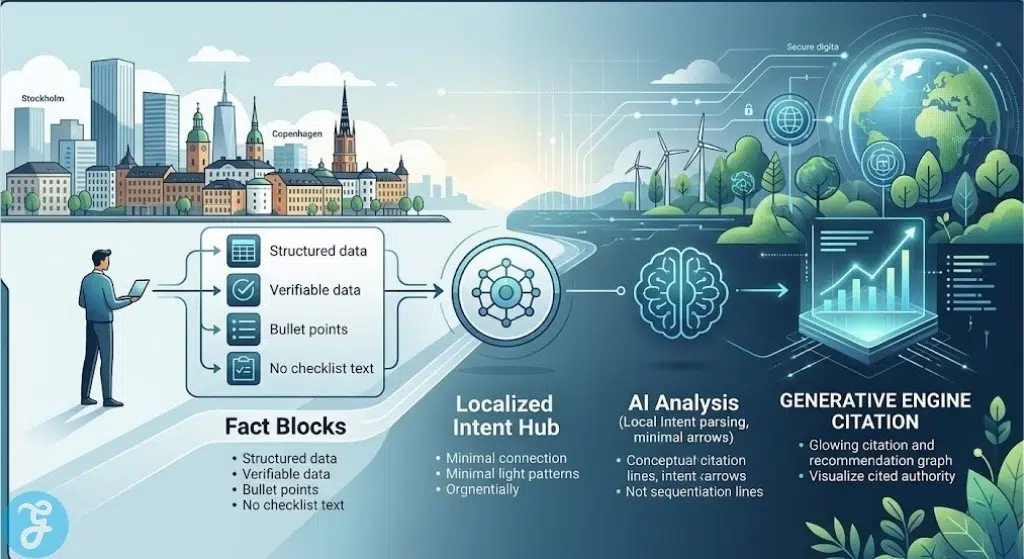
AI assistants like ChatGPT and Google AI Overviews now account for over 60 percent of information retrieval in 2026. For a Scandinavian brand to be “cited” as a top recommendation, your content must be structured into verifiable “fact blocks.” Use clear headings, bulleted summaries, and schema markup to make your value proposition undeniable to an AI agent in New York or Tokyo.
Best for: B2B firms and technology companies that want to be cited as industry leaders in AI-generated research.
Why We Chose It:
-
AI models prioritize content that is easy to summarize and extract for their generated responses.
-
It moves your brand beyond a simple link in a SERP to a cited authority in a conversational answer.
-
Scandinavian “minimalism” in design can be reflected in your content structure to create highly readable, factual pages.
Things to consider: Test your localized pages through AI prompts to see if your brand is being accurately recommended for relevant queries.
A major strategic decision for any expanding firm is how to structure their web presence for maximum authority.
4. Strategic URL Architecture: Subfolders vs. ccTLDs
The debate between using subfolders (example.com/us/) and country-code top-level domains (example.us) has shifted in 2026 toward a hybrid approach. For most Scandinavian businesses, using subfolders is the best way to retain “Nordic” domain authority while scaling. However, for high-stakes markets like Germany (.de) or Japan (.jp), a ccTLD is often necessary to build local trust and signal extreme geographic relevance.
Best for: Businesses looking to balance the cost of domain management with the need for high local trust signals.
Why We Chose It:
-
Subfolders allow your localized pages to benefit immediately from the authority of your primary global domain.
-
ccTLDs provide a massive local ranking boost and higher click-through rates in culturally protective markets.
-
A hybrid model allows you to “bet big” on priority markets while maintaining a lean international presence elsewhere.
Things to consider: Managing multiple ccTLDs is significantly more expensive and requires a dedicated technical resource for each domain.
Building localized authority requires more than just internal structure; it requires external validation from the target region.
5. Build Regional Backlink Authority
A common mistake for Nordic brands is relying on their existing high-authority links from Scandinavian media to rank in the US or UK. In 2026, search engines heavily weigh regional relevance. You must actively build a “local link profile” by securing guest posts, directory listings, and influencer mentions from the specific country you are targeting.
Best for: Brands entering highly competitive global markets where local authority is a “gatekeeper” for top rankings.
Why We Chose It:
-
Local links act as a “geographic verification” that your business is truly active and relevant in that market.
-
It helps search engines distinguish your US site from your global site in terms of regional importance.
-
PR outreach in your target market builds brand awareness alongside your SEO strength.
Things to consider: Quality over quantity is vital here; one link from a high-authority UK trade publication is worth fifty generic global directory links.
Scandinavian brands have a natural advantage that should be used as a primary SEO trust signal.
6. Leverage Sustainability and Ethics as Trust Signals
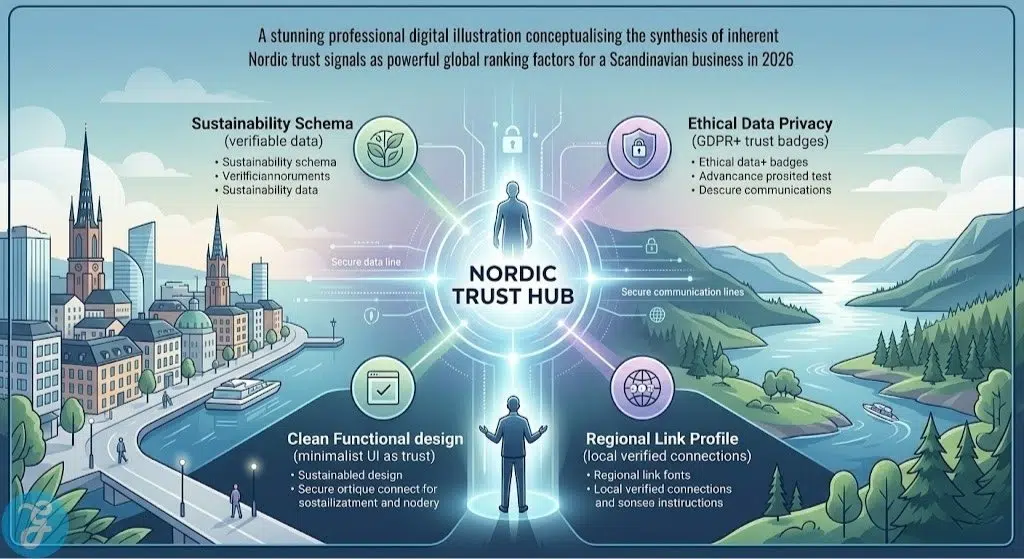
In 2026, search engines increasingly use “Experience, Expertise, Authoritativeness, and Trustworthiness” (E-E-A-T) as a core ranking pillar. Scandinavian businesses are world leaders in sustainability and data privacy. By prominently featuring these “Nordic values” through structured data and localized trust badges, you can outrank global competitors who lack your ethical pedigree.
Best for: FMCG, Fashion, and Tech brands that want to capitalize on the “wiser wallet” trend of 2026 consumers.
Why We Chose It:
-
Consumers in 2026 are highly sensitive to brand ethics and sustainability, often using them as a filter for their purchases.
-
Structured data (like B-Corp status or carbon footprint schema) makes these “trust signals” visible to both humans and AI.
-
It provides a unique differentiator that allows you to compete on values rather than just price.
Things to consider: Ensure these trust signals are localized—for example, highlight EU-compliant data privacy when targeting European markets.
The final step is ensuring your localized content doesn’t just rank, but actually converts by speaking the local “visual” language.
7. Localize Your “Visual” Language and UI
SEO isn’t just about text; it’s about the entire user experience. A website that ranks well but “looks Swedish” (minimalist, high whitespace) may struggle in markets like South Korea or the US where users expect higher information density or different color palettes. In 2026, localized UI/UX is a behavioral signal that search engines use to determine the quality and relevance of your page.
Best for: E-commerce and consumer-facing brands where the “vibe” of the site directly impacts conversion rates.
Why We Chose It:
-
Lower bounce rates and higher dwell time from a “native-feeling” UI are strong positive ranking signals.
-
It prevents the “uncanny valley” effect where a site feels translated and untrustworthy to a local user.
-
Localizing measurement units, currency, and date formats is the baseline for global user trust.
Things to consider: Use A/B testing in your target markets to see which visual layouts resonate best before committing to a full rollout.
Global Expansion Comparison 2026
Successfully moving from a Nordic-focused site to a global one requires a shift in how you view your technical and content assets. The following table summarizes the key differences in strategy.
The data below represents the transition from a “Nordic-Standard” site to a truly “Global-Ready” 2026 presence.
| Feature | Nordic-Standard (Pre-Expansion) | Global-Ready 2026 Strategy |
| Translation | Direct translation from Swedish/Danish | Native-intent localization from scratch |
| URL Structure | Subdirectories (e.g., .se/en/) | Optimized subfolders or strategic ccTLDs |
| Tech Strategy | Traditional SEO (Links/Keywords) | Generative Engine Optimization (GEO) |
| Trust Signals | General Scandinavian quality | Structured “Ethical & Sustainable” data |
| Backlinks | Predominantly Scandinavian sources | Region-specific (US/UK/EU) link profile |
Our Top 3 Critical SEO Factors and Why?
While all seven tips are essential for growth, these three are the most vital for Scandinavian firms to master in the current 2026 environment.
-
Native-Intent Localization: Without this, your content will never truly resonate or rank for the high-volume queries that local competitors are winning.
-
GEO Readiness: As AI search dominates, being “citable” is the only way to maintain top-of-funnel visibility in global markets.
-
Hreflang Governance: Technical errors in language routing can destroy a global SEO campaign before it even starts.
How to Audit Your Global SEO Readiness?
Before launching into a new market, you must perform a rigorous audit of your existing international assets. A successful expansion is built on a foundation of data-driven decisions.
-
Run an Intent Gap Analysis: Compare your top Swedish/Danish keywords with their English equivalents and check if the search volume and intent truly match in the target region.
-
Audit Your Technical Signals: Use a crawler to verify that your hreflang tags are self-referencing and consistent across all regional variants.
-
Test for “Nordic Bias”: Have a native speaker in your target market review your UI and copy to see if anything feels “alien” or untrustworthy.
-
Check AI Visibility: Use an AI prompt tool to see if your brand is currently mentioned when users ask for recommendations in your specific niche.
The following table can help you decide which path to take based on your current expansion goals.
| Focus on Technical Foundations if… | Focus on Localized Authority if… |
| You are launching in multiple markets simultaneously. | You are “betting big” on one high-value market (like the US). |
| You have recurring issues with the wrong language ranking. | You are struggling to outrank established local competitors. |
| You want to build a scalable, automated SEO workflow. | You need to build deep trust with a culturally specific audience. |
The Final Global Expansion Checklist
-
[ ] Hire native SEO consultants for keyword research in your top 3 priority markets.
-
[ ] Implement an automated hreflang management tool to handle regional routing.
-
[ ] Reformat your top 20 landing pages into “fact blocks” for AI extraction.
-
[ ] Secure at least 5 high-authority local backlinks in your primary target country.
-
[ ] Add structured schema for your sustainability and ethical certifications.
Securing Your Nordic Legacy on the Global Stage
The path from a Scandinavian regional leader to a global search powerhouse is paved with cultural nuance and technical precision. By embracing Multilingual SEO for Scandinavian Businesses, you are ensuring that your brand’s reputation for excellence is translated accurately for a global audience. The goal in 2026 is to build a digital presence that feels as native in London or San Francisco as it does in Stockholm or Oslo, allowing your products to speak for themselves in every corner of the world.
Why doesn’t my high-ranking Swedish site rank in the UK?
Answer: Search engines view regional relevance as a primary factor. Without localized intent, local backlinks, and correct hreflang tags, your Swedish authority does not “transfer” automatically to the UK.
Is machine translation good enough for SEO in 2026?
Answer: No, machine translation often misses cultural nuances and local keyword preferences. While it can be used for “drafting,” native human oversight is essential for SEO success.
Should I use a .com or a .se domain for my international site?
Answer: A .com domain is the most versatile for global expansion, as it allows you to use subfolders to build international authority while keeping your “Nordic” domain for the local market.
What is the most common technical error in multilingual SEO?
Answer: Broken or missing “return tags” in hreflang implementations is the most common error, which leads to search engines ignoring the tags and ranking the wrong language version.
Answer: Focus on your “Nordic advantage”—highlight your sustainability, ethics, and clean design. These are high-value trust signals that allow you to win on quality and authority rather than raw spending.