
Ever feel like you’re shouting into a void when you publish new content? You aren’t alone. It is frustrating to pour hours into a website only to see it buried on page two of Google. But here is the good news: the problem might just be your keywords, and the fix is easier than you think. The way people search has changed forever. We don’t just type “weather” anymore; we ask Siri, “Do I need an umbrella today?”
In fact, recent data shows that over 50% of all global searches are now voice-based. This shift toward conversational AI and voice assistants means the old rules of SEO are being rewritten right now.
Here is a secret that changed my entire strategy: 94.74% of all keywords get 10 or fewer monthly searches. That sounds small, but these “long-tail” hidden gems are where the real traffic lives.
What Are Long-Tail Keywords?
Long-tail keywords are highly specific phrases, usually three words or more, that people use when they are close to making a decision. Think of them as the specific questions you ask a store clerk, rather than the vague category you look for on a sign.
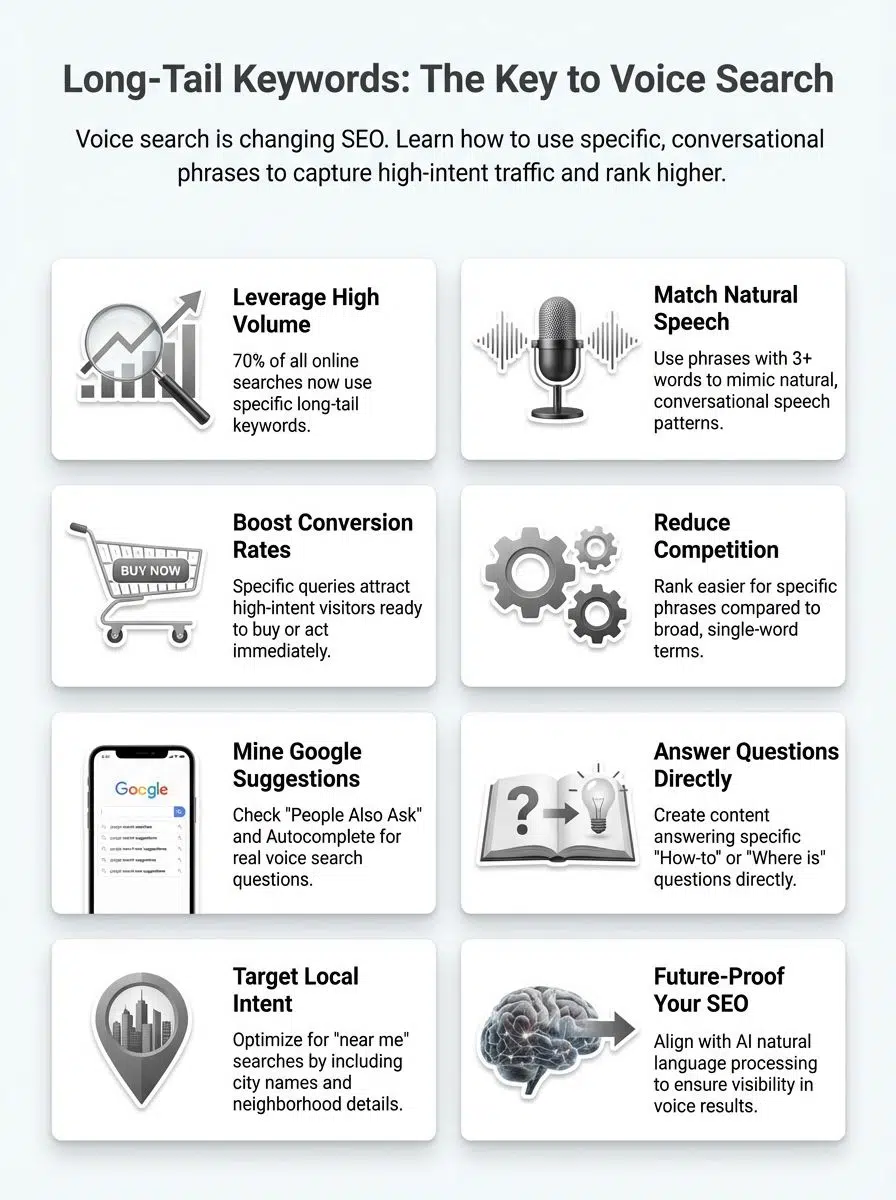
These phrases work like a secret handshake. They connect you directly with visitors who know exactly what they want.
Definition and Characteristics
Picture keywords as puzzle pieces. A single word like “shoes” is a generic edge piece; it could belong to any puzzle. But a phrase like “women’s waterproof hiking boots for wide feet” is a centerpiece that fits one specific spot.
According to a massive study by Ahrefs, nearly 95% of all search queries in the US are long-tail. They might have lower search volumes individually, but collectively, they make up the vast majority of the web’s traffic.
Short-tail keywords are broad and crowded. Long-tail phrases are specific and quiet. They reflect the natural way we talk to digital assistants like Alexa or Google Assistant.
Short keys open small doors, but long keys open castles.
Difference Between Short-Tail, Mid-Tail, and Long-Tail Keywords
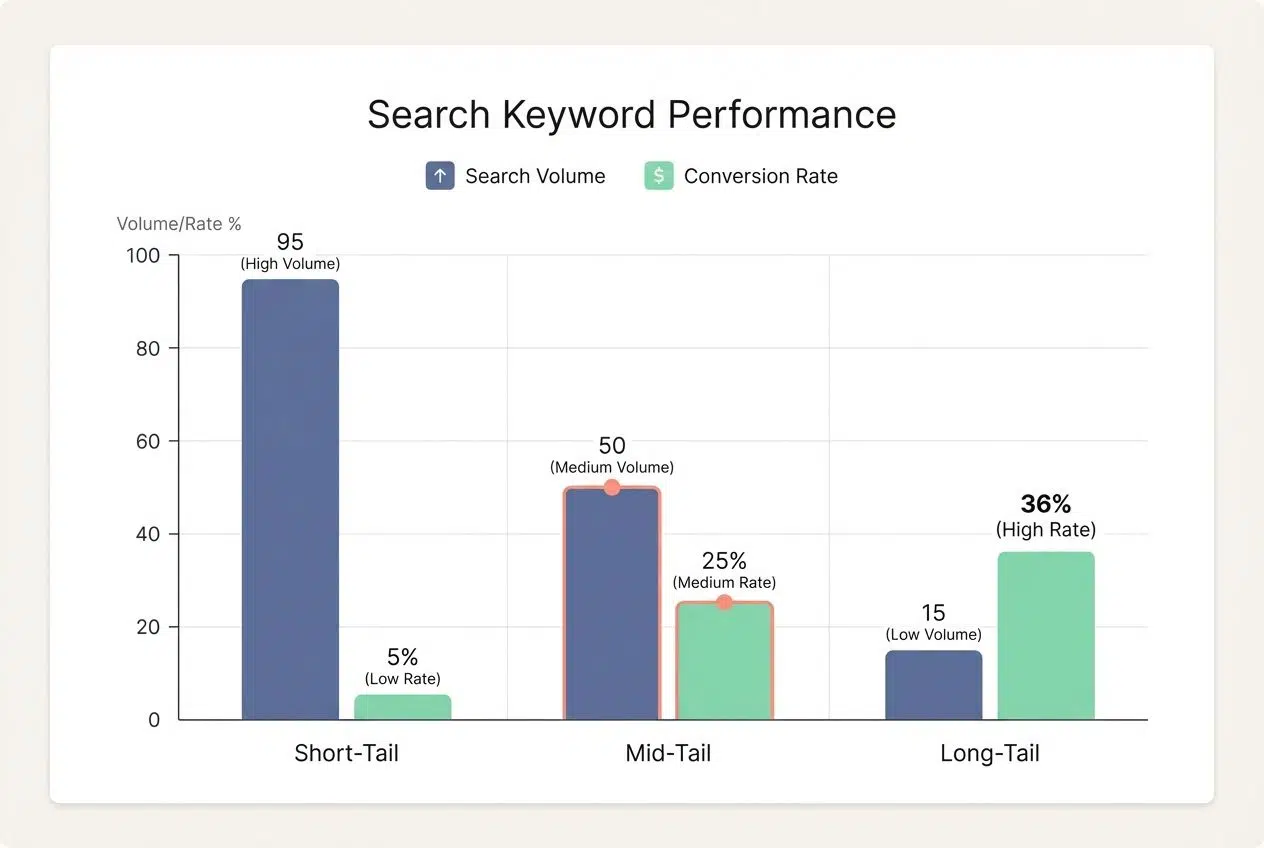
Understanding these three buckets is the first step to fixing your SEO strategy. Here is a clear breakdown of how they compare:
| Type | Description | Length | Search Volume | Conversion Rate | Example |
|---|---|---|---|---|---|
| Short-Tail | Broad, general terms. | 1-2 words | Very High | Low (~2%) | “Marketing” |
| Mid-Tail | More specifically, usually 2-3 words. | 2-3 words | Medium | Moderate | “Email marketing software” |
| Long-Tail | Highly specific queries or questions. | 3+ words | Low | High (~36%) | “Best email marketing software for small non-profits” |
Importance of Long-Tail Keywords in SEO
You might wonder why you should bother with keywords that fewer people search for. The answer comes down to one word: Intent. Long-tail keywords bring you visitors who are actually ready to do something, not just browse.
Easier to Rank For
Ranking for a broad term like “pizza” puts you in a cage match with Domino’s and Pizza Hut. You likely won’t win.
However, ranking for “best gluten-free deep dish pizza in Chicago” is a battle you can win. Since fewer websites compete for these specific phrases, you can often reach the top of Google without needing thousands of backlinks.
New data from Semrush in late 2025 shows that AI Overviews (the AI summaries at the top of Google) appear most often for these low-volume, specific queries. This means targeting long-tails is your best ticket to getting featured by AI.
“Specific is terrific.” A smaller audience that buys is always better than a massive audience that bounces.
Higher Conversion Rates
This is the most critical metric for your business. Recent industry benchmarks indicate that long-tail keywords convert at an average rate of 36%.
Compare that to the top 10% of landing pages, which usually only see conversion rates around 11%. When someone searches for “how to remove red wine stains from white carpet,” they have an immediate problem. If you have the solution, you win the click and the customer.
Greater Relevance for Niche Audiences
Long-tail keywords allow you to speak directly to your ideal customer. If you sell specialized equipment, you don’t need everyone to visit your site. You only need the right people.
For example, a local bike shop targeting “full suspension mountain bikes under $2000” will attract serious buyers. Voice assistants love these specific queries because they provide the exact answer the user asked for.
Categories of Long-Tail Keywords
Not all long-tail keywords do the same job. We generally group them into two buckets: supportive and thematic. Knowing the difference helps you structure your content effectively.
Supportive Long-Tail Keywords
These are the specific questions that support your main topic. Think of them as the FAQs of your article.
- They often start with “how,” “what,” or “where.”
- Example: If your main topic is “Coffee,” a supportive keyword is “How to brew French press coffee correctly.”
- Tools like AnswerThePublic are fantastic for finding these. You can see the exact questions people are asking around your core topic.
- These are perfect for Voice Search optimization because they mimic natural speech patterns.
Thematic Long-Tail Keywords
Thematic keywords focus on a specific variation of a broad topic. They help search engines understand the “niche” of your page.
- They narrow the focus. Example: “Eco-friendly running shoes for women.”
- They tell Google’s AI exactly what your page is about.
- They align perfectly with Google’s “Hummingbird” and “BERT” updates, which focus on understanding the context of a search.
- Using these themes helps you rank for hundreds of related terms with just one piece of content.
Long-Tail Keywords and Voice Search

Voice search isn’t coming; it is already here. With 58.6% of US consumers reporting they have used voice search, your content needs to be ready to listen.
How Voice Search Has Changed Keyword Strategies
When we type, we talk like robots: “weather NYC.” When we speak, we talk like humans: “What’s the weather like in New York this weekend?”
This means your keywords need to be conversational. A 2025 study found that the average voice search query is 4.2 words long. If your content only targets two-word phrases, you are missing out on this massive audience.
Conversational and Question-Based Queries
People treat their smart speakers like helpful friends. They ask full questions. This is why “Question Keywords” are now a goldmine. Instead of just targeting “oil change,” you should target “Where can I get a cheap oil change near me open now?”
Google’s algorithms now prioritize content that answers these direct questions. If you provide a clear, concise answer, you have a high chance of becoming the “featured snippet” that Siri or Alexa reads aloud.
Role in AI and Virtual Assistants
We now have over 86.5 million Siri users and 85 million Google Assistant users in the US alone. These assistants rely heavily on Natural Language Processing (NLP).
They don’t just look for keywords; they look for meaning. Long-tail keywords provide that meaning. They give the AI the context it needs to say, “This is the best answer for my user.” If you want to be the answer Alexa gives, you must write in natural, complete sentences that directly address the user’s intent.
How to Identify Long-Tail Keywords
Finding these golden keywords is easier than you might think. You don’t always need expensive software, though it helps.
Use Keyword Research Tools
Professional tools can save you hours of guessing. My favorite for this specific task is the Semrush Keyword Magic Tool. It allows you to filter specifically for questions and broad-match phrases.
Another excellent option is Ahrefs, which has a specific “Questions” report. These tools show you the search volume and, more importantly, the “Keyword Difficulty” (KD). You generally want to look for high-intent keywords with a low KD score.
Explore Google Autocomplete and People Also Ask
You have a powerful research tool right in your browser. Start typing your main topic into Google, but don’t hit enter. The suggestions that drop down? Those are real searches happening right now.
Pro Tip: Type your keyword followed by an underscore (e.g., “best shoes for _”) to see what specific details people are looking for.
Also, look at the “People Also Ask” box. Click on one question, and watch three more appear. This is an endless stream of long-tail topic ideas directly from Google’s database.
Analyze Competitors’ Rankings
Why reinvent the wheel? You can use tools like SpyFu or UberSuggest to see exactly what keywords your competitors are ranking for.
Look for their blog posts that get traffic but don’t have thousands of backlinks. These are usually ranked on the strength of long-tail keywords alone. Analyze their headings and see how they phrase their answers.
Leverage Online Communities Like Reddit and Quora
This is my favorite “insider” tactic. Go to Reddit and search for your topic. Look for subreddits like r/HomeImprovement or r/Marketing.
Read the thread titles. Real people use very specific language when they ask for help. They don’t say “plumber.” They say, “Help, my water heater pilot light keeps going out.”
Quora is arguably even better for this. The entire site is built on long-tail questions. If you see a question with lots of followers but few good answers, that is a perfect topic for your next blog post.
Optimizing Content for Long-Tail Keywords
Once you have your keywords, where do you put them? You need to weave them naturally into your content.

Creating Dedicated Blog Posts and Landing Pages
The best strategy is to create a dedicated post for a specific long-tail topic. If you find a great keyword like “how to stage a small living room for sale,” write an entire article about just that.
Don’t try to stuff it into a general article about “selling houses.” Give the topic the depth it deserves. Use the keyword in your:
- Page Title (H1)
- First paragraph
- One or two subheadings (H2 or H3)
- URL slug (e.g., /stage-small-living-room)
Optimizing Product and Service Descriptions
E-commerce stores often miss this opportunity. Don’t just list specs. Write descriptions that answer questions.
Instead of “Men’s Wool Jacket,” try “This men’s wool jacket is perfect for winter commutes and fits well over suits.” You just naturally included “jacket for winter commutes” and “fits over suits,” which are great long-tail signals.
Pro Tip: Add an FAQ section to your product pages. This is the perfect place to naturally include question-based keywords without cluttering your main description.
Implementing Local SEO Strategies
For local businesses, this is non-negotiable. 46% of all voice search queries have local intent. You need to optimize for “near me” searches. But you can’t just type “near me” on your site. Instead, mention landmarks and neighborhoods. “Best pizza near Central Park” or “Plumber serving the downtown Austin area.”
Also, ensure your Google Business Profile is 100% complete. Google states that customers are 70% more likely to visit businesses with a complete profile. This profile is often the primary source of information for voice assistants.
Benefits of Long-Tail Keywords for Voice Search
Let’s recap why this strategy is worth your time. It is not just about traffic; it is about the right traffic.
Improved Search Visibility
Targeting these phrases helps you show up where your competitors aren’t. While they fight for page 1 on broad terms, you can dominate the search results for dozens of specific questions.
Also, using Speakable Schema markup code on your site can tell Google specifically which parts of your text are good for text-to-speech. This is a technical edge many sites ignore.
Attracting High-Intent Traffic
We mentioned the 36% conversion rate earlier, but it bears repeating. These users are at the bottom of the funnel.
They have done their research. They know what they want. They just need to find who sells it. By the time they find your specific long-tail article, they are ready to buy.
Aligning with User Behavior Trends
User behavior is shifting toward “zero-click” searches, where Google provides the answer right on the results page. Long-tail optimization is the best way to get into those Featured Snippets.
By answering the question directly, you align your site with what users (and Google) actually want: quick, accurate information.
Illustrations of Long-Tail Keywords
To make this concrete, let’s look at some specific examples across different industries.
E-commerce Sector Examples
A generic store sells “laptops.” A smart store sells:
- “Best lightweight laptop for college students under $500”
- “Gaming laptop with 32GB RAM and RTX 4060”
- “15-inch laptop sleeve with waterproof pocket”
These customers aren’t browsing; they are hunting for a specific item.
Examples for Local Businesses
A generic dentist targets “dentist.” A smart local dentist targets:
- “Emergency dentist open on weekends in Seattle.”
- “Pediatric dentist for anxious kids near me”
- “Teeth whitening cost with insurance in Dallas”
These queries capture the urgent, local needs that drive phone calls.
SaaS Industry Examples
A generic software company targets “CRM.” A growth-focused SaaS targets:
- “CRM for real estate agents with SMS automation”
- “Free project management tool for creative agencies”
- “How to automate invoices for small consulting firms.”
These phrases attract users who are looking for a solution to a specific pain point your software solves.
Wrapping Up
Long-tail keywords are your secret weapon in the era of voice search. While everyone else fights over the crowded, broad terms, you can build a steady stream of high-converting traffic by answering specific questions. Remember, people are talking to their phones more than ever. The average voice query is longer and more conversational. By adapting your content to match this natural language, you future-proof your SEO strategy.
So, where should you start? Pick one product or service you offer. Use a tool like AnswerThePublic or just the Google search bar to find three specific questions people ask about it.
Write one blog post answering those questions this week. You might be surprised at how quickly the right visitors find you.