Do you ever find yourself staring at a loading circle, willing your phone to just go faster? We have all been there, especially when trying to stream a video or load a heavy webpage on the go. You are definitely not the only one facing these glitches. As we add more smart gadgets to our lives, the average US household now juggles about 21 connected devices, and the pressure on mobile networks is skyrocketing.
Fast data speeds and billions of users are forcing a massive shift in how mobile hosting works. Here is the good news: 5G networks are already pushing speeds up to roughly 300 Mbps for many users in the US. And 6G? It promises to be a complete game-changer with speeds we can barely imagine today.
I’m going to walk you through exactly how these upgrades are reshaping mobile hosting. We will look at the real Impacts Of 5G and 6G Networks In Mobile Hosting requirements and what you need to know to stay ahead.
Exploring Key Features of 5G and 6G Networks
Speed and reliability are the stars of the show here. But it is not just about downloading a movie faster; it is about how our devices talk to each other without interruption.
Accelerate data transmission speeds
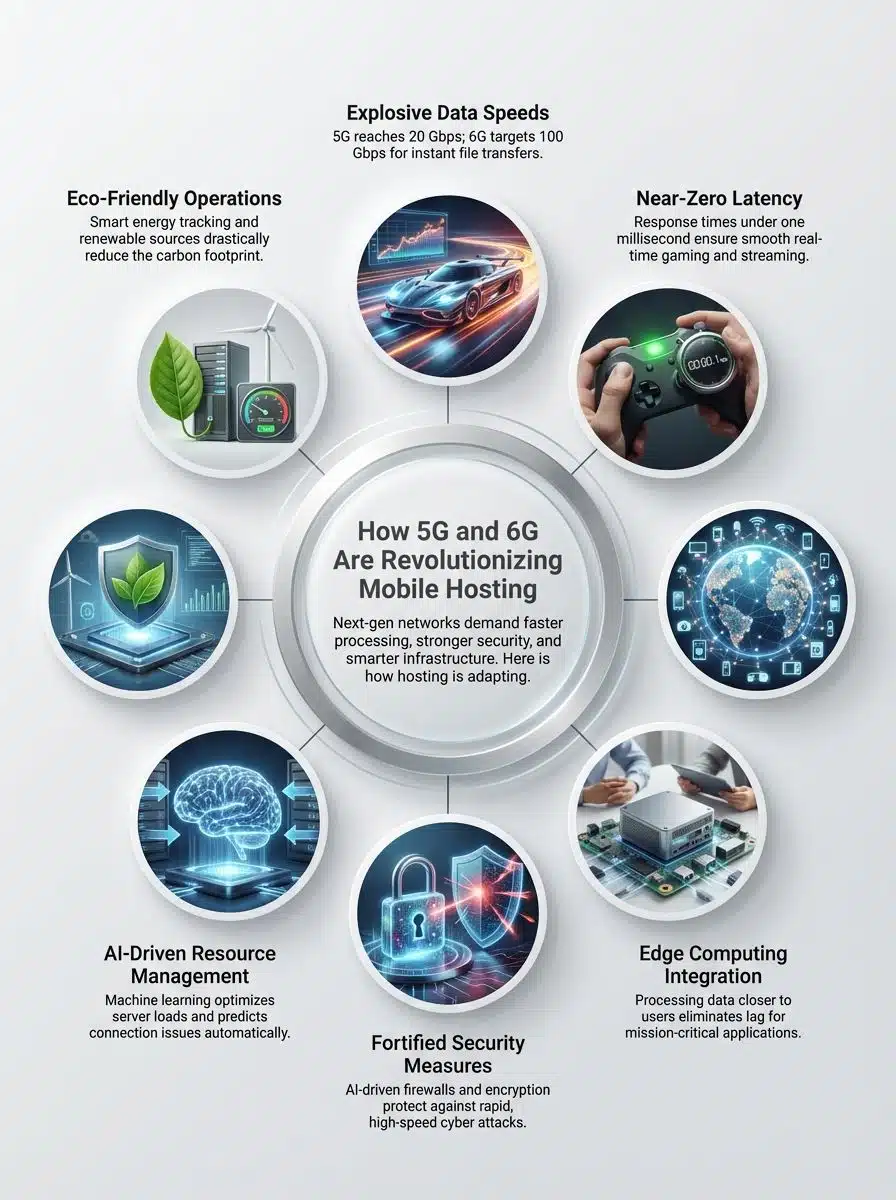
5G networks have already changed the game. While the theoretical peak hits 20 Gbps, real-world tests from Ookla in 2025 show that carriers like T-Mobile are delivering median speeds around 300 Mbps to users across the US. That is plenty of power to stream 4K video or download large files in seconds.
For hosting providers, this means handling a massive increase in throughput. They have to upgrade their bandwidth to ensure that when you hit “play,” the content flows instantly.
Now, look at 6G. The predictions for 2030 are wild. We are talking about speeds potentially reaching 1 Terabit per second (Tbps). That is 1,000 times faster than 1 Gbps. This leap will eliminate bottlenecks entirely, making data transfer between your device and the cloud feel instantaneous.
Heads up: Speed isn’t the only metric that matters. As Jessy Cavazos from Keysight Technologies noted in a recent 2026 forecast, the move to 6G is less about raw speed and more about an “architectural shift” toward AI-native networks.
Reduce latency and boost reliability
Lightning-fast speed gets the headlines, but lower latency is what actually makes your phone feel “snappy.” Latency is that tiny delay between tapping a button and seeing an action happen.
5G networks have pushed average latency down to around 10 milliseconds in real-world scenarios. But 6G is aiming for the “Tactile Internet”, with latency as low as one microsecond. This is crucial for things that cannot afford even a split-second delay, like remote robotic surgery or autonomous cars coordinating in traffic.
Reliability is just as critical. Network slicing is a feature that lets providers carve out dedicated “lanes” for specific traffic. Think of it like an HOV lane on the highway.
- Emergency services get a clear, guaranteed lane.
- Social media scrolling stays in the general lanes.
- Mission-critical apps for businesses stay online even during crowded events like the Super Bowl.
Expand device connectivity
You might think you have a lot of devices now, but the numbers are growing fast. In 2024, the world had about 18.5 billion connected IoT devices. By the end of 2025, that number is expected to hit 21.1 billion.
It is not just phones and laptops anymore. We are talking about smart traffic lights, agricultural sensors on remote farms, and even “ambient IoT” devices that run without batteries.
This massive web of connections puts a heavy load on hosting. Servers can’t just be powerful; they have to be smart enough to manage billions of tiny data packets simultaneously without crashing.
5G Versus 6G in Mobile Hosting Requirements
Hosting changes fast with each new network step. The jump from 5G to 6G is full of surprises that will change how we build and manage digital infrastructure.
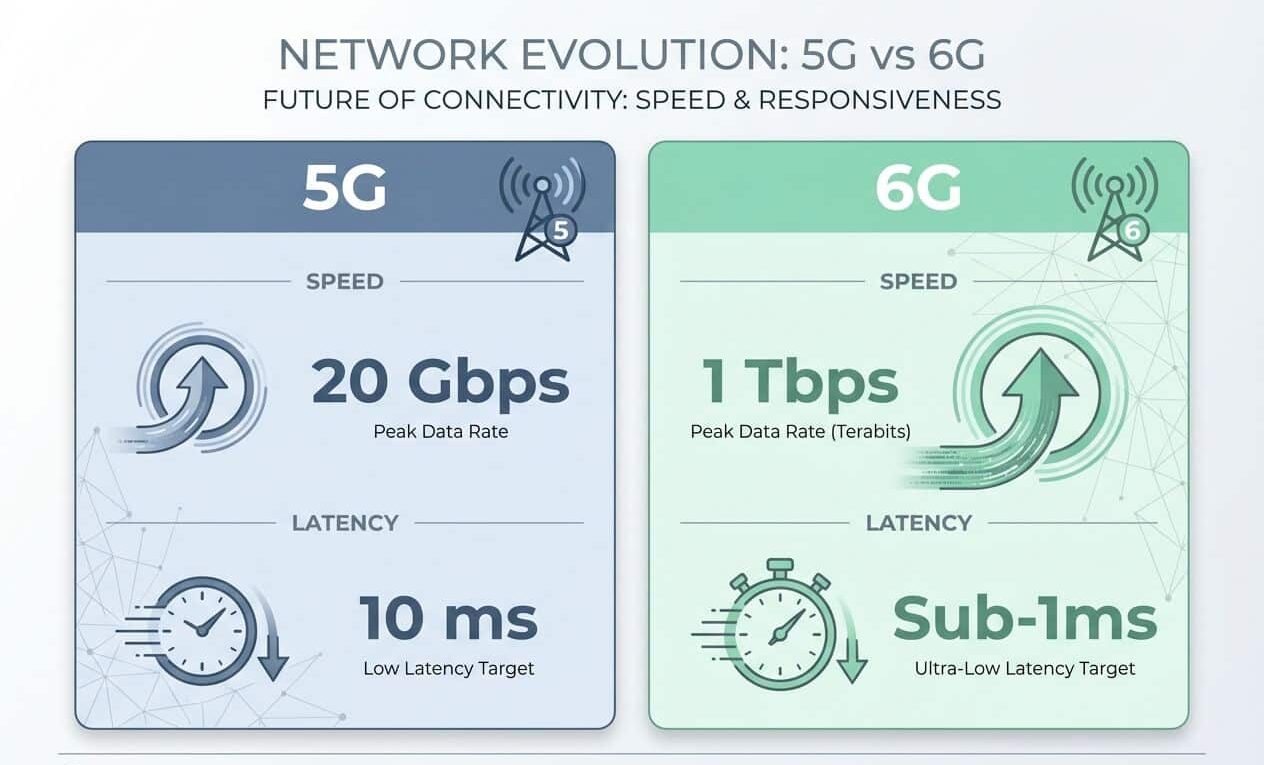
To give you a clear picture of the differences, here is a quick comparison:
| Feature | 5G Capabilities | 6G Projected Capabilities |
|---|---|---|
| Peak Speed | Up to 20 Gbps | Up to 1 Tbps (1000 Gbps) |
| Latency | 1-10 milliseconds | Microseconds (Sub-1ms) |
| Frequency | Sub-6 GHz & mmWave | 95 GHz – 3 THz (Terahertz) |
| Intelligence | AI applied on top | AI native (Built-in) |
Benefits of 5G for current hosting solutions
5G makes data move much faster, cutting waiting time for users. Big files and apps load in a snap now. Latency drops significantly compared to 4G, making cloud gaming and video calls smooth even during busy hours.
Mobile hosting can connect more devices at once without slowing down. IoT gadgets like smartwatches or sensors work better together with this level of wireless communication. Network slicing helps companies use only the parts they need without wasting bandwidth or speed.
Cloud hosting feels lighter, sharper, and much quicker for everyone using mobile technology today. But as good as 5G is, it is just the foundation for what comes next.
Future enhancements with 6G technology
6G networks will push mobile technology further with peak data rates that shoot past 1 terabit per second. Latency could drop to as low as one microsecond, which is nearly instant for wireless communication and IoT devices.
With smarter use of spectrum allocation, specifically in the Terahertz (THz) bands, more devices can connect at once without slowdowns. These advances allow new ways to handle network slicing and support growing smart cities, edge computing, and AI-driven services right on the device.
Data transfer between cloud hosting centers and user phones will feel seamless. It will be like the processing power of a supercomputer is right in your pocket. Telecom providers are preparing by designing next-gen infrastructure focused on better performance standards and security updates.
Adjusting Mobile Hosting Needs for Advanced Networks
The jump to faster networks means hosts need to think on their feet. As more devices rush in, systems must keep pace or risk being left behind.

Support real-time data processing demands
5G and 6G networks move data at lightning speed. Mobile hosting now needs to keep up with these rapid demands. Live video, smart cars, and interactive games need instant responses.
A delay of even a few milliseconds can cause glitches or lag. To fix this, providers are moving the “brains” of the operation closer to you.
This is where Edge Computing comes in. Services like AWS Wavelength and Verizon 5G Edge place servers physically closer to the mobile towers. This cuts out the long trip data usually takes across the internet, reducing “hops” and ensuring instant response times.
Increase infrastructure capabilities for providers
Mobile networks keep growing, and so does the need for stronger infrastructure. Providers must add more cell towers and upgrade antennas. But the biggest change is inside the data center.
With the intense heat generated by AI and high-speed 6G processing, traditional air conditioning often isn’t enough. Many modern data centers are switching to liquid cooling, specifically single-phase immersion cooling.
This method submerges servers in a special non-conductive liquid to wick away heat far more efficiently than air. It allows providers to pack more processing power into a smaller space without overheating.
Strengthen security measures for mobile platforms
Stronger infrastructure gives providers the muscle to handle more traffic, but increased connectivity means hackers may try harder too. Security needs to stay a step ahead as 5G and 6G networks boost data transfer rates.
Hackers can now use faster networks for attacks like phishing, app spoofing, or even hijacking smart gadgets. A major risk with network slicing is “lateral movement,” where an attacker breaches one slice (like a smart toaster) and tries to jump to a secure slice (like a payment system).
To stop this, hosting providers are adopting Zero Trust Architecture. This means the network doesn’t trust a device just because it’s connected. It verifies every single request, every time.
Impact on Developers and Hosting Services
Developers face new puzzles with 5G and 6G. They have to rethink how apps are built to take full advantage of this new speed.
Optimize applications for advanced network compatibility
Apps must keep up with faster data rates and lower latency in 5G and 6G networks. Streaming video, online games, and IoT devices rely on quick responses.
Using edge computing lets servers process information near the user. This cuts delays and boosts performance for mobile technology.
Code should adapt to varying bandwidth and signal changes. Smart caching helps use network speeds wisely during heavy traffic or outages. Testing apps across different devices supports strong compatibility with both current 5G systems and future 6G upgrades from providers like Verizon or AT&T.
Implement AI and machine learning in hosting frameworks
After tuning mobile applications to run well with faster networks, providers turn their eyes to smarter tools. AI and machine learning now shape hosting frameworks for mobile technology.
These smart systems help fix problems before users even notice them. Hosting platforms quickly adjust resources using real-time data from thousands of devices. For example, Google Cloud uses predictive autoscaling to spin up servers before a traffic spike hits.
AI tracks network reliability, boosts security, and manages huge amounts of information across cloud hosting environments. By 2030, digital brains will play a big part in handling future demands on mobile networks, ensuring that the infrastructure heals itself automatically.
Advancing Mobile Hosting with 6G Innovations
6G technology flips the script for mobile hosting. It is not just an upgrade; it is a new way of thinking about connectivity and the planet.
Transform IoT and edge computing practices
IoT devices keep growing in number each year. By 2030, experts predict nearly 39 billion connected things will talk to one another.
5G and newer networks push data quickly between these devices, supporting real-time chatter. Factories are already using Digital Twins, virtual replicas of physical machines, to spot trouble early. Companies like Siemens use this tech to simulate production lines in real-time, catching errors before they happen in the real world.
Mobile hosting services now need stronger tools for managing more gadgets plus greater security, so that all this traffic stays safe as new features roll out.
Promote energy efficiency and sustainability in hosting
Edge computing and IoT need lots of data, yet they also bring a fresh chance to save energy. 6G technology aims to be 100 times more energy-efficient than 5G for each bit of data moved.
Less power use means lower costs and helps keep our planet clean. Many hosting providers now add more solar panels or wind turbines to their data centers.
New servers may “sleep” when not needed, saving electricity. Hosting services get smarter with AI tools that track how much energy gets used every minute. By shrinking waste and shifting toward renewable energy sources, mobile technology improves both network performance standards and care for the earth at the same time.
Final Thoughts
5G and 6G networks are doing way more than just boosting speeds; they are completely rewriting the rules for mobile hosting. From slicing networks for better reliability to using liquid cooling for massive power, the infrastructure is evolving to keep up with our demand for instant connection.
These changes mean your apps will run smoother and your devices will work smarter. As mobile tech keeps moving forward, these upgrades will make our digital lives easier in ways we will probably take for granted in a few years!