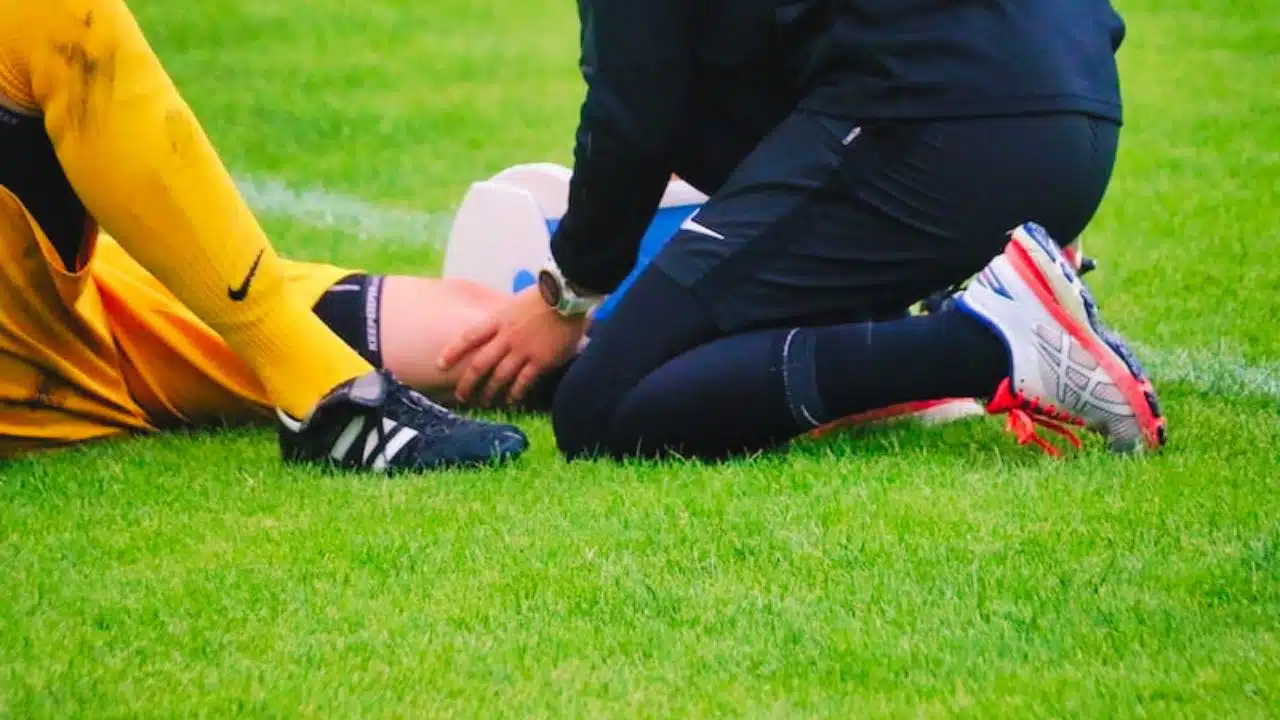
FIFA is set to trial a new two‑minute injury rule at the FIFA Arab Cup Qatar 2025, forcing most injured players who receive on‑field treatment to leave the pitch and leave their team temporarily down to 10 men. The experiment, pushed by FIFA’s refereeing department and backed by president Gianni Infantino, is framed as an anti‑time‑wasting measure that could later be extended to global competitions if it proves successful.
How the two-minute rule works
Under the rule, whenever medical staff enter the field to treat a player, that player must leave the pitch and remain on the sideline for two full minutes of playing time, during which his team continues with one fewer outfield player. The clock runs while the game is live, meaning the team effectively plays short‑handed until the injured player is allowed back or a substitution is made.
The rule will apply across the 2025 Arab Cup in Qatar, which runs in Doha from 1 to 18 December, giving FIFA a concentrated tournament environment to test its impact on match flow and refereeing. Referees will be instructed that the trigger is the actual entry of medical staff onto the field, rather than a player merely going down injured.
A direct move against time-wasting
Pierluigi Collina, head of FIFA’s Referees Committee, has explained that the measure is designed to discourage players and teams from using fake or exaggerated injuries to run down the clock. By turning on‑field treatment into a tactical disadvantage rather than a chance to rest and waste time, FIFA hopes to speed up restarts and keep more of the 90 minutes in active play.
The Arab Cup 2025 is already being used by FIFA as a laboratory for regulatory tweaks, alongside changes to tiebreak criteria and confirmation that all matches will count towards the FIFA men’s world ranking. Officials in Doha see the two‑minute rule as part of a broader push to enhance the sporting value and global credibility of the tournament.
Key exceptions and player safety concerns
FIFA’s guidance includes several notable exceptions to the rule in an attempt to protect player welfare and avoid unfair punishment when contact is clearly serious. Goalkeepers are exempt due to the unique nature of their position, and players injured in challenges that result in a yellow or red card for the opponent are not obliged to undergo the two‑minute exclusion.
Collina has also indicated that cases where an injury is clearly genuine and severe will be treated differently, with priority given to proper medical care rather than forcing a quick return to the pitch. Medical staff and match officials are expected to work closely, especially with head injuries and potential concussions already under separate protocols in FIFA competitions.
Tactical implications for coaches and players
The new rule is likely to influence in‑game decision‑making, especially in tight matches and in the closing stages of games when time‑wasting tactics have historically been most visible. Coaches may become more reluctant to allow borderline on‑field treatment, knowing it will automatically leave them numerically inferior for two minutes of open play. Teams trailing on the scoreboard could face an even bigger dilemma if a key attacker goes down but wants to stay on at all costs.
Defensively, sides protecting a narrow lead may be discouraged from feigning cramps or minor knocks, because each stoppage that brings medics onto the pitch now carries a built‑in punishment rather than a benefit. Referees, meanwhile, will be under pressure to distinguish between genuine medical need and attempts to invite treatment as a tactical ploy, even though the formal trigger is the arrival of the medical team.
Could this reshape global football?
FIFA has presented the Arab Cup 2025 in Qatar as a proving ground, and the two‑minute injury rule is being openly discussed as a potential addition to the Laws of the Game if data from the tournament is positive. Any move to roll it out more widely would require approval from the International Football Association Board (IFAB), which governs the laws and has recently been willing to experiment with measures such as concussion substitutions and semi‑automated offside technology.
If the trial shows that the rule both reduces time‑wasting and does not compromise player safety, it could soon become part of domestic leagues and major tournaments, fundamentally changing how teams manage injuries and game tempo in the final minutes. For now, all eyes will be on Doha from 1 December as Arab national teams become the first to navigate a regulation that may signal a new era of stricter enforcement against simulation and deliberate stalling.