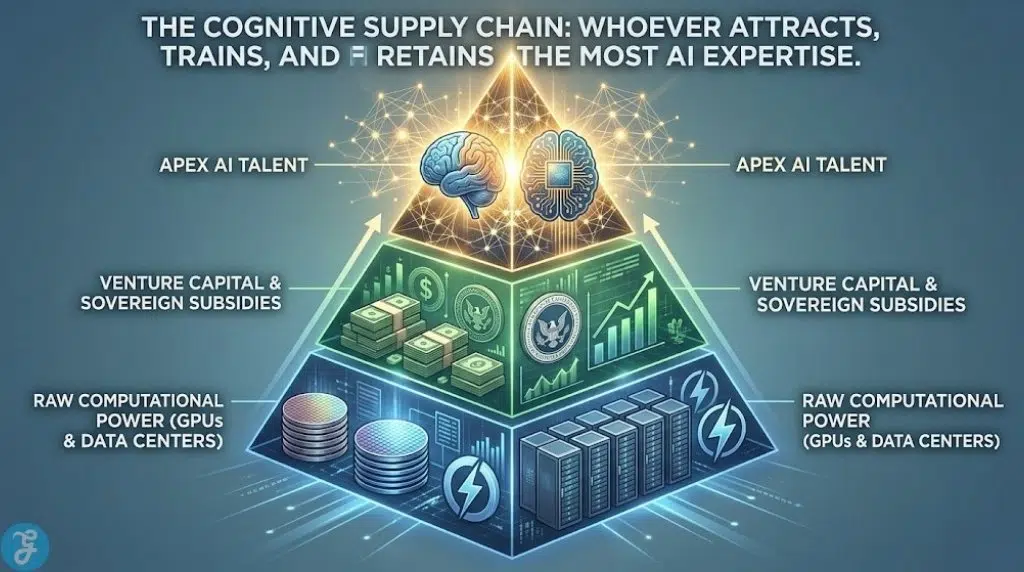
When we observe the prevailing narrative surrounding artificial intelligence in the mid-2020s, the discourse is almost exclusively dominated by the spectacular and the terrifying. The financial press fixates on trillion-dollar valuations of foundational model creators, breathless debates over the existential timeline of Artificial General Intelligence, and the massive, sovereign-level investments in hypersonic compute clusters. However, while the world’s attention is firmly glued to the technological stratosphere, the most profound and permanent macroeconomic shift is occurring quietly, largely unnoticed, on the ground level of the global economy.
We are witnessing the definitive end of the enterprise monopoly on cognitive labor. Across the world, from the bustling textile markets of Dhaka to boutique logistics firms in the American Midwest, local entrepreneurs are aggressively adopting practical, highly accessible cognitive tools.
This silent transformation is not about achieving sentience or writing theoretical poetry; it is about inventory management, dynamic pricing, and multilingual customer service. The integration of everyday AI for small business 2026 marks a fundamental rewiring of global capitalism. It is a transition where the defining feature of artificial intelligence has shifted from being a bespoke luxury for the Fortune 500 into a cheap, ubiquitous utility—as fundamental and invisible as broadband internet or electricity.
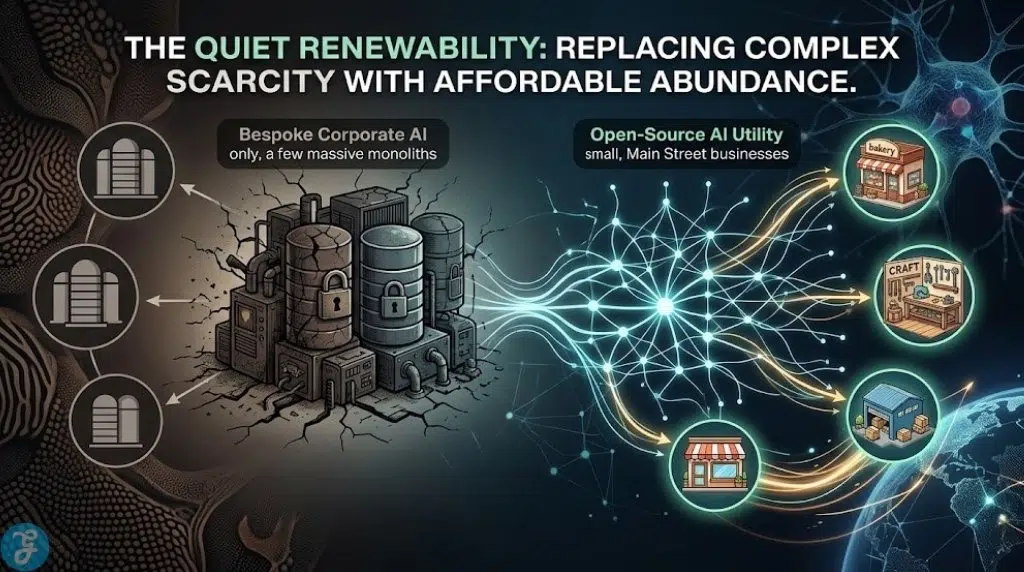
By leveling the technological playing field, these practical applications are allowing micro-enterprises to compete on a global scale without the need for massive capital expenditure. We are moving from a top-down global economy dictated by multinational conglomerates to a highly decentralized, bottom-up economy driven by hyper-empowered local businesses.
To truly grasp the magnitude of this shift, we must abandon the Silicon Valley lens and adopt a macro-structural, third-eye view of how practical automation is actively dismantling the traditional barriers to entrepreneurial scale.
| Economic Era | The Primary Driver of Scale | The Defining Advantage | The Role of the Small Business |
| Industrial Economy (20th Century) | Massive physical capital and manufacturing infrastructure. | Economies of scale; lowering unit costs through mass production. | Highly localized; restricted to immediate geographic communities. |
| Information Economy (Early 21st Century) | Proprietary software, global supply chains, and massive data silos. | Information asymmetry and enterprise resource planning (ERP) systems. | Franchised or subservient to digital platforms and massive aggregators. |
| The Cognitive Economy (2026 and Beyond) | Accessible, open-source, and low-cost generative models. | Hyper-agility, personalized automation, and borderless micro-commerce. | Global competitors; operating micro-multinationals with enterprise-grade efficiency. |
The Death of the Enterprise Capital Moat
For decades, the global business landscape was defined by an impenetrable “capital moat.” If a business wanted to operate with high efficiency if it wanted to predict supply chain disruptions, dynamically adjust pricing based on global demand, or offer seamless, twenty-four-hour customer service it required millions of dollars in upfront capital. It required purchasing bloated, complex enterprise software licenses, hiring floors of data analysts, and maintaining massive IT departments. Efficiency was a luxury that only scale could afford. Consequently, small businesses were structurally condemned to remain small, trapped in a cycle of manual, unoptimized labor that severely capped their profit margins and growth potential.
The proliferation of accessible generative tools and cognitive APIs has entirely evaporated this capital moat. The technological infrastructure that cost a multinational corporation ten million dollars to build in 2018 is now available to a micro-enterprise through accessible, low-cost monthly cloud subscriptions.
Local enterprises are no longer intimidated by technology; they are weaponizing it. A local bakery is not hiring a data scientist to forecast demand; they are feeding their historical sales data, and local weather API feeds into a lightweight model to tell them exactly how many croissants to bake on a rainy Tuesday, reducing food waste by double digits. A regional hardware supplier is not purchasing a massive logistics software suite; they are utilizing autonomous agents to scan global shipping manifests, instantly rerouting their inventory around sudden port congestions. This is the essence of practical adoption. It is the ruthless, unglamorous optimization of the back office, transforming historically fixed overhead costs into highly variable, incredibly cheap technological solutions.
The matrix below illustrates how the financial barrier to entry for enterprise-grade operations has systematically collapsed.
| Operational Function | The Legacy Corporate Model (High CapEx) | The Micro-Enterprise AI Reality (Low OpEx) |
| Market Research & SEO | Retaining expensive agency analysts for quarterly trend reports and keyword optimization. | Autonomous agents continuously scraping global trends and dynamically rewriting local web copy daily. |
| Inventory Forecasting | Complex, multi-million-dollar Enterprise Resource Planning (ERP) integrations. | Lightweight, cloud-based predictive models analyzing local variables and historical sales in real-time. |
| Accounts Receivable | Teams of junior accountants manually reconciling invoices and chasing late payments. | Automated, cognitive ledger systems that instantly match payments and draft customized collection communications. |
| Legal & Compliance | Expensive retainers with corporate law firms for basic contract review and localized compliance. | Large Language Models performing initial sweeps of vendor contracts for liabilities and standardizing global agreements. |
The Paradox of the Hyper-Local Globalist
As cognitive tools optimize the back office, they simultaneously perform an even more radical transformation on the front office: the total erasure of geographic and linguistic borders. We are currently observing the fascinating paradox of the “Hyper-Local Globalist.“
Historically, expanding a small business into an international market was a monumental undertaking. It required hiring local marketing agencies, employing native customer service representatives, and navigating highly complex, localized cultural nuances. Today, a single entrepreneur operating out of a small office in Nairobi or a cafe in Bogota can seamlessly project the presence of a massive, localized multinational corporation.
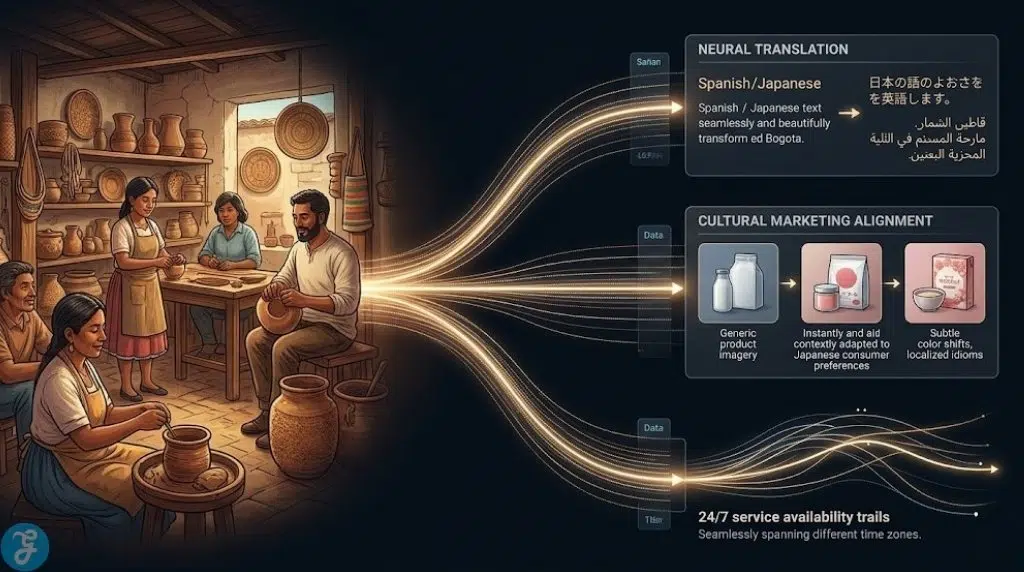
Through real-time, highly nuanced neural translation and culturally aligned generative marketing, a vendor can craft a highly specific, localized advertising campaign for a buyer in Munich, complete with colloquial German phrasing and culturally appropriate visual assets generated entirely by artificial intelligence. When that German buyer initiates a customer service inquiry at three in the morning, they are immediately greeted by an autonomous agent capable of resolving complex shipping disputes in perfect, empathetic German. The buyer has absolutely no idea they are interacting with a micro-enterprise on another continent.
This borderless micro-commerce fundamentally alters the architecture of global trade. We are witnessing the democratization of globalization itself. It is no longer just mega-corporations setting up massive factories in foreign nations; it is millions of micro-enterprises trading directly with global consumers, entirely bypassing the traditional, bloated middlemen of international commerce.
This comparative overview demonstrates how cognitive tools dismantle traditional barriers to international expansion.
| Expansion Barrier | Traditional Small Business Constraint | The Borderless Micro-Commerce Solution |
| Language & Communication | Restricted to selling within native-speaking demographics or relying on clunky, obvious translation plugins. | Fluid, real-time neural translation that perfectly captures localized idioms and professional tone. |
| Cultural Marketing Alignment | Launching generic, one-size-fits-all campaigns that frequently fail to resonate in foreign markets. | Generative models creating bespoke, hyper-localized ad copy and imagery tailored to specific regional demographics. |
| Time Zone Discrepancies | Losing international sales due to the inability to provide overnight customer support and immediate engagement. | Autonomous, conversational agents providing instant, highly competent 24/7 resolution across all global time zones. |
| Cross-Border Logistics | Overwhelmed by the complexity of international customs, tariffs, and varying shipping regulations. | AI-driven logistics aggregators that instantly calculate, optimize, and automate optimal international shipping routes and compliance paperwork. |
The Equalizer of Customer Experience
In the previous decade, the primary competitive advantage of massive corporations was their ability to throw overwhelming human capital at customer service and retention. Small businesses, constrained by limited headcount, simply could not compete with the polished, immediate, round-the-clock service levels offered by the giants. If a customer had a problem, they expected a small business to take days to respond, while they expected a massive corporation to resolve it instantly.
Today, that dynamic has been entirely inverted. The adoption of advanced, highly contextual cognitive tools has become the great equalizer of customer experience. In fact, small businesses are now uniquely positioned to out-service the massive incumbents.
Large corporations are currently struggling with the “innovator’s dilemma” regarding automation. Because they operate at such massive scale, they frequently deploy blunt, frustrating, generalized chatbots designed to deflect human interaction and minimize call center costs. These systems are notoriously maddening, trapping consumers in endless, unhelpful loops of automated menus.
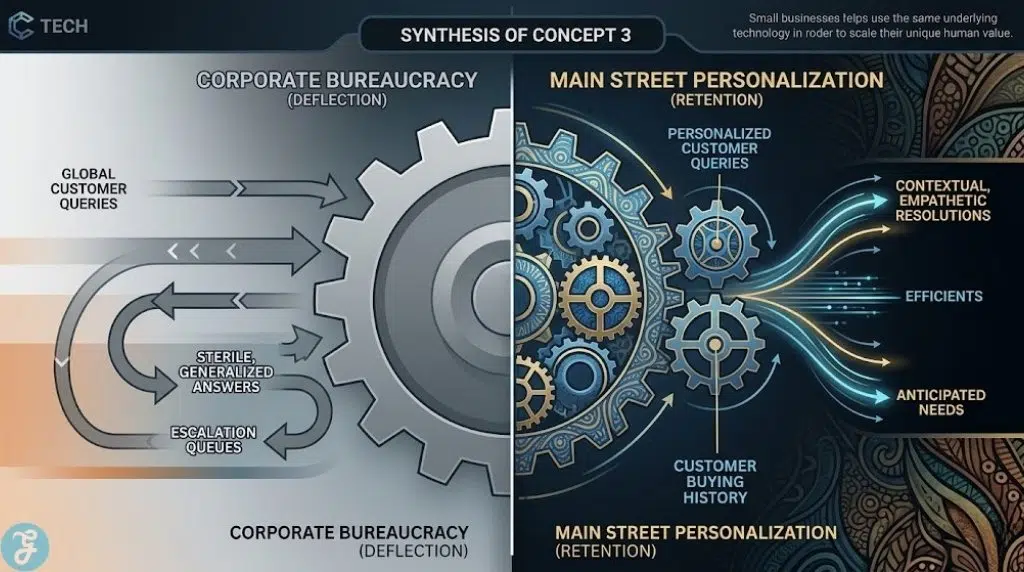
Conversely, the local entrepreneur is utilizing the exact same underlying foundational models but deploying them with a completely different objective: hyper-personalization. Because a small business has a narrower product line and a deeper, more intimate understanding of its specific customer base, it can highly fine-tune its autonomous agents to be incredibly empathetic, highly specific, and genuinely helpful. A specialized boutique can deploy an agent that remembers a client’s specific past purchases, recommends highly tailored complementary items, and instantly processes complex returns without ever escalating to a human manager. The small business is using technology to scale its humanity, while the corporation is using technology to scale its bureaucracy.
The grid below highlights the shifting paradigm of consumer expectations and service delivery.
| Service Metric | The Corporate Bureaucratic Approach | The Empowered Micro-Enterprise Approach |
| Primary Objective of Automation | Deflection: Actively preventing the customer from reaching a costly human representative. | Resolution: Empowering the agent to instantly solve the problem with high-level access to the customer’s history. |
| Tone and Engagement | Sterile, highly scripted, and rigidly confined to a pre-determined, branching decision tree. | Contextual, conversational, and deeply aligned with the specific brand voice and local cultural expectations. |
| Post-Sale Relationship | Generic, mass-emailed newsletters that inevitably end up in the consumer’s spam folder. | Hyper-personalized follow-ups, anticipating future needs based on cognitive analysis of individual buying patterns. |
| Agility of Service | Months required to update corporate service protocols or retrain massive offshore call centers. | Instantaneous adjustment of agent parameters and knowledge bases to address immediate product issues or market feedback. |
The Emerging Market Leapfrog
To view this phenomenon purely through a Western, developed-world lens is to miss the most dramatic macroeconomic impact of this technological shift. The true epicenter of this revolution is located in the Global South and emerging markets across South Asia, Latin America, and Sub-Saharan Africa.
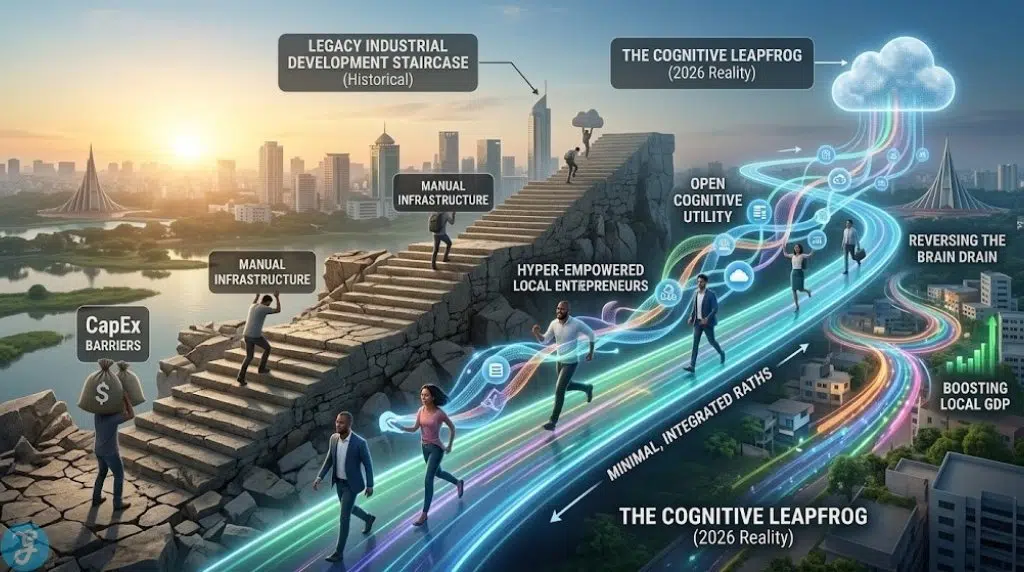
Historically, developing economies faced immense structural disadvantages. Even brilliant entrepreneurs were severely handicapped by a lack of access to elite business education, underdeveloped local financial infrastructures, and the prohibitive cost of enterprise software. The cognitive revolution is allowing these regions to execute a historical “leapfrog” event, entirely bypassing legacy systems and traditional development stages.
Just as the proliferation of mobile phones allowed entire continents to bypass the costly necessity of laying copper landline infrastructure, accessible artificial intelligence is allowing emerging market entrepreneurs to bypass the necessity of building massive, traditional corporate structures. An entrepreneur in Dhaka does not need to secure millions in venture capital to hire a world-class marketing firm, a dedicated logistics coordinator, and a senior data analyst. They can augment their own capabilities, becoming a highly efficient, single-person C-suite.
This is actively reversing the traditional “brain drain” that has plagued developing nations for decades. Previously, the brightest minds in emerging markets were economically forced to emigrate to Western tech hubs or financial centers to realize their potential. Today, the friction of geography has been removed. A brilliant entrepreneur can remain deeply embedded in their local community, significantly contributing to the local tax base and regional development, while simultaneously running a highly profitable, technologically advanced micro-multinational corporation that serves clients in New York, London, and Tokyo.
This matrix outlines the systemic advantages driving the emerging market leapfrog.
| Structural Disadvantage (Historical) | The Cognitive Leapfrog (2026 Reality) | Macroeconomic Result |
| Lack of Elite Business Education | Accessible models act as world-class, on-demand strategic advisors for complex financial and operational decisions. | Rapid upskilling of local entrepreneurs, democratizing high-level strategic planning. |
| Capital Starvation & Lack of VC Access | The operational costs of scaling a business have plummeted to near zero, removing the absolute reliance on external funding. | A massive surge in highly profitable, bootstrapped micro-enterprises driving robust local economic resilience. |
| Geographic Isolation from Major Markets | Borderless micro-commerce and seamless language translation completely erase physical distance as an economic barrier. | Unprecedented integration of emerging market talent directly into the highest value tiers of the global supply chain. |
| Systemic Brain Drain to the West | The ability to build global wealth without leaving the local community entirely alters the calculus of emigration. | Retention of apex talent, fostering powerful, localized innovation ecosystems outside of traditional Silicon Valley hubs. |
The New Architecture of Global GDP
The narrative that artificial intelligence will lead exclusively to massive corporate consolidation and widespread job displacement is a fundamental misreading of the technology’s true trajectory. While massive corporations will undoubtedly use these tools to cut overhead and maximize shareholder value, the far more disruptive narrative is happening at the bottom of the economic pyramid.
The quiet, relentless adoption of these practical tools by small businesses is fundamentally altering the architecture of global GDP. We are moving away from a fragile economic system reliant on a few massive, vulnerable corporate monoliths, and toward a highly resilient, deeply distributed network of hyper-efficient micro-enterprises.
These local businesses are not trying to build sentient machines; they are trying to build better businesses. They are using cognitive tools to eliminate the mundane, automate the predictable, and dramatically scale their unique human value. By erasing the capital moats, dismantling geographic borders, and democratizing enterprise-grade efficiency, technology has finally delivered on its ultimate, long-delayed promise: the true equalization of opportunity.
The next great global brand will not be born in a massive corporate boardroom heavily subsidized by sovereign wealth funds. It will be born on a kitchen table, built by a single entrepreneur armed with an internet connection, a visionary idea, and a suite of highly practical, everyday cognitive tools. They are rewriting the rules of global growth, and they are doing it entirely on their own terms.