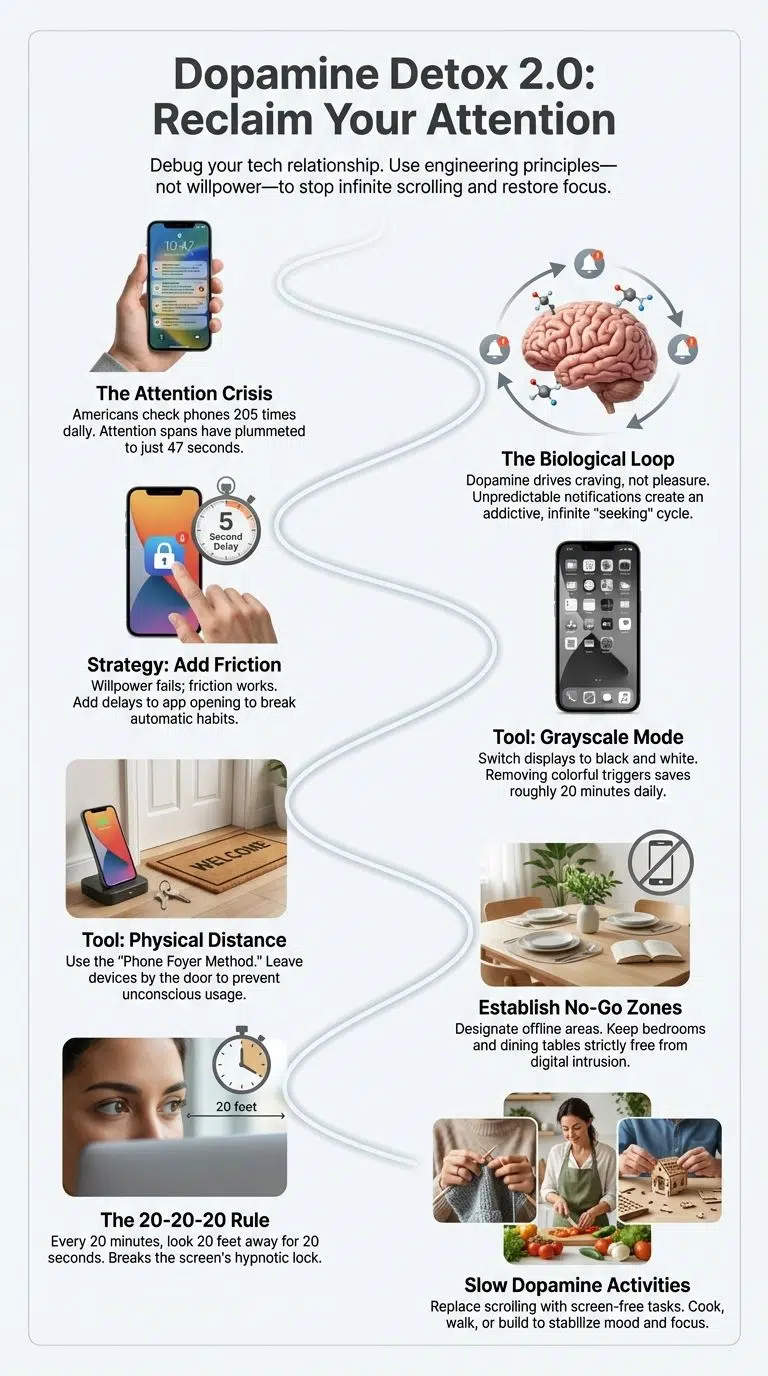
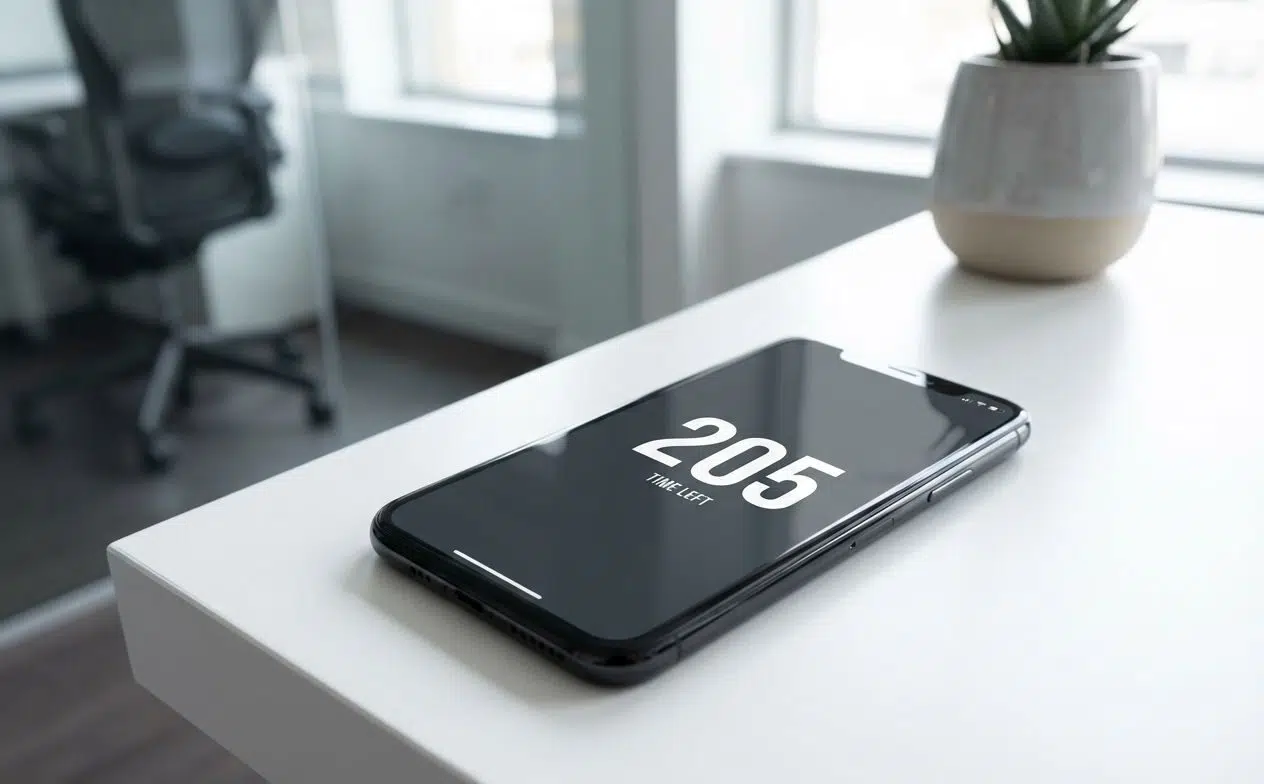
Does your phone steal your attention before breakfast? You unlock it to check the weather, and suddenly, twenty minutes have vanished into a social media feed. If this sounds familiar, you are not alone. In fact, recent data from Reviews.org reveals that the average American checks their phone 205 times a day. That is once every few minutes.
Dopamine Detox 2.0 is not about throwing your phone in the ocean. It is about debugging your relationship with technology. In this post, I will walk you through the exact system I used to stop the infinite scroll and reclaim my mental bandwidth. Dopamine Detox 2.0: reclaiming attention in an algorithm-heavy world gives us the framework, and I will give you the practical code to run it. Ready to push a hard refresh on your focus? Let’s get to work.
What is Dopamine and Why Does It Matter?
Think of dopamine as the notification badge of your brain. It is a neurotransmitter that signals importance, telling you, “Pay attention to this, it might be good for survival.” In the physical world, this helped us find food. In the digital world, it traps us in loops.
The role of dopamine in the brain
Dopamine is often misunderstood as the “pleasure chemical,” but it is actually about craving. It drives the search for reward, not the enjoyment of it. Dr. Anna Lembke, author of Dopamine Nation, describes dopamine as the “universal currency” for measuring the addictive potential of an experience.
“The more dopamine in the brain’s reward pathway, the more addictive the experience.” — Dr. Anna Lembke
When you see a red notification dot, your brain releases dopamine in anticipation of a connection or a like. If you check it and find nothing, your dopamine drops below baseline. This drop feels like pain, and the only way to fix it is to check again. It is a biological infinite loop.
How dopamine influences attention and behavior
This cycle wreaks havoc on your ability to focus. According to research by Dr. Gloria Mark at UC Irvine, the average attention span on a screen has plummeted to just 47 seconds. We are constantly task-switching, looking for the next hit.
Social media platforms exploit this by using “Variable Reward Schedules.” Sometimes you get a great update, and sometimes you get nothing. This unpredictability keeps your dopamine firing, much like a slot machine. The result is a brain that feels restless and unable to sustain deep work, a state I call “cognitive latency.”
The Concept of a Dopamine Detox
The original idea of a dopamine detox was often interpreted as “monk mode”, avoiding all pleasure to reset the brain. Dopamine Detox 2.0 takes a more realistic, engineering-based approach.
The Rise of the Dopamine Detox Trend
Dr. Cameron Sepah popularized the concept as a form of cognitive behavioral therapy. He intended it to be a way to manage impulsive behaviors, not a challenge to stare at a wall for 24 hours.
Early viral trends on YouTube made it seem like a challenge of willpower. Influencers tried to quit music, food, and eye contact. While interesting, these strict fasts rarely stick. You cannot “empty” your brain of dopamine; you need it to function. The goal is regulation, not elimination.
Objectives of Dopamine Detox for Enhanced Focus
The real objective is to reduce the “noise” so you can hear the “signal” again. By lowering the constant influx of high-stimulation triggers (like TikTok or breaking news), you re-sensitize your brain to lower-stimulation tasks.
Suddenly, writing a report or reading a book does not feel boring. It feels engaging. This is about refactoring your environment so that doing the hard thing becomes easier than doing the easy thing.
The Science of Dopamine Detoxing
To fix a bug, you have to understand the code. Neuroscience gives us the documentation we need to patch our attention spans.
Common Myths About Dopamine Fasting
- Myth 1: You can “deplete” dopamine. False. Your body produces it naturally. You are just resetting your tolerance.
- Myth 2: Screens are the only enemy. High-sugar foods and video games trigger the same pathways.
- Myth 3: You need to suffer. Boredom is a feature, not a bug. It is the state where creativity begins.
Insights from Neuroscience on Dopamine Control
The brain operates on a pleasure-pain balance. When you flood your system with cheap dopamine (Instagram reels), your brain compensates by tipping the scale toward pain to restore homeostasis. This is why you feel irritable or “come down” after an hour of scrolling.
A successful detox works by stopping the flood. When you stop hammering the “pleasure” button, the scale slowly tips back to level. This resets your baseline mood and motivation. You stop needing a notification to feel okay.
Challenges in an Algorithm-Driven Environment
You are up against supercomputers designed to keep you online. It is an unfair fight if you rely on willpower alone.
Effects of Digital Overload on Attention Span
The cost of interruption is higher than you think. Gloria Mark’s research highlights that once you are distracted, it takes an average of 23 minutes and 15 seconds to get back to the original task. This is the “context switching” penalty.
If you check your phone every 10 minutes, you are never actually focused. You are perpetually in a state of recovery. This leads to “attention residue,” where your mind is still processing the last email while you try to talk to your spouse or write code.
How Digital Algorithms Exploit Dopamine Responses
Tech companies employ behavioral psychologists to maximize “Time on Site.” They use specific patterns to hook you:
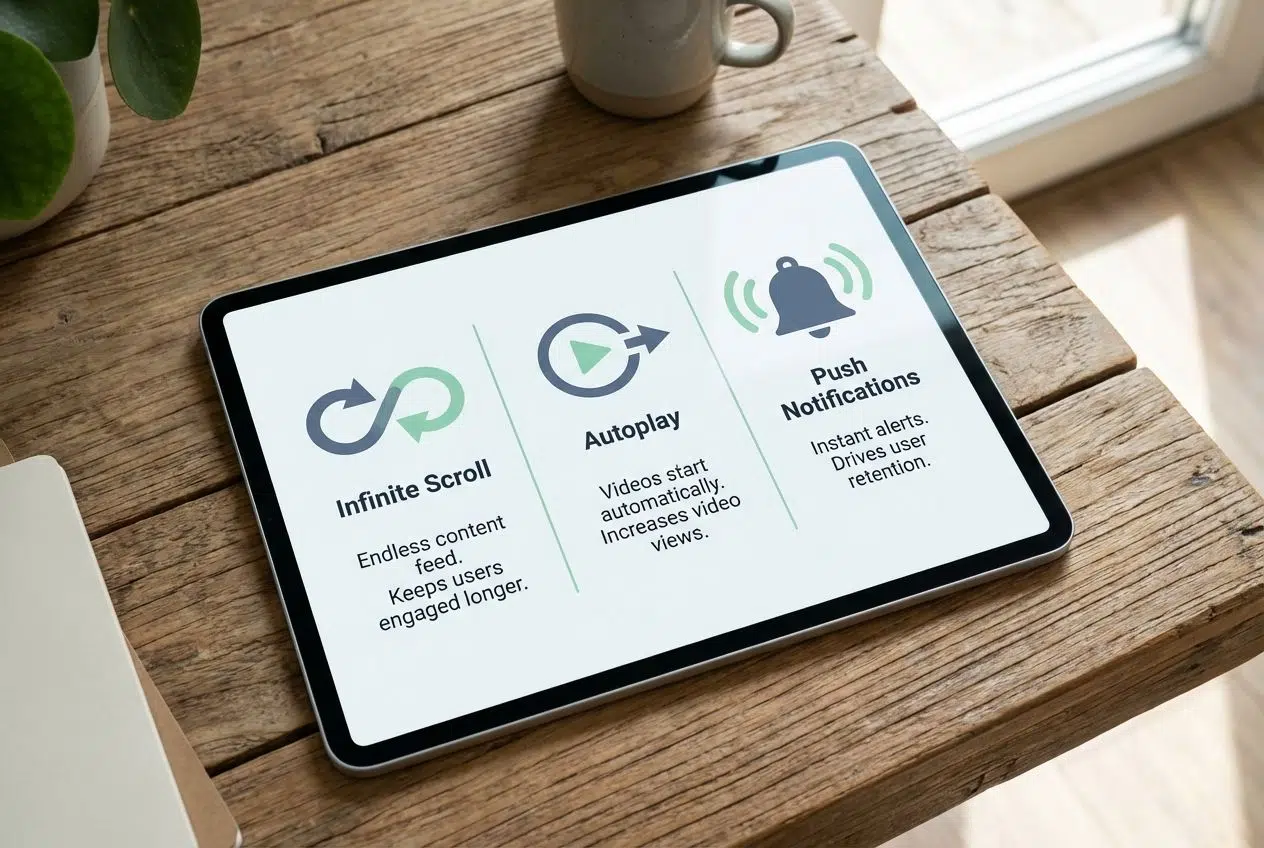
| Feature | Trigger | Why It Hooks You |
|---|---|---|
| Infinite Scroll | Lack of “Stopping Cues” | Your brain never gets a signal to stop, so you consume automatically. |
| Autoplay | Passive Consumption | Removing the choice to click “next” removes the friction of stopping. |
| Push Notifications | Urgency & Curiosity | Red badges trigger a “threat” response that demands immediate resolution. |
These features are not accidents. They are engineered loops. Recognizing them is the first step to breaking them.
Dopamine Detox 2.0: A Revised Strategy
We need a patch update. Version 1.0 (Abstinence) crashes too often. Version 2.0 focuses on Friction.
Advancing Past Traditional Dopamine Detox Methods
Willpower is a limited resource, like battery life. You will eventually run out. Instead of fighting the urge, Dopamine Detox 2.0 uses tools to make the bad habit difficult to execute. If you have to wait 10 seconds to open Twitter, your brain will often decide it isn’t worth it. This tiny delay breaks the automatic loop.
Integrating Mindful Technology Practices
I use specific tools to inject friction into my digital life. These are my top recommendations for your tech stack:
- One Sec App: This app forces you to take a deep breath for a few seconds before opening social media. A study by the Max Planck Institute found it reduces app usage by 57%.
- Grayscale Mode: Turning your screen black and white removes the colorful triggers. Research suggests this can save you about 20 minutes of screen time daily.
- Physical Distance: The “Phone Foyer Method” involves leaving your phone by the front door when you get home. If it is not in your pocket, you cannot check it unconsciously.
Choosing Balance over Complete Abstinence
You don’t need to delete every app. You just need to change the permissions. Treat social media like a desktop computer activity. If you only check Instagram on your laptop, you will naturally check it less because you can’t take it to the bathroom. This preserves the utility of the tool while removing the addiction.
Benefits of Gaining Back Control Over Attention
When you clear the cache of your mind, the performance improvements are immediate.
Boosting Focus and Productivity
Without the constant context-switching penalty, you enter a state of “Deep Work.” This is where complex problem-solving happens. You will find you can finish in four hours what used to take eight. Your brain stops looking for the “easy win” of a notification and starts enjoying the “hard win” of completing a project.
Enhancing Mental Clarity and Emotional Stability
The constant dopamine rollercoaster causes emotional spikes and crashes. Flattening that curve leads to a calm, steady energy. You become less reactive. When you aren’t constantly overstimulated, everyday annoyances trigger less stress. You might even find yourself sitting in a waiting room, just thinking, without reaching for your pocket. That is true freedom.
Steps to Regain Your Focus
Here is your deployment plan. Start with these three changes today.
1. Establishing Tech Use Limits
Define clear “No-Go Zones” in your house. The dining table and the bedroom should be offline servers. Use the 20-20-20 rule to reduce eye strain and mental fatigue: every 20 minutes, look at something 20 feet away for 20 seconds. This breaks the hypnotic lock of the screen.
2. Practicing Mindfulness and Meditation
Meditation is like defragmenting your hard drive. It teaches you to observe an urge (“I want to check my phone”) without acting on it. Start with just five minutes. You don’t need to be an expert. The goal is simply to notice when your mind wanders and bring it back. This builds the “muscle” of attention management.
3. Engaging in Valuable, Screen-Free Activities
You need to replace the cheap dopamine with “slow dopamine.” Go for a walk without headphones. Cook a meal from scratch. Build something with your hands. These activities release dopamine slowly and consistently, providing satisfaction without the crash. They remind your brain that the real world has higher resolution than any screen.
The Bottom Line
Dopamine Detox 2.0 is not about hating technology. It is about refusing to let algorithms run your life. Your attention is your most valuable asset, and right now, it is being mined for ad revenue. By adding friction, using tools like screen time tracking, and embracing a little boredom, you can patch the leaks in your focus. You will find that life is much richer when you aren’t watching it through a 6-inch window.
Start with one change. Put your phone in grayscale mode right now. See how much quieter the world feels.