
For years, the SaaS industry operated on a simple promise: if they log in, they are happy. We built massive Customer Success (CS) teams dedicated to “delighting” users, checking in on health scores, and sending swag bags. But the economic climate has shifted, and the “good vibes” era of software is over.
In 2025, usage does not equal value. A customer can log in every day and still churn because they aren’t seeing a tangible return on investment. This realization is driving a massive industry pivot. We are moving away from “Customer Success”—often perceived as a fuzzy, relationship-based function—toward “Customer Outcomes,” a hard-edged, data-driven discipline focused on delivering measurable business results.
This isn’t just a rebrand; it’s a survival strategy. Companies that stick to traditional success models are finding themselves on the chopping block during budget reviews. Those pivoting to an outcome-first mindset are proving they are indispensable revenue drivers, not just cost centers.
The Evolution of Customer Success: Why the Old Model Broke
To understand where we are going, we have to look at where we failed. Customer Success was born out of the subscription economy to solve the churn problem. If you sold a perpetual license, you didn’t care if the customer used the software. In a subscription model, you had to re-win their business every month or year.
From Support to Success
Initially, CS was just “proactive support.” Instead of waiting for a ticket, a CSM (Customer Success Manager) would reach out to ensure the customer was deployed. This worked when the market was growing at all costs. The primary goal was adoption: get them to use the features. We assumed that if a customer used Feature X, they were getting value.
Where Traditional CSM Falls Short
The cracks in this model appeared when CFOs started scrutinizing software spend. A CSM could report, “The client is healthy; they login daily and love our quarterly calls.” But when the client’s CFO asked, “How has this software increased our revenue or cut our costs?” the CSM had no answer.
Relationship-based success is fragile. If your champion at the client company leaves, the relationship leaves with them. Outcome-based success is sticky. If you have proven you saved the company $2M, it doesn’t matter who your point of contact is—the contract is safe.

Traditional CS vs. Modern Needs
| Feature | Traditional Customer Success | Modern Customer Outcomes |
| Primary Goal | Retention and “Happiness” | Value Realization and ROI |
| Key Metric | Usage / Logins / NPS | Time-to-Value / Verified Outcomes |
| Engagement | “Checking in” / Quarterly Reviews | Strategic Roadmap / Milestone Tracking |
| Relationship | High-touch with a “Champion” | Multi-thread with Budget Holders |
| Perception | Cost Center (Support) | Revenue Driver (Growth) |
What Are Customer Outcomes?
“Customer Outcomes” is not a job title; it is a business philosophy. It reorients the entire company around the specific goal the customer bought the product to achieve. Nobody buys a drill; they buy a hole in the wall. Similarly, nobody buys CRM software; they buy “20% faster sales cycles.”
Defining the Outcome-Based Approach
An outcome-based approach starts before the sale. It requires Sales to document exactly why the customer is buying. Is it to reduce headcount? To speed up processing time? To comply with a new regulation?
These goals become the “North Star” for the post-sales team. A Customer Outcome strategy ignores generic onboarding checklists in favor of “Success Plans” that map directly to these business goals. If a customer wants to reduce processing time, the CSM doesn’t train them on every feature—only the ones that reduce processing time.
Value Realization vs. Usage Metrics
This is the critical distinction. Usage is a proxy for value, and often a bad one.
- Usage: The customer sent 5,000 emails using our marketing tool.
- Outcome: The customer generated $50k in pipeline from those emails.
If they sent 5,000 emails and got zero leads, “high usage” is actually a churn signal (they are working hard for no result). An outcomes focus looks at the $50k pipeline number, not the button clicks.
Metrics Comparison (Usage vs. Outcome)
| Metric Type | Example Metric | What It Tells You | Why It Can Be Misleading |
| Usage (Old) | Daily Active Users (DAU) | Frequency of login | Users might be logging in to troubleshoot bugs. |
| Usage (Old) | Feature Adoption % | Breadth of tool use | Using more features doesn’t mean getting more value. |
| Outcome (New) | Time-to-First-Value | Speed of ROI | If fast, the customer trusts you immediately. |
| Outcome (New) | Outcome Achievement Rate | % of goals met | Direct correlation to renewal and expansion. |
| Outcome (New) | Net Dollar Retention (NDR) | Growth of account | Proves the customer is voting with their wallet. |
Why “Customer Outcomes” is the New Standard
The pivot to Customer Outcomes is being forced by the market. We are in an era of “efficient growth,” where money is no longer cheap and scrutiny on software spend is at an all-time high.
The Economic Pressure on SaaS
During the boom years, companies bought software redundantly. Marketing might have three different analytics tools. Now, consolidation is the trend. When a company decides to cut two of those three tools, they don’t keep the one with the nicest CSM. They keep the one that can prove it delivered the highest return.
SaaS vendors that focus on outcomes arm their champions with the data needed to defend the renewal. If you can provide a report saying, “We saved you 400 engineering hours this quarter,” you have done the CFO’s job for them.
Customers Demand Tangible ROI
Buyers are smarter now. They are tired of “shelfware”—software they bought but never fully utilized. They are demanding “outcome-based pricing” or performance guarantees.
We are seeing a rise in contracts where payment terms are tied to milestones. For example, a heavy implementation fee might be waived if the vendor fails to get the customer live within 60 days. This forces the vendor to align their resources (Customer Outcomes) with the customer’s goal (going live fast).
Economic Drivers of the Shift
| Economic Driver | Impact on SaaS Strategy |
| Budget Cuts | Vendors must prove their tool pays for itself (ROI) to avoid being cut. |
| Vendor Consolidation | Being “nice to have” is fatal; you must be “mission-critical.” |
| Subscription Fatigue | Customers want fewer tools that do more; they prioritize platforms delivering multiple outcomes. |
| C-Level Scrutiny | Renewals now require CFO sign-off; “happiness” data (NPS) won’t convince a CFO. |
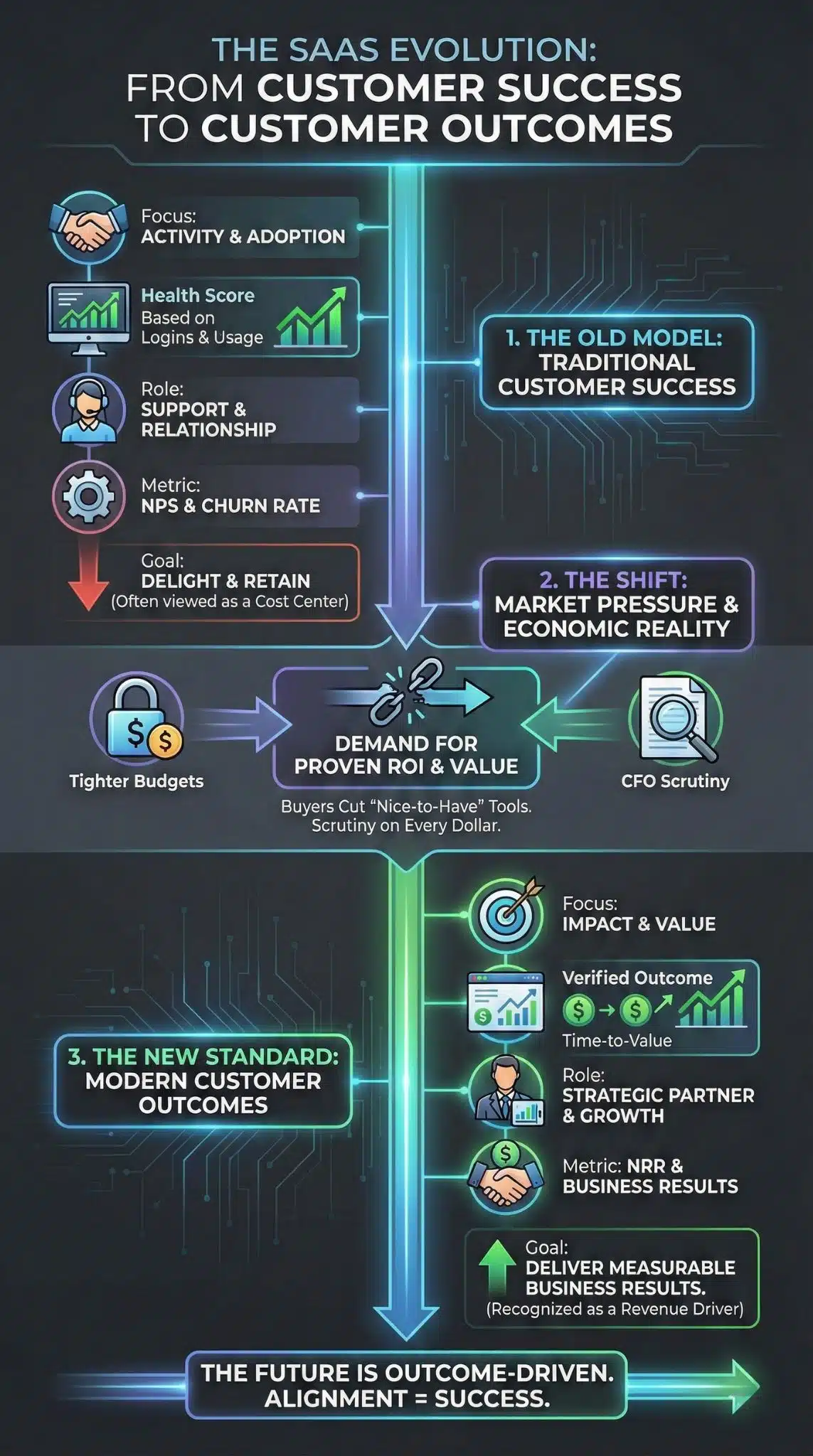
Key Differences Between Success and Outcomes
While they sound similar, the day-to-day execution of a Customer Outcomes team looks drastically different from a traditional Success team.
Mindset Shift: Activity vs. Result
Traditional CS manages activities: “Did I send the QBR deck? Did I reply to the email? Did I train them on the new feature?”
Customer Outcomes manages results: “Did the customer reduce their churn? Did they launch their campaign on time?”
This requires a shift in hiring. You don’t just need empathetic people-pleasers anymore. You need business consultants who understand the customer’s industry. A CSM for a FinTech product needs to understand banking regulations and cash flow, not just how to reset a password.
Measurement: Health Scores vs. Business Impact
Most “Customer Health Scores” are essentially a heartbeat monitor—they tell you if the patient is alive, not if they are healthy. Green, Yellow, Red indicators based on login frequency are reactive.
Outcome measurement is predictive. If a customer bought your software to improve site speed, you should be tracking their site speed. If the speed isn’t improving, the customer is “Red” (at risk), even if they log in five times a day.
Side-by-Side Comparison
| Dimension | Customer Success Approach | Customer Outcomes Approach |
| Focus | Product Adoption | Business Value |
| Conversation | “How are you liking the tool?” | “How are we tracking against your $1M savings goal?” |
| Churn Prevention | Reactive (Save teams) | Proactive (Value delivery) |
| Expansion | “Would you like to buy more?” | “You achieved Goal A; buying module B will help you hit Goal C.” |
Implementing a Customer Outcomes Strategy
Transitioning to this model is painful. It requires breaking down silos between Sales, Product, and Service. You cannot deliver outcomes if Sales is selling “blue sky” promises that the Product can’t deliver.
Aligning Sales and Post-Sales
The disconnect usually starts at the handoff. Sales closes the deal and throws it over the fence to CS. The CS team then asks the customer, “So, why did you buy this?” The customer gets frustrated because they just spent three months telling Sales why.
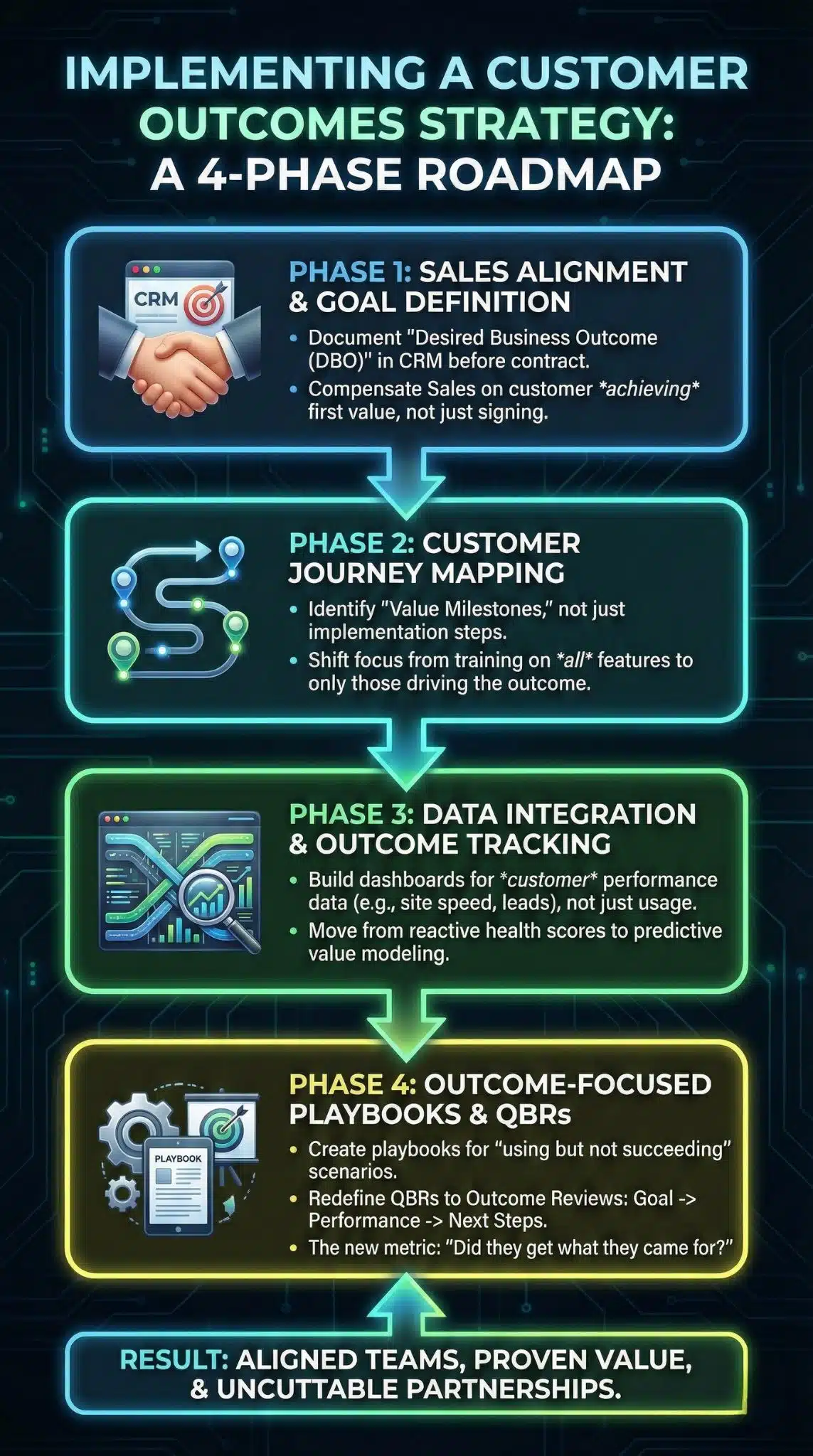
In an outcome model, the “Desired Business Outcome” (DBO) is documented in the CRM before the contract is signed. The CSM’s job is not to discover the goal, but to execute the plan to hit it. Compensation for Sales is increasingly tied to the customer actually achieving that first value, not just signing the paper.
Redefining the QBR (Quarterly Business Review)
The traditional QBR is dead. Customers hate them because they are usually 50 slides of the vendor talking about themselves: “Here is our roadmap, here are our new features, please renew.”
The Outcome Review is different. It is short, data-heavy, and customer-centric.
- Goal Review: We agreed to hit X.
- Performance: We hit X (here is the data).
- Next Steps: Now let’s aim for Y.
If you can’t prove you hit X, you don’t earn the right to ask for the renewal.
Steps to Transition
| Phase | Action Item |
| 1. Sales Alignment | Update CRM to require “Desired Outcome” fields before closing a deal. |
| 2. Customer Journey Map | Identify “Value Milestones” rather than just “Implementation Steps.” |
| 3. Data Integration | Build dashboards that track customer performance data, not just product usage data. |
| 4. Playbooks | Create specific playbooks for when a customer is using the tool but not seeing results. |
The Future of the Customer Relationship
As we look toward late 2025 and 2026, the concept of “Customer Outcomes” will merge heavily with AI and automation. We are moving toward a world of “Digital Outcomes.”
AI’s Role in Predicting Outcomes
We used to rely on a CSM’s gut feeling to know if a customer was happy. Now, AI analyzes sentiment in emails, support tickets, and Zoom calls. More importantly, AI analyzes usage patterns to predict failure.
If a customer is trying to set up an integration and fails three times, AI can flag this as a “Value Blocker” and trigger an intervention. This isn’t just support; it’s protecting the outcome. We will see “predictive value modeling” where the vendor tells the customer, “Based on your current trajectory, you will miss your Q3 targets unless we adjust X.”
The Rise of the CCO (Chief Customer Officer)
The Chief Customer Officer is becoming the most powerful person in the room next to the CEO. Why? Because in a recurring revenue model, current customers fund the future. The CCO is no longer just the head of support; they own the “Net Dollar Retention” number. They are responsible for the entire lifecycle of value.
We are also seeing the emergence of the “outcome engineer”—technical resources embedded in CS teams whose sole job is to build the scripts, APIs, and connections ensuring the software actually works in the customer’s unique stack.
Future Trends
| Trend | Prediction for 2026 |
| Outcome-Based Pricing | Vendors will charge based on results (e.g., per lead generated) rather than per seat. |
| AI “Success Bots” | Routine “how-to” questions will be 100% AI, leaving humans to focus on strategy. |
| Community as Success | Peer-to-peer outcome sharing will replace vendor-led training. |
| The “Value Portal” | Customers will have a real-time dashboard showing exactly how much money/time the software has saved them. |
Final Thoughts
The shift from Customer Success to Customer Outcomes is the maturation of the SaaS industry. We are leaving the “growth at all costs” adolescence and entering the “value at all costs” adulthood.
For vendors, this is scary. It means you can no longer hide behind friendly relationships and vague metrics. You have to deliver. But for those who make the leap, the reward is massive. When you align your success strictly with your customer’s outcomes, you stop being a vendor and start being a partner. You become uncuttable.