The global energy landscape is currently undergoing a radical, often painful metamorphosis. For decades, atomic energy was hailed as the ultimate “baseload” savior, but shifting political tides, aging infrastructure, and high-profile safety concerns have led several major economies to systematically shut down the most nuclear power facilities in their history.
This transition isn’t just about flipping a switch; it represents a multi-billion dollar pivot toward renewables that is testing the limits of national power grids and geopolitical stability. Understanding which countries are leading this retreat—and why—is essential for anyone tracking the future of global carbon emissions and energy security.
To accurately assess this retreat from the atom, we had to look beyond mere political rhetoric and focus on hard capacity data.
Our Selection Criteria
Identifying the countries that have dismantled or permanently deactivated their nuclear infrastructure requires a deep dive into international energy databases. We utilized a specific set of metrics to ensure our list reflects the most significant shifts in global energy policy.
-
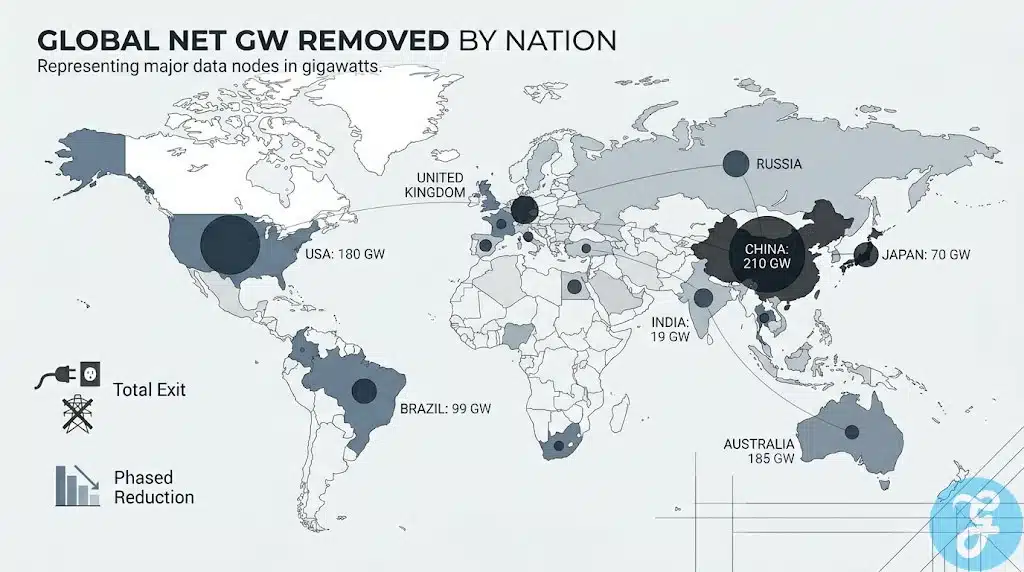
Net Gigawatts (GW) of nuclear capacity permanently removed from the national grid.
-
Total number of commercial reactors fully decommissioned or entered into permanent shutdown.
-
Long-term legislative commitments to nuclear phase-out as of 2026.
-
The economic impact of decommissioning costs relative to national energy GDP.
By applying these rigorous filters, we can better understand the strategic motivations behind these massive infrastructure changes.
Whom This Global Energy Breakdown Is For
This analysis is tailored for energy market investors, environmental policy researchers, and infrastructure analysts who need to understand how the removal of nuclear baseload is reshaping the global power market.
With the selection criteria and target audience defined, we can now examine the specific nations that have fundamentally altered their energy profiles.
Global Power Shifts: 10 Countries That Shut Down the Most Nuclear Power
The move away from nuclear energy is rarely a sudden event; it is often the result of decades of public pressure and evolving economic realities. Here is a detailed look at the countries that have led the charge in decommissioning their atomic fleets.
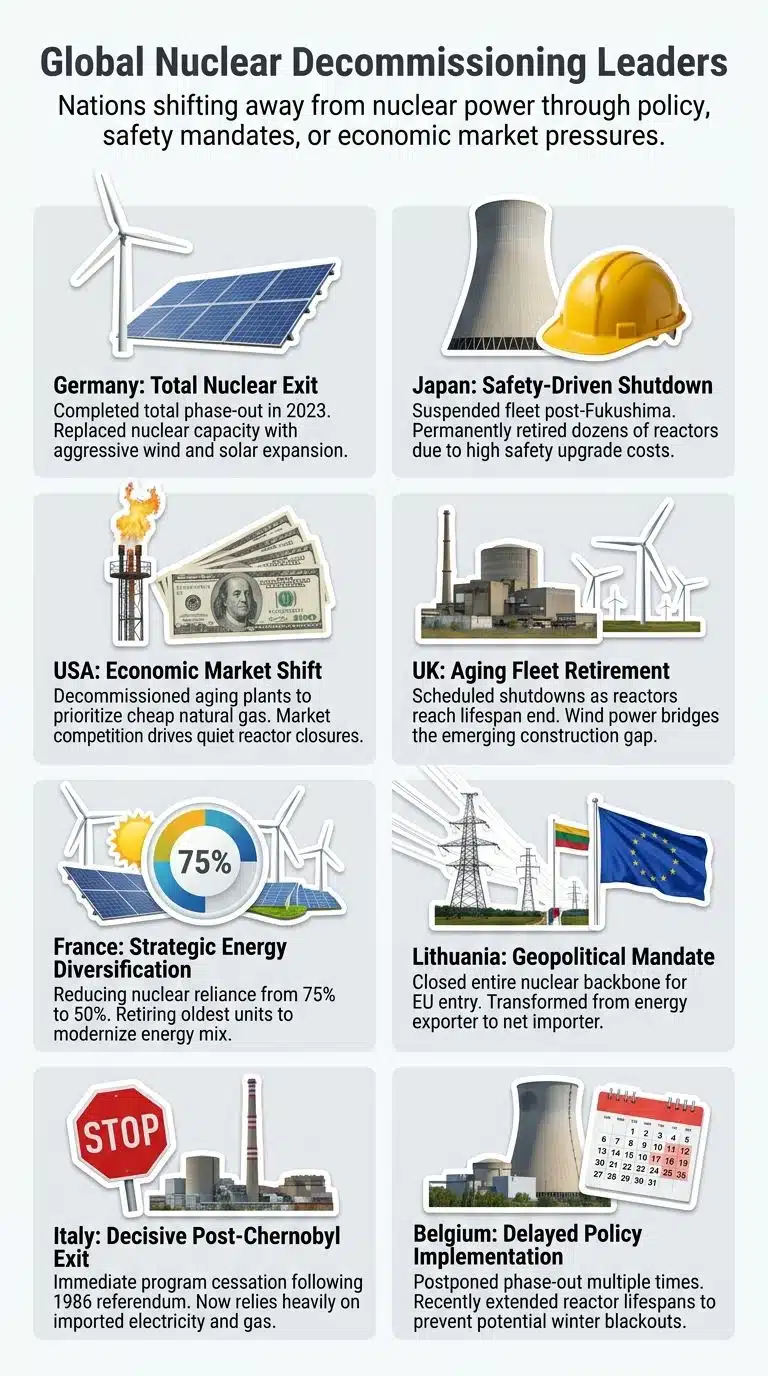
Germany stands as the most prominent example of a major industrial power choosing to exit the nuclear sector entirely.
1. Germany
Germany’s Energiewende policy culminated in the final shutdown of its last remaining reactors in 2023, marking the end of a multi-decade phase-out. This decision was largely driven by intense public opposition that spiked following the Fukushima disaster. To fill the massive energy gap, Germany has aggressively expanded its wind and solar capacity, though it has faced criticism for a temporary increase in coal reliance during the transition period.
Best for: Understanding the systemic challenges of a total national nuclear phase-out.
Why We Chose It:
-
It is the only G7 nation to have successfully completed a total exit from nuclear power.
-
Provides a massive dataset on the costs and logistics of large-scale decommissioning.
-
Illustrates the political power of environmental movements in shaping national energy policy.
Things to consider: The total phase-out has left Germany highly sensitive to energy price volatility and reliant on imports during peak demand.
In contrast to Germany’s planned exit, Japan’s shutdown was a reactive measure that fundamentally redefined its energy safety protocols.
2. Japan
Following the 2011 Fukushima Daiichi accident, Japan suspended its entire nuclear fleet for rigorous safety checks. While some reactors have since restarted, dozens have been designated for permanent decommissioning due to their proximity to fault lines or the prohibitive cost of safety upgrades. This mass deactivation forced one of the world’s most advanced economies to scramble for liquefied natural gas (LNG) and renewable alternatives.
Best for: Analyzing the impact of sudden, safety-mandated energy shifts on a national economy.
Why We Chose It:
-
Represents the largest single-event reduction in operational nuclear capacity in history.
-
Shows the extreme difficulty of retrofitting aging reactors to meet modern safety standards.
Things to consider: Japan’s ongoing struggle to balance carbon goals with nuclear safety has led to a highly fragmented energy policy.
While Japan and Germany were driven by safety and politics, the United States has seen a reduction primarily dictated by the “invisible hand” of the market.
3. United States
The U.S. still maintains the world’s largest nuclear fleet, but it has also shut down more individual reactors than almost any other nation. These closures are rarely due to anti-nuclear sentiment; instead, they are driven by the low cost of natural gas and the massive upfront expenses required to extend the licenses of aging plants. Many facilities are simply no longer economically competitive in deregulated energy markets.
Best for: Studying the economic viability of nuclear energy in a market dominated by cheap gas.
Why We Chose It:
-
Highlights the “quiet” decommissioning of dozens of smaller, older units.
-
Provides a look at how economic factors can override environmental or political goals.
Things to consider: The U.S. is currently exploring “re-powering” some shut-down sites, suggesting the retreat might not be permanent for all locations.
The United Kingdom is facing a different challenge: a fleet that is simply reaching the end of its natural life.
4. United Kingdom
The UK’s first generation of Advanced Gas-cooled Reactors (AGRs) is reaching the end of its operational lifespan, leading to a wave of scheduled shutdowns. While the government is keen on building new plants like Hinkley Point C, the rate of decommissioning is currently outpacing the speed of new construction. This has created a “nuclear gap” that the UK is attempting to bridge with massive investments in offshore wind.
Best for: Examining the logistics of managing an aging national nuclear fleet.
Why We Chose It:
-
Demonstrates the inevitable “end-of-life” phase that all nuclear fleets must eventually face.
-
Focuses on the high cost and long timeline of decommissioning 20th-century technology.
Things to consider: Delays in new nuclear construction could leave the UK grid vulnerable to supply shortages in the late 2020s.
France, long the poster child for nuclear energy, is now attempting a delicate balancing act to reduce its over-reliance.
5. France
France generates a higher percentage of its electricity from nuclear power than any other major economy, but recent policy shifts aim to reduce this from 75% to 50% to diversify the energy mix. This has led to the permanent closure of older plants like Fessenheim. The strategy is to modernize the remaining fleet while slowly retiring the oldest units to make room for renewables.
Best for: Observing a strategic, gradual reduction in nuclear dominance without a total exit.
Why We Chose It:
-
Shows how even pro-nuclear nations are looking to diversify their energy portfolios.
-
Illustrates the technical challenges of maintaining a massive, aging infrastructure.
Things to consider: The recent global energy crisis has forced France to slow its decommissioning plans to ensure domestic energy security.
Sweden’s journey shows how public referendums can set an energy course that lasts for decades.
6. Sweden
Following a 1980 referendum, Sweden set a course to phase out nuclear power, though the timeline has been repeatedly adjusted. Several reactors at the Ringhals and Oskarshamn sites have been shut down over the last decade. However, like France, Sweden is currently debating the wisdom of further closures as it strives for a fossil-free future.
Best for: Understanding the long-term effects of direct democracy on energy infrastructure.
Why We Chose It:
-
Exemplifies the tension between 20th-century political mandates and 21st-century climate goals.
-
Provides a case study in “partial phase-outs” and the associated grid stability issues.
Things to consider: Public opinion in Sweden has recently swung back toward nuclear, creating a political stalemate over future shutdowns.
Lithuania’s exit from nuclear power was not a choice, but a requirement for international integration.
7. Lithuania
Lithuania once had the highest nuclear share in the world thanks to the Ignalina Nuclear Power Plant. As a condition of its entry into the European Union, Lithuania was required to shut down its Chernobyl-style RBMK reactors. This transformed the country from a major energy exporter to a net importer almost overnight, forcing a rapid and difficult restructuring of its entire economy.
Best for: Studying the impact of geopolitics on national energy independence.
Why We Chose It:
-
It is a rare example of a country losing its entire energy backbone for political reasons.
-
Shows the massive economic and social impact of decommissioning a nation’s primary employer.
Things to consider: The Ignalina decommissioning process is one of the most complex and expensive technical projects in EU history.
Italy’s exit was one of the quickest and most decisive responses to public fear in the wake of Chernobyl.
8. Italy
Following the 1986 Chernobyl disaster, Italy held a referendum that led to the immediate cessation of its nuclear program. By 1990, all of its reactors were shut down. This left Italy as one of the few G7 nations without a domestic nuclear capacity, leading to a heavy reliance on imported electricity and natural gas from neighboring countries.
Best for: Analyzing the long-term consequences of a rapid, total nuclear exit.
Why We Chose It:
-
Provides a 30-year data window on the economic cost of importing energy vs. domestic production.
-
Highlights the difficulty of restarting a nuclear program once the specialized workforce has vanished.
Things to consider: Italy now has some of the highest electricity prices in Europe, partly due to its lack of baseload nuclear.
Spain is currently in the early stages of a planned phase-out that prioritizes a “green” transition.
9. Spain
The Spanish government has reached an agreement with energy companies to gradually shut down the most nuclear power capacity by 2035. The plan is to replace nuclear output with a massive surge in solar and wind power. While the transition is currently underway, there is significant debate regarding the high decommissioning costs and the potential impact on industrial competitiveness.
Best for: Tracking a “live” phase-out in a sun-rich European nation.
Why We Chose It:
-
Represents the modern, climate-focused rationale for moving away from nuclear.
-
Shows the importance of collaboration between the state and private energy firms.
Things to consider: Spain’s heavy investment in renewables makes it a prime candidate for a successful transition, provided storage technology keeps pace.
Belgium has spent years grappling with the “stop-start” nature of its nuclear phase-out policy.
10. Belgium
Belgium has a long-standing law to phase out nuclear power, but the timeline has been delayed multiple times due to fears of winter blackouts. Some older reactors have finally been taken offline, but the recent energy crisis has forced a 10-year extension for its newest units. It remains a key example of how difficult it is to actually “pull the plug” on a reliable energy source.
Best for: Observing the political and practical hurdles of a delayed phase-out.
Why We Chose It:
-
Highlights the conflict between legislative goals and real-world grid requirements.
-
Shows how external geopolitical shocks can derail decades of energy planning.
Things to consider: The frequent changes in policy have made long-term energy investment in Belgium incredibly risky.
To better visualize how these nations compare in their approach to decommissioning, we have compiled a data summary.
An Overview Of Global Decommissioning and the Goal to Shut Down the Most Nuclear Power
Comparing the decommissioning strategies across these ten nations reveals a wide range of motivations and timelines.
Overview Comparison Table
| Country | Primary Shutdown Driver | Current Status | Long-term Strategy |
| Germany | Political / Public Pressure | Total Exit Complete | 100% Renewables |
| Japan | Safety / Regulation | Partial Decommissioning | Mixed (Restarting some) |
| United States | Economic Competition | Ongoing Retirement | Small Modular Reactors |
| United Kingdom | Aging Infrastructure | Scheduled Retirement | New Build Replacements |
| France | Resource Diversification | Gradual Reduction | Modernized Nuclear |
| Lithuania | Geopolitical (EU entry) | Total Exit Complete | Regional Integration |
| Italy | Public Referendum | Total Exit Complete | Heavy Energy Imports |
| Spain | Green Transition | Phased Exit (Start) | Solar / Wind Focus |
| Belgium | Legislative Mandate | Phased Exit (Delayed) | Natural Gas / Renewables |
| Sweden | Public Referendum | Partial Exit | Policy Re-evaluation |
Reviewing this data helps identify which nations are most successful in their transition away from atomic energy.
Our Top 3 Picks and Why?
While all these countries have significantly reduced their nuclear footprint, three stand out for their impact on the global conversation.
-
Germany: For proving that a major industrial power can entirely dismantle its nuclear backbone, regardless of the cost.
-
Lithuania: For successfully navigating the total loss of its primary energy source under intense geopolitical pressure.
-
United States: For demonstrating that market forces can be just as effective as political mandates in retiring aging reactors.
Successfully navigating a transition away from nuclear power requires a structured framework to ensure grid stability.
How to Evaluate the Impact of a Nuclear Shutdown by Yourself?
If you are analyzing the energy security of a specific region, you can use the same framework applied by national energy boards.
-
Analyze the Baseload Gap: Calculate how many gigawatts are being removed and identify what will replace that 24/7 power.
-
Audit Decommissioning Funds: Check if the utility company has set aside enough capital to manage the 50-year cleanup process.
-
Assess Grid Interconnectivity: Determine if the country can easily import power from neighbors during the transition period.
Before reaching a final conclusion on a nation’s energy future, consider this essential checklist.
The Final Checklist
Ensure you have accounted for these five factors when reviewing a nuclear shutdown.
-
Is there a 1:1 replacement for the lost gigawatt capacity?
-
Have the carbon emissions increased since the shutdown?
-
Is the local community around the plant being economically supported?
-
What is the long-term plan for high-level radioactive waste storage?
-
How has the retail price of electricity changed for the average consumer?
Moving beyond the data, we must reflect on the long-term consequences of these monumental decisions.
The Half-Life of Political Promises
The global movement to shut down the most nuclear power reactors in history is perhaps the most significant gamble of the modern era. While the goal of a nuclear-free, renewable-heavy future is noble, the transition is fraught with a degree of “uncomfortable” truth that many policymakers are hesitant to discuss. In the rush to dismantle the old world, we have often ignored the sheer physical reality of energy density.
Replacing a single nuclear plant requires thousands of acres of solar panels or wind turbines, along with storage technology that in 2026 still hasn’t reached the scale needed to support heavy industry through a long, dark winter. Many of the nations on this list, most notably Italy and Germany, have traded a domestic energy “risk” for a geopolitical one, often finding themselves at the mercy of foreign natural gas supplies.
The future of energy is likely a messy, hybrid reality where we may look back at these dismantled reactors with a sense of “carbon regret.” True sustainability requires a level of pragmatic analysis that goes beyond the emotional hook of a protest banner, demanding that we value grid stability and carbon reduction over political expediency.
Understanding the complexities of nuclear decommissioning often leads to several recurring questions from the public.
Frequently Asked Questions (FAQs) About Countries That Shut Down the Most Nuclear Power
Here are the most common inquiries regarding the global retreat from atomic energy.
Is it possible to “un-shut down” a nuclear reactor?
It is technically possible but incredibly expensive and rare. Once a reactor has entered the decommissioning phase and critical cooling systems are removed, the cost of “re-powering” it often exceeds the cost of building a new plant.
Which country has the most reactors currently being decommissioned?
The United States currently has the highest number of reactors in various stages of decommissioning, followed closely by Germany and the United Kingdom.
Does shutting down nuclear power always increase carbon emissions?
In the short term, yes. Many countries have had to rely more heavily on coal or natural gas to provide the “baseload” power that nuclear once provided while they wait for renewable infrastructure to scale.
How much does it cost to shut down a single nuclear plant?
The costs range from $500 million to over $1 billion per reactor, and the process can take 20 to 50 years to complete fully.
Why did Italy shut down its nuclear power so quickly?
Italy’s decision was purely democratic. Following the Chernobyl accident, a national referendum showed overwhelming public fear of nuclear technology, forcing the government to shutter the industry within a few years.