2025 didn’t end with a whimper; it ended with a spark. While the early months were filled with ambitious promises, late 2025 marked the transition from “lab experiments” to “market realities.” The final quarter saw long-awaited technologies like solid-state batteries and direct ocean capture finally hit commercial milestones that skeptics said were years away.
This list covers the 6 most impactful clean tech breakthroughs of 2025 delivered in the final months. These aren’t just scientific curiosities. They are the scalable solutions that are reshaping energy, transport, and industry right now in 2026.
The 6 Clean Tech Breakthroughs from Late 2025
Here are our picks:
1. Solid-State Batteries Hit the Road
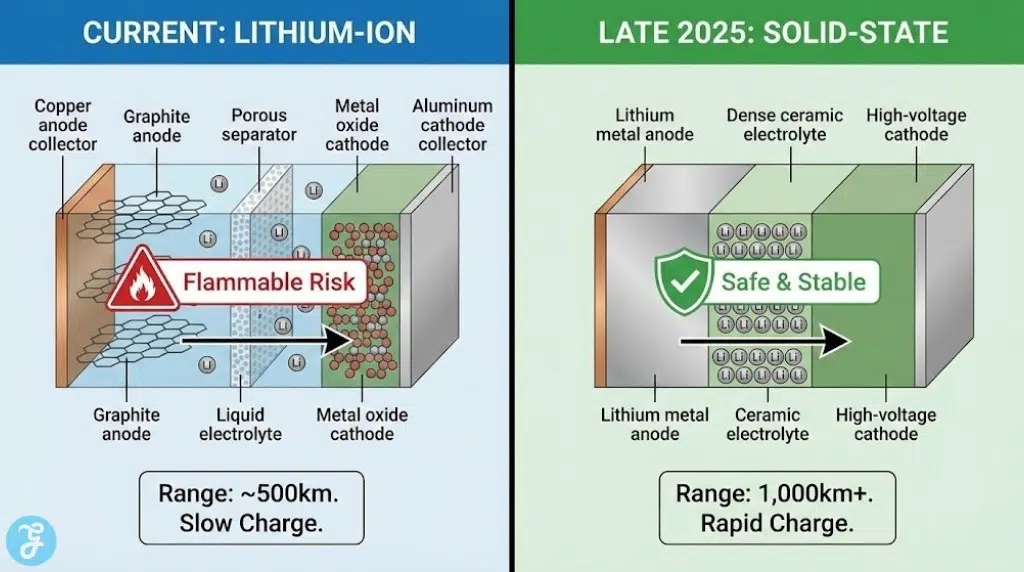
For years, solid-state batteries were the “holy grail” that was always five years away. Late 2025 changed that narrative completely. Major Asian automakers, including GAC and Chery, brought their first pilot production lines online in November and December. These batteries replace the flammable liquid electrolyte with a solid material, drastically improving safety and energy density.
Best For: Long-range electric vehicles and eventually aircraft.
Pros:
- Energy density exceeding 400 Wh/kg (vs ~250 for current tech).
- Significantly reduced fire risk.
- Enables 1,000km+ driving range on a single charge.
Cons:
- Manufacturing costs remain high.
- Initial availability is limited to premium luxury models.
2. Commercial Perovskite Tandem Solar
Silicon solar panels have dominated the market for decades, but they are hitting their theoretical efficiency limits. In Q4 2025, we saw the first commercial shipments of “tandem” panels. These combine a traditional silicon layer with a layer of perovskite, a crystal material that captures a different part of the light spectrum. This allows the panels to break the 30% efficiency ceiling that silicon could never reach alone.
Best For: Residential rooftops where space is limited.
Pros:
- Generates 20% more power than standard panels of the same size.
- Lowers the “Levelized Cost of Energy” (LCOE) over the system’s life.
- Works better in low-light conditions.
Cons:
- Long-term durability in outdoor conditions is still being proven.
- Contains small amounts of lead (though containment tech is improving).
3. Direct Ocean Capture (DOC) Scaling
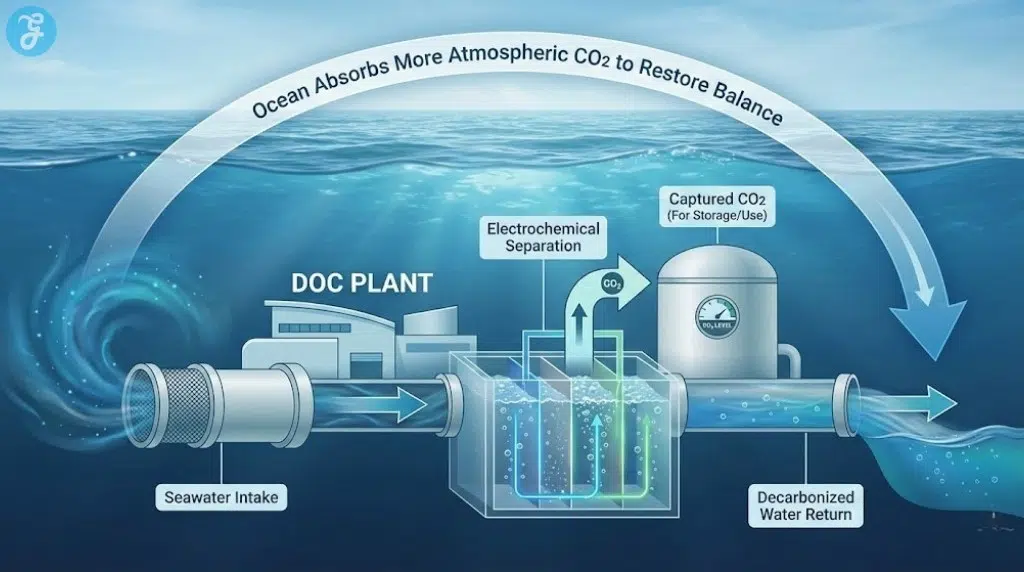
Direct Air Capture (sucking CO2 from the sky) grabs headlines, but it is energy-intensive. Late 2025 proved that the ocean might be a better partner. Pilot plants in Hawaii and California successfully demonstrated Direct Ocean Capture at a meaningful scale. The ocean is a natural carbon sponge. These systems use electrochemistry to strip CO2 from seawater, allowing the ocean to naturally absorb more from the air to restore equilibrium.
Best For: Large-scale carbon removal credits.
Pros:
- More energy-efficient than air capture (higher CO2 concentration in water).
- Can be co-located with desalination plants or offshore rigs.
- No land use requirements.
Cons:
- Potential impacts on local marine ecosystems if not managed perfectly.
- Requires massive scaling to make a dent in global emissions.
4. Sodium-Ion Grid Storage
While lithium is precious, sodium is everywhere. In late 2025, the first GWh-scale sodium-ion battery facilities went live. These batteries are slightly heavier than lithium-ion, making them less ideal for cars, but they are perfect for stationary grid storage. They are cheaper to make, use abundant materials (soda ash), and perform far better in freezing temperatures.
Best For: Utility companies and home backup power.
Pros:
- Cost-effective and free from geopolitical lithium supply chains.
- Excellent performance in cold weather (-20°C).
- Can be discharged to 0% without damage (unlike lithium).
Cons:
- Lower energy density requires more physical space.
- Recycling supply chains are not yet established.
5. AI-Native “Self-Healing” Grids
As we add more solar panels and wind turbines, the power grid becomes unstable. In late 2025, utility providers began deploying autonomous AI agents to manage this chaos. These aren’t just monitoring systems. They are active agents that can reroute power, store excess energy in neighborhood batteries, and isolate faults milliseconds before they cause a blackout.
Best For: Modernizing aging electrical infrastructure.
Pros:
- Prevents blackouts by reacting faster than human operators.
- Optimizes the use of decentralized energy (rooftop solar).
- Reduces energy waste during transmission.
Cons:
- High cybersecurity risk profile.
- Requires significant sensor upgrades to existing poles and wires.
6. Structural Battery Composites
One of the most futuristic clean tech breakthroughs 2025 delivered was the concept of “massless” energy storage. In late 2025, breakthroughs in carbon fiber composites allowed engineers to turn the actual body of a vehicle into a battery. The material itself carries the structural load and stores the electrons.
Best For: Electric aircraft and high-performance sports cars.
Pros:
- Drastic weight reduction improves efficiency.
- Saves space for passengers or cargo.
Cons:
- Extremely expensive to manufacture currently.
- Cannot be replaced easily; if the battery dies, the “structure” is dead.
Here’s a quick overview:
| Technology | Key Application | Impact Level |
| Solid-State Batteries | EVs & Aviation | Commercial Pilot |
| Perovskite Solar | Residential & Utility | Commercial Rollout |
| Direct Ocean Capture | Carbon Removal | Advanced Pilot |
| Sodium-Ion Storage | Grid Stabilization | Mass Scale |
| AI Self-Healing Grids | Energy Distribution | Enterprise |
| Structural Batteries | Heavy Transport | Emerging |
How to Assess Clean Tech Impact
With so much hype in the sector, it is hard to know what is real. Use this framework to evaluate new tech.
-
Look for Commercial Pilots: Lab results are easy. A pilot plant with a paying customer (like the DOC plants in Hawaii) is the real test.
-
Check the Supply Chain: Sodium-ion is exciting because the ingredients are cheap and local. If a tech relies on a rare mineral found in only one country, be skeptical of its scale.
- Efficiency: Does it offer a clear step-change (like Perovskite’s 30% barrier) or just a marginal gain?
- Integration: Can it plug into existing systems (like drop-in sustainable fuels) or does it need a total rebuild (like hydrogen infrastructure)?
Our quick picks:
-
Best for EVs: Solid-State Batteries. The 1,000km range barrier has finally been broken by pilot production lines in Asia.
-
Most Scalable: Sodium-Ion Grid Storage. A cheaper, lithium-free alternative that is perfect for stabilizing renewable energy grids.
-
Best for Homeowners: Commercial Perovskite Tandem Solar. New panels are shattering efficiency records and offering more power per square foot.
Wrap-Up
2026 is shaping up to be the year of deployment. The clean tech breakthroughs 2025 gave us—from solid-state batteries to ocean capture—are now moving from the whiteboard to the real world. Keep an eye on these sectors. The companies that successfully scale these pilots will be the titans of the next decade.