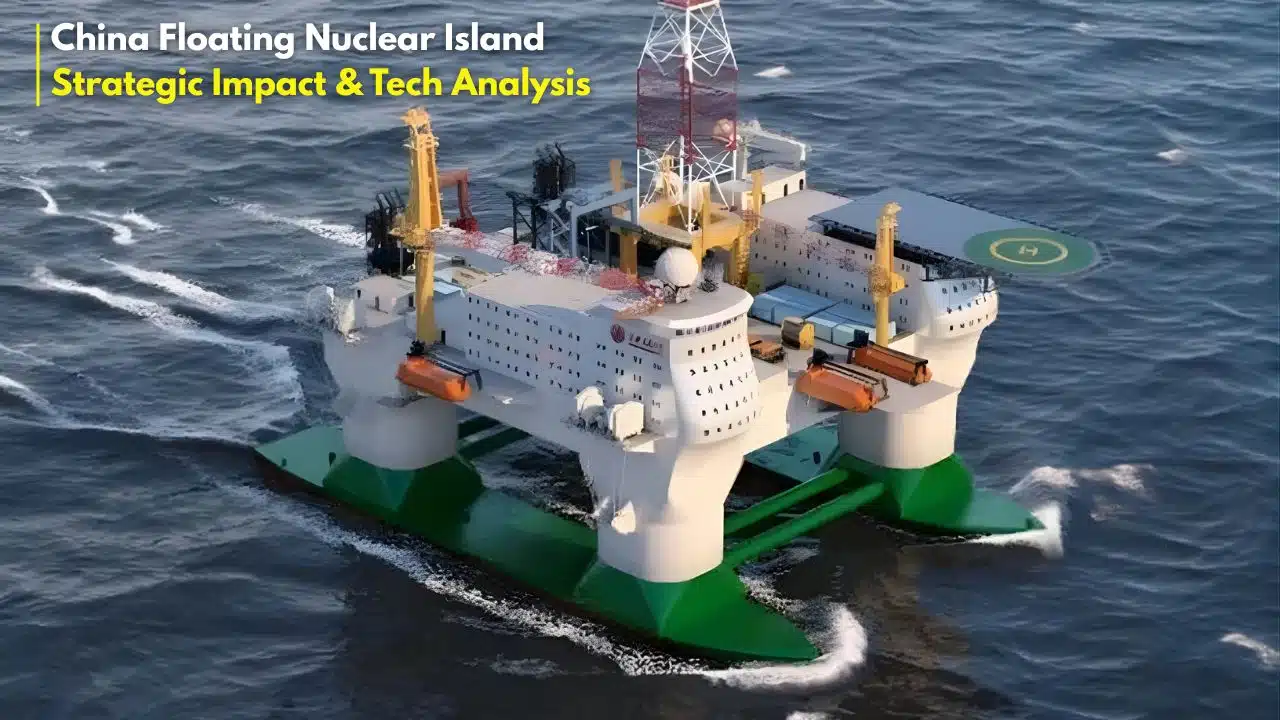
The strategic equilibrium of the Indo-Pacific is facing a paradigm shift as engineering details emerge regarding China’s most ambitious maritime project to date. Moving beyond the static, dredged artificial islands that defined the last decade of territorial expansion, Beijing has accelerated the construction of a “Nuclear-Resistant Floating Island” in the South China Sea.
Displacing nearly 80,000 tonnes and engineered with revolutionary “metamaterials” to survive tactical nuclear strikes, this facility represents a new phase in China’s “Grey Zone” warfare: the mobile sovereign fortress.
Quick Take: The Strategic Shift
-
The Pivot: China is moving from fixed islands (vulnerable to missiles) to mobile floating bases (harder to target).
-
The Tech: First-of-its-kind “metamaterial” armor designed to absorb nuclear shockwaves rather than resist them rigidly.
-
The Power: Likely powered by marine Small Modular Reactors (SMRs), specifically the ACP100S series.
-
The Goal: A logistics and command hub capable of “forward deployment” deep into the Pacific, operational by 2028.
1. Anatomy of the “Floating Fortress”
The project, spearheaded by the China State Shipbuilding Corporation (CSSC) and Shanghai Jiao Tong University (SJTU), is officially cataloged as a “Large-Scale Deep-Sea Research Platform.” However, defense analysts suggest its specifications far exceed civilian needs.
The “Sandwich” Armor Technology
The most startling revelation from recent design papers published in the Chinese Journal of Ship Research (2025) is the hull’s composition. Standard naval steel shatters under the intense overpressure of a nuclear detonation. To counter this, Chinese engineers have developed a metamaterial sandwich structure.
-
Negative Poisson’s Ratio: Unlike normal materials that thin out when stretched, the auxiliaryetic materials used in the hull expand laterally when hit, densifying the material at the point of impact.
-
The Lattice Core: Between the outer steel plates lies a core of corrugated, lattice-shaped tubes.
-
Energy Dissipation: Computer simulations cited by the research team show this design reduces blast damage volume by 50% compared to traditional stiffened plates.
Expert Insight: “The logic is similar to the crumple zone in a car, but on a gigaton scale. Instead of trying to block the nuclear shockwave entirely, the hull absorbs the kinetic energy, deforming in a controlled manner that keeps the vessel buoyant and the crew inside alive.” — Dr. Wei Liao, Structural Maritime Engineer (Analysis derived from SJTU papers).
Dimensions and Capacity
The scale of the platform rivals a Supercarrier.
| Specification | Data Point | Comparison |
| Displacement | 78,000 – 80,000 Tonnes | Heavier than the UK’s HMS Queen Elizabeth (65k tonnes) |
| Length | 300+ meters (segmented) | Similar to the USS Gerald R. Ford |
| Top Speed | 10-15 Knots | Slower than a carrier, faster than an oil rig |
| Endurance | Unlimited (with Nuclear Power) | Limited only by food supplies |
| Survivability | Category 17 Typhoons | Designed for “Sea State 7” survival |
2. Strategic Context: Why a Floating Island?
To understand why China is building this, one must look at the limitations of its current strategy.
The Vulnerability of Fixed Islands
China has spent years dredging sand to build bases like Fiery Cross Reef and Mischief Reef. While formidable, these are static targets. In a hypothetical conflict, long-range precision fires (like US Tomahawk or LRASM missiles) could neutralize these runways in minutes. They cannot move, they cannot hide, and their coordinates are permanently locked into every adversary’s targeting computer.
The Mobile Advantage
A floating island changes the calculus:
-
Maneuverability: While slow, the ability to move even a few miles creates a targeting problem for ballistic missiles, which require precise terminal guidance updates.
-
Typhoon Evasion: The South China Sea is typhoon alley. Fixed islands take the full brunt of storms; a floating base can relocate to calmer waters.
-
Jurisdictional Ambiguity: A fixed island is territory (or not, under UNCLOS). A floating island is technically a “ship.” This allows China to claim “freedom of navigation” for its massive base, parking it just outside the Exclusive Economic Zones (EEZ) of rival claimants like the Philippines or Vietnam, or even off the coast of Taiwan
3. The Nuclear Heart: Powering the Behemoth
While the hull is “nuclear-resistant,” the power source is almost certainly nuclear as well. This project runs parallel to China’s development of Floating Nuclear Power Plants (FNPPs).
The ACP100S, a small modular reactor designed by the China National Nuclear Corporation (CNNC), has been in development specifically for marine platforms.
-
Output: approx 125 MW per unit.
-
Function: It provides the massive energy load required for deep-sea desalinization, high-powered Over-The-Horizon (OTH) radars, and potentially directed-energy weapons (lasers) for missile defense.
-
Logistics: With nuclear power, the island does not need fuel tankers. It only requires food resupply, allowing it to stay on station for months or years.
Critical Risk: “Putting a reactor on a combat platform in a typhoon zone creates a ‘floating Chernobyl’ risk. If this vessel is struck in combat, the environmental fallout for the entire South China Sea ecosystem—and the fisheries of Southeast Asia—would be catastrophic.” — Environmental Risk Assessment, Greenpeace East Asia (2024 Archive).
4. International Reaction and Legal “Grey Zones”
The deployment of such a vessel challenges the United Nations Convention on the Law of the Sea (UNCLOS).
-
Is it a Ship or an Island?
-
If it is a ship, it has the right of innocent passage through other nations’ waters.
-
If it is an artificial island, it has no territorial sea of its own, but China may try to enforce a “security zone” around it.
-
The Philippines’ Stance: Manila has expressed alarm. A mobile base could anchor at Scarborough Shoal, effectively occupying the territory without technically “building” on it, bypassing previous diplomatic agreements to halt island building.
United States Response: The US Navy has been monitoring the CSSC shipyards closely. While the US abandoned its own “Mobile Offshore Base” concept in the 1990s due to cost, China’s fusion of civil-military resources makes the economics feasible for Beijing.
5. What to Watch: The Timeline to 2028
As of late 2025, the project is transitioning from the “proof of concept” phase to physical assembly.
-
Phase 1 (Completed 2024): Validation of metamaterial armor in small-scale blast tests.
-
Phase 2 (Current – 2025/26): Keel laying and module assembly at major shipyards (likely Jiangnan or Dalian). Watch for massive, box-like hull sections appearing in satellite imagery.
-
Phase 3 (2027): Reactor installation and harbor trials.
-
Phase 4 (2028): Deployment to the South China Sea.
Conclusion: A Permanent Presence
China’s “Nuclear-Resistant Floating Island” is more than a feat of engineering; it is a statement of intent. It signals that Beijing prepares not just for skirmishes, but for high-intensity warfare involving nuclear exchanges. By creating a base that is mobile, self-sustaining, and hardened against the ultimate weapon, China aims to turn the South China Sea into a true “Chinese Lake,” regardless of international law or regional protest.