


The Fourth Amendment to the United States Constitution safeguards individuals from unreasonable searches and seizures. This fundamental right ensures law enforcement officers have a legitimate basis for stopping and searching someone. If you believe your rights have been violated during a police encounter, consulting with an Oakland police misconduct attorney is essential.
The Foundation: The Fourth Amendment
The Fourth Amendment sets a high bar for law enforcement intrusions. Generally, a police officer needs probable cause – a reasonable belief that a crime has been committed or is being committed – to conduct a search or make an arrest. Searches often require a warrant from a judge based on probable cause and describing the place to be searched and the items to be seized. There are specific exceptions to the warrant requirement, but these are narrowly defined and fact-dependent.
A police stop, also known as a Terry stop, is a more limited seizure that allows an officer to briefly detain someone if they reasonably suspect that the person is involved in criminal activity. Reasonable suspicion is a lower standard than probable cause, but still requires more than just a hunch. An officer must be able to point to specific and articulable facts that, taken together with rational inferences, warrant the intrusion.
Common Scenarios Of Unlawful Stops
Unlawful stops can occur in various situations. A stop based solely on racial profiling, without any specific evidence of wrongdoing, violates the Fourth Amendment. Similarly, a stop initiated because someone is in a high-crime area, without any other individualized suspicion, is likely unlawful. Prolonging a traffic stop beyond its original purpose without reasonable suspicion of additional criminal activity also constitutes an illegal seizure.
If an officer stops you based on a minor traffic violation but then begins questioning you about unrelated criminal activity or asks for consent to search your vehicle without any reasonable suspicion of further wrongdoing, your Fourth Amendment rights may be implicated. Knowing the difference between a lawful stop and an unlawful detention is crucial.
What Constitutes An Unlawful Search?
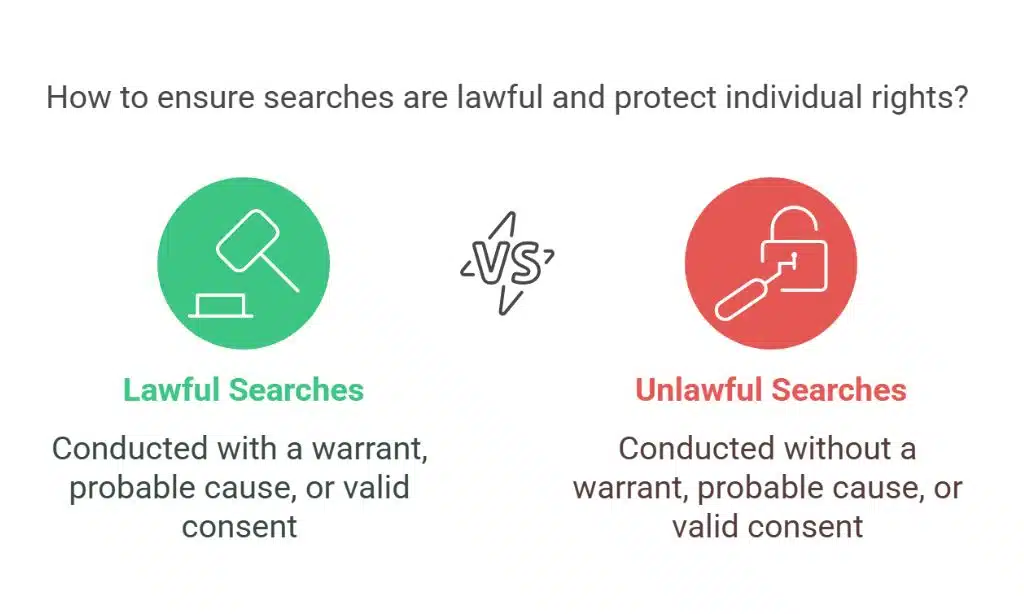
An unlawful search occurs when law enforcement searches without a warrant or a valid exception to the warrant requirement, and without probable cause [or reasonable suspicion for a limited search incident to a lawful stop]. This can include searching your person, vehicle, home, or belongings. Consent to a search is a typical exception to the warrant requirement, but that consent must be freely and voluntarily given, not coerced.
If an officer requests to search your car and you feel pressured to agree, that consent may not be considered voluntary. Similarly, a search incident to a lawful arrest is permitted, allowing officers to search the arrestee and the area within their immediate control. However, the scope of this search is limited. Searching your entire house after arresting you outside, without a warrant or valid consent, would likely be unlawful.
Challenging An Unlawful Stop Or Search
If you believe you have been subjected to an unlawful stop or search in the East Bay Area, it is vital to remain calm and not physically resist the officer. However, you are not obligated to consent to a search. Clearly state that you do not consent to the search. Obtain the officer’s name and badge number if possible, and meticulously document the details of the encounter, including the date, time, location, and specific actions taken by the officer. Note any witnesses who may have observed the stop or search.
The primary legal mechanism for challenging an unlawful stop or search is through a motion to suppress evidence in any resulting criminal proceedings. Suppose your attorney can demonstrate to the court that the stop or search violated your Fourth Amendment rights. In that case, any evidence obtained as a result of that unlawful action may be excluded from the trial. This can significantly impact the prosecution’s case.
Conclusion
An Oakland police misconduct attorney specializing in Fourth Amendment rights can assist in challenging unlawful stops and searches. They possess the expertise to analyze the specific facts of your case, determine if your rights were violated, and build a compelling legal argument for the suppression of evidence. Your attorney can also represent you in court proceedings and advocate for protecting your constitutional rights.





















