


Finding the right place to study can feel tricky for English-speaking students. You might want top-tier universities and friends who understand you, but you don’t necessarily want to stay in the US or UK. Here is one thing I have learned. Many countries now offer incredible programs taught entirely in English. This means you can get a world-class education while living somewhere new and making friends from around the globe.
In this post, we will explore the 5 best countries for English-speaking students outside of the US and UK. I’ll walk you through your options and share some practical tips to help you choose the best fit.
Quick Comparison of The Best Countries: The Big Picture
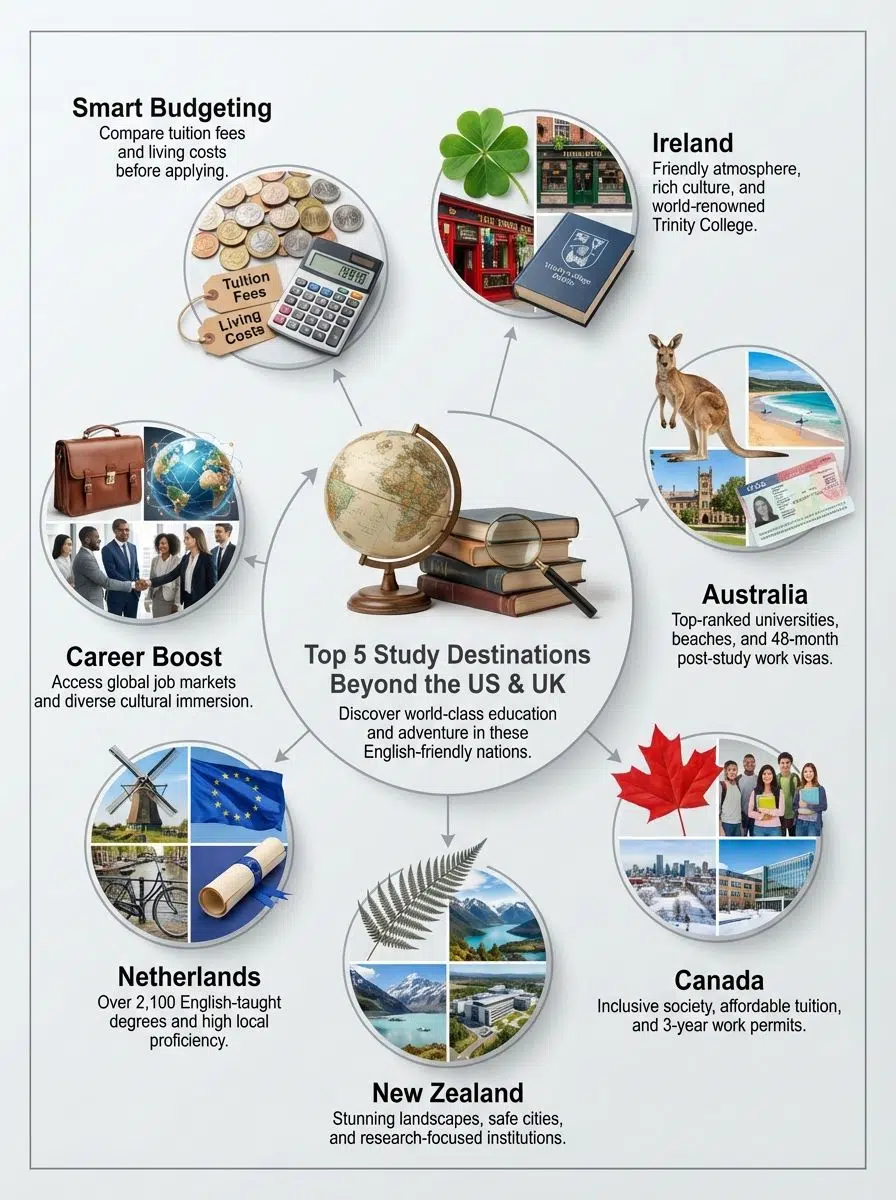
To help you get started, here is a snapshot of the top countries for English-speaking students. Use this table to compare costs and benefits side-by-side.
| Country | Language of Instruction | Tuition Fees (USD, per year) | Cost of Living (USD, per month) | Post-Study Work Options | Highlights |
|---|---|---|---|---|---|
| Ireland | English | $11,000 – $27,000 | $1,100 – $1,600 | Up to 24 months (1G Visa) |
|
| Australia | English | $16,000 – $35,000 | $1,400 – $2,500 | Up to 4-5 years (Subclass 485) |
|
| Canada | English | $10,000 – $25,000 | $1,000 – $1,800 | Up to 3 years (PGWP) |
|
| New Zealand | English | $14,000 – $23,000 | $1,000 – $1,500 | Up to 3 years |
|
| Netherlands | English, Dutch | $9,000 – $24,000 | $1,200 – $1,900 | 1 year (Orientation Year) |
|
1. Ireland
Ireland often feels like a second home the moment you land. The cities are lively, the people are genuinely curious about you, and the language barrier is non-existent. You might find yourself debating philosophy in a cozy pub or hiking the Cliffs of Moher with classmates on the weekend.
High-quality universities with English-taught programs
Trinity College Dublin and University College Dublin consistently rank among the top global universities. They act as beacons for international talent. In fact, Ireland hosts over 35,000 international students from 160 countries, so you will never feel like the odd one out.
The academic system here is rigorous but supportive.
“The standard of education in Ireland is among the highest in the world, with seven public universities all ranking within the top 3% globally.” – Education in Ireland
Professors use clear English in lectures, and all your coursework will be in English too. One massive benefit is the class size. Unlike massive lecture halls elsewhere, Irish colleges often keep groups small. This helps you ask questions without feeling intimidated.
Rich cultural heritage and welcoming environment
While the academics are strong, the lifestyle is what makes students stay. Ireland is famously safe and friendly. A 2024 report by the Global Peace Index ranked Ireland as the second most peaceful country in the world. This safety lets you focus on your studies rather than looking over your shoulder.
Here are a few things that make life here special:
- Tech Hub Access: Dublin is known as the “Silicon Docks” because companies like Google, LinkedIn, and Pfizer have their European headquarters there.
- Social Culture: Festivals like St. Patrick’s Day aren’t just for tourists; they are community events where everyone participates.
- Travel: You can hop on a cheap flight to London, Paris, or Berlin for a weekend getaway.
2. Australia
If you love the idea of studying in a place where the sun shines and the lifestyle is laid-back, Australia is hard to beat. It draws students who want a top-tier degree without sacrificing their quality of life.
World-class education system
Australia is an educational powerhouse. Institutions like The University of Melbourne and The University of Sydney are members of the “Group of Eight,” a coalition of world-leading research universities. A degree from here carries weight anywhere in the world. The learning style is very practical.
Instead of just memorizing facts, you work on real-world problems. For example, engineering students often partner with local firms for capstone projects. The main language of instruction is English, so you can hit the ground running immediately.
Opportunities for scholarships and post-study work
Finances are always a concern, but Australia offers solid support. The Australia Awards are prestigious government-funded scholarships that cover full tuition and travel for eligible global students. Individual universities also offer merit-based grants that can shave thousands off your tuition. Here is a tip that many students miss.
Australia has one of the highest minimum wages in the world. As an international student, you can work up to 48 hours per fortnight (every two weeks) while classes are in session. This can cover a significant chunk of your living expenses.
After you graduate, the Temporary Graduate Visa (Subclass 485) allows you to stay and work. Depending on your degree, you could live and earn in Australia for 2 to 5 years after finishing school. This is a golden ticket for gaining international work experience.
3. Canada
Canada is like that friendly neighbor who always has time for a chat. It combines prestigious education with a society that actively celebrates diversity. Plus, if you love nature, the landscapes are unbeatable.
Diverse and inclusive culture
Canada officially adopted multiculturalism as a policy back in the 1970s, and you can feel it today. In cities like Toronto and Vancouver, over 50% of the population belongs to a visible minority group. You will hear dozens of languages on your commute, but English is the common thread that connects everyone. This diversity makes settling in much easier.

You won’t stand out as a foreigner because almost everyone has a story about coming from somewhere else. Universities run active “International Student Services” centers that organize trips, workshops, and social nights to help you make friends fast.
Affordable tuition fees and living costs
Compared to the US, Canada is often more affordable. While tuition varies, you might pay around $20,000 to $30,000 CAD (approx. $14,500 to $22,000 USD) for many undergraduate programs. That is significantly less than comparable American institutions. However, you need to be smart about where you live.
| City | Avg. 1-Bedroom Rent (CAD) | Lifestyle Vibe |
|---|---|---|
| Toronto | $2,500+ | Big city hustle, expensive but exciting |
| Montreal | $1,600+ | Artistic, historic, French-influenced |
| Halifax | $1,800+ | Coastal, friendly, relaxed pace |
Another huge perk is the Post-Graduation Work Permit (PGWP). This is an open work permit, meaning you don’t need a job offer to get it. It lets you work anywhere in Canada for up to three years after you graduate, helping you gain the experience needed for permanent residency.
4. New Zealand
Life in New Zealand is like stepping into a postcard. It is quieter than the other options, but that peace allows for deep focus and genuine connection. You might spot students studying on the grass by a lake or hiking a volcano between classes.
Renowned for its education and research facilities
New Zealand’s eight universities all rank in the top 3% worldwide according to QS World University Rankings. The University of Auckland and the University of Otago are standouts, particularly for research in sustainability and marine science. The government takes student care seriously.
New Zealand is the first country to have a “Code of Practice for the Pastoral Care of International Students.” This means schools are legally required to ensure you are safe, well-housed, and supported mentally and physically. You aren’t just a number here.
Safe and picturesque study environment
If you hate big crowds and traffic, this is your spot. New Zealand cities are small and walkable. Crime rates are very low, and the locals, known as Kiwis, are famously relaxed.
A quick insider tip: Look into the Manaaki New Zealand Scholarships. These are government-funded and extremely generous, often covering full tuition and a living allowance. They are competitive, but definitely worth the application effort.
Weekends here are for adventure. You can go surfing, skiing, and hiking, often all within a few hours of campus. It is the perfect balance to a hard week of study.
5. Netherlands
The Netherlands is a powerhouse of efficiency and innovation. It is the best option if you want to be on the European mainland while still studying entirely in English.
Highest English proficiency among non-native speakers
You do not need to speak Dutch to survive here. The Netherlands consistently ranks #1 in the world for English proficiency among non-native speaking countries. From the bus driver to the cashier, almost everyone switches to fluent English instantly.
This removes the stress of daily life. You can easily handle tasks like opening a bank account or setting up your internet. However, learning a few Dutch phrases is always appreciated by the locals and helps you integrate better.
Wide range of English-taught programs across disciplines
Dutch universities offer over 2,000 programs taught completely in English. This is more than any other non-English speaking country in Europe. Whether you are into Water Management (a huge specialty here), International Law, or Design, you will find a course.
The teaching style is unique. It is very interactive and direct. Students are expected to challenge their professors and participate in debates. It builds critical thinking skills that employers love.
Warning: The Housing Shortage.
One critical thing you must know is that student housing is very scarce. Universities often do not have dorms like in the US. You must start looking for a room 3-6 months before you arrive. Websites like Kamernet are popular, but watch out for scams.
Benefits of Studying in These Countries
Moving abroad isn’t just about the degree. It changes who you are and how you see the world. These places open doors you never knew existed.
Access to global career opportunities
Graduating from these countries plugs you into a massive network. For instance, a degree from a Dutch or Irish university is recognized across the entire European Union. This gives you access to a job market of over 400 million people. Employers value the “soft skills” you gain.
When you put “Study Abroad” on your resume, it tells a hiring manager that you are adaptable, independent, and culturally aware. A 2024 survey by Erasmus Student Network found that 80% of graduates felt their time abroad helped them secure their first job.
Immersion in English-speaking environments
Even if you are already fluent, studying in these countries refines your communication. You learn the nuances of business English, local slang, and professional etiquette. In Ireland and Australia, you are immersed 24/7. In the Netherlands, you get the added benefit of picking up a second language (Dutch) on the side, which is a huge resume booster.
Exposure to diverse cultures
You won’t just meet locals. You will meet the world. In a typical classroom in Toronto or Melbourne, you might sit next to students from India, Brazil, Nigeria, and China. This network becomes your global contact list for the rest of your career.
Tips for Choosing the Right Country
Picking the best country is like finding the right pair of shoes. Fit matters. Here is how to decide which path matches your stride.
Consider your academic and career goals
Start with the end in mind. If you want to work in marine biology, Australia or New Zealand are obvious choice. If you are aiming for big tech, Ireland’s connection to Silicon Valley companies makes it a winner. If you want a career in international law, the Netherlands (home to The Hague) is unbeatable.
Check the “QS World University Rankings by Subject” to see which country leads in your specific field.
Evaluate the cost of living and tuition fees
Be realistic about your budget. Tuition is just one part of the equation.

- Ireland & Netherlands: Rent is high in capital cities like Dublin and Amsterdam. Look at student towns like Galway or Groningen to save money.
- Australia: High cost of living, but high wages for part-time work help balance it out.
- Canada: Costs vary wildly. Vancouver is expensive; cities in Alberta or Nova Scotia are much cheaper.
Use tools like Numbeo to compare the cost of a liter of milk or a monthly bus pass in different cities. It gives you a real-world picture of your expenses.
Research visa requirements and post-study opportunities
Visa rules change often, so check the official government sources.
- For Canada: Look up the specific requirements for the “Provincial Attestation Letter” (PAL), a new requirement for many students.
- For Ireland: Check the “Third Level Graduate Programme” rules to see how long you can stay.
- For the Netherlands: Read about the “Orientation Year” visa, which gives you 12 months to find a job after graduating.
Knowing these rules now prevents panic later. You want a clear path from student to professional.
Final Words: The Decision Beyond Rankings!
You have seen the top five countries for English-speaking students. Each option offers strong education, welcoming people, and great career chances. Picking your best fit is easier with these simple tips in mind.
So, have you thought about which country matches your goals? Studying abroad can change your life and set you up for future success. Sometimes the biggest step is just choosing where to begin.
Curious minds should check university websites or talk to current international students. You might find a story that inspires you, too.
























