Apple’s latest iPhone 16 comes with two headline features: Apple Intelligence, the company’s long-awaited AI-powered system, and a new dedicated camera control button. However, despite the global marketing push emphasizing Apple Intelligence, the company has yet to introduce it in China—a key market that significantly influences Apple’s overall sales and revenue.
This delay isn’t just a technical issue but a regulatory and strategic challenge. Apple Intelligence relies on AI models that are not currently approved for use in China due to the country’s strict data and cybersecurity regulations. To overcome this hurdle, Apple is now reportedly exploring the integration of DeepSeek, a locally developed AI model, as a potential alternative.
This move could be a game-changer for Apple, allowing it to introduce its AI features in China while staying compliant with local laws. However, despite this promising development, Apple still faces substantial challenges, including the slow rollout of Apple Intelligence, the limitations of its AI capabilities, and increasing competition from domestic smartphone brands.
Why Apple Intelligence Hasn’t Reached China Yet
Apple Intelligence, which powers a range of AI-driven functionalities, is a major selling point for the iPhone 16 lineup. It includes advanced text summarization, email management, personalized suggestions, and a much-anticipated overhaul of Siri. However, while these features are being introduced in other parts of the world, China remains an exception.
The primary reason is China’s strict regulatory environment surrounding artificial intelligence. Unlike in Western markets, where AI models can be developed and deployed with relatively fewer restrictions, China mandates that AI models be reviewed and approved before they can be used. The Chinese government enforces stringent data security and AI regulations, requiring foreign companies like Apple to comply with local standards before launching AI-powered products in the country.
Apple has been unable to use its standard AI models—likely powered by a combination of its in-house technology and partnerships with OpenAI or Google’s Gemini—in China. To meet Chinese legal requirements, Apple must either develop a completely new AI model tailored for the country or integrate an existing, government-approved AI model into its devices.
This is where DeepSeek comes in.
DeepSeek: A Potential AI Lifeline for Apple in China
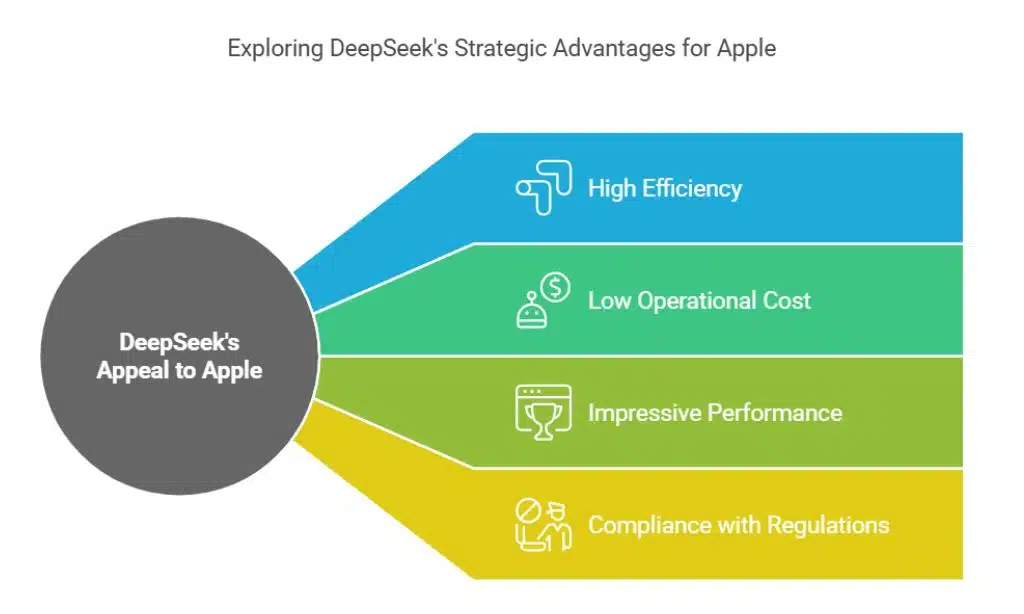
DeepSeek is a rising Chinese AI company that has been making waves in the artificial intelligence space. Its DeepSeek-V3 model has been gaining traction due to its high efficiency, low operational cost, and impressive performance, which rivals top Western AI models such as OpenAI’s GPT-4 and Google’s Gemini.
One of the biggest advantages of DeepSeek is that it is a Chinese-developed AI system. This means that it is already in compliance with China’s strict AI regulations, making it an attractive option for Apple.
Why Apple Might Choose DeepSeek
- Regulatory Approval:
- Apple Intelligence cannot function in China without an AI model that is approved by the government. DeepSeek, being a domestic AI model, already fits within the country’s legal framework.
- Cost-Effectiveness:
- DeepSeek’s AI model is significantly cheaper to operate compared to Western AI counterparts. Training DeepSeek-V3 reportedly cost around $5.58 million using approximately 2,000 GPUs over 55 days—far less than what tech giants like OpenAI and Google spend on AI model training.
- Performance and Efficiency:
- DeepSeek’s AI is capable of performing complex tasks such as natural language processing, content summarization, and text generation with high accuracy. If Apple successfully integrates DeepSeek, it could offer Chinese iPhone users a near-identical AI experience to what’s available in the West.
- Localized AI for a Competitive Edge:
- Many Chinese smartphone brands, such as Huawei and Xiaomi, have already developed their own AI-powered features. If Apple Intelligence remains absent from the Chinese market, Apple risks falling behind its competitors. By integrating DeepSeek, Apple could offer localized AI features, making iPhones more appealing to Chinese consumers.
Will This Move Boost iPhone Sales in China?
Apple has been facing increasing pressure in China as local competitors such as Huawei, Xiaomi, and Oppo continue to capture a growing share of the market. These brands offer powerful hardware, innovative features, and competitive pricing, making it harder for Apple to maintain its dominance.
Recent reports indicate that iPhone sales in China have been declining. One of the main reasons for this downturn is that Chinese consumers feel that domestic brands offer more value for money. Companies like Huawei, for instance, have been rapidly improving their technology, even launching their own AI-driven smartphone experiences.
If Apple successfully integrates DeepSeek and launches Apple Intelligence in China, it could give iPhone sales a much-needed boost. Many Chinese users have been waiting for AI-powered features similar to those available in the West. The inclusion of Apple Intelligence, even if powered by a different AI model, could make the iPhone 16 more competitive against domestic alternatives.
However, this move alone may not be enough. Apple is also facing challenges related to its pricing strategy, competition in hardware innovation, and growing geopolitical tensions between the U.S. and China.
Challenges Apple Still Faces with Apple Intelligence
Even if Apple manages to launch Apple Intelligence in China, it still faces several broader challenges with its AI strategy.
- Apple Intelligence is Still Incomplete
- Many of the promised features of Apple Intelligence have been delayed. Users were expecting a revolutionary Siri upgrade with deep AI integration, but reports suggest that Siri’s overhaul won’t be fully realized until 2026. This slow rollout has disappointed users who expected a more immediate AI transformation.
- AI Performance Issues
- Even in markets where Apple Intelligence has launched, there have been reports of inconsistent performance. Some users have complained that Apple’s AI assistant struggles with simple tasks like summarizing news and messages, sometimes providing misleading or incorrect information.
- User Trust and Privacy Concerns
- Apple has long marketed itself as a privacy-focused company, which makes AI integration a tricky balancing act. Apple Intelligence needs to process vast amounts of data to be truly effective, but Apple must ensure that its AI doesn’t compromise user privacy. Any misstep in handling user data could result in backlash.
- Competitive Pressure from Google and OpenAI
- Apple is entering the AI space much later than its competitors. Companies like OpenAI, Google, and Microsoft have already established strong AI ecosystems. Apple needs to accelerate its AI development to catch up and compete effectively.
What’s Next for Apple in China?
The introduction of DeepSeek as a potential AI partner in China is a significant development for Apple. If successfully implemented, it could finally bring Apple Intelligence to Chinese iPhone users, helping the company regain some lost market share.
However, Apple’s AI journey is far from smooth. Delays in rolling out key features, ongoing regulatory challenges, and competition from Chinese smartphone brands continue to pose risks.
Ultimately, while DeepSeek offers Apple a viable path to AI integration in China, Apple Intelligence still needs to prove its worth globally. Whether Apple can turn its AI vision into a game-changing reality remains to be seen.