

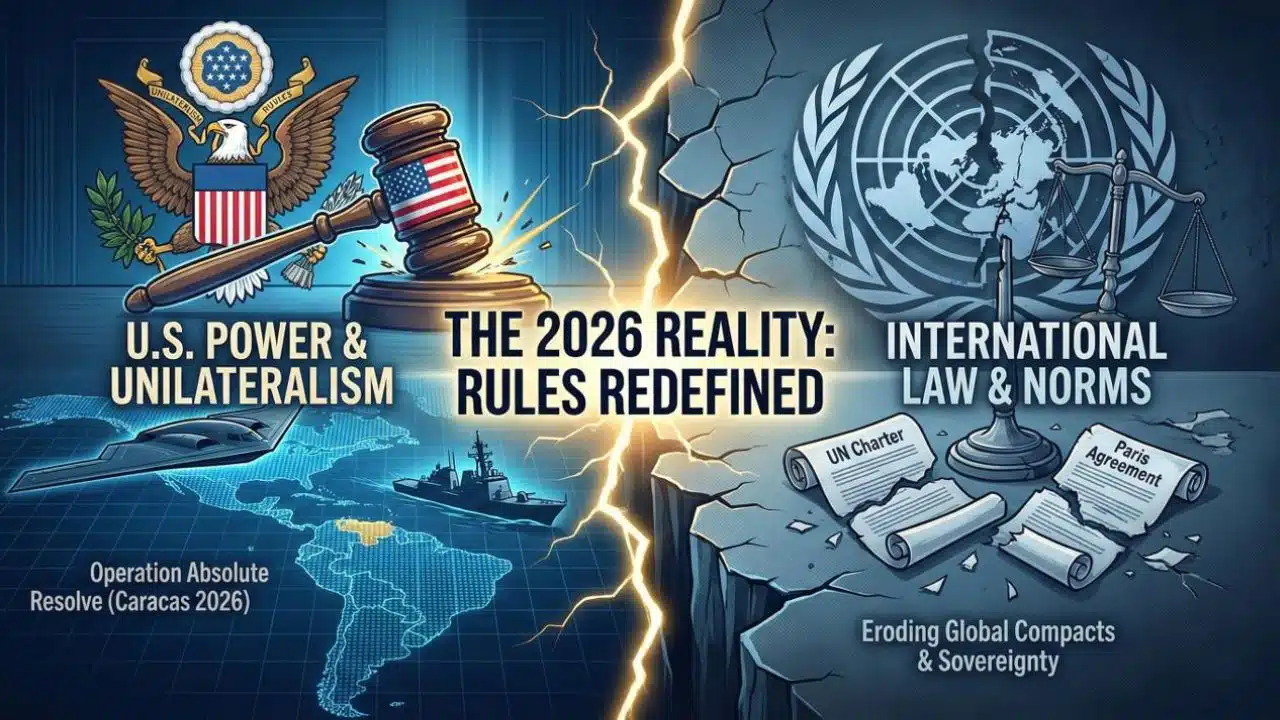
The January 2026 capture of Nicolás Maduro by U.S. forces in Caracas and the simultaneous dismantling of the OECD global tax compact mark a definitive pivot from the “rules-based order” toward a doctrine of raw power. This shift signals that for Washington, international law is no longer a restrictive framework but a selective tool, fundamentally redefining global sovereignty for the modern era.
For nearly a century, following the devastation of World War II, the global community operated under a fragile but essential consensus: the United Nations Charter and international law would provide a universal shield for state sovereignty. This architecture was designed specifically to prevent the kind of unilateral military interventions that characterized the colonial era, ensuring that even the smallest nations had a theoretical protection against the predatory instincts of the powerful.
However, the events of early 2026—most notably the January 3rd military “extraction mission” in Venezuela—have laid bare a starkly different reality. The United States, under its current administration, has effectively signaled that when core national security or supreme economic interests are at stake, the “rules-based international order” is a secondary consideration. This isn’t merely a return to isolationism; it is a transition to aggressive unilateralism. By bypassing the UN Security Council, ignoring the non-intervention tenets of the Organization of American States (OAS), and executing a kinetic operation to apprehend a sitting head of state, Washington has asserted a new norm: its domestic judicial reach is extraterritorial and supreme.
Operation Absolute Resolve: The Military Reality of 2026
The raid in Caracas on January 3, 2026, was not a localized skirmish or a covert intelligence pickup; it was a structural stress test for the UN Charter. Codenamed Operation Absolute Resolve, the mission involved over 150 U.S. aircraft—including F-35 stealth fighters, B-1B Lancer bombers, and MQ-9 Reaper drones—launching from 20 different land and sea bases across the Western Hemisphere.
U.S. special forces, primarily from the elite Delta Force, conducted a complex, high-stakes operation into the sovereign territory of Venezuela to seize Nicolás Maduro and his wife, Cilia Flores, on long-standing charges of narco-terrorism. The operation resulted in significant casualties among Venezuelan Republican Guard units at the Fuerte Tiuna military complex and inevitable collateral civilian damage in the dense urban environment of Caracas.
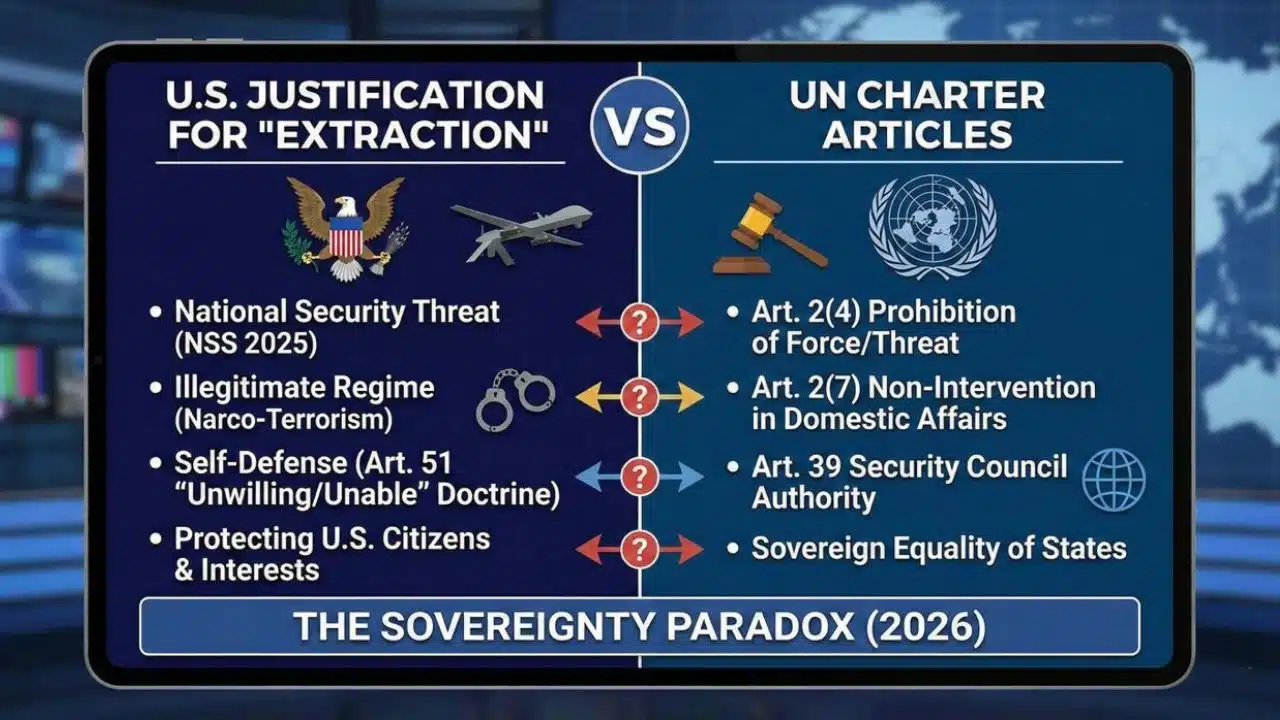
The legal defense for this action rests on an expanded interpretation of Article 51 of the UN Charter—the “Unwilling or Unable” doctrine. Washington argues that Maduro’s regime was not only illegitimate following the 2024 elections but acted as a non-state criminal enterprise that the Venezuelan state was “unable” to self-correct. This suggests that legitimacy—and the protection it affords—is now a status granted or revoked by the Hegemon, rather than by internal constitutional processes.
Timeline of Operation Absolute Resolve (Jan 2–3, 2026)
| Time (EST/VET) | Event | Action Taken |
|---|---|---|
| Jan 2, 10:46 PM EST | Go-Ahead Received | President Trump issues the formal “Execute Order” to General Dan Caine. |
| Jan 3, 1:50 AM VET | Air Suppression | First explosions reported in Caracas as U.S. assets disable air defenses and ISR. |
| Jan 3, 2:01 AM VET | Ground Assault | Delta Force teams land via helicopter at the Fuerte Tiuna garrison compound. |
| Jan 3, 2:30 AM VET | Capture Secured | Maduro and Cilia Flores are taken into custody after a brief, high-intensity firefight. |
| Jan 3, 3:29 AM EST | Exfiltration | Extraction helicopters carrying the targets clear Venezuelan airspace toward the USS Iwo Jima. |
| Jan 3, 5:21 AM VET | Public Confirmation | President Trump posts a photo on Truth Social of Maduro in U.S. custody. |
Economic Autonomy: Shattering the Global Tax Compact
The shift toward aggressive unilateralism is equally potent in economic statecraft. On January 5, 2026, the U.S. Treasury Department stunned global finance ministers by securing a “landmark agreement”—effectively a unilateral opt-out—exempting U.S.-headquartered multinationals from key provisions of the OECD’s “Pillar Two” global minimum tax.
By asserting that U.S. multinationals are subject primarily to U.S. global minimum tax rules (specifically the renamed Net CFC Tested Income or NCTI), Washington prioritizes its own tax sovereignty and corporate competitiveness over a unified global framework. The result is a fragmented economic landscape. American firms now enjoy a competitive edge protected by unilateral domestic policy, while other nations are left to manage budget shortfalls and a weakened global tax floor that was meant to end the “race to the bottom.”
The Tax Divide – OECD Pillar Two vs. US Unilateral Policy
| Feature | OECD Pillar Two (Multilateral Goal) | US NCTI Policy (2026 Reality) |
|---|---|---|
| Minimum Rate | 15% Global Floor | 12.6% (Adjusted from 10.5% GILTI) |
| Enforcement | Under-Taxed Profits Rule (UTPR) | U.S. Tax Sovereignty Exemption |
| Primary Beneficiary | Developing economies / Small nations | U.S.-based Multinationals (Tech/Pharma) |
| R&D Credits | Neutralized by top-up taxes elsewhere | Fully preserved and incentivized by U.S. Law |
Technological Exceptionalism: The 2025 AI Action Plan
Artificial Intelligence has become the newest frontier for American unilateralism. The America’s AI Action Plan, released in late 2025, explicitly rejects “centralized global governance” of AI development. While the European Union finalized its restrictive AI Act, prioritizing ethics and safety, the U.S. has moved toward radical deregulation to maintain a competitive lead over China.
The plan introduces principles like “Truth-Seeking” and “Ideological Neutrality” for Large Language Models (LLMs), effectively forbidding federal agencies from using AI that follows what it deems “ideological dogmas.” By declining to sign the UN Cybercrime Treaty in October 2025, the U.S. signaled deep distrust of international bodies. This “technological exceptionalism” ensures that while the world attempts to build a “standardized” and ethically cautious AI, the U.S. is building an “unrestricted” one, betting that its technological lead will dictate global standards by default.
Global AI Governance Models (2026 Comparison)
| Region / Power | Governance Philosophy | Key Strategy | Primary Goal |
|---|---|---|---|
| United States | Innovation First / Deregulation | “AI Action Plan”; Deregulated R&D; Liability shields. | Innovation dominance; National Security. |
| European Union | Rights-Based / Precautionary | EU AI Act; Mandatory safety audits; Ethical constraints. | Fundamental rights; Consumer safety. |
| China | State-Centric Control | Algorithmic alignment with state ideology; State oversight. | Social stability; State control; Industrial lead. |
The Death of Treaties: Withdrawal as a Strategic Tool
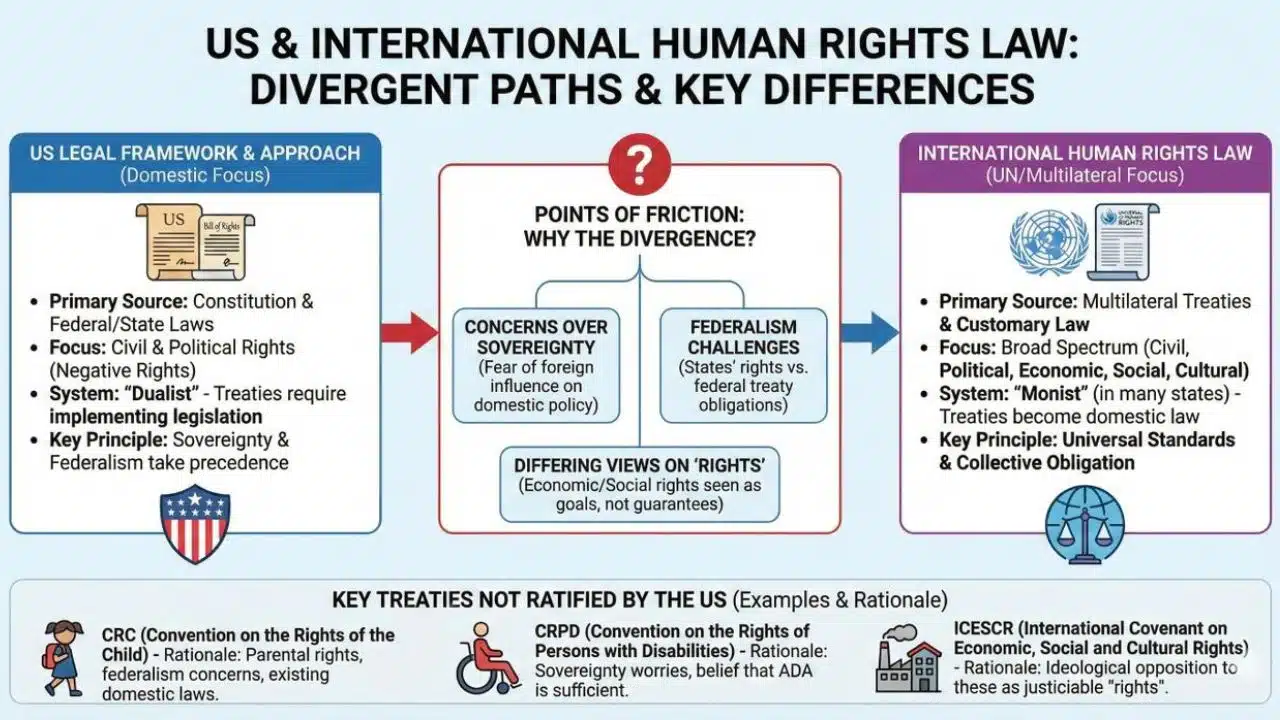
The systematic withdrawal or neutralization of international agreements has become the operational hallmark of 2026 U.S. policy. The re-withdrawal from the Paris Climate Agreement—becoming effective on January 27, 2026—is the most visible example. This strategy of “treaty renunciation” serves a dual purpose: it removes domestic industries from international oversight and forces other nations to negotiate with the U.S. on a bilateral basis, where Washington’s size gives it asymmetrical leverage.
Key Statistics: The Scale of Unilateralism in 2026
- 78 Instances: The number of times Article 51 (Self-Defense) has been invoked by various UN member states since 2021, with the U.S. leading the expansion of the “unwilling or unable” doctrine.
- $10.5 Trillion: Estimated annual global cost of cybercrime, yet the U.S. remains the most significant non-signatory to the new UN Cybercrime Treaty.
- 15% to 12.6%: The gap between the proposed OECD global minimum tax and the actual U.S. rate following the 2026 Treasury exemptions.
- 2,100 Miles: The distance Maduro was flown from Caracas to New York, traversing international waters under heavy military escort.
Regional Fallout: The Security Dilemma for Allies
Europe and America’s traditional allies in Asia (Japan, South Korea, Australia) are currently facing a profound security dilemma. For decades, they built their defense strategies and economic models on the reliability of the U.S. as the “guardian of the rules.” The Caracas raid and the abandonment of the OECD tax deal have forced a brutal realization: Washington is moving toward a “Power-Based Order.” In response, “Middle Powers” like Canada, Poland, and the EU are beginning to form “coalitions of the committed”—partnerships that aim to sustain multilateral norms in trade, climate, and human rights without U.S. leadership.
Future Outlook: Toward a Fractured World
As we look ahead to the remainder of 2026, three major milestones will determine the future of the global order:
- The Maduro Trial in New York: The upcoming legal proceedings in the Southern District of New York will test the boundaries of sovereign immunity. If Maduro is convicted, it will codify the U.S. right to criminalize and kidnap foreign leaders it deems “illegitimate.”
- Trade Retaliation: Expect the EU and other OECD members to implement “carbon border taxes” or “digital service taxes” to counter U.S. tax and climate exemptions. This could trigger a new era of trade protectionism.
- The Rise of BRICS+ Law: With the U.S. stepping back from UN treaties, nations in the Global South may accelerate the creation of parallel international institutions (e.g., a BRICS-led investment court) that exclude Western influence entirely.
The reality of 2026 is that America “wants what it wants,” and it possesses the military and economic leverage to ignore the rules it once helped write. While this may provide short-term gains, the long-term consequence is a world where “might makes right” is the only law left standing.