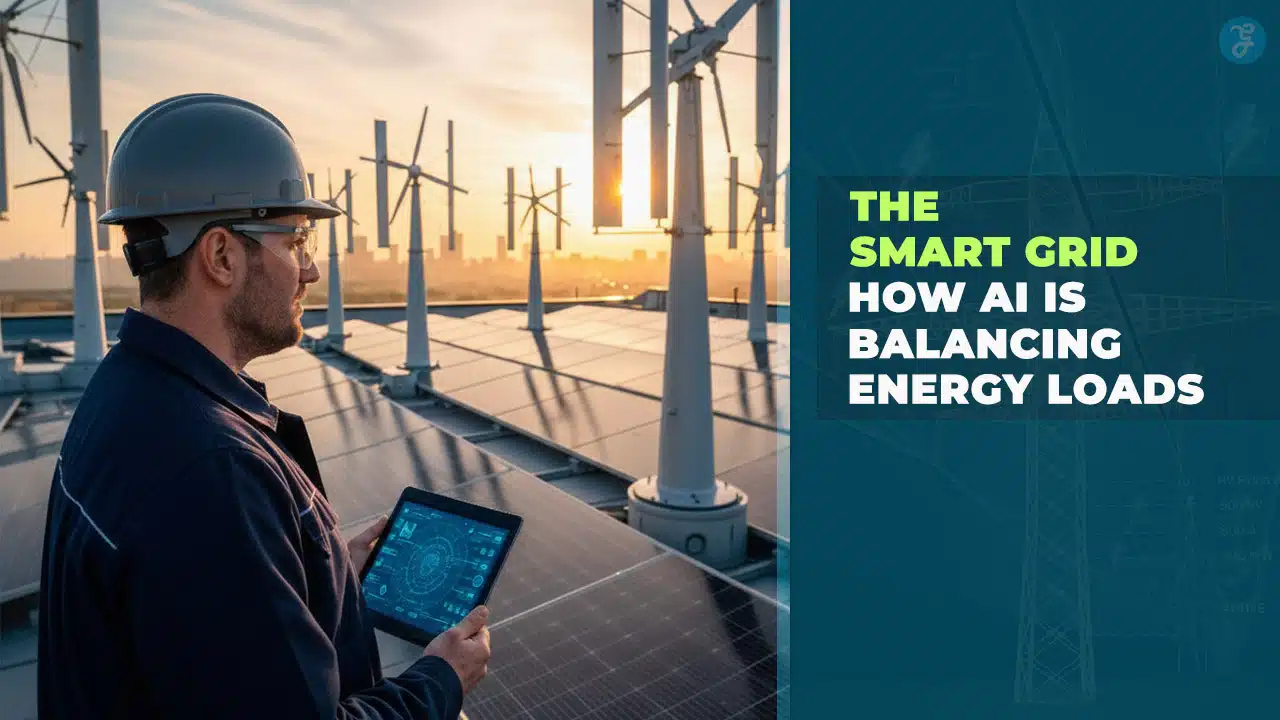
Electricity demand does not rise gently anymore. It jumps. A heatwave pushes air conditioners hard at sunset. Solar output drops at the same time. EV chargers start pulling power as people get home. Factories keep running. Data centers do not slow down.
That is why the phrase AI in smart grids is showing up in utility plans, regulator hearings, and grid tech roadmaps. The promise is simple. Make the grid quicker to “sense and respond” so supply and demand stay balanced without wasting money or risking outages.
The bigger story is that the grid is changing shape. It is no longer just a few large power plants pushing electricity in one direction. It is becoming a network of millions of devices, many of them owned by customers, that can produce, store, or shift electricity use.
The Problem: Demand Spikes And Supply Shifts Are Now Normal
The grid has always needed balance. What changed is the speed and complexity of imbalance.
-
Demand is harder to predict because weather extremes are stronger and more frequent in many regions.
-
Supply is more variable because wind and solar output moves with nature.
-
Electrification adds new loads in new places, especially EV charging clusters and heat pumps.
-
Grid infrastructure needs major upgrades and expansion in many countries.
The International Energy Agency warns that meeting national energy and climate goals implies adding or refurbishing over 80 million kilometres of electricity grids by 2040, which it compares to the entire existing global grid. It also says the need for system flexibility doubles between 2022 and 2030 in a scenario aligned with national climate goals.
What A Smart Grid Is (In Plain English)
A smart grid is a power system that can measure conditions faster and act faster.
In a traditional grid, utilities often learned about local problems late. In a smart grid, sensors, meters, and automation shorten the time between “something changed” and “we responded.” The U.S. Department of Energy describes the smart grid as a way for utilities to learn about and respond to changing electricity demand in real time, improving reliability.
Smart Grid vs Traditional Grid
Traditional grid traits:
-
Less visibility into local usage and congestion
-
Slower fault detection and restoration
-
Limited control over customer devices
Smart grid traits:
-
More data from meters and sensors
-
More automation in switching and voltage control
-
Software platforms that coordinate distributed energy resources
AI In Smart Grids: What “Balancing Energy Loads” Really Means
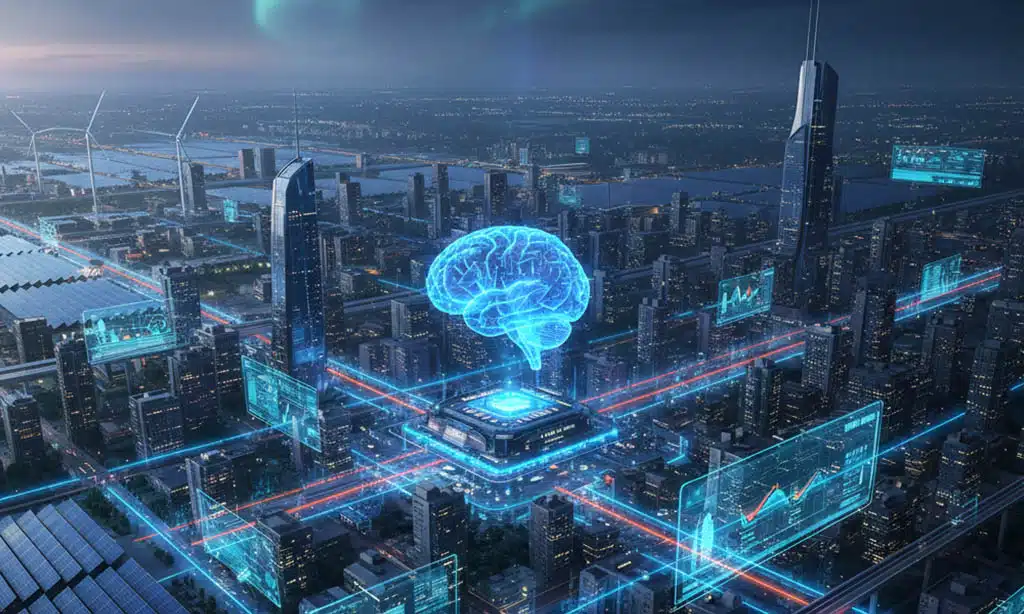
Balancing is not only “make supply equal demand.” Operators also protect frequency and voltage, avoid congestion, and keep reserves for surprises.
AI in smart grids supports those goals by turning messy data into better decisions. In practice, AI usually does three jobs:
-
Predict what will happen next
-
Detect what looks abnormal right now
-
Recommend or automate actions within safety limits
The IEA points out that grids must become “bigger, stronger and smarter” to integrate renewables and support electrification, and it highlights the rising need for flexibility and digitalisation.
Three Time Horizons Where AI Helps
-
Seconds to minutes: situational awareness, anomaly detection, fast response support
-
Minutes to hours: load and renewable forecasting, dispatch, congestion mitigation
-
Days to seasons: planning, maintenance scheduling, capacity forecasting
Why Load Balancing Got Harder In The Last Decade
The grid did not become “hard” because utilities forgot how to run it. It got harder because it must do more things at once.
More Renewables Means More Variability
Wind and solar create “net load” swings. Net load is demand minus renewable output. When solar drops at sunset, net load can surge quickly.
The IEA also notes that modern and digital grids are vital for electricity security as variable renewables rise.
Electrification Adds New Peaks
EV charging can overload specific feeders even if the whole system looks fine. Heat pumps can shift winter peaks higher in some areas.
Grid Bottlenecks Are Becoming Visible
The IEA reports that at least 3,000 GW of renewable projects are waiting in grid connection queues, showing grids can become a bottleneck for clean energy transitions.
The Evolution of Electricity: Traditional vs. Smart Grids
The shift from a centralized, one-way system to a decentralized, multi-directional network is the core of the energy transition.
| Feature | Traditional Grid | Smart Grid (AI-Enhanced) |
| Power Flow | One-way (Plant to Consumer) | Two-way (Consumer can produce/store) |
| Visibility | Blind spots at the local level | Real-time data from every node |
| Response | Reactive (Manual intervention) | Proactive (Automated & Predictive) |
| Renewables | Difficult to integrate (Variable) | Seamless integration via AI balancing |
| Outages | Localized manual detection | Self-healing and automated rerouting |
How AI Balances Energy Loads In Practice
This is the part most people care about. What does the software actually do?
Load Forecasting
Forecasting is the foundation. If you do not know tomorrow’s demand curve, you will either overbuy power or risk shortage.
Modern forecasting blends:
-
Weather (temperature, humidity, wind, cloud cover)
-
Calendar patterns (weekends, holidays, events)
-
Recent consumption (smart meter data where available)
-
Local factors (industrial schedules, tourism)
NERC’s 2024 white paper notes that industry use of AI/ML is especially focused on predicting system load and renewable generation.
Renewable Generation Forecasting
Solar and wind forecasts reduce uncertainty. Better forecasts reduce the need for expensive “just in case” reserves.
Demand Response Targeting And Dispatch
Demand response works when you can reduce or shift consumption quickly. AI helps utilities choose:
-
Which customers to target
-
How much reduction is realistic
-
When to trigger events
-
How to avoid comfort problems or backlash
A DOE briefing on the 2024 Smart Grid System Report cites FERC’s estimate that demand response participation in ISO/RTO markets was 32,421 MW in 2021, representing 6.6% of peak load.
Storage And Distributed Energy Resource Dispatch
Batteries can shave peaks, smooth ramps, and relieve congestion. AI helps choose when to charge and discharge based on:
-
Expected net load
-
Market prices (where relevant)
-
Local constraints like transformer limits
DOE also notes that DERs and the demand flexibility they provide are expected to grow 262 GW from 2023 to 2027, nearly matching 271 GW in bulk generation additions over the same period.
The Tech Stack Behind AI Decisions
Grid AI is not one model sitting in the cloud. It is usually a pipeline that turns raw signals into safe actions.
Where The Data Comes From
Common inputs include:
-
Smart meters (interval load)
-
SCADA and distribution automation data
-
Weather feeds and forecasts
-
DER telemetry (solar inverters, batteries, EV chargers)
-
Outage and maintenance records
-
Market prices (in competitive markets)
Edge vs Cloud
-
Edge computing fits fast local decisions and resiliency.
-
Cloud computing fits training, simulations, and large-scale optimization.
Human-In-The-Loop Operations
Most utilities do not want “autopilot.” They want decision support with clear limits. NERC’s survey results emphasize that AI/ML systems are not perfect and “need humans” to keep them working properly, reflecting the reality of high-stakes operations.
Real-World Scenarios Where AI Is Already Shifting Load
Smart grid wins tend to look boring on the surface. That is a compliment. The best systems prevent drama.
Demand Response During Grid Stress
AI helps utilities call the right amount of reduction at the right time. It can also track performance so operators know what is actually happening, not what a spreadsheet predicted.
Managed EV Charging
EV charging is flexible in many cases because the car often sits parked for hours. Managed charging tries to fill those hours without creating a spike.
A typical managed charging strategy:
-
Set a “ready by” time and minimum charge level
-
Avoid local transformer overload windows
-
Shift charging to off-peak price periods (where time-based rates exist)
-
Pause or slow charging during emergencies
Virtual Power Plants And DER Aggregation
A virtual power plant pools many small resources so they act like one larger resource.
Regulation matters here. In the U.S., FERC’s Order No. 2222 created rules to enable distributed energy resource aggregations to participate in organized wholesale markets, helping break down barriers to competition for aggregated resources.
Risks And Limits: When AI Makes The Grid Worse
AI can help. It can also create new failure modes if teams treat it like magic.
Bad Data And Model Drift
Models learn patterns. Patterns change.
-
New EV adoption shifts load shapes
-
Weather extremes break old assumptions
-
Customer behavior changes with new pricing
Cybersecurity And Adversarial Risks
Connectivity expands the attack surface. The IEA notes that cyberattacks on energy utilities have tripled in the past four years and have become more sophisticated because of AI, even as AI also becomes a tool for defense.
Explainability And Trust
Operators need to know why the tool recommends an action. Black-box suggestions create hesitation or misuse.
NREL’s work on generative AI for grid operations highlights concerns like privacy, cybersecurity, and hallucination, and stresses rigorous testing, validation, and human oversight.
What Good Deployment Looks Like For Utilities And Regulators
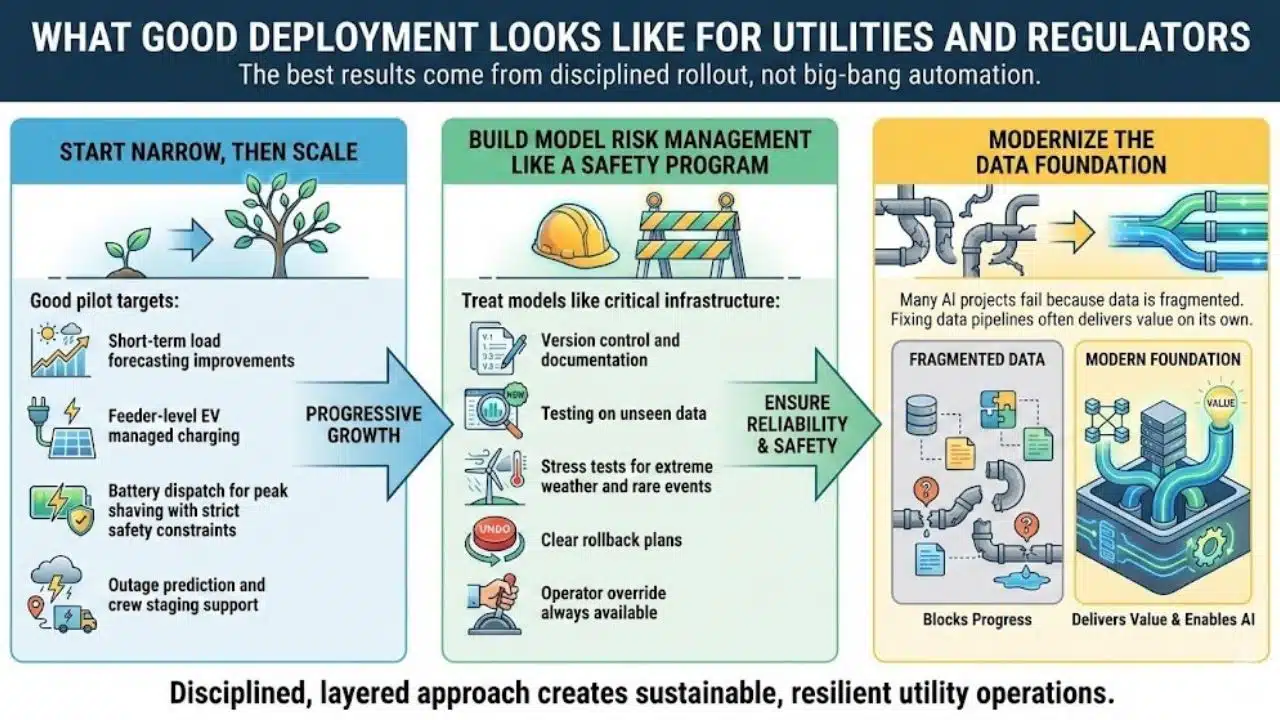
The best results come from disciplined rollout, not big-bang automation.
Start Narrow, Then Scale
Good pilot targets:
-
Short-term load forecasting improvements
-
Feeder-level EV managed charging
-
Battery dispatch for peak shaving with strict safety constraints
-
Outage prediction and crew staging support
Build Model Risk Management Like A Safety Program
Treat models like critical infrastructure:
-
Version control and documentation
-
Testing on unseen data
-
Stress tests for extreme weather and rare events
-
Clear rollback plans
-
Operator override always available
Modernize The Data Foundation
Many AI projects fail because data is fragmented. Fixing data pipelines often delivers value on its own.
What Consumers And Businesses Can Do Today
You do not need to run a utility to benefit from smarter grids.
Use Time-Based Pricing If It Fits Your Life
If your schedule is flexible, shifting usage can cut bills and reduce peak stress.
Automate The “Small Stuff”
Smart thermostats, smart water heaters, and EV chargers can respond to signals without daily effort.
Ask Clear Questions Before You Opt In
-
What data is collected?
-
Who can access it?
-
Can you opt out?
-
What happens during an event?
-
Are there comfort or productivity safeguards?
Final Thoughts
The grid’s job has not changed. Keep electricity reliable, affordable, and stable. The way it must do that has changed fast.
More renewables, more electrification, and more distributed devices push complexity into every layer of operations. That is why AI in smart grids matters. It helps utilities see demand earlier, predict renewable swings, coordinate flexible loads, and use storage and demand response with more precision.
The most realistic future is not a fully automated grid. It is a grid where humans stay in charge, but software handles more of the sensing, prediction, and routine coordination. If utilities invest in data quality, cybersecurity, and careful validation, smarter load balancing can reduce costs and improve reliability while supporting cleaner energy.