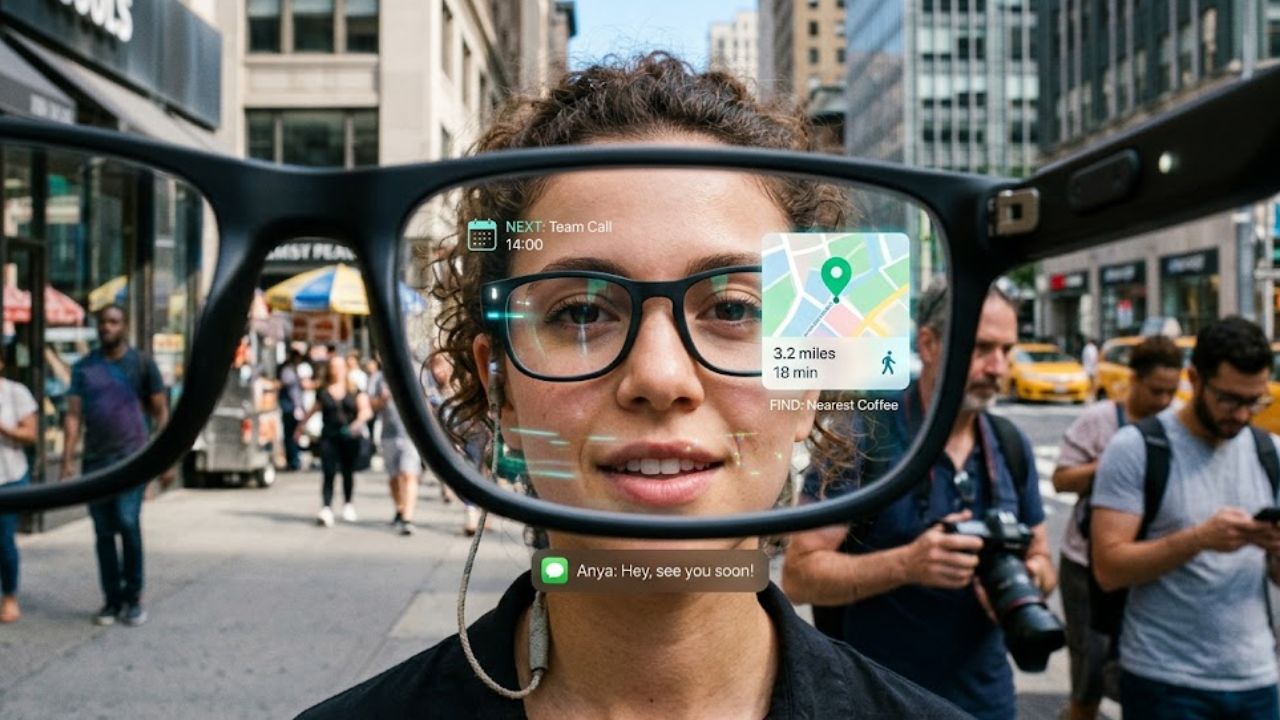
For most of us, reaching for a smartphone has become second nature. We check directions while walking through a new city, look up a restaurant before making a reservation, translate unfamiliar words, take photos, answer messages, and search for information throughout the day. Smartphones have made all of this remarkably easy, but they have also created a strange habit: whenever we need digital information, we tend to look away from the world around us and down at a screen.
AI-powered smart glasses are beginning to challenge that routine.
Instead of requiring users to pull out a phone for every small task, smart glasses can bring cameras, microphones, speakers, connectivity, and artificial intelligence into something people already know how to wear. The technology is still evolving, but the basic idea is surprisingly simple: make digital assistance available without making the screen the center of every interaction.
That is one reason the latest generation of smart glasses feels different from the wearable experiments of the past. Companies are increasingly combining familiar eyewear designs with AI and hands-free features, while the wider industry is paying closer attention to whether these products can become useful everyday devices rather than short-lived technology trends.
Moving Beyond the Smartphone Screen
The biggest change smart glasses introduce is not necessarily a new feature. It is a different way of interacting with technology.
Using a smartphone usually requires a series of deliberate actions. You take it out, unlock it, find the right application, look at the screen, and then do whatever you needed to do. None of that is particularly difficult, but it can interrupt whatever you were already doing.
Smart glasses can make some of those interactions feel much more natural.
Imagine walking through Rome and wanting to know the name of a building in front of you. Instead of stopping to open a search engine, you could ask an AI assistant directly. On a trip, you might hear directions while continuing to look at the street rather than constantly checking a map. If someone sends you a message while you are cooking, you could potentially hear it without touching your phone.
This broader movement toward wearable AI is already gaining attention. Recent discussion of the shift toward a post-smartphone era shows how technology companies are exploring more natural ways to integrate AI and connected devices into everyday life.
The appeal is easy to understand. Technology becomes useful without necessarily demanding your full attention.
When Your Glasses Can See What You See
One of the most interesting developments in smart glasses is computer vision.
A camera positioned on the frame gives the device the ability to capture information from the wearer’s surroundings. When combined with AI, that visual information can become useful in ways that go beyond simply taking photographs.
A traveler could ask what a landmark is. A shopper might ask for information about an item in front of them. Someone reading a sign in another language could potentially get a translation. A user could even ask an assistant to describe something they are looking at.
This is where products such as Oakley camera glasses demonstrate how the category is moving toward a combination of traditional eyewear and connected technology.
The important point is that the camera itself is not the real innovation. Cameras have been part of smartphones for years. The interesting part is what happens when a camera, AI assistant, microphone, and speakers are always available from something sitting naturally on your face.
That could make certain digital interactions faster and less disruptive.
The Most Useful Features May Be the Simplest Ones
When new technology launches, the conversation often focuses on its most impressive capabilities. With smart glasses, however, the features that people use every day may be much less dramatic.
Voice commands are a good example.
Asking for directions, making a call, setting a reminder, checking the weather, or getting a quick answer does not require a sophisticated interface. The advantage comes from being able to do those things without stopping to interact with a screen.
Translation could be another practical use. Travel often involves small moments of uncertainty: a menu you cannot read, a street sign you do not understand, or a conversation where you are missing a few important words. Having translation assistance available through glasses could make those moments feel less disruptive.
There is also potential for accessibility. Wearable AI could help users interpret visual information, recognize objects, or receive spoken descriptions of their surroundings.
None of these functions sounds particularly futuristic anymore. That may actually be a good sign. The most successful consumer technology often becomes valuable when it stops feeling like a demonstration and starts solving ordinary problems.
Privacy Is Still the Biggest Complication
There is, of course, a major difference between putting a camera on a phone and putting one on a pair of glasses.
When someone holds a smartphone up, other people can generally tell that a photo or video may be being taken. A camera built into a normal-looking pair of glasses is far less obvious.
That raises uncomfortable questions about consent and privacy, especially in public spaces. People nearby may not know when they are being recorded or how the resulting footage might be processed.
Recent reporting has drawn attention to privacy and the social risks of camera-enabled smart glasses, showing that concerns around these devices are no longer purely hypothetical.
Manufacturers therefore have to think about more than technical performance. Recording indicators need to be visible and understandable. Privacy controls need to be straightforward. Users need to know what information is being collected and where it is processed.
There is also a social etiquette question that cannot be solved entirely through software.
If smart glasses become as common as smartphones, society will have to establish its own expectations around when recording is acceptable. Restaurants, workplaces, schools, concerts, and private gatherings may all develop different norms.
For the technology to succeed, people need to trust not only the device but also the people wearing it.
Good Design Could Matter More Than Raw Specifications
Another lesson from the history of wearable technology is that people do not necessarily want to wear something just because it is technically impressive.
Glasses are personal. People choose frames based on appearance, comfort, fit, and style. If a smart pair feels heavy, looks awkward, or needs to be charged constantly, even excellent AI features may not be enough to make it part of someone’s routine.
This is why the involvement of established eyewear brands is significant.
The industry is increasingly moving away from the idea that smart glasses should look like miniature computers. Instead, the goal is to make them look and feel like eyewear first, with technology working quietly in the background.
That approach could be one of the most important factors behind wider adoption. People are much more likely to wear technology consistently when it fits naturally into something they already use.
The Smart-Glasses Market Is Becoming More Serious
The growing attention from major companies suggests that smart glasses are no longer being treated purely as an experimental category.
The industry is seeing greater investment in hardware, AI capabilities, and partnerships with established eyewear companies. The result is a market that is gradually becoming more competitive and more focused on everyday use.
The growing adoption of smart glasses also reflects a broader change in consumer technology. Instead of asking whether people want another gadget, companies are asking whether existing objects—such as glasses—can become smarter without becoming harder to use.
That is a much more interesting proposition.
If the technology can remain comfortable, discreet, reliable, and reasonably priced, smart glasses could eventually become less of a novelty and more of a normal consumer product.
What Could AI Glasses Do Next?
The next stage may be less about adding individual features and more about improving context.
An AI assistant that simply answers questions is useful. An assistant that understands what you are looking at, where you are, what you were doing a few minutes ago, and what you are trying to accomplish could be considerably more useful.
Imagine walking through a museum and asking about an artwork without typing anything. Or looking at a piece of equipment and asking for a basic explanation. Instead of opening an application and figuring out where to start, you could simply speak naturally.
That kind of interaction would make AI feel less like a separate service and more like an invisible layer around everyday activities.
There are still significant technical challenges, though. Small devices have limited space for batteries and processors. They need reliable connectivity while remaining lightweight. AI systems also have to interpret visual information accurately without making confident mistakes.
Solving those problems will determine how quickly smart glasses can move from interesting technology to genuinely useful infrastructure.
Smart Glasses Do Not Have to Replace Smartphones
It is tempting to think of smart glasses as the next replacement for smartphones. That may not be the most realistic outcome.
Phones remain better for tasks that require a large screen, detailed editing, extended reading, gaming, or complex applications. Smart glasses can serve a different purpose.
They could handle quick interactions while the smartphone remains available for everything that requires more attention.
In that sense, the future may not be about choosing between a phone and smart glasses. It may be about the two devices working together.
The phone could remain the main computing hub, while glasses provide a more immediate way to access information, communication, and AI assistance.
A More Natural Relationship With Technology
The most important change AI glasses could bring is not necessarily a specific feature. It is a change in how we think about interacting with technology.
For years, digital life has revolved around screens. We look down at them when we need information, communicate through them, and often interrupt conversations or activities to use them.
Smart glasses suggest another possibility.
Instead of technology constantly asking us to look at it, technology could become more responsive to what we are already doing. Information could be available when we need it and stay in the background when we do not.
Whether that vision becomes mainstream will depend on privacy, comfort, battery life, reliability, affordability, and public acceptance. The technology still has plenty of problems to solve.
But the direction is becoming increasingly clear. The next generation of personal technology may not be about making screens bigger or adding more applications. It may be about making technology feel smaller, quieter, and more naturally connected to everyday life.