Technological breakthroughs in the health industry have saved many lives and are constantly enhancing our quality of life. Not only that, but medical technology has substantially impacted virtually all operations and practices of healthcare professionals.
The future of healthcare is being shaped right in front of our eyes, mostly through digital technologies. We must become acquainted with the latest advancements to regulate technology and make the best of it.
This article will take you through the various technological advancements that have improved the healthcare system.
1. Robotics
Robotics is one of the most exciting and fast-growing healthcare disciplines. There are plans for robot companions, surgical robots, pharmabiotics, disinfection robots, and exoskeletons. These devices enable paralyzed people to walk, and stroke or spinal cord injury patients to be rehabilitated. They can help a nurse raise an old patient by increasing strength.
Certain robot companions can operate as social partners to help people deal with loneliness or mental health issues. Existing examples include the Jibo, Paro, Buddy robots, and Pepper. Some of them include cameras, touch sensors, and microphones, allowing their owners to talk with them, ask them to propose a fantastic show for that night, or just remind them about their medications.
2. Online Education
Online education is one of the fastest-growing areas of educational technology development. Online education can be especially beneficial for students in the healthcare industry, considering their often busy schedules and high fees.
Online education has been a blessing to medical students looking to advance their careers while working full-time as well. For example, students of nursing can complete their online master of science in nursing while working as assistant nurses or understudies at hospitals or clinics. This allows them to learn from their fieldwork and apply what they learn in their online classes in practical life as well, helping them gain confidence and experience.
3. Virtual Reality
Institutes are using cutting-edge virtual reality equipment for neurosurgery and thoracic surgery, allowing surgeons to virtually explore a patient’s brain and body before surgery. As a result, surgical efficiency and situational awareness have both increased. Patients and their families can also better understand procedures ahead of time.
Virtual reality can mimic medical conditions such as dementia, Parkinson’s disease, and migraines. In training for aging services, for example, virtual reality improved students’ understanding of age-related health concerns and increased their empathy for older people with vision and hearing loss or Alzheimer’s disease.
Furthermore, VR has been demonstrated to be an effective method for lowering pain. VR applications can also help women in labor, those in acute and chronic pain, and others. Virtual reality headsets are now being used to help sick and injured children deal with treatments by transporting them to virtual worlds and games.
4. Augmented Reality (AR)
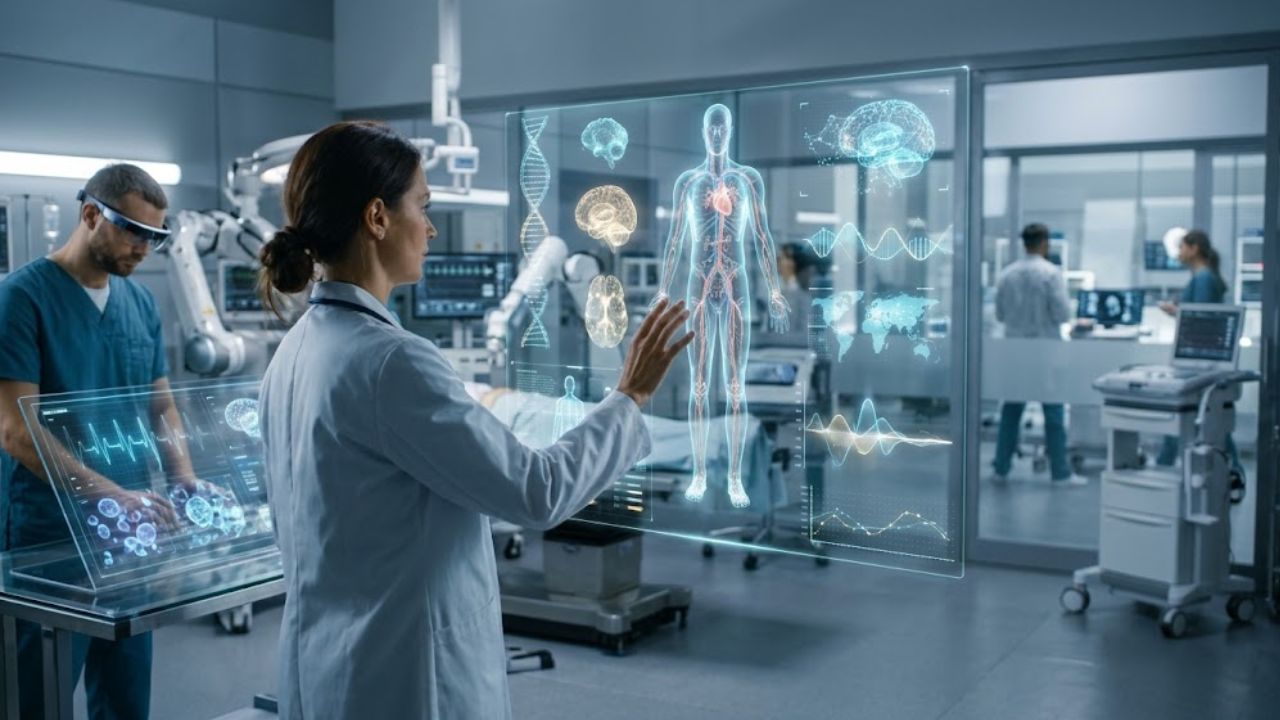
Unlike VR, Augmented Reality (AR) allows users to maintain contact with reality and receive information as quickly as possible. Due to these distinguishing characteristics, both on the receivers’ and medical providers’ sides, augmented reality is becoming a driving force in the future of healthcare.
For medical professionals, it could help medical students better prepare for real-life procedures while also allowing current surgeons to improve their skills. Students utilize the HoloAnatomy app on the Microsoft HoloLens to learn anatomy. Medical students receive access to precise and detailed, albeit digital, depictions of human anatomy, allowing them to study without the need for actual persons.
Magic Leap is another promising firm working on something unique with its mixed-reality headset. Magic Leap teamed with XRHealth to build SyncThink for brain health and BrainLAB, a startup that will bring its technologies to healthcare. Although no commercial goods have yet been released, we may expect to see these collaborations populate the healthcare industry in the near future.
5. Faster Results
Medical test results used to take weeks or even months to arrive. With new technology, you can have the findings as soon as the lab finishes processing your sample. Many hospitals and clinics now provide web portals. This enables you to view your results within hours or days.
This is a smart approach since it relieves the patient’s anxiety and provides them with the diagnosis they were waiting for. Patients can also access their previous medical information through the web portals, allowing them to keep track of their appointments, medical conditions, and billing.
6. Different Online Platforms
Clinics, doctors, and even research centers can use social media sites like Facebook to reach a bigger audience. Healthcare facilities, particularly hospitals, are embracing social media to stay in touch with patients, answer their queries, start public awareness campaigns, and undertake community outreach. Some of these services are sophisticated, allowing for instant discussions with nurses and doctors about medical conditions or even reminding individuals to obtain routine testing and vaccines.
7. Improvement of Pharmaceutical Companies
Pharmaceutical businesses are finding it easier to acquire access to more information to influence their product development decisions as electronic health records [EHRs] grow more common, and data availability rises. The manner businesses select to use this information will be determined by how they earn revenue.
Moreover, many pharmaceutical businesses are incorporating single-use technology (SUT) into their manufacturing processes. This trend is continuing as more industry players become aware of the great benefits of this technology. Furthermore, the method enables the creation of more dependable products by eliminating the need to sterilize containers.
8. Nanotechnology
We are in the early phases of the nanomedicine era. Nanoparticles and nanodevices will be used as precise medicine delivery systems, cancer therapy equipment, and microscopic surgeons in the not-too-distant future.
For example, Max Planck Institute researchers have been working with incredibly micro-sized (smaller than a millimeter) robots that swim through your physiological fluids and might be used to provide drugs or other medical relief in a highly concentrated manner. These scallop-shaped microbots are designed to navigate through non-Newtonian fluids such as your bloodstream, lymphatic system, or the slippery goo on the surface of your eyeballs.
Conclusion
The transformative impact of technology in the healthcare sector cannot be overstated. Although it is a subject that requires highly qualified people with many years of experience, it is also extremely demanding in terms of equipment and instruments. Global life expectancy increases and population aging create a very demanding environment for healthcare innovation and technology.