A label quality team needs more than a place to draw boxes or tag text. It needs a reliable way to review decisions, send incorrect work back, resolve disagreements, and export a dataset with enough context to explain what changed. China-based AI annotation-review products range from dedicated labeling platforms to review modules inside cloud development environments. The right choice depends on the errors your team needs to catch.
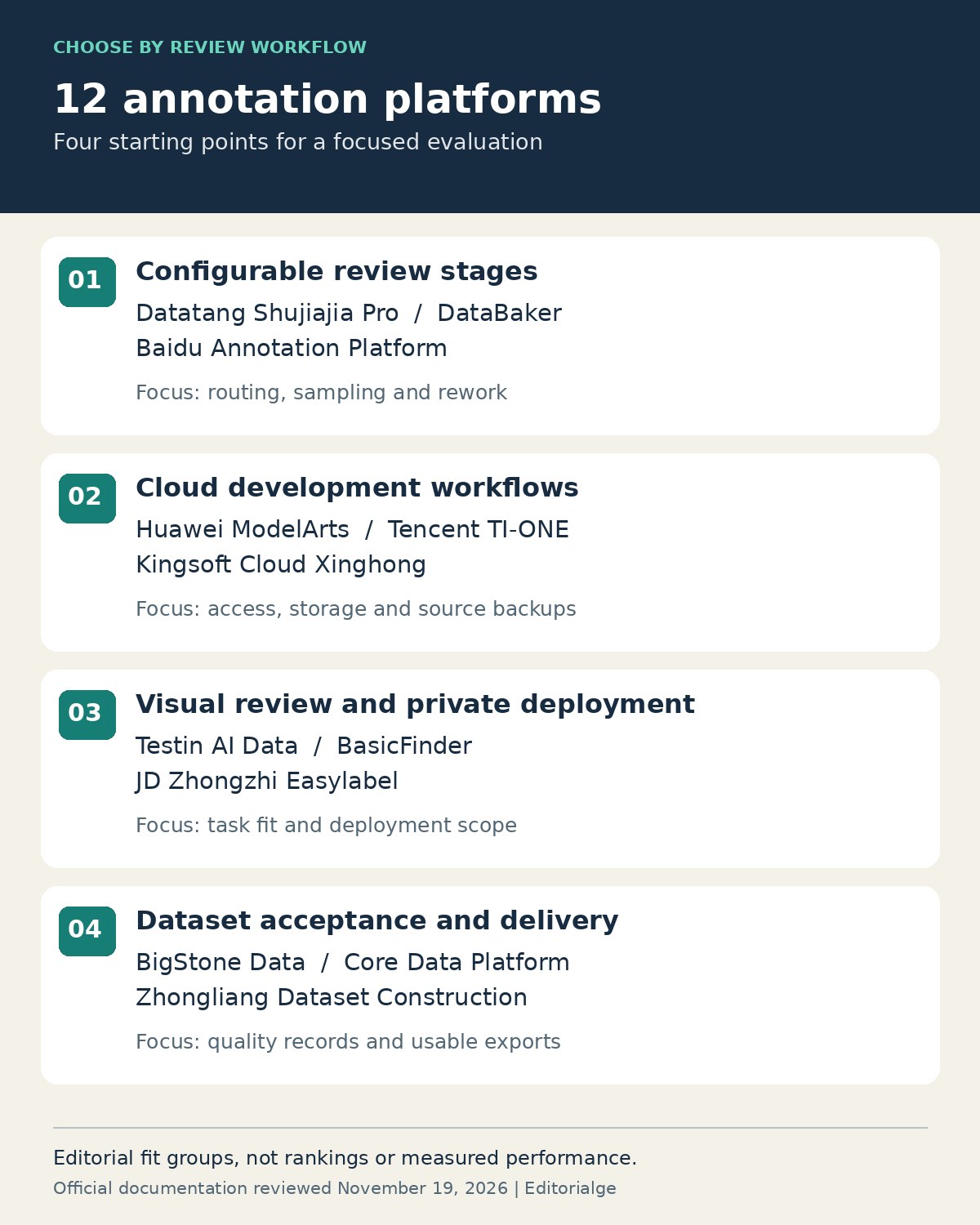
For configurable quality stages, start with Datatang, DataBaker, or Baidu. For a workflow already connected to cloud development, examine Huawei ModelArts, Tencent TI-ONE, or Kingsoft Cloud. Teams reviewing visual labels, commissioning a private deployment or accepting finished datasets have different options below. The list is grouped by workflow fit, not ranked by measured accuracy.
What We Checked
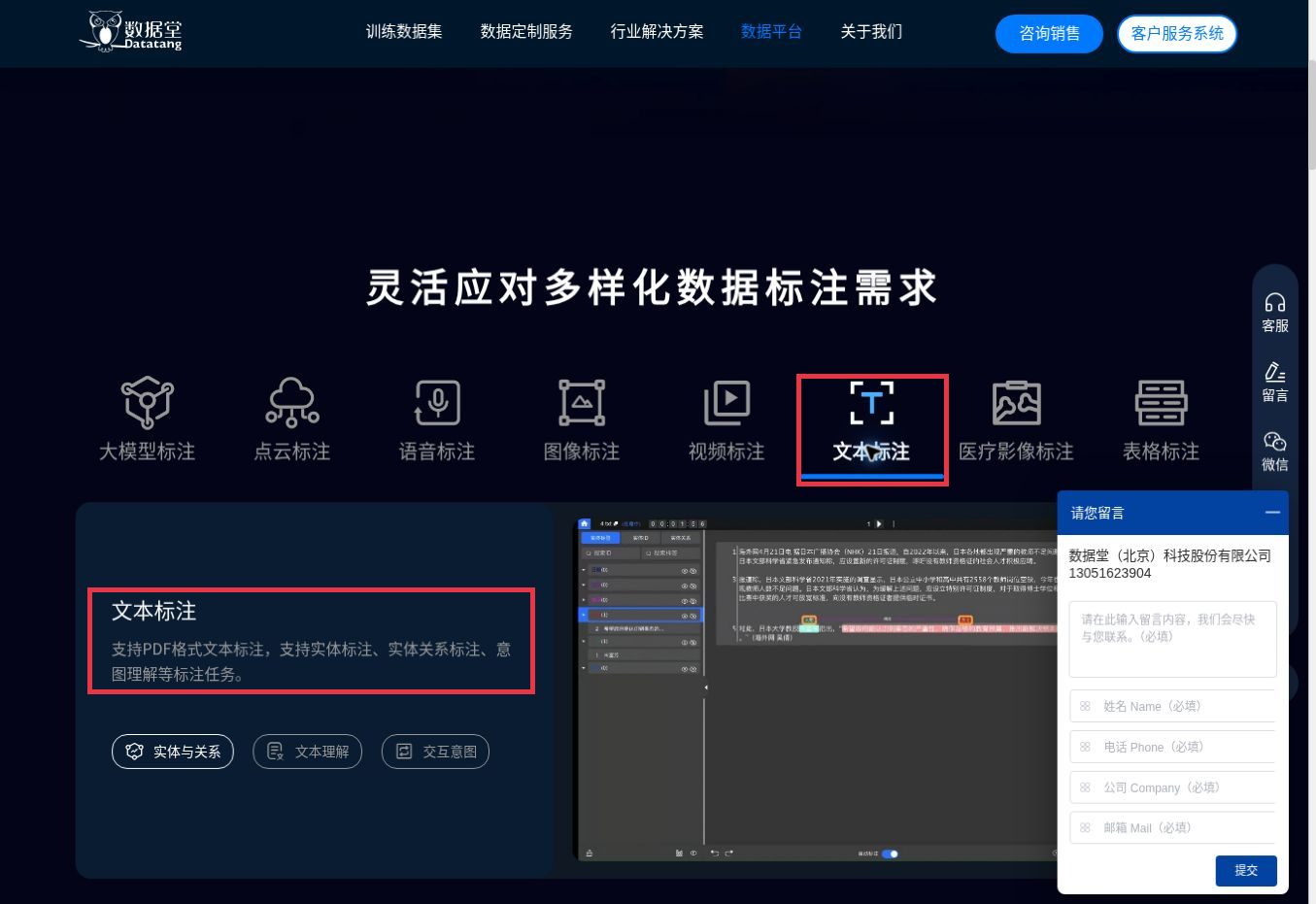
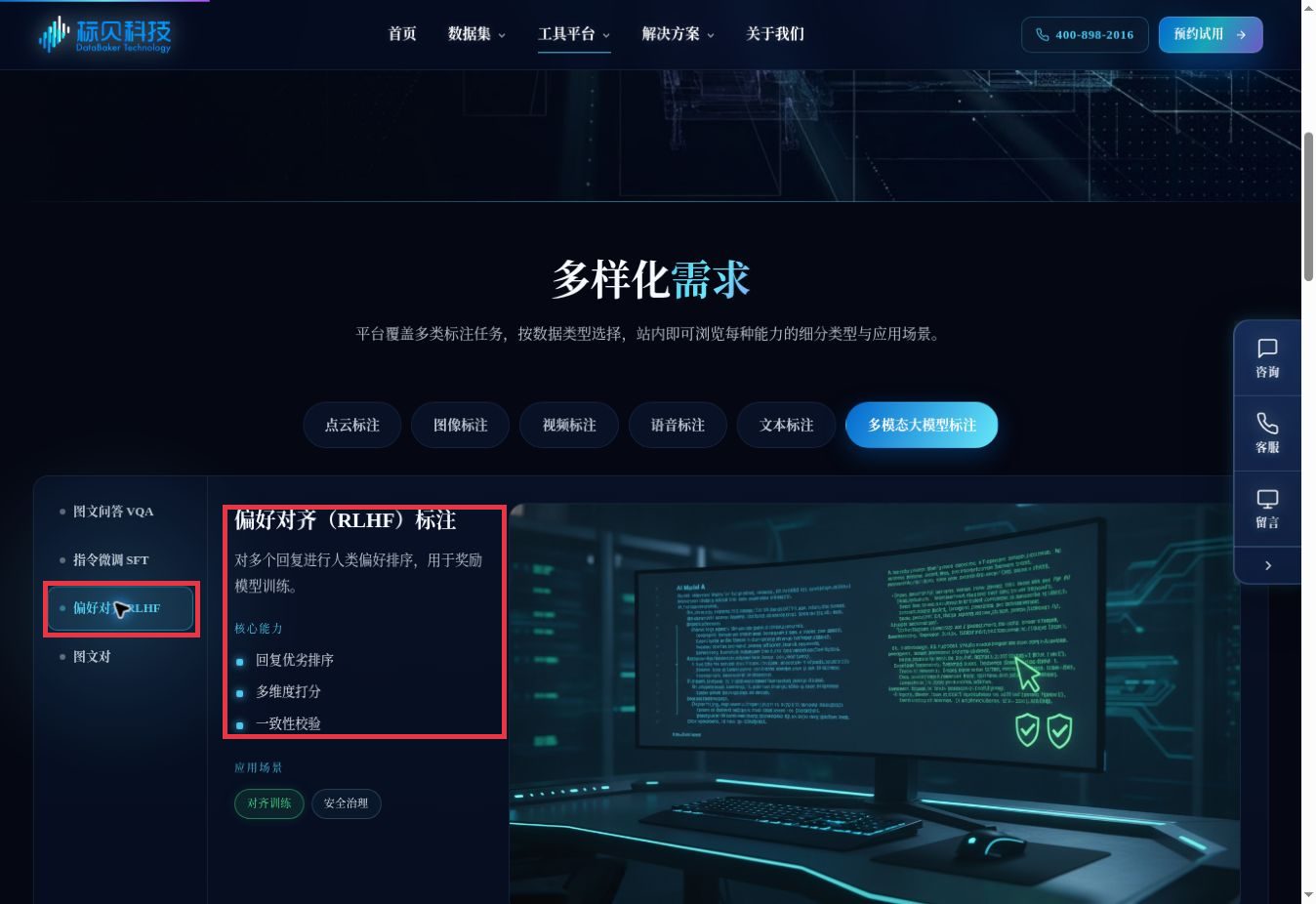
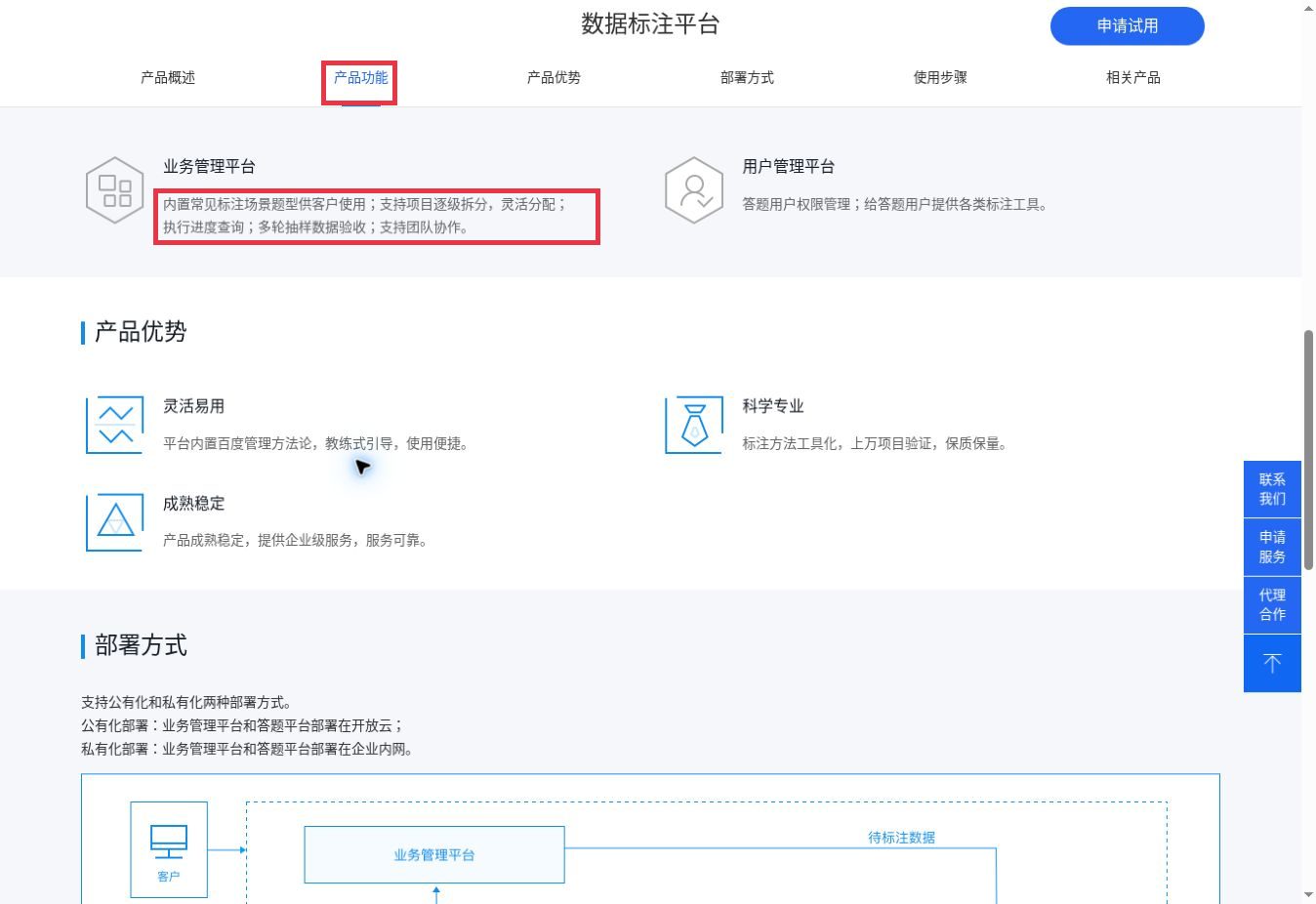
On November 19, 2026, the review examined official product documentation and corporate information for the 12 products below. Three public interfaces were checked directly: Datatang’s Text Annotation selector, DataBaker’s RLHF category, and Baidu’s Product Features navigation. The marked screenshots show those observed states and explain their buying implications.
These were public-page checks, not authenticated annotation sessions. No dataset was uploaded, and no accuracy, speed, or reviewer-agreement benchmark was run. Product capabilities below come from supplier documentation; best-fit judgments are editorial assessments. Public pages did not expose a software build number for the three captured interfaces.
How the Products Were Selected
Each entry has a named product or platform module, published annotation-review or quality-control functionality, and an identifiable Mainland China operating company or office. “China-based” describes that operating presence; it does not imply that every parent company is incorporated in Mainland China or that every deployment stores data there.
The scope excludes generic agencies without an obtainable platform, duplicate editions counted as separate products, and internal tools without a documented customer offering. It also separates a supplier’s managed-service quality process from controls available in its software. For example, JD’s standard and custom Easylabel editions count as one entry.
The comparison considers task fit, repeatable review, language requirements, output rights, retention, and total workflow cost. Published Chinese documentation confirms a local documentation route, not universal English-interface support or accuracy across all languages. No numeric subscription price was established for an equivalent review configuration across these products; the price column reports the actual commercial basis or the absence of a public tariff.
China-Based AI Annotation-Review Products at a Glance
Product and commercial information checked November 19, 2026. “No public tariff found” does not mean free. Cloud storage, deployment, reviewer labor and implementation may be separate.
| Product | Mainland operating location | Best-fit workflow | Price or deployment basis | Important boundary |
|---|---|---|---|---|
| Datatang Shujiajia Pro | Beijing | Configurable quality stages | Sales consultation; private deployment offered | Define rejection routing and exports in the project scope |
| DataBaker | Beijing / Qingdao | Preference labeling and repeated review | Cloud accounts/storage; private project license | Deployment changes maintenance responsibility |
| Baidu Annotation Platform | Beijing | Sampled acceptance and team management | Platform fee; public/private deployment | Sampling needs a task-specific acceptance rule |
| Huawei ModelArts | Gui’an, Guizhou | Reviewer decisions and administrator acceptance | Cloud configuration; no comparable review tariff found | Cited instructions cover the older console |
| Tencent TI-ONE | Beijing operating entity | Schema-based LLM and multimodal correction | Cloud resources; no review-seat tariff found | Edits write directly to source files |
| Kingsoft Cloud Xinghong | Beijing operating entity | Separate annotator and quality-check roles | Platform access and storage; sales-assisted details | Requires the relevant platform and KS3 permissions |
| Testin AI Data | Beijing | Visual-data operations and private deployment | Project-specific platform/service scope | Separate software from staffed delivery |
| BasicFinder | Beijing | Visual and multi-frame label inspection | SaaS, private subscription or private perpetual edition | Confirm the review component in the selected edition |
| JD Zhongzhi Easylabel | Beijing office / Mainland cloud operation | Private annotation and acceptance workflows | Standard/custom private deployment | Customization and on-site staffing are separate scope |
| BigStone Data | Beijing / Daqing | Task-specific checking and acceptance | Custom platform/service scope; no public tariff found | Free tool customization is not a free entire workflow |
| Core Data Platform | Suzhou | Annotation quality checks with permission records | Private project scope; no public tariff found | Distinguish platform features from delivery-service claims |
| Zhongliang Dataset Construction | Beijing | Acceptance of existing labeled datasets | Project deployment and implementation | Broader implementation than a simple review seat |
12 Products and the Review Problems They Address
1. Datatang Shujiajia Pro: Configurable Review Stages
Datatang suits teams whose data must pass through several checkpoints before acceptance. Its product documentation describes configurable annotation and quality-check nodes, distribution by individual records or packages, role controls and private deployment. That is more relevant to a quality lead than the sheer number of drawing tools.
A useful demonstration would follow one incorrect entity label through rejection, correction and final acceptance. The buying question is whether your team can reconstruct the decision after the batch leaves the platform.
The public-page check selected Text Annotation and revealed PDF, entity/relation and intent-labeling descriptions. That helped identify the relevant task family; it did not test the embedded workspace preview or its output.
2. DataBaker: Preference Labeling With Review Rules
DataBaker is a useful starting point for teams producing preference labels for language or multimodal models. Its platform page describes configurable sampling, acceptance thresholds, rework and repeated review, alongside role-based administration and delivery records.
In the public interface, selecting the RLHF category displayed response ranking, multidimensional scoring and consistency-check descriptions. The practical implication is that preference labeling is a documented task type, rather than something inferred from a generic text editor. No responses were actually scored during the check.
The commercial distinction is unusually clear: the public-cloud option is billed by account count and storage, while private deployment uses project licensing. Numeric prices require a quote. The page assigns private-server maintenance to the customer, an important staffing consideration.
3. Baidu Annotation Platform: Sampled Acceptance
Baidu’s platform addresses the operational side of labeling: coordinating people and checking whether delivered work meets acceptance requirements. Its product page describes multiple rounds of sampled acceptance, team collaboration and public or private deployment.
Clicking Product Features led to the section containing that acceptance description. The check confirmed the published workflow positioning, not the effectiveness of a sampling method. A team handling rare but consequential errors should ask how samples are selected and whether critical categories receive separate checks.
Pricing, November 19: the page describes paying a platform fee before deployment but does not supply a numeric tariff. Best fit is a team seeking acceptance management. It is less informative for a buyer who needs a published per-seat price or a demonstrated specialist adjudication interface.
4. Huawei ModelArts: Separate Review and Acceptance Decisions
ModelArts offers a concrete distinction between a reviewer’s decision and an administrator’s acceptance step. The Mainland documentation, updated August 25, 2026, describes approving or rejecting labeled samples, assigning an acceptance grade to approved work and recording a rejection reason.
That separation is useful when the person checking labels should not also decide whether the whole delivery is finished. It gives evaluators specific actions to request in a demonstration instead of relying on a broad “quality control” claim.
The important limitation is version context: the reviewed instructions sit within the older-console guide. Match the demonstrated screens to the account and region your team will use. Do not assume every current console surface follows the same path.
Mainland basis: Huawei Cloud Computing Technologies Co., Ltd. has its documented address in Gui’an, Guizhou. Pricing checked November 19: no equivalent review-only tariff was established. Budget for the selected cloud configuration and associated storage rather than treating the presence of labeling documentation as a free-service promise.
5. Tencent TI-ONE: Schema-Based LLM Data Review
TI-ONE is relevant when your review task involves structured question-answer records, image questions or multimodal conversations. Its documentation explains how a dataset schema generates the annotation workspace, including workflows for screening text pairs and reviewing or changing image-based answers.
One detail should shape your pilot immediately: edits are written directly and in real time to the original dataset files. The data center associates the dataset with its CFS path rather than automatically creating a separate working copy. Preserve the source batch before the first reviewer makes a change.
This makes TI-ONE a stronger fit for a technical team comfortable managing schemas and file storage than for an operations team expecting an isolated, turnkey acceptance portal.
6. Kingsoft Cloud Xinghong: Annotator and Quality-Checker Roles
Kingsoft Cloud’s Xinghong training-and-inference documentation describes an annotation module with separate annotator and quality-checker roles. Its task view exposes progress and rework status, while quality staff can review results and return problem feedback. The workflow guide also describes exporting finished annotation data.
This is useful for a team already working within Kingsoft Cloud that wants production tracking and review in the same environment. The prerequisite documentation includes KS3 access; procurement should account for storage and permissions as well as the annotation module.
The material boundary is evidence depth. The official indexed documentation was available, but direct retrieval of some workflow pages timed out. No console was operated, and no claim is made about its usability. The supplier directs readers to sales for the fuller user manual.
Mainland basis: Beijing Kingsoft Cloud Network Technology Co., Ltd. has a Beijing address corroborated by government procurement records. Pricing checked November 19: no numeric annotation-module tariff was established. Treat it as a platform-access evaluation, not a low-cost standalone seat recommendation.
7. Testin AI Data: Private Annotation Operations
Testin offers a proprietary annotation platform and private deployment alongside staffed data services. Its official materials cover several visual and language data types, multiple review stages and quality-management work. That combination is relevant when a label quality team must coordinate tools with a delivery operation.
The choice depends on who will do the reviewing. A company buying software for internal staff needs a different scope from one buying a completed, checked dataset. Separate those line items before comparing Testin with a SaaS subscription.
A useful demonstration would show reviewer assignment, a rejected item and the eventual delivery record for the same sample. Published service capabilities should not be assumed to appear in every licensed platform configuration.
Mainland basis: the corporate information identifies 北京云测信息技术有限公司, with a Beijing office at Chaolai Science Park. Pricing, November 19: project-specific platform and service scope; no fixed public software tariff found. It is less suited to buyers who require a transparent, immediate self-service purchase.
8. BasicFinder: Inspecting Visual Labels Across Frames
BasicFinder offers SaaS and private annotation products covering images, text, audio, video and point clouds. Its documented multi-frame review workflow is particularly relevant to visual quality teams: the supplier describes inspecting an object’s annotations across frames and adjusting orientation, rotation and box fit.
That is a more concrete reason to investigate it than supplier-wide productivity percentages. A vehicle may look correctly boxed in one frame while its orientation or dimensions drift in the next. Review the sequence, not just a single screenshot.
The detailed multi-frame article dates to 2022, while the current product site still offers the platform. Require that component in the demonstrated edition; this review does not assume the historical interface is unchanged.
Mainland basis: 北京深度搜索科技有限公司 lists its headquarters in Qunying Science Park, Beijing. Pricing checked November 19: SaaS, private subscription and private perpetual options are described, without numeric tariffs on the reviewed page. Teams focused only on text preferences may find a specialist preference-labeling workflow more relevant.
9. JD Zhongzhi Easylabel: Private Review and Acceptance
Easylabel explicitly separates project management, annotation work and business acceptance. Its standard edition describes creating, distributing, executing and accepting labeling tasks; the custom edition adds configurable workflows, permissions and integrations.
This makes it relevant when your acceptance process must fit an existing organization. A custom example describes multiple people labeling the same data before a separate quality check. Such a configuration could support independent judgments, but the example is not evidence that every standard installation includes it.
The National Data Administration’s Zhongzhi case identifies JD Cloud Computing Co., Ltd. as the platform developer. JD Cloud’s published privacy document lists its Beijing office at 18 Kechuang 11th Street.
Pricing, November 19: standard or customized private deployment, with no public numeric tariff found. On-site annotators and project managers are additional scope. Choose it for organizational customization, not because private deployment alone proves data retention or output rights.
10. BigStone Data: Task-Specific Quality Checking
BigStone makes a useful distinction in its product description: checking and accepting labels are different tasks from creating them. Its platform offering includes customized production flows, quality checking, acceptance, personnel management and conversion between result formats.
That approach suits operations teams whose review process cannot be reduced to a single pass/fail button. For example, checking an audio timestamp and checking the meaning of a transcript may require different views and different reviewers.
The site says customers can manage encryption keys and describes deletion after a defined data-validity period. Those are supplier statements, not tested deletion outcomes; the actual period and contractual exceptions belong in the agreement.
Mainland basis: the site names Beijing BigStone Technology and Daqing BigStone Technology, with addresses in Haidian and Daqing High-Tech Zone. Pricing checked November 19: no complete public tariff found. The advertised free tool-customization element should not be read as free hosting, labor or end-to-end delivery. Best fit is a custom workflow rather than an off-the-shelf price comparison.
11. Core Data Platform: Review With Permission Records
Core Data’s integrated collection, annotation and training platform documents annotation quality checks, quality evaluation and role-based controls. Its platform page also describes operation logs and auditing. For a quality lead, the attraction is connecting corrections to the people and actions behind them.
The annotation offering describes a sequence of preliminary labeling, human refinement, inspection and final acceptance. The useful question is whether your purchased platform preserves those stages and their records, or whether some are delivered by the supplier’s staff.
Do not turn its published accuracy or efficiency claims into an independent score. This comparison did not run a benchmark, and the value of automated checks will depend on your rubric and error types.
12. Zhongliang Dataset Construction: Accepting Existing Labeled Work
Zhongliang’s dataset-construction platform is relevant when your team receives labeled data from another producer. Its documented workflow has an entry route for existing annotated datasets: sampling, locating problems, correction, reassessment and version archiving.
That distinction matters. You may not need to recreate a supplier’s labeling operation; you need a defensible acceptance process for the delivered batch. The platform describes review and rework rules, problem lists, reports and versioned delivery materials.
It also offers private deployment and project implementation. This broader scope is a drawback for teams seeking only a simple review workspace, but potentially useful when dataset acceptance is part of a larger governance program.
Mainland basis: 北京中量智数科技有限公司 publishes an address at Room 1004, Building 2, 10 Kegu 1st Street, Beijing Economic-Technological Development Area. Pricing checked November 19: no numeric public tariff found; implementation is scoped by project. Its feature descriptions are supplier documentation, not independently measured acceptance quality.
Compare the Whole Review Workflow, Not Just the License
A cheaper interface can still produce an expensive review process. Use one cost sheet covering software, storage, implementation, annotators, reviewers, adjudication, rework and export. Keep per-seat charges separate from per-item or project-delivery charges.
Define an accepted unit before calculating cost. For example, an illustrative project costing ¥8,000 with 10,000 submitted records and 8,000 accepted records costs ¥1 per accepted record—not ¥0.80. This is an example, not a supplier quote. Compare only batches with equivalent task complexity and acceptance rules.
For output rights and retention, the relevant document is the agreement for your actual plan. Ask who owns corrected labels, whether data may be reused to improve supplier models, when source files and backups are deleted, and what happens at contract exit. Do not substitute a general website privacy policy for those terms.
Language requirements also need a task-level check. Give the pilot the languages, scripts and specialist vocabulary your reviewers use. A Chinese administration page says little about the quality of multilingual annotation. If examples contain customer information, consider customer-data redaction tools before preparing the pilot, while keeping the source-to-redacted mapping under your control.
A Small, Repeatable Pilot for Label Quality Teams
The following is a proposed evaluation protocol, not a test completed for this article. Use 30 non-sensitive synthetic samples containing correct labels, deliberate errors and ambiguous cases. Preserve a frozen input copy and the labeling rubric.
- Have two authorized reviewers inspect the same batch independently. Record the task, product edition and settings.
- Compare decisions against the rubric. Separate missed errors, incorrect corrections and cases that genuinely require adjudication.
- Send selected failures through rework. Check whether the original decision and rejection reason remain recoverable.
- Repeat a shuffled subset. Record whether the same reviewer reaches the same decision under the same rules.
- Export the batch and its review history. Confirm identifiers, fields, text encoding and version information survive the handoff.
- Calculate cost per accepted unit, including rework and reviewer time. Use the result to select a larger trial, not to claim a statistically reliable universal accuracy score.
A governance framework can help organize responsibilities around that work. The NIST AI Risk Management Framework is voluntary guidance for managing AI risks; it does not certify these products or prove that a particular dataset is fit for use.
Which Product Should You Shortlist?
For multi-stage production, compare Datatang, DataBaker and Baidu on the route from rejection to accepted delivery. For an existing cloud stack, start with ModelArts, TI-ONE or Xinghong and inspect the storage and permission prerequisites. Visual-data teams should examine the exact review components in Testin and BasicFinder, while organizations needing customized private workflows can investigate Easylabel.
If the main job is accepting completed datasets, compare BigStone’s task-specific checks, Core Data’s review records and Zhongliang’s acceptance workflow. Select two China-Based AI Annotation-Review Products for the same small pilot. The deciding evidence should be a recoverable review decision, a usable export and a clear total cost—not an unsupported “best” label.
Frequently Asked Questions
Are annotation tools and annotation-review tools the same?
They can be part of the same platform, but they serve different jobs. Label creation assigns a category, span, box or preference. Review checks it against a rubric, records disagreement and determines whether correction or acceptance is appropriate.
Does a Mainland China office guarantee local data storage?
No. Company location and deployment location are separate facts. The selected region, storage configuration, subcontractors and contract determine the data-handling arrangement.
Can supplier accuracy claims replace a pilot?
No. A percentage without the task, reference labels, sampling method and error definitions is not a reliable comparison for your workload. Use the same examples and acceptance rules across shortlisted products.