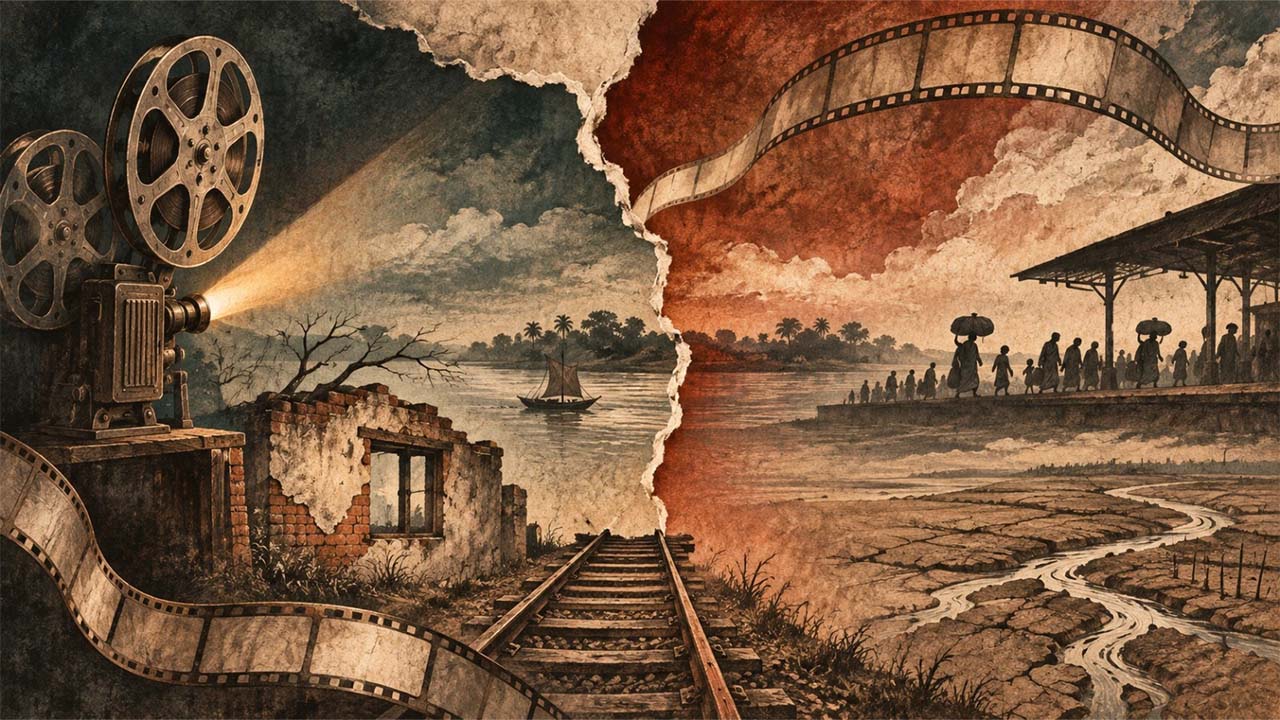
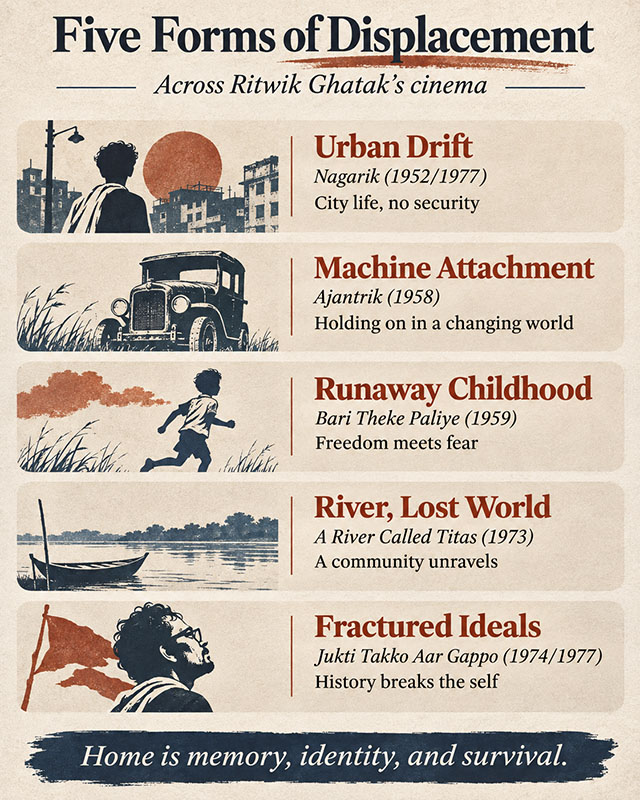
In Ritwik Ghatak’s films, displacement is not limited to crossing a border and seeking refuge in another country. It can mean struggling to survive in a city without stable work, clinging to a familiar object as the world changes, losing the security of childhood, or watching a river-based community lose the landscape that once sustained it. It can also mean discovering that political convictions, relationships, and memories no longer offer a secure place to stand.
The familiar Partition Trilogy—The Cloud-Capped Star (Meghe Dhaka Tara), Komal Gandhar, and Subarnarekha—is central to understanding this vision. But the trilogy is only one entrance into Ghatak’s larger cinematic world. Nagarik, Ajantrik, Bari Theke Paliye, A River Called Titas, and Jukti Takko Aar Gappo investigate other kinds of estrangement, from urban insecurity to environmental loss and ideological fracture. Their protagonists are not all refugees in the historical sense. What connects them is a more unsettling question: when the world that made a person feel at home breaks apart, where can that person belong?
Why the Partition Trilogy Is Not the Whole Story
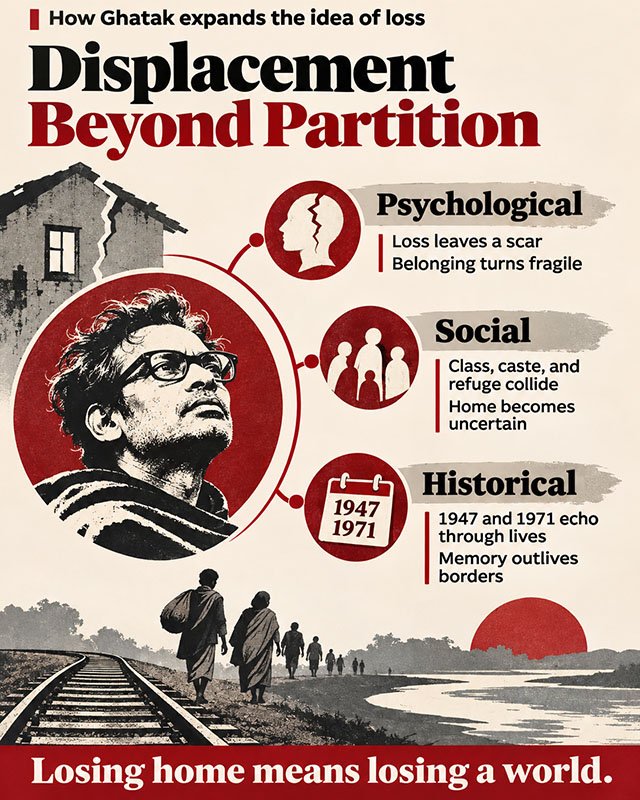
The Cloud-Capped Star (1960), Komal Gandhar (1961), and Subarnarekha (released in 1965) are widely discussed as Ghatak’s Partition Trilogy. They explore the afterlives of the 1947 division of Bengal, but they do so through intimate relationships rather than a simple retelling of political events. In The Cloud-Capped Star, Neeta’s sacrifices for her displaced family erode her own possibilities. In Komal Gandhar, a fractured people’s theatre group echoes a divided cultural homeland. In Subarnarekha, a new address fails to resolve the pressures of class, caste, longing, and social exclusion.
The trilogy demonstrates a central principle of Ghatak’s cinema: a border drawn across a map can continue to divide the emotional and social life of a household. Yet “trilogy” is also a convenient critical grouping, not a boundary around everything the director wanted to say about history.
Film scholar Ira Bhaskar has proposed reading Nagarik alongside those three works as a “Partition Quartet.” This reading, discussed in her writing for the Criterion Collection and in work associated with the published Nagarik screenplay, matters because it brings a less overtly Partition-centered film into the conversation. History need not always announce itself through a character’s direct recollection of a border crossing. It may operate through employment, hunger, precarious housing, or the fading memory of a more secure life.
An earlier Editorialge profile of Ritwik Ghatak at 100 provides a broader introduction to his life and artistic legacy. The focus here is narrower and more analytical: how does the psychology of displacement emerge when his films are read together, including those outside the celebrated trilogy?
Nagarik: Feeling Homeless While Living in the City
Completed in 1952, Ghatak’s first feature Nagarik was not released until 1977, after his death. Its central figure, Ramu, is searching for work as his family’s economic conditions deteriorate. Kolkata is full of people, buildings, and opportunities that seem just out of reach. A roof exists, but that does not guarantee security. A city can contain a person without making that person feel that they belong to it.
Bhaskar’s interpretation draws attention to Partition as a formative, sometimes unspoken presence in this urban story. Unemployment, anxiety about the future, and memories of lost stability turn the city into a landscape of interrupted expectations. The emotional consequence is not identical to being driven across a national border. Rather, the film suggests that a historical rupture may continue to shape ordinary struggles over work and shelter long after the moment of departure.
Ghatak’s visual treatment of cramped interiors and constricted movement reinforces that uncertainty. The viewer sees a social world in which the possibilities for advancement seem to narrow even as the city stretches around its inhabitants. Ramu’s predicament can be read as a form of unsettled urban citizenship: he is physically present, yet the economic order offers him no reliable claim to a future.
It would be misleading to declare every unemployed urban resident a Partition refugee. The more careful insight is that forced migration, economic dispossession, and urban precarity can intersect. Nagarik makes the intersection emotionally legible without reducing one experience to another.
Ajantrik: A Machine as a Fragile Substitute for Home
At first glance, Ajantrik (1958) is not a film about Partition at all. Its taxi driver, Bimal, forms an extraordinary bond with his aging Chevrolet, Jagaddal. The car supplies his livelihood, but it is also a companion and a familiar presence. As the industrial world changes around him, the relationship becomes funny, eccentric, and profoundly affecting.
Jagaddal’s sounds and movements are treated with an intimacy rarely granted to a mechanical object. Bimal responds as if the vehicle can listen, answer, and remember. The car is not literally a homeland, and the film should not be turned into a disguised account of 1947. But it asks a related psychological question: what happens when the object that anchors a person’s routine and identity begins to fail?
One possible reading is that Bimal’s attachment expresses a fear of losing continuity. In a changing economy, Jagaddal preserves the rhythm of a known life. Losing the car threatens not only income but also the emotional structure through which Bimal understands himself. Film at Lincoln Center’s account of the work similarly emphasizes his struggle to adapt to an increasingly industrial society.
Seen beside Ghatak’s films about uprooted people, Ajantrik expands the notion of displacement without erasing its differences. A person can be estranged by technological and social change even while remaining in the same country. That is a critical interpretation of the film’s emotional logic, not a clinical diagnosis of Bimal or an argument that industrial change and refugee trauma are interchangeable.
Bari Theke Paliye: The Freedom to Leave and the Fear of Not Belonging
In Bari Theke Paliye (The Runaway, 1959), Kanchan leaves home voluntarily and heads for Kolkata. That fact immediately distinguishes his experience from those of people who were forced from their homes by violence or political upheaval. For the boy, the city initially represents excitement and freedom. But the imagined metropolis becomes less secure as he encounters people struggling with poverty, fragile livelihoods, and exploitation.
The contrast between childhood curiosity and the harsh realities of urban life gives the film much of its force. A Film at Lincoln Center synopsis describes encounters that expose Kanchan to the vulnerabilities of people earning a living on the margins, including a teacher who has to make money as a street vendor. The city is no longer merely an adventure; it is a network of unequal chances to survive.
Kanchan’s movement also introduces a revealing contrast. His decision to run away is possible partly because he can imagine going back. For many displaced families, return was not an option, or no longer meant returning to a familiar social world. The difference between chosen departure and involuntary loss makes the film valuable in a broader discussion of belonging.
The Runaway therefore complicates the language of exile rather than simply repeating it. Its young protagonist learns that leaving a house, finding a place to sleep, and possessing a meaningful home are three different things. Ghatak makes that realization visible through the perspective of someone who first sees the city as a promise and then discovers the insecurity beneath its surface.
A River Called Titas: When a Landscape Stops Being Home
A River Called Titas (1973), adapted from the novel by Adwaita Mallabarman, stands apart in Ghatak’s filmography. Its story is rooted in the riverine fishing communities of pre-Partition eastern Bengal, while the film itself was made in independent Bangladesh after the 1971 Liberation War. Those are two distinct historical layers: the time represented in the story and the moment in which the director returned to the geography of his birthplace to make the film.
For the Malo fishing community, the river is not simply scenery or a means of transport. It sustains work, settlement, kinship, social customs, and collective identity. As the river changes and dries, the conditions of a shared life begin to disintegrate. People may remain close to the same physical location while losing the environmental and cultural world that made the place recognizable as home.
The Criterion Channel describes the film in relation to the vanishing life of a community; writing and programming around the film at the BFI likewise draw attention to the connections between personal catastrophe and a fragile river ecosystem. These descriptions help explain why the film can be read through the lens of collective displacement even though its narrative is not primarily about crossing the 1947 border.
Its modern relevance is striking. Contemporary readers might see a conceptual connection with environmental displacement, river erosion, or climate-related loss. That connection can illuminate the film, but it should not be presented as a term spoken by its characters or as a direct declaration of the director’s intentions. The historical world of Titas deserves to remain distinct from the policy vocabulary of our own time.
What the film makes especially clear is that memory can be shared and material. It lives in boats, nets, seasonal patterns, spoken language, and systems of mutual dependence. Losing such a world is more than losing a building. It means losing the conditions that made a community’s life intelligible to itself.
Jukti Takko Aar Gappo: Displacement Becomes Political Self-Interrogation
Ghatak’s last feature, Jukti Takko Aar Gappo (Reason, Debate and a Tale), was made in 1974 and released in 1977. Ghatak plays Neelkantha Bagchi, a troubled intellectual whose personal unraveling unfolds against political conflict. As he travels, he encounters a range of people, including Bangabala, a young refugee from Bangladesh. The journey brings contrasting forms of loss into the same conversation.
The historical background is no longer only the Partition of 1947. The 1971 Bangladesh Liberation War, the Naxalite movement in India, and arguments about political responsibility create an atmosphere of urgent disagreement. The BFI has characterized the film as an example of autobiographical fiction, or auto-fiction, in which the filmmaker’s own crisis becomes inseparable from the political condition of his time.
Bangabala’s presence evokes displacement connected to a particular history of war and refuge. Neelkantha’s crisis is different: the weakening of his relationships, convictions, work, and position in the world. These losses should not be declared equal. The film’s power comes from placing them near one another and asking what ethical responsibility remains when private life and public history both seem fractured.
Here displacement becomes a question of thought as much as geography. People can lose confidence in inherited ideas, political movements, and the language through which they once explained the world. Reason, Debate and a Tale refuses a simple resolution. Instead, argument itself becomes a way of confronting a history that is still unsettled.
Sound, Rivers, Railways: How Trauma Becomes Film Language

Ghatak rarely relies on exposition alone to communicate the weight of historical loss. Trains, roads, interrupted journeys, distant songs, mechanical noises, rivers, and cramped rooms create a second language alongside dialogue. These recurring forms do not have one fixed meaning in every film, but they allow viewers to sense what characters cannot easily explain.
In The Cloud-Capped Star, abrupt, piercing sound effects intensify moments of Neeta’s humiliation and despair. They are not simply neutral sounds from the surrounding environment. They interrupt the apparent realism of a scene, making emotional injury something a viewer almost physically hears. Bhaskar’s Criterion essay draws attention to the expressive relationship between sounds located within a scene and those added beyond its visible space.
Komal Gandhar offers another register. Songs, theatre rehearsals, broken group loyalties, and performances turn cultural activity into a field of separation and potential reunion. In Ajantrik, the voice-like sound of Jagaddal’s engine becomes part of Bimal’s intimate relationship with his world. In Titas, the river and rhythms of communal work hold the memory of a way of life. In Jukti Takko Aar Gappo, voices in argument refuse the comfort of a settled historical account.
Read together, these choices reveal why Ghatak’s films cannot be summarized merely as stories “about” trauma. Their editing, sound, setting, and performance styles are part of how disruption is experienced. Here the word trauma describes a cultural and aesthetic reading of damaged memory, security, and belonging. It does not imply that fictional characters have been clinically assessed or assigned psychiatric conditions.
1947, 1971, and an Earlier River World Are Not One History
There is a risk in treating every instance of loss in Ghatak as the same event under a different name. Partition in 1947 involved the creation of new state borders, communal violence, and large-scale forced movement. Nagarik and the celebrated trilogy can be understood in relation to its social aftermath. The narrative world of A River Called Titas belongs to a river community before Partition, even though the film was made after Bangladesh became independent. Jukti Takko Aar Gappo addresses the conflicts of the post-1971 moment more directly.
Each history has distinct causes. Poverty is not war. Ecological decline is not identical to expulsion across a border. The freedom of a runaway child is not the involuntary flight of a refugee family. At the same time, cinema can place different histories in conversation by showing how they affect people’s sense of continuity, relationships, and future possibilities.
The most useful common thread is therefore not a claim that all homelessness is equivalent. It is the recognition that home is made through a combination of place, livelihood, family, culture, ecology, and political belonging. If one of those foundations collapses, a person may remain geographically stationary yet feel profoundly unmoored.
Whose Loss Becomes Visible?
Reading Ghatak beyond the trilogy also reveals differences in whose suffering receives recognition. Neeta in The Cloud-Capped Star carries her family’s economic burden while her own desires are steadily pushed aside. Sita in Subarnarekha faces a world narrowed by social hierarchy and restrictive norms. The Malo community in Titas represents a collective life whose history can be overlooked by accounts centered entirely on urban, middle-class experience.
Gender, class, caste, and livelihood matter because displacement is not experienced by an undifferentiated population. Some people carry more of the cost of family survival than others. Some possess the money or social position to rebuild, while others lose the very networks on which rebuilding depends. Ghatak’s films make these differences impossible to ignore, even when the characters share the language of longing or loss.
That diversity also demands precision in the use of the word trauma. The films are not medical records. Their fictional lives should not be reduced to diagnostic labels. In this analysis, the term refers to the cultural and psychological wounds produced when history disrupts memory, relationships, safety, and a sense of place. It is a way to ask how a person or community makes meaning after rupture—not a claim that every kind of rupture has the same causes or consequences.
Rethinking Ghatak: What Remains After Home Is Lost?
The enduring concern of Ritwik Ghatak’s cinema is not solely the country that was lost, but what people try to hold on to afterward. In Nagarik, hope rests uneasily on the possibility of employment. In Ajantrik, companionship survives in an aging machine. In Bari Theke Paliye, a child learns the costs of urban freedom. In Titas, communal memory depends on a threatened river. In Jukti Takko Aar Gappo, the ability to argue with history becomes a kind of last responsibility.
The Partition Trilogy remains indispensable, but it is a beginning rather than the whole story. Looking beyond it reveals a cinema concerned with the disintegration and reconstruction of belonging across several kinds of historical change. Ghatak’s deepest question is not simply where a border has been drawn. It is how human beings can form relationships with one another, with a landscape, and with their own memories after the world that once gave them an identity has broken apart.