
Comparing Wise vs PayPal vs Payoneer for receiving international payments resolves quickly: Wise is the cheapest of the three, and it is cheaper by a wider margin than the headline fees suggest: on a $1,000 client payment, the published receiving cost runs from nothing to $6.11 at Wise, nothing to $40.39 at Payoneer, and $35.39 to $50.39 at PayPal.
That spread reaches five percent of the invoice, and it is set entirely by which door your client pays through. It compounds across every payment you take for as long as you take them. What follows is what each one actually charges, and the part none of their pricing pages puts next to the others.
The Fee That Nobody Quotes You Upfront
Both Wise and Payoneer advertise free receiving, and both statements are true. They are also both incomplete in the same way, and the incompleteness is worth understanding before comparing numbers.
Wise charges nothing to receive a domestic payment and nothing to hold the money, then charges a fixed $6.11 if the client pays by wire or SWIFT in dollars. Payoneer charges nothing when the payment lands in your local currency and 1% when it arrives in a foreign currency, with card-funded payments costing up to 3.99% plus $0.49. PayPal has no free path at all on a commercial transaction, and it layers a 1.50% international surcharge on top of its domestic rate.
So the honest comparison comes down to which funding method your client will actually use, and that is rarely yours to control.
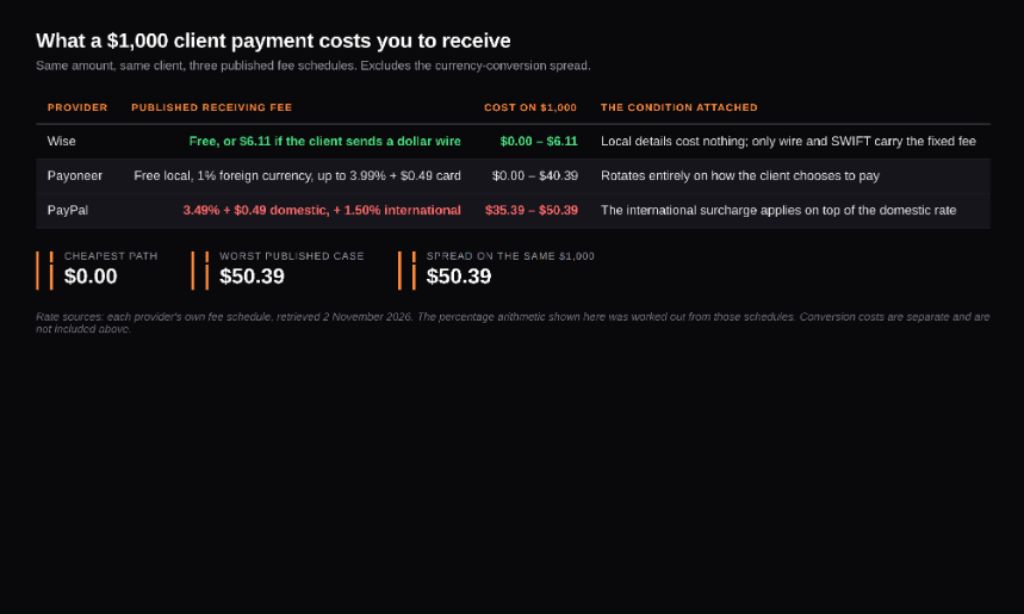
Those figures are the receiving cost on a $1,000 payment, worked out from each provider’s published rate. The conversion spread is excluded, and I will come back to that, because on a large payment it can exceed everything in the table.
What Wise Charges to Receive
Wise gives you account details in 22 currencies and lets other people send money into them. According to its own US pricing page, getting those details is free, and receiving a domestic payment — a non-wire, non-SWIFT transfer — is free in AUD, CAD, EUR, GBP, HUF, NZD, PHP, SGD and USD.
The charges appear only when the client uses the expensive rails. A wire or SWIFT payment in dollars costs a fixed $6.11. A GBP SWIFT payment costs £2.16 and a EUR SWIFT payment €2.39. Wise also publishes SWIFT receiving fees for another 19 currencies on a separate help page rather than on the main table, which is worth knowing if you invoice in something other than the majors.
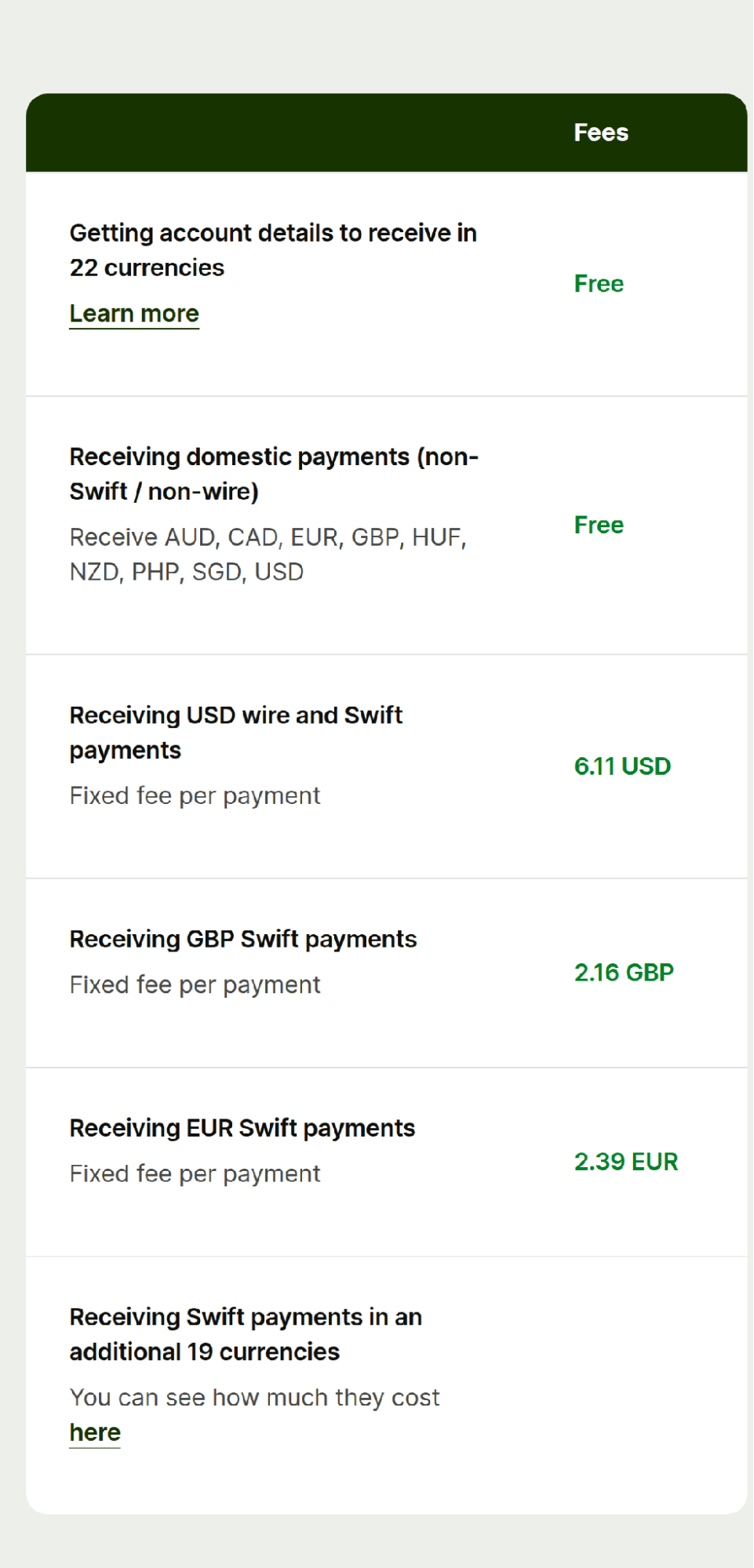
The structural advantage is the account details themselves. Your client is not making an international transfer at all in most cases — they are making a domestic transfer to a local account number, which is the cheapest and fastest path available on their side too. That is why the free column holds up: it describes the normal case.
What Payoneer Charges to Receive
Payoneer’s receiving structure is more conditional than Wise’s, and every condition rotates on the sender’s behavior. From its own pricing page, dated 1 January 2026: a transfer from another Payoneer customer’s balance is free, a receiving account in your local currency is free, and a receiving account in a non-local currency costs 1% with a minimum of $1.00 or equivalent.
The expensive paths are the funded ones. A payer using a credit card costs up to 3.99% plus $0.49, a payer using ACH bank debit in the US costs 1%, a payer using an EU or UK bank account costs 1%, and a payer using PayPal costs up to 3.99% plus $0.49. Receiving from a marketplace or integrated platform varies by marketplace and is not published as a single number.
Two charges sit outside the receiving table and catch people who only read the first screen. Moving funds between your own Payoneer balances costs 0.50%, and there is an annual account fee of $29.95 that applies only if the account receives less than $6,000 or equivalent in any 12 consecutive months. On a small account, that annual fee can exceed every transaction fee you paid.
A note on sourcing. Payoneer shows different pricing pages by region, and the page served to me carried its India content, which publishes no fee table. The rates above are from Payoneer’s own pricing material as published on 2 November 2026. I could not take a screenshot of that table, so treat the Payoneer column as published by the vendor but not visually confirmed.
What PayPal Charges to Receive
PayPal is the only one of the three with no free receiving path for a commercial transaction, and its international pricing is an addition, not an alternative.
Its published US merchant fee schedule, last updated 1 October 2026, sets the standard domestic commercial rate at 3.49% plus a fixed fee for checkout transactions, with a 2.99% rate for send-or-receive-money-for-goods-and-services. The fixed fee depends on the currency received: 0.49,€0.39,£0.39,R2.90, and so on down a table of 24 currencies.
Receiving from abroad adds a further 1.50% on all commercial transactions, applied on top of the domestic rate, not in place of it.
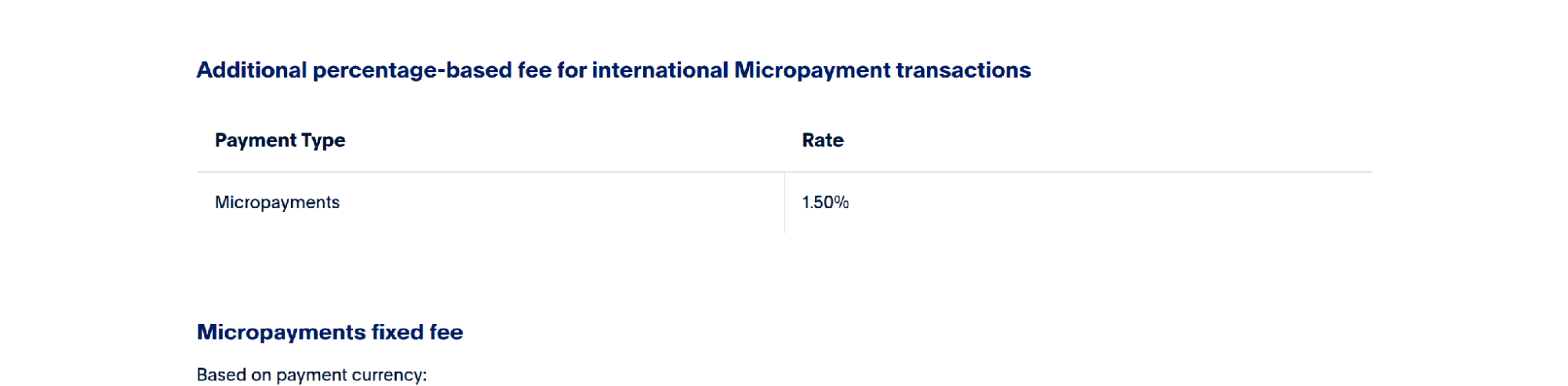
That stacking is the single most important thing to understand about PayPal’s pricing, because it is what turns a 3.49% rate into something close to 5% on a cross-border invoice. On the same $1,000 payment, the domestic case costs $35.39 and the international case costs $50.39. Nothing on PayPal’s side of the comparison is negotiable by choosing a different funding method, because there is no free funding method to choose.
The Wise vs PayPal vs Payoneer Comparison
Every figure below is taken from the provider’s own fee schedule; the check was run on 2 November 2026.
|
What you are comparing |
Wise | Payoneer | PayPal |
|---|---|---|---|
| Receiving a local-currency payment | Free | Free | 3.49% + fixed fee |
| Receiving a foreign-currency payment | Free via local details; $6.11 if wired | 1% (minimum $1.00) | Domestic rate + 1.50% |
| Card-funded payment | Not a supported receiving path | Up to 3.99% + $0.49 | 3.49% + fixed fee |
| Cost on a $1,000 payment | $0.00 – $6.11 | $0.00 – $40.39 | $35.39 – $50.39 |
| Account holding fees | None | $29.95/year under $6,000 received | None |
| Balance-to-balance conversion | Charged at the mid-market rate plus a disclosed fee | 0.50% | Charged with a spread |
| Currency detail held | 22 currencies | Local currency plus majors | Held balance in supported currencies |
One column deserves attention before the others. Payoneer’s range is the widest of the three, which means Payoneer is simultaneously the cheapest and one of the most expensive options depending on a decision your client makes without asking you. Wise’s range is the narrowest, and that is the real argument for it: its worst case is $6.11.
The Hidden Cost Is the Conversion Spread, Not the Fee
Every figure so far is a percentage of the payment. The larger number is usually the rate at which your money gets converted, and none of the three publishes a single spread figure that lets you compare them directly on the pricing pages above.
Wise converts at the mid-market rate and states its conversion fee as a separate line, which is how a pricing page can show a fee of zero on a transaction that still costs money to convert. Payoneer publishes a 0.50% charge to move funds between your own balances and, on its own country-guide page, describes internal conversion as costing a margin above the market rate, with no flat published percentage. PayPal applies a currency conversion charge when it converts for you, quoted as a separate fee schedule from the transaction fees.
What that means in practice: a provider with a free receiving fee and a one percent conversion margin costs more, on any payment you intend to convert, than one charging a visible fee at the mid-market rate. If you receive in USD and spend in USD, no conversion happens and the receiving fee is the whole cost. If you receive in USD and need the money in another currency, the receiving fee is the smaller half of what you pay.
The way to settle it for your own numbers is to take one real invoice and price it end to end at each provider: the fee, plus the amount that actually lands. Comparing the fee tables alone will not get you there. The fee tables are published precisely because they are the smaller number.
Where Each One Falls Over
Start with the wire. If your client’s finance department pays every invoice by wire, you are paying $6.11 on every single payment, and $6.11 on a $200 invoice is over three percent. Wise also does not hold a balance that sits outside your bank in every market, and the account details are not a bank account, which occasionally fails a client’s vendor onboarding form that insists on one.
Variability is where Payoneer costs you. Because the fee depends on how the sender pays, a single client who switches from a bank transfer to a card can multiply your cost on that payment by four or more, and you find out after the money lands rather than before. The annual account fee is a real trap for anyone receiving under $6,000 in a year, which is exactly the profile of someone testing a new client relationship.
PayPal has no cheap path at all. On a cross-border invoice you pay the international surcharge no matter what, and the only way to reduce it is to be paid in a currency where the fixed fee is smaller, which is a marginal saving against a 1.50% surcharge. Where PayPal wins is on client convenience: a client who will not fill in bank details will still pay a PayPal invoice, and a payment that costs 5% beats one that never arrives.
Frequently Asked Questions
Which is cheapest for a freelancer receiving a few invoices a month?
Wise, in almost every case, because its free local-details path is the normal receiving method and its worst case is a $6.11 fixed fee. The exception is a client who can only pay by card, where Payoneer’s card fee and PayPal’s standard rate become the only options available.
Is Wise really free to receive, or is there a catch?
The receiving fee is genuinely zero on domestic payments. There are no hidden charges, just two details left off the main page. Wire and SWIFT payments carry the fixed $6.11, and the conversion spread applies whenever the money is converted into another currency. Neither is disclosed on the same page as the free claim.
Should I use Payoneer or PayPal if my client is a marketplace?
Whichever the marketplace integrates with, because that decision is not yours. Payoneer’s own table states that receiving from marketplaces and integrated platforms varies by marketplace and does not publish a single rate, so the fee is set by the platform’s arrangement rather than your preference.
Do I need more than one of these accounts?
Most businesses receiving cross-border payments end up with two, and the reason is coverage, not cost. A provider that is free for one client’s funding method is expensive for another’s, and having a second account means you can tell the client which door to pay through instead of absorbing whichever one they pick.
What is the actual total cost on a payment I intend to convert?
Add the receiving fee to the conversion cost, and the receiving fee will usually be the smaller of the two. Take one real invoice, price it end to end at each provider using the amount that lands rather than the fee percentage, and the comparison resolves in a single calculation.
Are these fees the same everywhere in the world?
No. Each provider publishes fees by receiving country and currency, and Payoneer shows different content by region, so the page available to me listed no fee table at all. The figures here are the ones each provider published for the currencies named, as of 2 November 2026, and your own account’s fee page is the authority for your location.
Which of Wise vs PayPal vs Payoneer to Set Up First
Open Wise first, and give your clients the local account details rather than your bank details — that single change moves most of your payments into the free column and caps your worst case at $6.11. Add Payoneer if any client pays from a marketplace or insists on a card, and accept that you are handing the fee decision to their finance department.
In the Wise vs PayPal vs Payoneer decision, treat PayPal as a client-acquisition tool first and a payments rail second. It is the most expensive of the three on every cross-border transaction, and it is also the one a reluctant client is most likely to actually use. Pay the 1.50% when it converts a client who would otherwise not pay you at all, and route everything else through Wise.