
Imagine booking a flight, buying a smartphone, or ordering a new car and being offered insurance right at checkout—without visiting an insurance company or filling out lengthy forms. This is the idea behind embedded insurance, a technology-driven approach that makes insurance coverage available exactly when and where customers need it.
By integrating insurance products directly into digital platforms, e-commerce websites, banking apps, and other services, businesses can simplify the buying process and improve the customer experience. But how does embedded insurance actually work, and what role does technology play in making it possible?
In this article, we’ll explore what embedded insurance is, how it works, the technologies behind it, and why it is transforming the future of the insurance industry.
What Is Embedded Insurance?
Embedded insurance is coverage offered as a built-in feature of a purchase, subscription, or digital platform rather than a separate product a customer has to seek out. The insurance protection appears automatically during checkout, onboarding, or account setup, and the customer can accept coverage without leaving the app or website.
Traditionally, insurance has worked the opposite way. A consumer decides they need coverage, then goes looking for a policy from an agent, a company website, or a comparison tool. With embedded insurance, the offer comes to the customer at the exact moment it is relevant, like buying a car, activating a phone, or signing a lease.
Here are a few defining traits of embedded insurance:
- Coverage is offered inside an existing transaction, not sold on its own.
- The insurance company (often called the “embedded” partner) handles underwriting and claims behind the scenes.
- The business embedding the coverage usually isn’t a licensed insurer itself but partners with one through technology.
- Pricing and eligibility are often calculated instantly using data already collected during the purchase.
Chubb, a major commercial and personal lines insurer, has been expanding partnerships that let digital platforms integrate insurance products directly into their customer journeys. This reflects a broader industry shift: insurance companies are becoming infrastructure providers as much as risk carriers.
How Does Embedded Insurance Actually Work?
Embedded insurance works through an API connection between a business’s digital platform and an insurance company’s backend systems, allowing real-time quotes, underwriting, and policy issuance inside someone else’s checkout flow. The customer never has to visit a separate insurance website.
Here is a simplified version of how embedded insurance works in practice:
- Data capture. When a consumer makes a purchase (a car, a phone, a home), the retailer’s platform collects relevant data: price, location, item type, customer details.
- API call. That data gets sent through an API to the insurance company’s rating engine, which calculates a price and eligibility in seconds.
- Offer presentation. The insurance offer appears right in the checkout flow, often as a simple toggle or add-to-cart button.
- Purchase. If the customer accepts, a policy is issued instantly, with the insurance company underwriting the risk and the platform acting as the distribution channel.
- Claims and servicing. When something goes wrong, the customer can usually file a claim through the same app, though the actual claims decision and payout come from the insurance company.
This is different from older point-of-sale insurance, where a salesperson manually offered a paper add-on policy. Embedded insurance automates that entire interaction using software, data, and APIs instead of a person reading a script.
What Are Real Examples of Embedded Insurance?
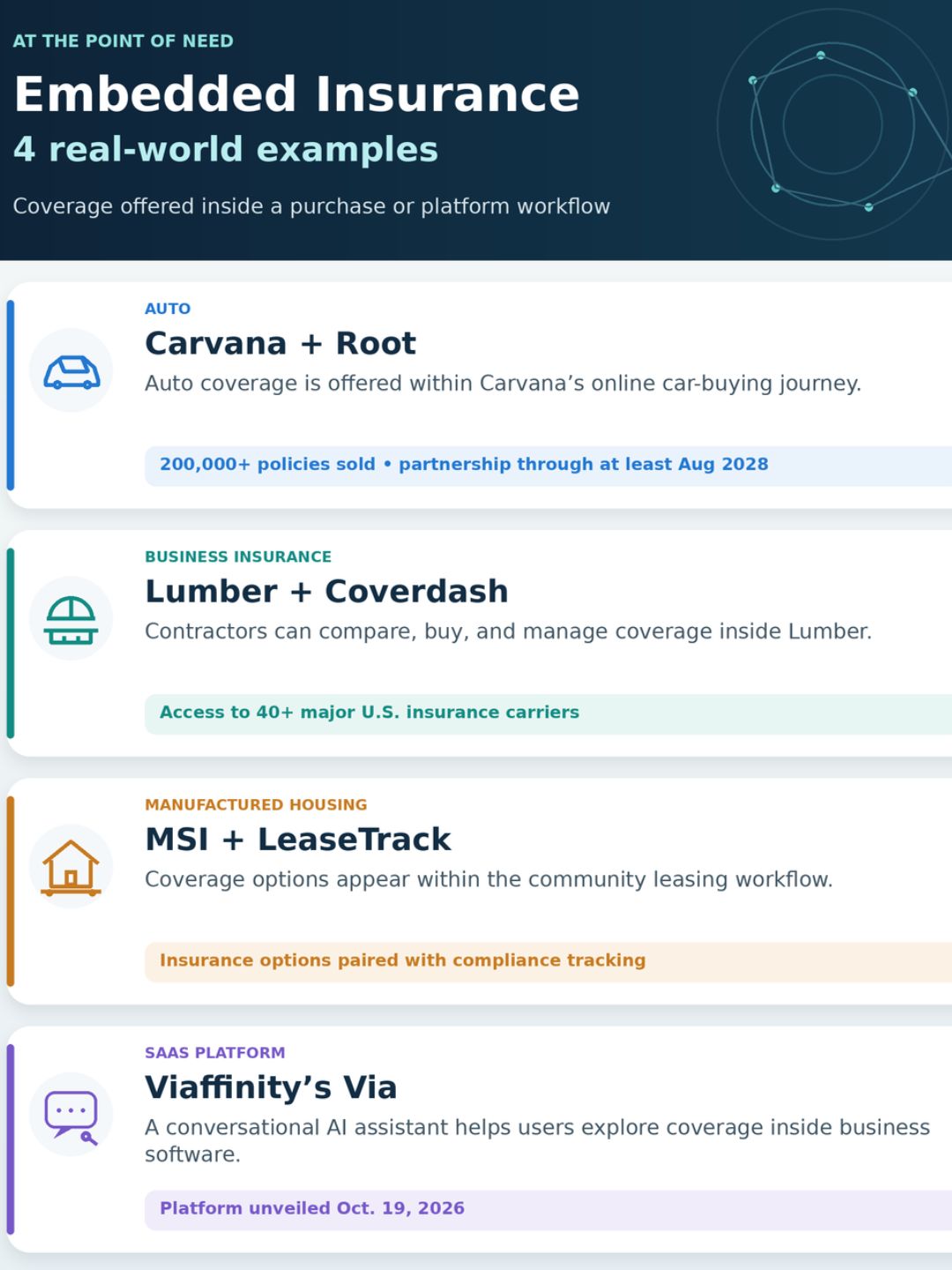
Real examples of embedded insurance include auto insurance offered during a car purchase, device protection bundled with a phone plan, and business insurance built into software platforms used by small companies. These examples show embedded insurance working across very different industries.
Some current, concrete examples:
- Carvana and Root. Root Insurance and Carvana extended their exclusive partnership, “Carvana Insurance Built with Root,” through at least 2028. Since launching in 2022, the program has sold more than 200,000 policies by embedding auto insurance quotes directly into Carvana’s online car-buying flow, so buyers can get coverage at the point of sale instead of shopping separately.
- Lumber and Coverdash. In 2026, construction workforce platform Lumber partnered with Coverdash, an embedded insurtech connected to more than 40 major U.S. carriers, to let construction companies purchase and manage business insurance inside the same software they already use for scheduling and payroll.
- MSI and manufactured housing. MSI extended its embedded insurance and compliance tracking into manufactured housing communities through its LeaseTrack platform, letting property managers embed coverage options directly into the lease signing process.
- Viaffinity’s Via platform. Launched in October 2026, Via is a SaaS-native embedded insurance distribution platform that adds a conversational AI assistant inside the business software partners already use, helping customers understand coverage needs and complete a purchase without switching apps.
These examples span auto, business, property, and housing, which shows embedded insurance is not limited to one industry or product type.
Is Embedded Insurance Different From Bundled Insurance?
Yes, embedded insurance and bundled insurance are different concepts, even though people sometimes use the terms loosely. Bundled insurance combines two or more separate policies, often for a discount, while embedded insurance builds coverage directly into a non-insurance purchase or platform.
Here’s a simple comparison:
| Feature | Embedded Insurance | Bundled Insurance |
|---|---|---|
| What it is | Coverage built into a purchase or app | Multiple policies sold together |
| Example | Auto insurance offered during a car purchase | Home and auto insurance from the same company |
| Who sells it | Often a non-insurance business, through API | Usually an insurance company or agent |
| Purchase process | Automatic, inside another transaction | Customer actively buys both policies |
| Customer awareness | May barely notice it’s insurance | Clearly understands they’re buying insurance |
Choose embedded insurance if a business wants to add protection inside an existing customer journey without customers shopping for it separately. Choose bundling if a consumer is comparing insurance products directly and wants a discount for buying more than one from the same company.
Who Uses Embedded Insurance and Why?
Small businesses, auto buyers, travelers, and digital-native consumers are the biggest users of embedded insurance because it removes friction from the buying process. People who dislike shopping for insurance separately are drawn to embedded options.
Industry research cited by Capco indicates most consumers actually prefer insurance that comes built into a purchase rather than something they have to buy on their own. That preference lines up with a few groups that benefit most:
- Millennials and Gen Z shoppers who expect digital-first experiences and dislike lengthy insurance applications.
- Small business owners who need business insurance but don’t have time to shop multiple carriers.
- Auto buyers who want to drive off the lot with coverage already arranged.
- Renters and manufactured housing residents who need to meet lease insurance requirements quickly.
Economic Times CIO reporting on 2026 insurance trends describes embedded coverage as part of a broader “Insurance-for-Living” model, where protection is dynamic, flexible, and woven into everyday purchases rather than bought as a once-a-year chore.
How Much Does Embedded Insurance Typically Cost?
Embedded insurance pricing varies widely depending on the product, but it’s usually calculated instantly using data collected at the point of purchase, such as the price of the item, the buyer’s location, or the business type. There isn’t one standard cost because embedded insurance covers everything from phone protection plans costing a few dollars a month to commercial business insurance policies costing hundreds or thousands annually.
A few cost factors to consider:
- Item or transaction value: higher-value purchases (a car, a home) generally mean higher premiums.
- Risk profile: a construction business will pay more for embedded business insurance than a low-risk consulting firm.
- Platform fees: some embedded insurance offers include a margin for the distribution partner, built into the quoted price.
- Coverage scope: narrow protection (like a single device) costs less than broader business insurance covering liability, property, and workers compensation.
Is Embedded Insurance Regulated and Safe?
Yes, embedded insurance is regulated the same way traditional insurance is, because a licensed insurance company is still underwriting the risk behind the scenes. The technology platform offering embedded insurance is usually a distribution partner, not the entity bearing financial risk.
This matters for consumer protection:
- State insurance regulators still require proper licensing for anyone involved in selling insurance, even through an embedded flow.
- The insurance company providing coverage must meet solvency and reserve requirements just like with any other policy.
- Consent, disclosure, and data protection rules apply to embedded insurance transactions, especially since customer data from the host platform often feeds into underwriting.
Is embedded insurance legit? Generally, yes, as long as a named insurance company stands behind the policy. Before purchasing, check that the fine print names a specific, licensed insurer, not just the platform brand. If no insurance company is named, that’s a red flag worth investigating further.
What Companies Offer Embedded Insurance Right Now?
Chubb, Root, Coverdash, Viaffinity, TruStage, and MSI are among the companies actively building or distributing embedded insurance products as of late 2026. Each plays a different role in the embedded insurance ecosystem.
- Chubb partners with digital platforms to integrate business and personal insurance products into customer journeys, offering both the underwriting capacity and brand trust of a long-established carrier.
- Root Insurance powers embedded auto insurance for Carvana’s car-buying platform.
- Coverdash connects small businesses to more than 40 carriers through embedded integrations like its partnership with Lumber.
- Viaffinity built Via, a SaaS-focused embedded insurance platform with a conversational AI assistant for partner businesses.
- TruStage offers embedded insurance and protection products for credit unions and financial institutions, and actively invites businesses interested in partnering to reach out with questions.
- MSI embeds compliance tracking and coverage options into leasing software for manufactured housing communities.
If a business wants to add embedded insurance to its own platform, working with an established carrier or embedded insurtech partner is far faster than trying to become a licensed insurer from scratch.
What Are the Main Benefits of Embedded Insurance?
The main benefits of embedded insurance are convenience for the customer, new revenue for the business, and better risk data for the insurance company. These three benefits work together to make embedded insurance attractive across the industry.
Four reasons businesses add embedded insurance to their model:
- Simplify the consumer experience. Customers get coverage without extra forms, phone calls, or separate shopping trips.
- Boost revenue per customer. Businesses earn commission or margin on every embedded policy sold, adding a new income stream to existing products.
- Deepen customer relationships. Offering insurance protection builds trust and keeps customers engaged with a company’s platform longer.
- Enhanced personalization. Because embedded insurance uses existing purchase data, pricing and coverage recommendations can be more tailored than a generic policy.
Generative AI is pushing these benefits further. Coverage reporting from Yahoo Finance on embedded insurance notes that AI now supports automated policy generation, tailored coverage recommendations, and real-time customer support inside embedded channels, which makes the whole experience faster for everyone involved.
Can I Get Embedded Insurance on My Phone?
Yes, embedded insurance is commonly available through smartphones, both as device protection plans at phone activation and through mobile apps that embed coverage into other purchases. Mobile is actually one of the most common channels for embedded insurance today.
Examples include:
- Device protection offered automatically when activating a new phone plan.
- Travel insurance offered inside a flight or hotel booking app.
- Auto insurance quotes appearing inside a car marketplace app during checkout.
- Business insurance dashboards built into workforce management apps used on a phone or tablet.
Because embedded insurance relies on APIs rather than paperwork, it fits naturally into mobile experiences where speed matters most.
What Problems Do People Have With Embedded Insurance?
The most common problems with embedded insurance involve unclear disclosures, confusion about coverage limits, and difficulty understanding the deductible attached to a policy. Some consumers also report feeling like they were “upsold” coverage without fully realizing what they purchased.
Common complaints include:
- Confusing checkout flows that don’t clearly explain what the embedded insurance covers.
- Difficulty canceling a policy that was added automatically during a purchase.
- Overlap with existing coverage, such as buying embedded phone protection when a credit card already covers device damage.
- Unclear claims process when the embedded platform and the actual insurance company are different companies.
Is Embedded Insurance Good for Small Businesses?
Yes, embedded insurance is often a good option for small businesses because it reduces the time and complexity of finding business insurance separately. Many small business owners don’t have time to compare quotes from multiple traditional insurance companies, so embedded offers inside platforms they already use can save real effort.
A few decision rules:
- Choose embedded business insurance if a company already uses a platform (like a workforce management or invoicing tool) that offers coverage integration, since setup is minimal.
- Choose traditional business insurance if a company has unusual risk factors that a generic embedded product might not cover well, such as specialized equipment or international operations.
- Always run an annual business insurance review regardless of how the policy was purchased, to confirm coverage still matches the business’s current size and risk.
Best options for home-based business insurance often include embedded add-ons from the same software a freelancer or home-based company already uses for invoicing or scheduling, since the data needed to quote a policy is already available.
How Do You Claim on Embedded Insurance?
You typically file a claim on embedded insurance the same way you would with any other policy, through the insurance company named in your policy documents, though many embedded platforms also let you start the process inside the original app. Always check your policy paperwork for the exact “report claim” and “claim login” process.
Steps usually include:
- Locate the policy documents from the original purchase confirmation email.
- Identify the actual insurance company underwriting the policy, not just the app brand.
- Use the claim reporting method listed in the policy (sometimes inside the app, sometimes through the insurer’s own portal).
- Provide purchase details, since the original transaction data often speeds up claims processing for embedded policies.
The Open & Embedded Insurance Observatory has reported on AI-powered systems that can automatically trigger payouts for events like flight delays or lost luggage and settle claims within minutes, showing how embedded insurance claims are becoming faster than traditional processes in some cases.
What Are Alternatives If Embedded Insurance Isn’t Available?
If embedded insurance isn’t offered during a purchase, consumers and businesses can still get coverage through traditional insurance agents, direct-to-consumer insurance apps, or by requesting a standalone business insurance quote. These alternatives take more effort but offer more control over comparing coverage options.
Alternatives worth considering:
- Independent agents and brokers who can compare multiple insurance companies for a specific need.
- Direct carrier websites where consumers can get a business insurance quote online without an embedded partner.
- Insurance marketplaces that let consumers compare several products at once, similar to shopping for traditional insurance before embedded options existed.
Final Thoughts
Embedded insurance is changing how people buy protection, moving coverage from a separate chore into a built-in part of everyday purchases like buying a car, signing a lease, or managing a small business. The technology behind it relies on APIs, real-time underwriting, and partnerships between insurance companies and the businesses customers already trust.
For consumers, the next step is simple: read the fine print on any embedded insurance offer, confirm which insurance company actually underwrites it, and compare it against a traditional quote if the purchase is significant. For businesses and InsurTech entrepreneurs, the opportunity is to partner with an established insurance company or embedded insurtech rather than trying to build underwriting capability from scratch. Whether you’re a consumer clicking “add protection” at checkout or a business leader exploring embedded insurance as a new revenue line, understanding how the model works puts you in a much stronger position to use it well.
Frequently Asked Questions
What is the difference between embedded and non-embedded insurance?
Embedded insurance is offered automatically inside another purchase or platform, using API connections to an insurance company. Non-embedded, or traditional insurance, requires the customer to actively seek out and purchase a policy separately, usually through an agent, broker, or insurance company’s own website.
How do I know if my deductible is embedded?
Check your policy documents for a section describing deductible structure. An “embedded deductible” usually means a single deductible applies across combined coverage types, rather than separate deductibles for each type of claim. If unclear, contact the insurance company directly and ask them to explain the deductible structure in writing.
What does “embedded” mean in health insurance?
In health insurance, “embedded” usually refers to an embedded deductible on family plans, where each individual family member only has to meet their own smaller deductible, rather than the whole family needing to hit one large combined deductible before coverage kicks in. This differs from embedded insurance distribution models used in other industries.
What is embedded value insurance?
Embedded value is an accounting and valuation concept used mainly for life insurance companies, measuring the present value of future profits from existing policies plus the company’s net asset value. It is different from “embedded insurance” as a distribution model; embedded value is about company valuation, not how a policy is sold.