Running a SaaS company alone is manageable only when the business is designed around limited time and attention. To understand How to Run a SaaS Company, start by narrowing the product’s promise, documenting recurring tasks, automating predictable work, monitoring cash and security, and setting realistic support boundaries.
Keep product development focused on problems paying customers repeatedly face, not every feature request. Use contractors or managed services for specialized work such as accounting, legal review, and infrastructure security. The aim is a company that keeps operating reliably even when its founder steps away from the keyboard for a full working day.
How to Run a SaaS Company With One Promise
A broad product creates more work than its feature list suggests. Each additional customer segment can introduce different integrations, onboarding questions, support expectations, and pricing demands.
Choose a specific customer and one recurring problem worth paying to solve. “Reporting software for small marketing agencies” provides better product boundaries than “an all-in-one business platform.”
Before approving a feature, ask:
- Does it solve a repeated problem for paying customers?
- Could it improve activation, retention, revenue, or operating efficiency?
- Will it complicate onboarding for everyone else?
- Can one founder maintain, document, and support it?
- What existing work will be delayed to build it?
That final question is often overlooked. A feature that attracts several trials but creates months of support work may be a poor investment. Product surface area remains an operating cost long after development ends.
Create a Weekly Rhythm
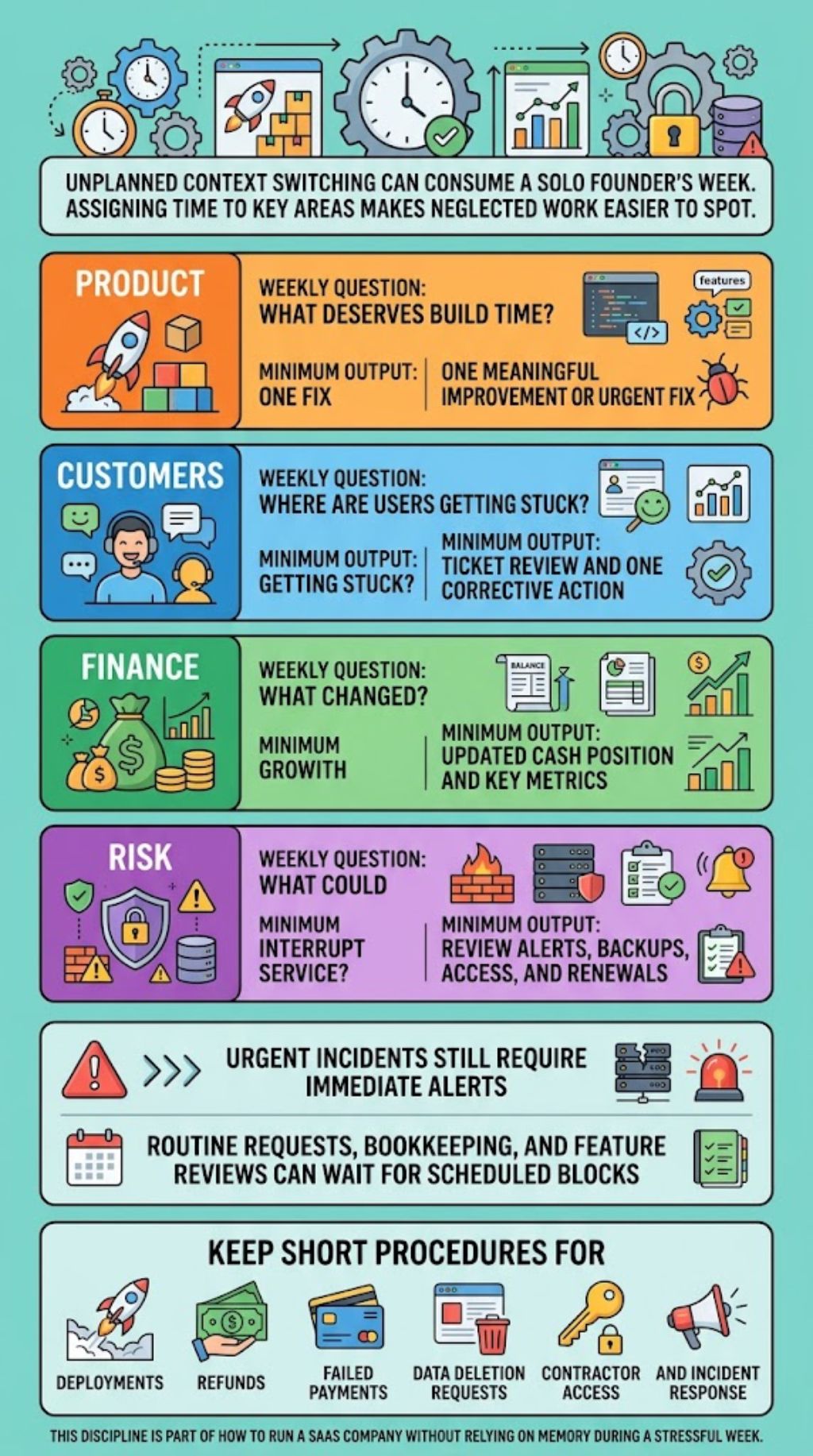
Unplanned context switching can consume a solo founder’s week. Assigning time to product, customers, finance, and risk makes neglected work easier to spot.
| Area | Weekly Question | Minimum Output |
| Product | What deserves build time? | One meaningful improvement or urgent fix |
| Customers | Where are users getting stuck? | Ticket review and one corrective action |
| Finance | What changed? | Updated cash position and key metrics |
| Risk | What could interrupt service? | Review alerts, backups, access, and renewals |
Urgent incidents still require immediate alerts. Routine requests, bookkeeping, and feature reviews can wait for scheduled blocks.
Keep short procedures for deployments, refunds, failed payments, data deletion requests, contractor access, and incident response. This discipline is part of how to run a SaaS company without relying on memory during a stressful week.
Focus on One Acquisition Channel
A solo founder cannot give serious attention to outbound sales, advertising, search content, partnerships, and several social platforms at once.
Match the channel to the buying process. A higher-value B2B product may need targeted outreach, demonstrations, and referrals. A self-service product with established search demand may benefit more from documentation, templates, comparison pages, and integrations. Developer tools often need clear technical examples before they need a large social following.
Anyone learning how to run a SaaS company should measure qualified trials, activated accounts, and paid conversions—not traffic alone. A blog post that attracts thousands of unrelated visitors may contribute less than a technical guide that brings ten well-matched prospects.
Give one channel enough time to reveal a pattern before adding another. Expanding because a channel feels slow can leave the founder maintaining several incomplete marketing systems.
Automate Repeatable Work
Automation is useful when both the trigger and the expected response are predictable. Suitable tasks include onboarding emails, invoice delivery, database backups, uptime alerts, scheduled reports, and failed-payment notices.
Stripe Billing, for example, supports configurable payment retries and customer emails for failed payments or expiring cards. These features require setup and monitoring. A founder should confirm which emails are enabled, what customers receive, and what happens when recovery fails.
Keep human approval around:
- Large refunds
- Account suspensions
- Permanent data deletion
- Pricing changes
- Production releases
- Unusual billing adjustments
Automation can execute a mistaken rule faster than a person can notice it. Review failure logs and notification destinations regularly, particularly after changing providers or email addresses.
Learn From Support
One shared support inbox is usually sufficient during the early stage. Publish a response window that can realistically be maintained, prepare templates for common questions, and use a public status page when service incidents affect multiple customers.
Tag conversations by cause: bug, billing problem, onboarding confusion, feature request, or expectation gap. Five tickets about the same setting may indicate poor interface copy or missing documentation. One request from a large prospect may still be too specialized to justify changing the roadmap.
Understanding how to run a SaaS company includes setting a support promise the founder can keep. Fast replies are valuable, but preventing avoidable tickets creates more capacity. A clear error message can save more time than another support template.
Watch for customers who repeatedly require manual configuration, custom reports, or exceptions. They may need a higher-priced service arrangement—or may simply be a poor fit for a self-service product.
Make Releases Boring
A solo founder needs predictable releases, not dramatic launch days. Maintain separate development and production environments, test the main customer journey, and establish a rollback path before deploying a risky change.
Monitor application errors, authentication failures, payment events, background jobs, and service availability. Backups provide limited protection unless restoration has also been tested.
GitHub Dependabot alerts can identify dependencies associated with known vulnerabilities. When security updates are enabled and a suitable patch exists, Dependabot can attempt to open an update pull request. It cannot find every security problem, and an automated pull request still needs testing before it is merged.
Avoid combining a large database migration, billing change, and major feature release in one deployment. Smaller changes are easier to diagnose. Scheduling risky work when the founder can monitor the system is also more sensible than releasing immediately before travel or sleep.
Track Cash and Metrics
Monthly recurring revenue represents recurring subscription revenue on a monthly basis; it is not the same as cash available. An annual subscription brings money forward while leaving the company responsible for future service.
A useful monthly review should include:
- New, expansion, contraction, and churned recurring revenue
- Failed payments, refunds, and chargebacks
- Hosting, storage, email, monitoring, and third-party API costs
- Payment processing and customer-support expenses
- Available cash and upcoming annual renewals
- Appropriate tax reserves based on local professional advice
Use the same metric definitions each month. Changing the calculation can make ordinary movement look like growth.
A founder deciding how to run a SaaS company must also examine customer concentration. If one account provides a large share of revenue, its departure could create an immediate cash problem. Likewise, a small group of heavy users may generate attractive revenue while consuming disproportionate infrastructure or support resources.
More revenue does not automatically repair weak unit economics.
Handle Security Early
Use a password manager, multifactor authentication for administrative accounts, restricted permissions, managed secret storage, software updates, backups, and a written incident checklist. Contractors should receive only the access required for their work, and that access should be removed when the engagement ends.
Application logs should capture relevant authentication failures, authorization problems, administrative changes, and significant billing events. Passwords, access tokens, encryption keys, payment-card data, and unnecessary personal information should not be recorded directly in logs.
The GDPR may apply to a company outside the European Union when it offers goods or services to people in the EU or monitors their behavior there. It is not a blanket rule covering every visitor from Europe, but company size alone does not create a general exemption.
Maintain a basic data map: what customer information is collected, why it is needed, where it is stored, which vendors process it, and how relevant deletion or portability requests are handled. Registration, tax, marketing, subscription, and cancellation rules differ by jurisdiction, so local professional advice may be necessary.
Buy Help at the Right Time
Bookkeeping, tax filings, contract review, privacy advice, penetration testing, and complex infrastructure migrations are reasonable candidates for specialist help. Trying to learn them during an urgent incident is often a false economy.
Use a written scope, deliverables, acceptance criteria, access limits, confidentiality terms, and ownership provisions. Knowing how to run a SaaS company also means recognizing when qualified assistance costs less than delay, errors, or founder exhaustion.
Keep an operator document covering domains, hosting, repositories, billing, deployment, rollback, renewals, and emergency contacts. Store credentials in a password manager rather than inside that document. The business should remain recoverable if the founder loses a laptop, becomes ill, or cannot respond for several days.
Final Thoughts
Learning how to run a SaaS company as a solo founder comes down to controlled scope, dependable systems, financial visibility, and honest customer promises. Choose one clear market, automate predictable work, document critical operations, and pay for specialist help where mistakes could become expensive.
A healthy solo SaaS business should become calmer as its systems improve. If every new customer creates another exception or emergency, repair the operating model before pursuing faster growth.
Frequently Asked Questions (FAQs)
Can a non-technical solo founder operate a SaaS business?
Yes, but technical responsibility does not disappear. A qualified person must still oversee architecture, security, releases, backups, and maintenance. No-code platforms and contractors can reduce development work, but founders should understand where customer data goes, what vendors control, and how the product can be recovered.
How much runway should a solo founder keep?
There is no dependable universal number. Calculate fixed costs, usage-based expenses, taxes, personal withdrawals, annual renewals, and likely revenue under a conservative scenario. Runway should reflect how many months those obligations can be paid without assuming new sales arrive on schedule.
How to Run a SaaS Company When Support Gets Too Busy
Identify the repeated source of tickets before hiring help. Fix the bug, onboarding step, billing message, or missing documentation first. If legitimate customer demand still interrupts planned development, limited contractor coverage or scheduled support shifts may be justified.
Should a solo founder offer custom work?
Only when the price covers development, communication, future maintenance, and the opportunity cost of delaying the core product. Custom work that benefits one customer but permanently complicates the software deserves particular caution.