Artificial intelligence may feel like a software story, but its future increasingly depends on physical infrastructure. Every advanced model, business application, and automated service needs computing equipment housed in facilities with reliable power, cooling, networking, and security.
Demand is growing faster than many traditional construction and power systems were designed to handle. Companies are no longer planning only for the computing capacity they need today. They are securing land, energy, equipment, and development partners for workloads that could expand for years.
That shift places long-term investment in AI data center infrastructure at the center of business strategy. The organizations that can build dependable capacity at speed may gain an advantage that cannot be created through software updates alone.
AI Growth Is Becoming an Infrastructure Challenge
AI models require large clusters of high-performance processors. These chips generate intense heat and draw far more electricity than typical business servers. Supporting them requires specialized power systems, advanced cooling equipment, high-capacity network connections, and facilities built for dense computing environments.
This is why construction speed now matters almost as much as access to chips. A business may have the funding and technical talent to develop an AI product, yet still struggle to secure sufficient data center capacity.
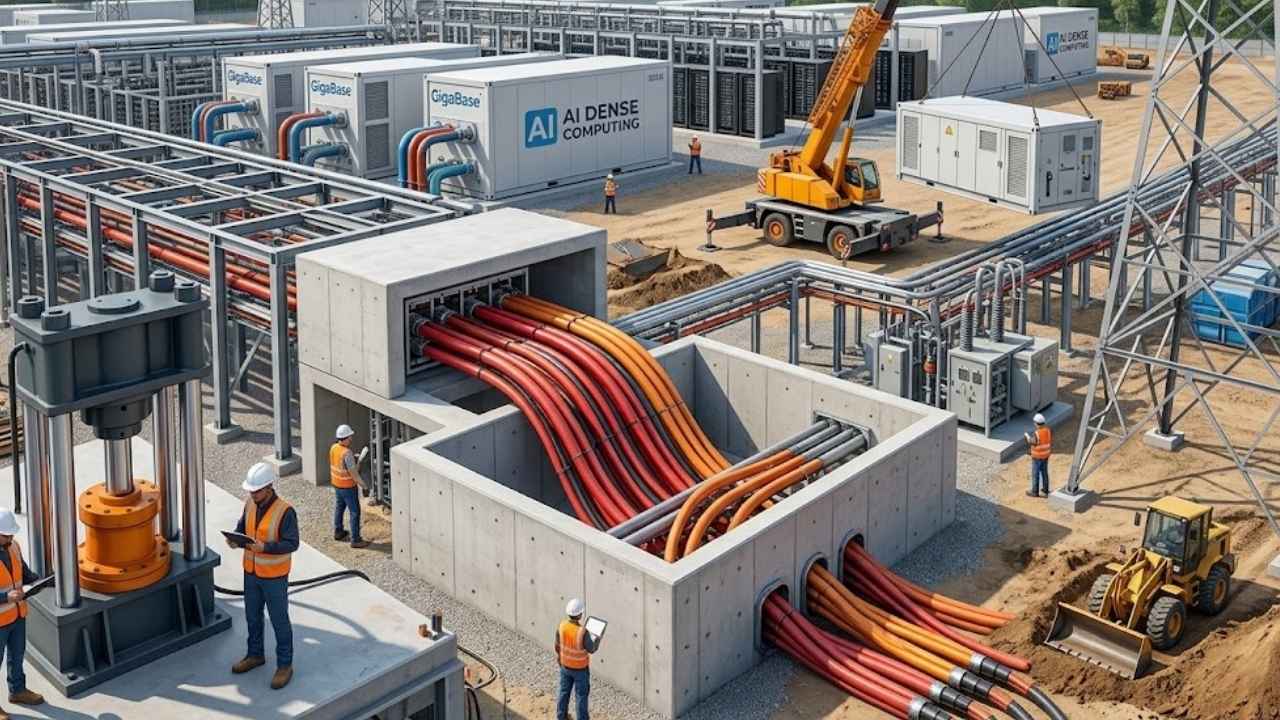
Pre-engineered systems such as GigaBase show how the industry is responding. Its core data center components are manufactured in factories before being installed at a prepared site. The system includes modular AI white space, switchgear, uninterruptible power infrastructure, and other essential equipment.
The approach is designed to support complete AI data center deployments in as little as 9 months, roughly half the time of many traditional builds. Factory production also gives developers greater control over quality, scheduling, and repeatability.
That matters when demand can change within months. A multiyear construction schedule creates the risk that a facility will open after a major market opportunity has passed. Faster deployment lets AI operators add computing capacity closer to the moment it is needed.
Modular construction also supports gradual expansion. Instead of treating every project as a single custom development, operators can add standardized components as customer demand grows. This can reduce project complexity while making future costs and timelines easier to estimate.
Here is the revised section with the IEA paragraph moved closer to the end:
Long-Term Value Depends on Power, Land, and Execution
Building the data center shell is only one part of the challenge. A facility has little value without enough electricity to operate its equipment. For many projects, securing dependable power has become one of the longest and most uncertain steps.
These limits explain why investors are looking beyond short-term demand for computing. Power agreements, substations, transmission upgrades, and site development can take years. Companies that wait until capacity is urgently needed may find that the best locations have already been secured.
A vertically integrated development model can address some of this uncertainty. When one organization controls equipment manufacturing, powered land, construction, and site operations, fewer parts of the project depend on unrelated vendors. Decisions can move through a connected process rather than a series of handoffs.
This structure can also create value after construction. Some developers operate facilities as colocation providers, renting rack capacity to AI customers on a monthly basis. That model turns infrastructure into a long-term service rather than a one-time construction project.
For investors, the potential appeal lies in the mix of digital growth and physical assets. AI demand may change quickly, but land, power connections, cooling systems, and specialized facilities can support multiple customers and generations of computing equipment.
The investment case still requires discipline. Developers must evaluate energy availability, water use, community impact, construction costs, customer concentration, and the risk of technology changing during a long project. A large facility built in the wrong market, or without secure power, can become an expensive stranded asset.
Strong projects start with practical questions. Is the power real and deliverable? Can the site expand? Does the design support newer cooling methods and higher rack densities? Are major components available when construction begins? Is there a clear path to customers and recurring revenue?
The International Energy Agency expects electricity use from data centers to keep rising as AI adoption expands. This growth will require new generation, transmission infrastructure, grid connections, and flexible energy systems. It will also increase competition for powered land, meaning property with both suitable acreage and practical access to large amounts of electricity.
These details may sound less exciting than a new AI model, yet they determine whether ambitious computing plans can operate in the real world.
Durable AI Leadership Will Be Built From the Ground Up
AI infrastructure is moving from a supporting role to a strategic priority. Companies need more than processors and software. They need dependable sites that can be built quickly, powered affordably, expanded efficiently, and operated for years.
Long-term investment helps solve this timing problem. It allows developers to secure critical equipment, prepare land, arrange energy supply, and create repeatable construction systems before demand reaches a crisis point. It also gives customers greater confidence that capacity will be available when their products are ready to scale.
Factory-built platforms, modular designs, and integrated development models could play an important role in meeting that need. Systems such as GigaBase reflect a broader move toward treating data centers as standardized products that can be deployed repeatedly, rather than custom projects that must be reinvented at every location.
The AI race will not be decided only by who creates the smartest model. It will also depend on who can provide the power, facilities, and operational systems needed to run that model at scale. That is why patient, well-planned investment in data center infrastructure is front and center today.