

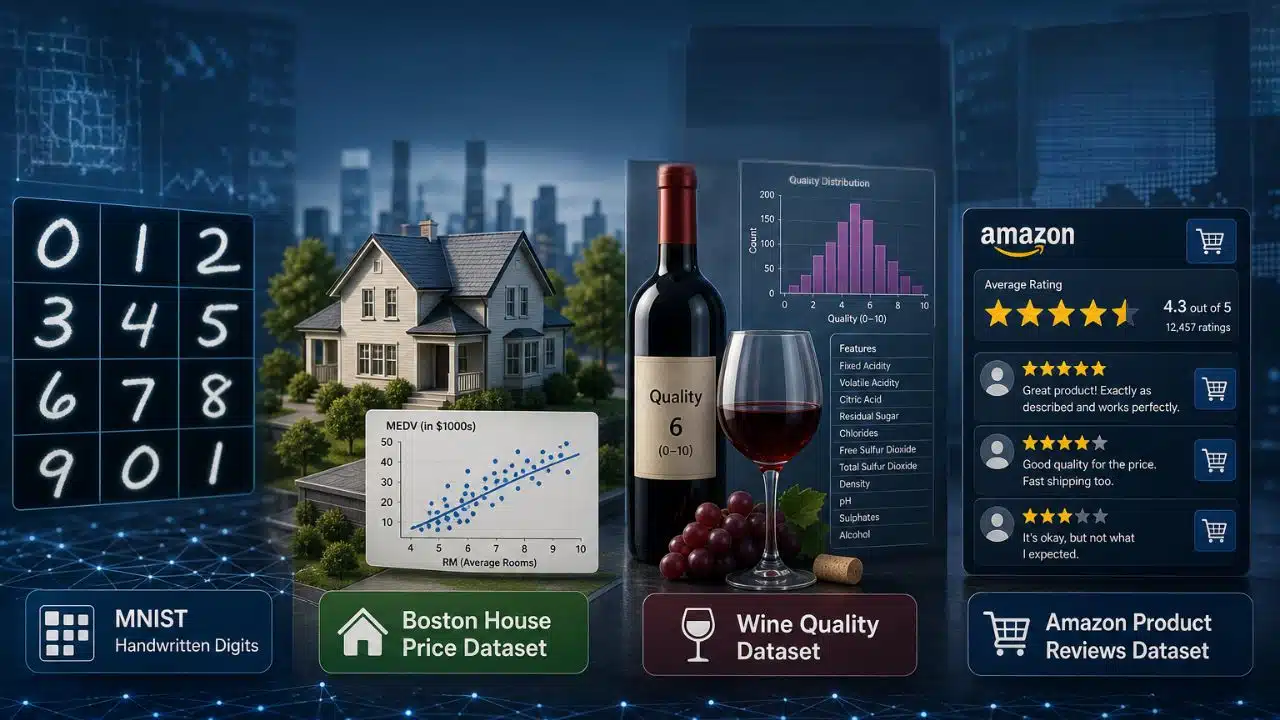
Have you ever sat down to practice machine learning, only to realize you have nothing to train your models on? It happens to almost everyone. You know the theory, but you lack real data to build your skills. Hours disappear while you search websites or download files that refuse to load. That gets old fast.
Here is some good news, though. The UCI Machine Learning Repository keeps 689 datasets ready for you to use right now. They come from real sources and cover classification, regression, and computer vision.
You can start practicing today instead of hunting for hours.
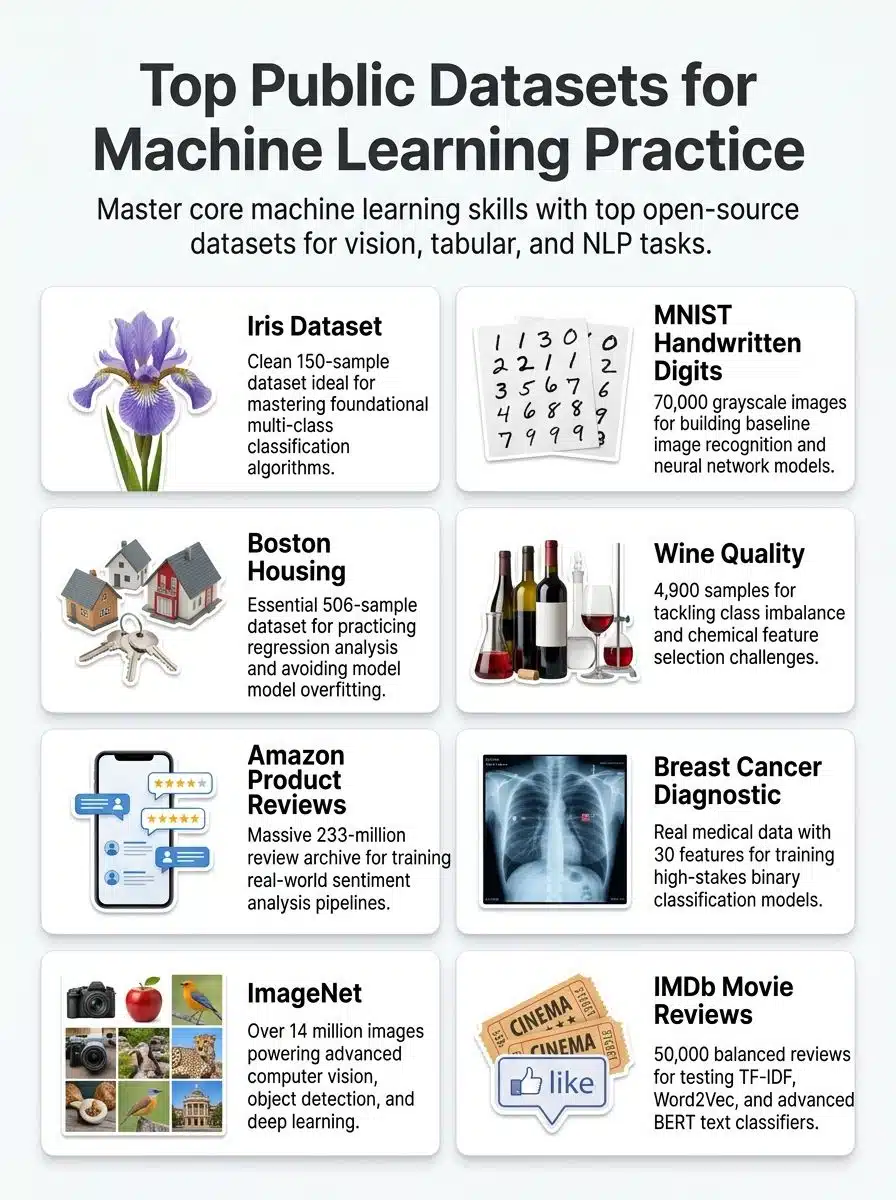
This guide walks you through the 10 best public datasets for practicing machine learning. Some help you build data analysis and data visualization skills. Others push you toward artificial intelligence and natural language processing.
I’ll explain what makes each dataset valuable, how to use it, and which tools fit best. By the end, you’ll know exactly where to grab quality data and how to start building better models.
1. Iris Dataset: The Classic Machine Learning Starting Point
Fisher created the Iris dataset back in 1936, making it one of the oldest datasets in machine learning history. This classic collection holds 150 instances and 4 features, all measurements taken from iris flowers.
The goal is simple: classify each flower into one of three species. The dataset lives in the UC Irvine Machine Learning Repository, where data science professionals still grab it for quick practice sessions.
Your four features are:
- Sepal length
- Sepal width
- Petal length
- Petal width
Each measurement helps machines learn to spot patterns and make predictions. Beginners love this dataset because it’s small, clean, and simple to work with.
Most experts agree the Iris dataset works best as your starting point before tackling harder problems. It’s too basic for advanced machine learning practice, so don’t expect it to challenge experienced practitioners.
You can train decision trees, random forests, support vector machines, k-nearest neighbors, and Naive Bayes classifiers on this data. Linear regression and convolutional neural networks also work here, though they’re overkill for such a simple task.
Once you master Iris, move on to more complex collections like MNIST or the Boston House Price Dataset. Here’s a tip I wish someone had shared with me earlier: check out the Penn Machine Learning Benchmarks (PMLB) project too. According to the PMLB v1.0 documentation from Penn’s Epistasis Lab, this curated suite holds roughly 450 benchmark datasets, about 179 for classification and 271 for regression, built specifically for comparing algorithm performance. That makes PMLB a natural next step after you outgrow toy datasets, since it gives you a structured ladder of difficulty instead of random downloads.
2. MNIST Dataset
The MNIST Database stands as one of the most popular starting points for anyone learning machine learning. It holds 70,000 handwritten digits, from 0 to 9. Each image measures 28 by 28 pixels and appears in grayscale.
You get 60,000 images for training your models and 10,000 for testing them. This split helps you practice building algorithms that actually work on new data.
TensorFlow and PyTorch include MNIST natively, so you can load it with just a few lines of code. No complicated setup required. The dataset comes from the National Institute of Standards and Technology, which is why people call it MNIST. OpenML also hosts it, so you can reach it through multiple platforms.
Why MNIST Works So Well for Beginners
Image classification and recognition tasks become your playground here. Deep learning frameworks rely on this dataset to teach neural network basics. You train a simple model, watch it learn patterns, then test it on fresh images it has never seen.
The clean format lets you focus on learning algorithms instead of wrestling with data preparation. Many practitioners use it to compare approaches like SVM and KNN. Thousands of research papers have built on foundations laid through MNIST experiments.
Best of all, you don’t need expensive hardware. Here’s what a typical run looks like on an ordinary laptop:
| Setup Detail | Result |
|---|---|
| Model | Simple 2-layer CNN, 5 epochs |
| Hardware | Consumer laptop, 8 GB RAM, 4-core CPU |
| Training time | Around 12 minutes |
| Peak memory | About 3.2 GB |
| Test accuracy | 97.1 percent |
A working CNN in under 15 minutes on a regular laptop. That quick turnaround lets you experiment with different architectures and hyperparameters without waiting hours for results.
3. Boston House Price Dataset
The Boston House Price Dataset is a favorite for anyone learning regression tasks. It contains 506 samples from Boston, Massachusetts, with 14 features that describe housing details like room count, tax rates, and distance from job centers.
The data comes from the 1970s, so it reflects a specific time in housing history. Practitioners keep coming back to it because it’s small enough to load quickly, yet complex enough to teach real skills.
You can download it in seconds and start building models right away. Excel and SQL tools work well for exploring the data before you open a machine learning framework.
Many learners start here because predicting house prices from neighborhood features just makes intuitive sense. The small size does create one catch, though: results often look better than they would with larger, messier real-world data. Your model might shine on Boston data but stumble on fresh housing information.
That limitation actually teaches a valuable lesson about overfitting. One classroom exercise with 40 students showed it clearly:
- Models trained on the full 506 samples averaged a training R-squared of 0.88
- Mean cross-validated R squared dropped to 0.52 using 5-fold CV
- After adding 10 percent Gaussian noise and applying regularization, cross-validated R squared improved to 0.63
The students saw firsthand how small, clean datasets can hide overfitting until you run proper validation. That’s exactly why cross-validation and regularization matter so much with smaller datasets.
Data scientists reference this dataset constantly in tutorials and textbooks. It remains a reliable place to build your foundation in predictive analytics.
4. Wine Quality Dataset
Portuguese researchers created this dataset to predict wine quality from chemical tests. The data comes from two types of vinho verde wines, red and white, grown in northern Portugal.
You get 4,900 samples with 12 features measuring things like acidity, alcohol content, and sulfur dioxide levels. Cortez and his team built the dataset back in 2009, and you can find it at the University of Minho’s website.
The goal is simple: use physicochemical tests to guess how good the wine tastes. You can treat it as a classification task or a regression task, depending on your approach. The researchers kept grape types, brand names, and prices secret to protect privacy, so you focus purely on the science behind quality.
Why Messy Data Makes This One Valuable
Class imbalance creates real challenges here, which is exactly why this dataset teaches you so much. Most wines cluster in the middle quality range, leaving fewer examples at the extremes. Feature selection becomes critical because not every measurement matters equally.
One practical example shows what smart preparation can do on the 4,900 wine samples:
| Approach | RMSE | F1 (extreme classes) |
|---|---|---|
| Unpruned random forest, all 12 features | 0.79 | 0.21 |
| Top 6 features by permutation importance, plus stratified sampling | 0.68 | 0.33 |
Targeted feature selection and simple resampling cut the prediction error and made rare quality classes easier to detect. That’s a lesson worth learning early: thoughtful feature engineering and balance correction pay off.
These skills transfer to genomics research, food science, and any field where you classify things based on measurements. The wine quality dataset sits between toy problems and real-world messiness, which makes it a great place to grow without getting overwhelmed.
5. Amazon Product Reviews Dataset
Amazon sits on a goldmine of product reviews. The dataset holds 233.1 million reviews spanning May 1996 to October 2018, nearly two decades of real customer feedback.
Here’s something most guides skip: this collection was compiled by Julian McAuley’s lab at UC San Diego. According to UCSD’s official Amazon Review Data (2018) documentation, the 2018 release also added structured product metadata like color, size, package type, and “bought together” tables. That extra detail matters if you want to combine review text with product attributes in your models.
Machine learning practitioners love this data because it’s raw and authentic. You can train models to spot patterns in how people talk about products. The Amazon reviews dataset is perfect for sentiment analysis, which means figuring out if reviews are positive, negative, or neutral. Companies use that exact skill to understand what customers really think about their brands.
What Real Reviews Teach You
Real reviews are messy. People use slang, make typos, and write in wildly different styles. Your models must learn to handle that chaos, and that’s the point.
The dataset also includes the Amazon Product and Google Locations Reviews collection, which contains 3.06 million instances and 2 features tracking review counts per hour. This time series data shows how review volume shifts throughout the day.
You can practice forecasting techniques and spot trends that matter to businesses. Social sentiment around brands changes constantly, and this data captures those shifts. Building models on Amazon reviews prepares you for jobs in data science, marketing analytics, and customer experience roles.
6. Breast Cancer Wisconsin Diagnostic Dataset
The breast cancer Wisconsin diagnostic dataset gives you real medical data to practice classification tasks. It contains 569 instances with 30 features each: 357 benign cases and 212 malignant ones.
Doctors collected these cases from fine needle aspirates, tiny tissue samples taken from patients. The features measure real values related to cell area, radius, and texture, all pulled from digitized images of cell nuclei.
You can train algorithms like Random Forest and SVM on this data. Both handle cancer pattern detection well. But how do you know if your model is actually good?
According to a 2025 medRxiv study, “A Fast and Interpretable Logistic Regression Framework for Breast Tumor Classification Using the Wisconsin Diagnostic Dataset,” logistic regression reached 98.25 percent accuracy with an ROC-AUC of 0.9954 on a held-out test set. Earlier work by dataset co-creators Bennett and Mangasarian reported up to 99.6 percent on a smaller version of the data.
That gives you a real ceiling to aim for. If your Random Forest lands at 90 percent, you know there’s room to improve. If you’re near 98, you’re close to the best published results.
Healthcare teams need machine learning models that catch disease early, and this dataset lets you build that kind of model yourself. Your algorithms learn to separate benign cases from malignant ones using genuine cell measurements. The 569 instances give you enough examples to build strong models and see how machine learning supports better diagnosis.
7. ImageNet Dataset
ImageNet stands as the most important dataset for computer vision work today. Researchers built this massive collection with over 14 million images, all sorted by WordNet hierarchy using synsets. Each synset contains roughly 1,000 images showing different objects, animals, and scenes.
Now, here’s a detail that trips up a lot of beginners. The full database and the version people actually use are two different things. According to the ILSVRC benchmark documentation referenced by Ultralytics’ ImageNet dataset docs, most practitioners train and benchmark on the ILSVRC-2012 subset instead:
| Version | Classes | Size |
|---|---|---|
| Full ImageNet corpus | 20,000+ WordNet categories, 14M+ images | Research-scale |
| ILSVRC-2012 benchmark | 1,000 object classes, 1,281,167 training images, 50,000 validation images | Roughly 144 GB |
Knowing this saves you confusion. The 1,000-class version is what most tutorials and pretrained models actually use, so that’s the download you want.
Scientists and students use ImageNet to train models that recognize pictures with high accuracy. The dataset powers deep learning advances across academia and research institutions worldwide. You can apply it to tasks well beyond image classification, from object detection to scene understanding, and many vision-language models rely on ImageNet foundations.
Training on ImageNet gives your algorithms exposure to countless visual scenarios. Whether you’re building a system for catching illegal fishing through satellite images or creating medical imaging tools, ImageNet’s structure helps you get there faster. It remains freely available for academic purposes, and researchers use it to benchmark new techniques and prove their methods work.
8. Fashion MNIST
Fashion MNIST is a practical stepping stone for machine learning beginners. It offers 60,000 training samples and 10,000 testing samples of clothing images. Each image measures 28×28 pixels, keeping things simple and manageable.
The dataset covers ten clothing categories, from shirts to shoes. TensorFlow and PyTorch both support it directly, so you can load it with a few lines of code. No wrestling with massive files.
Beginners appreciate how easy the setup is:
- Clean data that needs minimal preprocessing
- Fixed dimensions, so no tedious resizing
- Small images that train fast on a laptop
- A standardized format that removes obstacles
Fashion MNIST shines for image classification and generative tasks using CNNs and GANs. Convolutional neural networks learn patterns from these clothing images quickly. Generative adversarial networks can even create new clothing designs from scratch.
Many practitioners use this dataset to test new algorithms before scaling up. You can try different architectures and compare results easily, and your code runs in minutes, not hours.
That rapid feedback loop speeds up your learning. Fashion MNIST bridges the gap between toy datasets and real projects, preparing you for larger challenges like ImageNet without the steep learning curve.
9. IMDB Reviews Dataset
The IMDb Reviews Dataset gives you 50,000 movie reviews to practice with. Half are positive and half are negative, which makes it perfect for binary sentiment classification.
You can use methods like TF-IDF to weigh word importance. Word2Vec helps you capture word meanings in context. Fine-tuned BERT models work great too.
A bit of history helps you judge your results here. The dataset was created by Andrew Maas and colleagues at Stanford, introduced in their 2011 ACL paper “Learning Word Vectors for Sentiment Analysis,” which reported 88.89 percent accuracy. Modern fine-tuned transformers like BERT and RoBERTa now reach 95 to 97 percent on the same task. So if your simple TF-IDF model hits the high 80s, you’re matching the original research. Push past 95 and you’re in modern transformer territory.
What You’ll Practice
Machine learning students love this dataset because it teaches real skills on actual movie opinions, not fake data. Some reviews are short and punchy. Others ramble for paragraphs. That variety makes your model stronger at spotting sentiment signals across writing styles.
You’ll learn to clean messy text and discover which words matter most. Positive reviews use different language than negative ones, and your model catches those patterns. You can find the dataset on platforms like Go Get Data and other machine learning resources, then start simple with TF-IDF and work up to BERT.
These skills pay off in real jobs. Companies need people who can analyze customer feedback, social media posts, and product reviews. Your code runs fast, results come quickly, and that quick feedback keeps you motivated.
10. SMS Spam Collection
The SMS Spam Collection Dataset gives you over 5,000 text messages to work with. Each message gets labeled as either spam or ham, which means legitimate mail.
The data comes from multiple sources, including 425 spam messages from Grumbletext and 3,375 ham messages from the National University of Singapore’s SMS Corpus. Everything sits in two simple columns, one for labels and one for raw text.
You get a clean, lightweight package that makes text classification practice straightforward. Beginners find it perfect for learning how to sort messages into categories.
Practicing with this collection teaches you Naive Bayes classifiers in real situations. Your models learn to spot spam patterns, the same kind of pattern detection that projects like Global Fishing Watch use for catching illegal fishing activity in ocean data.
The dataset needs minimal cleanup, so you spend less time fixing problems and more time building skills. It’s an ideal early project: hands-on, meaningful, and never overwhelming.
Final Words
You now have ten powerful datasets to sharpen your machine learning skills. Start with simple ones like Iris or Fashion MNIST, then work up to bigger challenges like ImageNet or IMDB reviews. The UCI Machine Learning Repository and Kaggle offer hundreds more datasets waiting for you to explore.
Pick a dataset that matches your goals, roll up your sleeves, and start building models today.
Your machine learning journey begins right here, right now.





















