

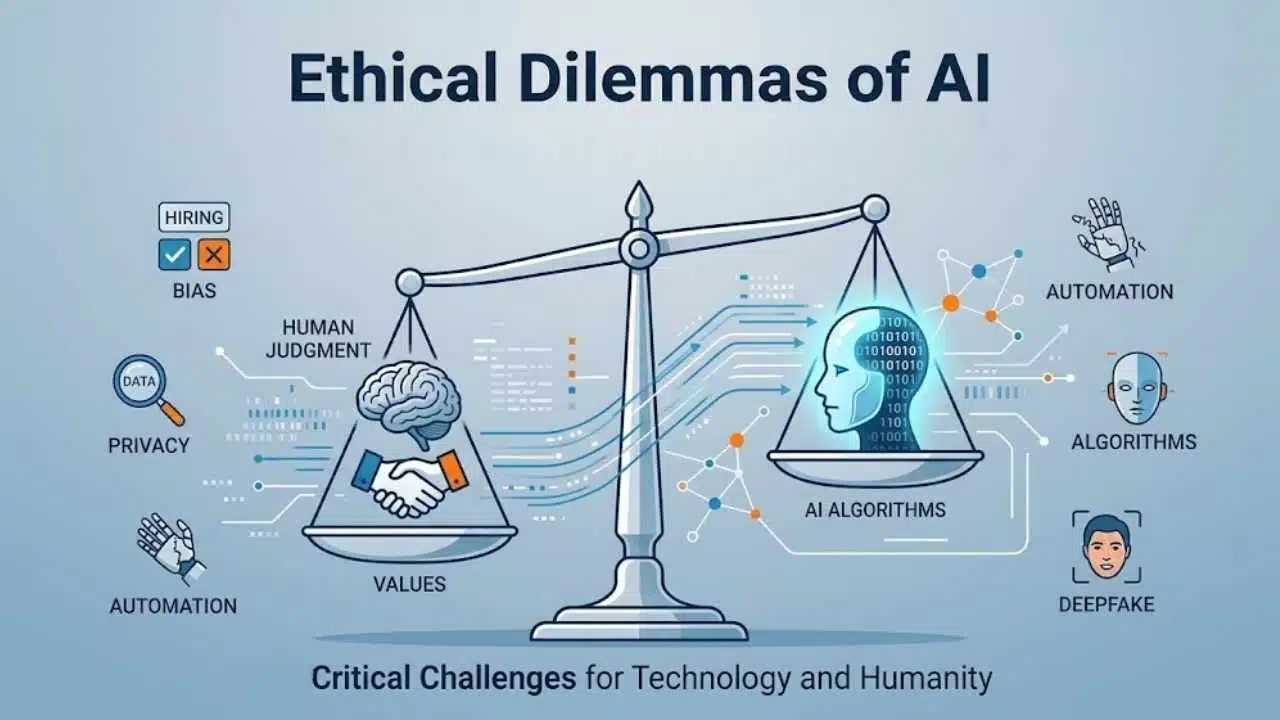
The ethical dilemmas of AI arise when the efficiency of artificial intelligence creates trade-offs in fairness, privacy, and accountability. While automated systems streamline hiring, financial monitoring, and content delivery, they often introduce bias, erode personal data rights, and obscure responsibility.
As artificial intelligence takes over high-stakes decisions—from who gets a job to how legal cases are processed—society must balance algorithmic speed against human impact. Resolving these core dilemmas is critical to ensuring technology serves humanity fairly without compromising autonomy or trust.
These nine ethical dilemmas track this tension, moving from everyday administrative automation to high-risk applications where algorithmic mistakes are difficult, or impossible, to undo.
Why the Ethical Dilemmas of AI Resist Checklists
Responsible AI is often reduced to a familiar set of instructions: remove bias, protect privacy, explain decisions, and keep a person involved. None is as simple as it sounds.
Fairness can mean equal treatment, equal error rates, or an effort to correct an existing disadvantage. Privacy can reduce the data available for testing. A human reviewer may add little protection if that person lacks the time or authority to challenge the software.
Ethical principles matter only when an organization is willing to accept the work behind them: narrower data collection, extra testing, slower deployment, appeal procedures, and sometimes a decision not to automate.
1. Can AI Be Fair in a Society That Is Not?
An AI system does not need to use race, gender, disability, or class directly to produce unequal outcomes. Other information can act as a proxy. Postal codes may reflect historic segregation. Employment gaps may disadvantage caregivers. Previous hiring records can teach a recruitment model to favor candidates who resemble earlier hires.
A 2019 NIST evaluation tested 189 face-recognition algorithms from 99 developers and found demographic differences in the majority of them. Performance varied by algorithm, demographic group, task, and image quality. The research did not test every finished commercial product, so it should not be treated as proof that all current systems perform alike.
It does show why a single accuracy figure is inadequate. A system that performs well on average may still fail one group more often, and the consequence depends heavily on its use. A mistaken phone-unlock rejection is inconvenient. A false identification during a police investigation is far more serious.
Organizations should test results across relevant groups under realistic conditions. They also need to examine the objective itself. Better training data cannot repair a system built around a poor measure of merit, need, or risk.
2. How Much Privacy Should Convenience Cost?
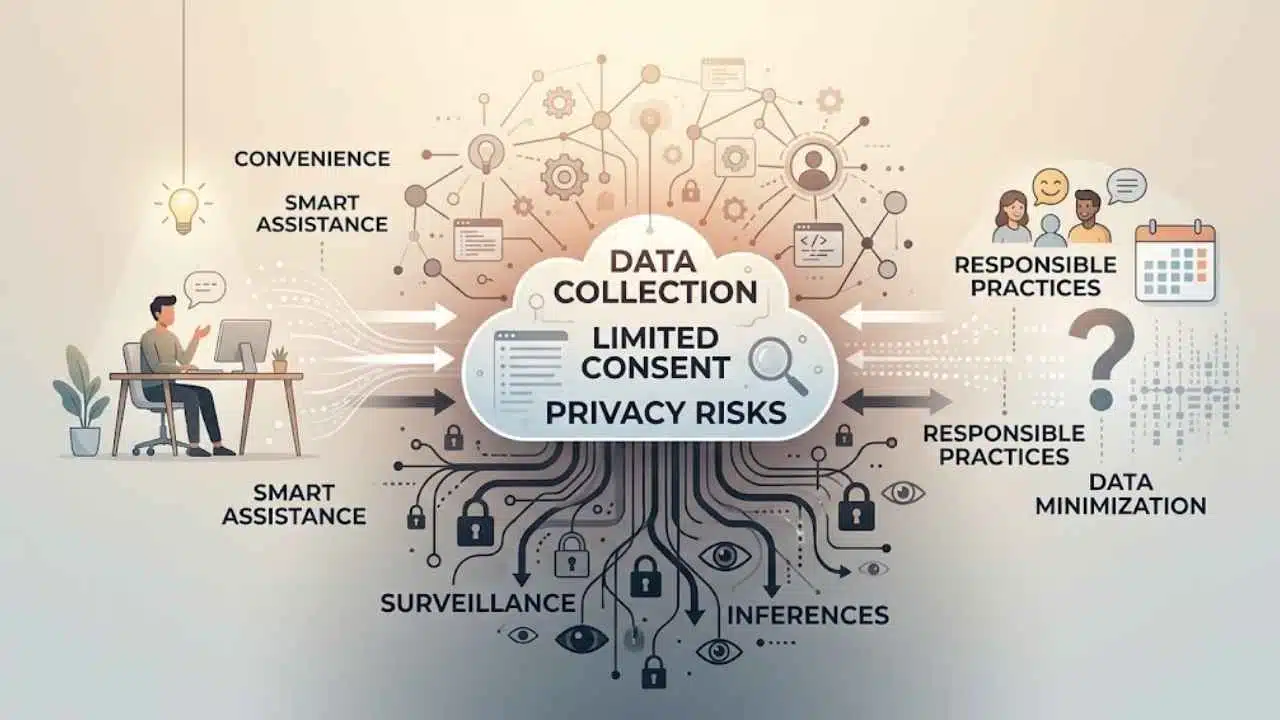
An AI meeting assistant may need access to recordings, calendars, messages, contact histories, and internal documents. Each permission makes the tool more useful. Together, they can produce a detailed record of how people work and communicate.
Consent offers limited protection when refusing is difficult. An employee may not be able to reject workplace monitoring. A patient may accept broad data terms because receiving care matters more than negotiating a privacy policy.
AI can also infer information that a person never knowingly supplied. Seemingly ordinary data may help a system estimate health concerns, financial stress, political interests, or identity.
Before adopting an AI service, organizations should check what information it collects, how long that information remains available, whether inputs may be used for training, who can retrieve them, and what deletion actually covers. If those answers are unclear, a polished privacy dashboard will not make the underlying practice responsible.
Data minimization is the better starting point. Information that is unnecessary for the task should not be collected merely because it might become valuable later.
3. Who Answers for a Decision No One Can Explain?
A hospital buys a decision-support system from a vendor. The vendor builds it around a model developed by another company. A consultant handles the integration, and clinicians see the recommendations inside hospital software.
If a harmful recommendation reaches a patient, each party can point elsewhere. The developer supplied a general model. The vendor configured it. The hospital approved it. The clinician made the final decision.
This accountability gap is one of the most difficult ethical dilemmas of AI. Adding a “human in the loop” does not settle it. A clinician, loan officer, or caseworker may lack the time, technical information, or institutional authority needed to reject an automated recommendation. Human review becomes ceremonial when approval is expected.
Explanation must also suit the person receiving it. An auditor may need performance data and technical documentation. An employee operating the system needs to know its limits and warning signs. Someone denied credit or public assistance needs a clear reason, a way to correct inaccurate information, and an appeal route that a real person will review.
Responsibility should be assigned before deployment. Someone must have the authority to monitor errors, suspend the system, investigate complaints, and provide a remedy. Shared responsibility too easily becomes no responsibility.
4. Who Gains From AI at Work?
Predictions about mass unemployment dominate the AI debate, but quieter workplace changes deserve equal attention. Algorithmic systems are already used in some workplaces to assign tasks, monitor activity, evaluate performance, and recommend management decisions.
The International Labour Organization estimated in 2025 that 24% of jobs worldwide had some degree of exposure to generative AI. Exposure does not mean that one in four jobs will disappear. The ILO found transformation more likely than complete replacement.
That transformation can still be harmful. Removing routine junior work may weaken the path through which people learn a profession. Productivity software can lead to higher targets without giving employees more time, control, or pay. Monitoring tools can also reduce complex work to whatever the system can count.
Employers should involve workers before introducing these systems, explain what data will be collected, and prevent an unreliable score from becoming the sole basis for discipline or dismissal. Training should happen before new targets arrive, not after employees are judged against them.
5. When Does Personalization Become Manipulation?
Recommendation systems can help people manage an impossible amount of information. Trouble begins when a system learns which emotion, price, message, or moment of vulnerability is most likely to change someone’s behavior.
A music suggestion based on listening history is not equivalent to targeting a financially distressed person with gambling promotions. Describing both as personalization hides the difference.
The EU AI Act prohibits certain harmful manipulative uses, but legal compliance is a minimum standard, not a complete ethical test. Engagement, conversion, and retention are business measures. Left without sensible limits, they can reward systems for provoking anxiety, compulsion, or anger.
Companies should apply stronger restrictions when personalization involves children, health fears, financial distress, addictive behavior, or political persuasion. If a system succeeds by exploiting vulnerability, its effectiveness is part of the problem.
6. What Happens to Truth When Fabrication Becomes Cheap?
Synthetic media has legitimate uses in entertainment, accessibility, translation, and education. It can also imitate a person’s face or voice, fabricate evidence, and spread convincing falsehoods before verification catches up.
Since August 2, 2026, Article 50 of the EU AI Act has applied transparency duties to certain AI providers and deployers. Covered providers must enable the detection of generated or manipulated content through machine-readable marking. Deployers have disclosure duties for deepfakes and certain AI-generated public-interest text. The rules include defined exceptions, so they should not be described as a requirement to label every use of AI.
Marking helps, but it does not settle authenticity. Labels can be removed, platforms can strip metadata, and detectors can struggle with unfamiliar generation methods or heavily edited files.
Deepfakes also create what researchers call the liar’s dividend. Once people know that convincing fabrications exist, a dishonest person can dismiss genuine evidence as synthetic. The damage is no longer limited to believing something false; it includes losing confidence in material that is real.
Publishers should verify the original source, context, editing history, and available provenance information before distributing sensitive media. A detector can support that work. It should not become the entire verification process.
7. Can AI Learn From Human Work Without Permission?
Generative AI is trained on large collections of text, images, music, code, and other material. Publicly accessible work is not automatically free of copyright, and the ability to download something does not settle whether it may legally be used for model training.
Copyright law also differs by country. In the United States, the Copyright Office’s report on generative AI training treats fair use as a context-specific analysis rather than granting blanket permission or declaring all training unlawful. At the time of writing, Part 3 remains available in pre-publication form, although the Office says it does not expect substantive changes to its conclusions.
The ethical dispute is wider than copyright. Were creators informed? Could they reserve their work? Is the training source documented? Who receives the economic benefit?
Individual licensing for every training item may be unworkable, especially for smaller developers. Yet an opt-out system can force writers, artists, musicians, and photographers to track numerous companies themselves. More credible models will need clearer dataset records, practical rights-reservation tools, and licensing options that do not serve only the largest technology and media companies.
8. How Much Environmental Cost Is Justified?

The International Energy Agency projects that global data-center electricity consumption could rise from 485 terawatt-hours in 2025 to about 950 terawatt-hours in 2030, or roughly 3% of global electricity demand. Electricity use by AI-focused data centers is projected to grow faster, tripling during that period.
These are projections, not fixed outcomes, and data centers support services beyond AI. Hardware efficiency, demand, energy sources, and infrastructure constraints will affect the result. Water use also varies substantially by cooling method, climate, and location, making a single universal figure misleading.
The useful question is not whether every AI request is wasteful. It is whether an application’s value justifies its resources and whether nearby communities carry grid, water, or infrastructure costs without receiving comparable benefits.
Environmental review should cover model size, hardware use, energy sources, cooling design, and location. Treating those factors as a data-center provider’s problem is no longer a defensible position for major AI buyers.
9. Should Software Help Decide Who Lives or Dies?
Autonomous weapons expose the sharpest limit of delegation. The International Committee of the Red Cross describes them as weapons that, once activated, can select and apply force to targets without further human intervention.
That is the ICRC’s position within an ongoing international debate, not a universally agreed treaty definition. The organization has called for binding rules, including prohibitions on unpredictable systems and systems designed to target people.
Even without international consensus, the ethical concern is immediate. Software may process sensor data quickly while lacking the contextual judgment needed to interpret surrender, civilian behavior, or a rapidly changing environment. Responsibility can also become scattered among commanders, operators, developers, and manufacturers.
Meaningful human control requires more than approving a weapon’s general deployment. A person needs enough information, time, authority, and situational understanding to make a genuine judgment about force.
Other automated decisions may be reviewed or reversed. Lethal force cannot. That difference should set an exceptionally high boundary around what states are willing to delegate.
The Practical Takeaway
The ethical dilemmas of AI will not be resolved by a principles page or an ethics committee with no authority. Organizations need controls that affect real decisions: limited data collection, testing across affected groups, named owners, worker consultation, environmental review, appeal procedures, and clear limits on unacceptable uses.
Before approving an AI system, ask who benefits, who carries the risk, and whether an affected person can understand, challenge, or refuse its role. Vague answers are a warning. Sometimes the responsible choice is to narrow the system’s authority—or leave the decision with a properly informed human.





















